Stores Organisation
Dr. Kshitija Gandhi
Phd. M.Phil, M.Com, MBA ,Net
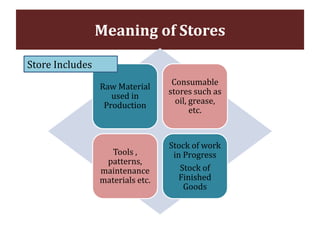
Meaning of Stores
Raw Material
used in
Production
Consumable
stores such as
oil, grease,
etc.
Tools ,
patterns,
maintenance
materials etc.
Stock of work
in Progress
Stock of
Finished
Goods
Store Includes
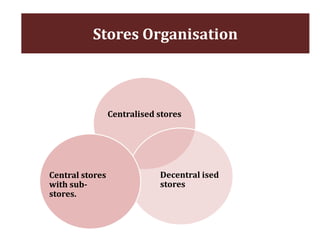
Store Organisation
Centralised stores
Decentral ised
stores
Central stores
with sub-
stores.
Stores Organisation
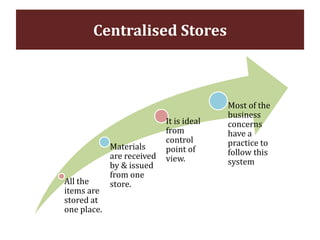
All the
items are
stored at
one place.
Materials
are received
by & issued
from one
store.
It is ideal
from
control
point of
view.
Most of the
business
concerns
have a
practice to
follow this
system
Centralised Stores
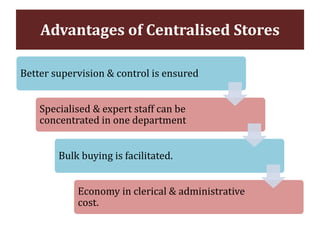
Advantages of Centralised Stores
Better supervision & control is ensured
Specialised & expert staff can be
concentrated in one department
Bulk buying is facilitated.
Economy in clerical & administrative
cost.
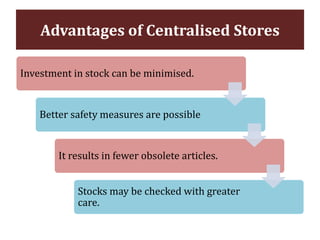
Advantages of Centralised Stores
Investment in stock can be minimised.
Better safety measures are possible
It results in fewer obsolete articles.
Stocks may be checked with greater
care.
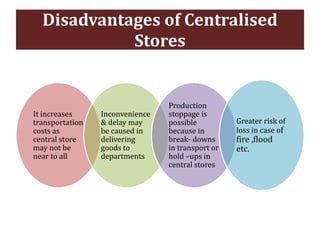
Disadvantages of Centralised
Stores
It increases
transportation
costs as
central store
may not be
near to all
Inconvenience
& delay may
be caused in
delivering
goods to
departments
Production
stoppage is
possible
because in
break- downs
in transport or
hold –ups in
central stores
Greater risk of
loss in case of
fire ,flood
etc.
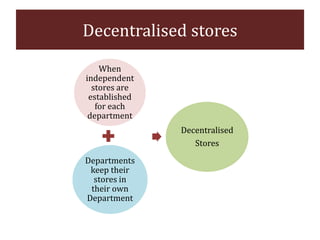
When
independent
stores are
established
for each
department
Departments
keep their
stores in
their own
Department
Decentralised
Stores
Decentralised stores
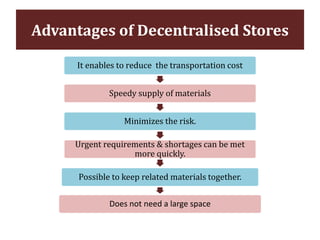
It enables to reduce the transportation cost
Speedy supply of materials
Minimizes the risk.
Urgent requirements & shortages can be met
more quickly.
Possible to keep related materials together.
Does not need a large space
Advantages of Decentralised Stores
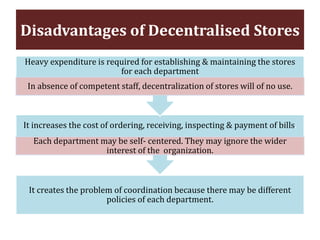
Disadvantages of Decentralised Stores
It creates the problem of coordination because there may be different
policies of each department.
It increases the cost of ordering, receiving, inspecting & payment of bills.
Each department may be self- centered. They may ignore the wider
interest of the organization.
Heavy expenditure is required for establishing & maintaining the stores
for each department
In absence of competent staff, decentralization of stores will of no use.
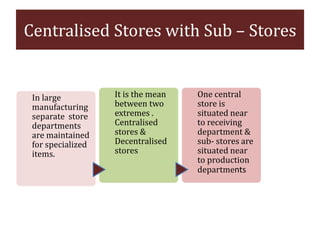
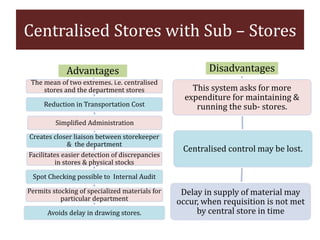
Centralised Stores with Sub – Stores
In large
manufacturing
separate store
departments
are maintained
for specialized
items.
It is the mean
between two
extremes .
Centralised
stores &
Decentralised
stores
One central
store is
situated near
to receiving
department &
sub- stores are
situated near
to production
departments
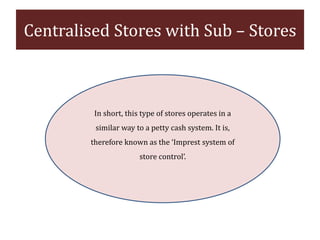
In short, this type of stores operates in a
similar way to a petty cash system. It is,
therefore known as the ‘Imprest system of
store control’.
Centralised Stores with Sub – Stores
Advantages
The mean of two extremes. i.e. centralised
stores and the department stores
Reduction in Transportation Cost
Simplified Administration
Creates closer liaison between storekeeper
& the department
Facilitates easier detection of discrepancies
in stores & physical stocks
Spot Checking possible to Internal Audit
Permits stocking of specialized materials for
particular department
Avoids delay in drawing stores.
Disadvantages
This system asks for more
expenditure for maintaining &
running the sub- stores.
Centralised control may be lost.
Delay in supply of material may
occur, when requisition is not met
by central store in time
Centralised Stores with Sub – Stores
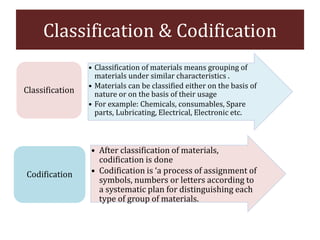
Classification & Codification
• Classification of materials means grouping of
materials under similar characteristics .
• Materials can be classified either on the basis of
nature or on the basis of their usage
• For example: Chemicals, consumables, Spare
parts, Lubricating, Electrical, Electronic etc.
Classification
• After classification of materials,
codification is done
• Codification is ‘a process of assignment of
symbols, numbers or letters according to
a systematic plan for distinguishing each
type of group of materials.
Codification
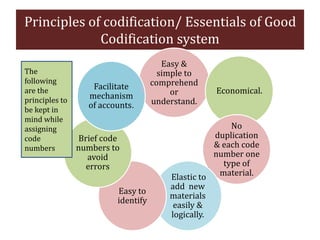
Principles of codification/ Essentials of Good
Codification system
Easy &
simple to
comprehend
or
understand.
Economical.
No
duplication
& each code
number one
type of
material.Elastic to
add new
materials
easily &
logically.
Easy to
identify
Brief code
numbers to
avoid
errors
Facilitate
mechanism
of accounts.
The
following
are the
principles to
be kept in
mind while
assigning
code
numbers
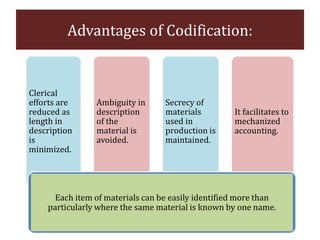
Advantages of Codification:
Clerical
efforts are
reduced as
length in
description
is
minimized.
Ambiguity in
description
of the
material is
avoided.
Secrecy of
materials
used in
production is
maintained.
It facilitates to
mechanized
accounting.
Each item of materials can be easily identified more than
particularly where the same material is known by one name.
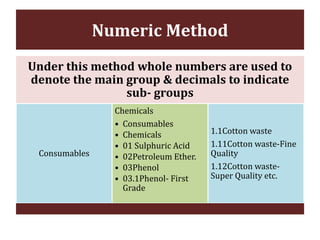
Numeric Method
Under this method whole numbers are used to
denote the main group & decimals to indicate
sub- groups
Consumables
Chemicals
• Consumables
• Chemicals
• 01 Sulphuric Acid
• 02Petroleum Ether.
• 03Phenol
• 03.1Phenol- First
Grade
1.1Cotton waste
1.11Cotton waste-Fine
Quality
1.12Cotton waste-
Super Quality etc.
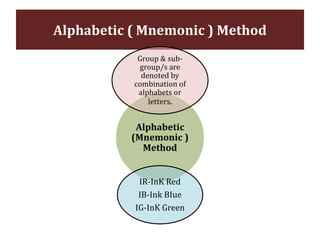
Alphabetic ( Mnemonic ) Method
Alphabetic
(Mnemonic )
Method
Group & sub-
group/s are
denoted by
combination of
alphabets or
letters.
IR-InK Red
IB-Ink BIue
IG-InK Green
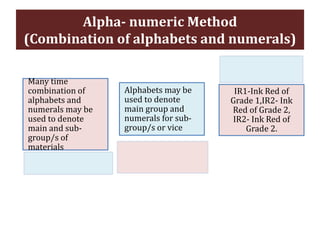
Alpha- numeric Method
(Combination of alphabets and numerals)
Many time
combination of
alphabets and
numerals may be
used to denote
main and sub-
group/s of
materials
Alphabets may be
used to denote
main group and
numerals for sub-
group/s or vice
IR1-Ink Red of
Grade 1,IR2- Ink
Red of Grade 2,
IR2- Ink Red of
Grade 2.
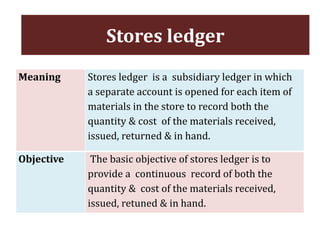
Stores ledger
Meaning Stores ledger is a subsidiary ledger in which
a separate account is opened for each item of
materials in the store to record both the
quantity & cost of the materials received,
issued, returned & in hand.
Objective The basic objective of stores ledger is to
provide a continuous record of both the
quantity & cost of the materials received,
issued, retuned & in hand.
Stores ledger
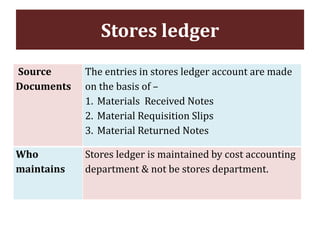
Stores ledger
Source
Documents
The entries in stores ledger account are made
on the basis of –
1. Materials Received Notes
2. Material Requisition Slips
3. Material Returned Notes
Who
maintains
Stores ledger is maintained by cost accounting
department & not be stores department.
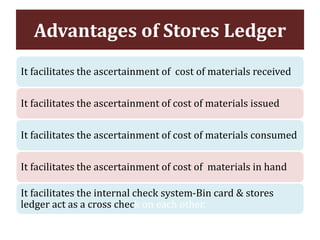
It facilitates the ascertainment of cost of materials received
It facilitates the ascertainment of cost of materials issued
It facilitates the ascertainment of cost of materials consumed
It facilitates the ascertainment of cost of materials in hand
It facilitates the internal check system-Bin card & stores
ledger act as a cross check on each other.
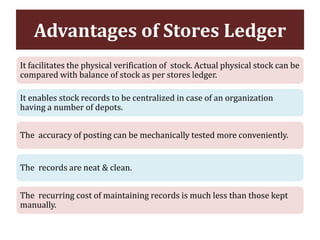
Advantages of Stores Ledger
It facilitates the physical verification of stock. Actual physical stock can be
compared with balance of stock as per stores ledger.
It enables stock records to be centralized in case of an organization
having a number of depots.
The accuracy of posting can be mechanically tested more conveniently.
The records are neat & clean.
The recurring cost of maintaining records is much less than those kept
manually.
Stores Organisation

Stores Organisation

  • 1.
    Stores Organisation Dr. KshitijaGandhi Phd. M.Phil, M.Com, MBA ,Net
  • 2.
    Meaning of Stores RawMaterial used in Production Consumable stores such as oil, grease, etc. Tools , patterns, maintenance materials etc. Stock of work in Progress Stock of Finished Goods Store Includes
  • 3.
    Store Organisation Centralised stores Decentralised stores Central stores with sub- stores. Stores Organisation
  • 4.
    All the items are storedat one place. Materials are received by & issued from one store. It is ideal from control point of view. Most of the business concerns have a practice to follow this system Centralised Stores
  • 5.
    Advantages of CentralisedStores Better supervision & control is ensured Specialised & expert staff can be concentrated in one department Bulk buying is facilitated. Economy in clerical & administrative cost.
  • 6.
    Advantages of CentralisedStores Investment in stock can be minimised. Better safety measures are possible It results in fewer obsolete articles. Stocks may be checked with greater care.
  • 7.
    Disadvantages of Centralised Stores Itincreases transportation costs as central store may not be near to all Inconvenience & delay may be caused in delivering goods to departments Production stoppage is possible because in break- downs in transport or hold –ups in central stores Greater risk of loss in case of fire ,flood etc.
  • 8.
    When independent stores are established for each department Departments keeptheir stores in their own Department Decentralised Stores Decentralised stores
  • 9.
    It enables toreduce the transportation cost Speedy supply of materials Minimizes the risk. Urgent requirements & shortages can be met more quickly. Possible to keep related materials together. Does not need a large space Advantages of Decentralised Stores
  • 10.
    Disadvantages of DecentralisedStores It creates the problem of coordination because there may be different policies of each department. It increases the cost of ordering, receiving, inspecting & payment of bills. Each department may be self- centered. They may ignore the wider interest of the organization. Heavy expenditure is required for establishing & maintaining the stores for each department In absence of competent staff, decentralization of stores will of no use.
  • 11.
    Centralised Stores withSub – Stores In large manufacturing separate store departments are maintained for specialized items. It is the mean between two extremes . Centralised stores & Decentralised stores One central store is situated near to receiving department & sub- stores are situated near to production departments
  • 12.
    In short, thistype of stores operates in a similar way to a petty cash system. It is, therefore known as the ‘Imprest system of store control’. Centralised Stores with Sub – Stores
  • 13.
    Advantages The mean oftwo extremes. i.e. centralised stores and the department stores Reduction in Transportation Cost Simplified Administration Creates closer liaison between storekeeper & the department Facilitates easier detection of discrepancies in stores & physical stocks Spot Checking possible to Internal Audit Permits stocking of specialized materials for particular department Avoids delay in drawing stores. Disadvantages This system asks for more expenditure for maintaining & running the sub- stores. Centralised control may be lost. Delay in supply of material may occur, when requisition is not met by central store in time Centralised Stores with Sub – Stores
  • 14.
    Classification & Codification •Classification of materials means grouping of materials under similar characteristics . • Materials can be classified either on the basis of nature or on the basis of their usage • For example: Chemicals, consumables, Spare parts, Lubricating, Electrical, Electronic etc. Classification • After classification of materials, codification is done • Codification is ‘a process of assignment of symbols, numbers or letters according to a systematic plan for distinguishing each type of group of materials. Codification
  • 15.
    Principles of codification/Essentials of Good Codification system Easy & simple to comprehend or understand. Economical. No duplication & each code number one type of material.Elastic to add new materials easily & logically. Easy to identify Brief code numbers to avoid errors Facilitate mechanism of accounts. The following are the principles to be kept in mind while assigning code numbers
  • 16.
    Advantages of Codification: Clerical effortsare reduced as length in description is minimized. Ambiguity in description of the material is avoided. Secrecy of materials used in production is maintained. It facilitates to mechanized accounting. Each item of materials can be easily identified more than particularly where the same material is known by one name.
  • 17.
    Numeric Method Under thismethod whole numbers are used to denote the main group & decimals to indicate sub- groups Consumables Chemicals • Consumables • Chemicals • 01 Sulphuric Acid • 02Petroleum Ether. • 03Phenol • 03.1Phenol- First Grade 1.1Cotton waste 1.11Cotton waste-Fine Quality 1.12Cotton waste- Super Quality etc.
  • 18.
    Alphabetic ( Mnemonic) Method Alphabetic (Mnemonic ) Method Group & sub- group/s are denoted by combination of alphabets or letters. IR-InK Red IB-Ink BIue IG-InK Green
  • 19.
    Alpha- numeric Method (Combinationof alphabets and numerals) Many time combination of alphabets and numerals may be used to denote main and sub- group/s of materials Alphabets may be used to denote main group and numerals for sub- group/s or vice IR1-Ink Red of Grade 1,IR2- Ink Red of Grade 2, IR2- Ink Red of Grade 2.
  • 20.
    Stores ledger Meaning Storesledger is a subsidiary ledger in which a separate account is opened for each item of materials in the store to record both the quantity & cost of the materials received, issued, returned & in hand. Objective The basic objective of stores ledger is to provide a continuous record of both the quantity & cost of the materials received, issued, retuned & in hand. Stores ledger
  • 21.
    Stores ledger Source Documents The entriesin stores ledger account are made on the basis of – 1. Materials Received Notes 2. Material Requisition Slips 3. Material Returned Notes Who maintains Stores ledger is maintained by cost accounting department & not be stores department.
  • 22.
    It facilitates theascertainment of cost of materials received It facilitates the ascertainment of cost of materials issued It facilitates the ascertainment of cost of materials consumed It facilitates the ascertainment of cost of materials in hand It facilitates the internal check system-Bin card & stores ledger act as a cross check on each other. Advantages of Stores Ledger
  • 23.
    Advantages of StoresLedger It facilitates the physical verification of stock. Actual physical stock can be compared with balance of stock as per stores ledger. It enables stock records to be centralized in case of an organization having a number of depots. The accuracy of posting can be mechanically tested more conveniently. The records are neat & clean. The recurring cost of maintaining records is much less than those kept manually.