By :
RICHA
DIVYA
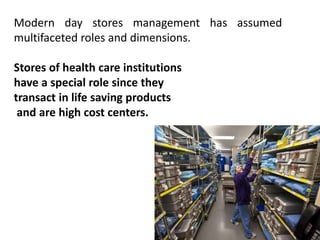
Modern day stores management has assumed
multifaceted roles and dimensions.
Stores of health care institutions
have a special role since they
transact in life saving products
and are high cost centers.
The elements of materials management as applicable to
healthcare institutions may be grouped as:
Materials planning and programming
Purchasing
Receiving and warehousing
Store keeping
Inventory control
Value analysis and standardization
Condemnation and disposal
Materials management is the integrated functioning
of an organization dealing with supply of materials
and allied activities in order to achieve the maximum
coordination and optimum expenditure on materials.
Materials management may also be interchangeably
termed as stores management.
OBJECTIVES OF STORES
Stores functions focus on the physical movement and storage of goods and
materials. This involves managing the physical flow of materials into and out of
the organization and developing and managing networks of warehouses when
needed.
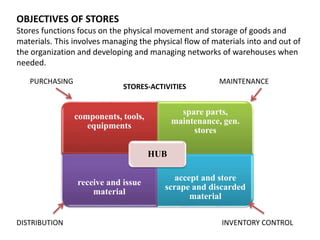
components, tools,
equipments
spare parts,
maintenance, gen.
stores
receive and issue
material
accept and store
scrape and discarded
material
HUB
STORES-ACTIVITIES
PURCHASING MAINTENANCE
DISTRIBUTION INVENTORY CONTROL
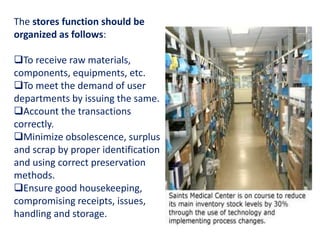
The stores function should be
organized as follows:
To receive raw materials,
components, equipments, etc.
To meet the demand of user
departments by issuing the same.
Account the transactions
correctly.
Minimize obsolescence, surplus
and scrap by proper identification
and using correct preservation
methods.
Ensure good housekeeping,
compromising receipts, issues,
handling and storage.
WAREHOUSE DESIGN PRINCIPLES
The advantages of warehousing can be maximized if the design
is optimum keeping in mind the specific functions of the
warehouse. The basic warehouse design principles are based
on incorporating in the design the four principles described
below.
These are:
Product movement
Handling technology
Storage plan
Future expansion
Manual versus computerized systems
The information system must include data on products entering and leaving
the warehouse, products in stock, products on order, and ways to monitor
the progress of orders in the supply pipeline. Key elements of the system
are well-designed forms, computerized information systems, and clearly
defined procedures.
Stock records
Stock records contain information about suppliers, customers, prices, stock
receipts, stock issues, stock losses, and stock balances. These data are
essential for planning distribution.
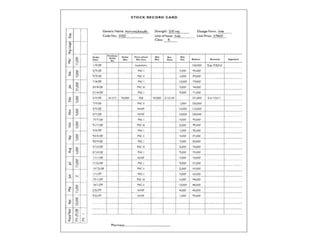
A stock record (manual or computerized) must be maintained for each
item in the inventory. The stock record documents all transactions relating
to an item.
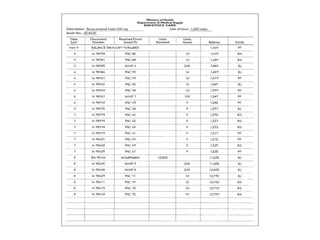
Many stores also maintain bin cards for each product in each storage area
to record information on issues, receipts, and stock balances.
Performance monitoring and reporting
A store should monitor and evaluate its operations to identify
problems in the system that need to be addressed.
Stock records are a vital source of information on how effectively
the distribution system is being managed; therefore, maintaining
these records accurately and keeping them up-to-date is vital.
Communications
The medical stores must maintain effective communications with
suppliers, with procurement and inventory control units, with
lower-level warehouses and health facilities.
Periodic meetings with the staff members of client facilities can help
ensure good communications and a more effective supply
system.
Flow of stock and information
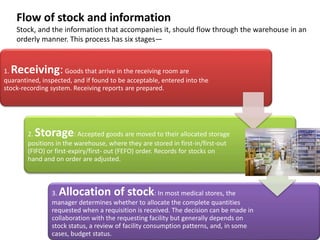
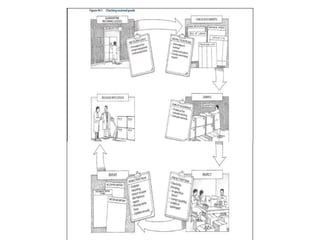
Stock, and the information that accompanies it, should flow through the warehouse in an
orderly manner. This process has six stages—
1. Receiving:Goods that arrive in the receiving room are
quarantined, inspected, and if found to be acceptable, entered into the
stock-recording system. Receiving reports are prepared.
2. Storage: Accepted goods are moved to their allocated storage
positions in the warehouse, where they are stored in first-in/first-out
(FIFO) or first-expiry/first- out (FEFO) order. Records for stocks on
hand and on order are adjusted.
3. Allocation of stock: In most medical stores, the
manager determines whether to allocate the complete quantities
requested when a requisition is received. The decision can be made in
collaboration with the requesting facility but generally depends on
stock status, a review of facility consumption patterns, and, in some
cases, budget status.
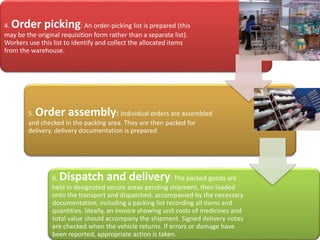
4. Order picking: An order-picking list is prepared (this
may be the original requisition form rather than a separate list).
Workers use this list to identify and collect the allocated items
from the warehouse.
5. Order assembly: Individual orders are assembled
and checked in the packing area. They are then packed for
delivery. delivery documentation is prepared.
6. Dispatch and delivery: The packed goods are
held in designated secure areas pending shipment, then loaded
onto the transport and dispatched, accompanied by the necessary
documentation, including a packing list recording all items and
quantities. Ideally, an invoice showing unit costs of medicines and
total value should accompany the shipment. Signed delivery notes
are checked when the vehicle returns. If errors or damage have
been reported, appropriate action is taken.
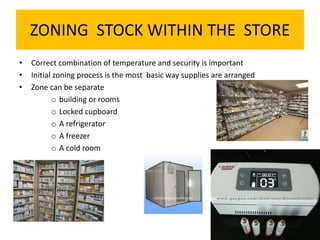
ZONING STOCK WITHIN THE STORE
• Correct combination of temperature and security is important
• Initial zoning process is the most basic way supplies are arranged
• Zone can be separate
o building or rooms
o Locked cupboard
o A refrigerator
o A freezer
o A cold room
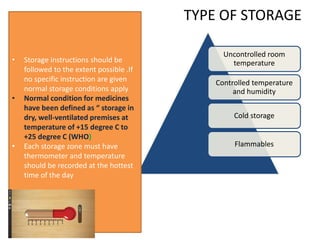
TYPE OF STORAGE
The product
manufactures
Uncontrolled room
temperature
Controlled temperature
and humidity
Cold storage
Flammables
• Storage instructions should be
followed to the extent possible .If
no specific instruction are given
normal storage conditions apply
• Normal condition for medicines
have been defined as “ storage in
dry, well-ventilated premises at
temperature of +15 degree C to
+25 degree C (WHO)
• Each storage zone must have
thermometer and temperature
should be recorded at the hottest
time of the day
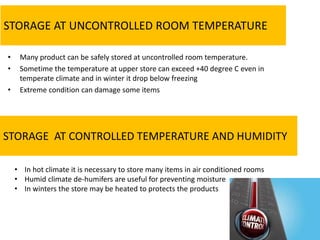
STORAGE AT UNCONTROLLED ROOM TEMPERATURE
• Many product can be safely stored at uncontrolled room temperature.
• Sometime the temperature at upper store can exceed +40 degree C even in
temperate climate and in winter it drop below freezing
• Extreme condition can damage some items
STORAGE AT CONTROLLED TEMPERATURE AND HUMIDITY
• In hot climate it is necessary to store many items in air conditioned rooms
• Humid climate de-humifers are useful for preventing moisture
• In winters the store may be heated to protects the products
COLD STORAGE
• The potency of vaccines ,sera, test kits and many others item depend on cold
storage
• Vaccines are temperature sensitive and must be kept at precisely controlled
temperatures from the point of manufacture to the point of administration
• Cold chain defects are frequent problem of immunization programs
• National and regional vaccine stores should be equipped with stand by
generators
SECURE STORAGE
• Narcotics and other controlled substances (antiretroviral ) should be kept in secure
room
• Red active lights or warning bells will activate when doors is unlocked
• Entry to the store is controlled
• No more than two officers have access
FLAMMABLES
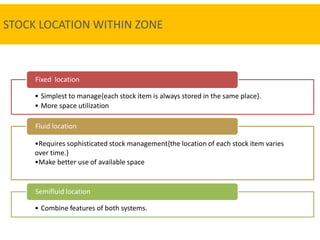
Flammables like alcohol and ether must be stored in special buildings
or room
Separate location is best as it reduces the risk of fire spreading to the
main store
Must be well ventilated and fire roof
Explosion hatch part of roof or wall
Fuel should never be stores in or near medical store
STOCK LOCATION WITHIN ZONE
• Simplest to manage{each stock item is always stored in the same place}.
• More space utilization
Fixed location
•Requires sophisticated stock management{the location of each stock item varies
over time.}
•Make better use of available space
Fluid location
• Combine features of both systems.
Semifluid location
FIXED LOCATION SYSTEM
Each stock item is allocated to specific shelves, pallet racking, or an area of floor.
A fixed location system is like a house in which each family member has his or her own room.
A room is left empty if a person is not at home.
The administration :
The store has to be large enough to accommodate the maximum possible level of stock for
every item, including safety stock.
As stock is used up, the storage location is emptied and left vacant until a new shipment of the
item is received.
With a fixed location system, stock administration is relatively easy. Goods can always be
found in the same place.
Disadvantages—
• Fixed location systems are inflexible.
• If a new item is ordered, there may be no place to store it.
• Theft may increase because all store staff are familiar with the locations of valuable items.
• Storage space may be wasted, because at times it is largely empty.
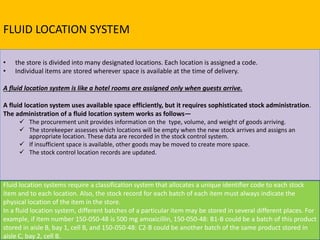
FLUID LOCATION SYSTEM
• the store is divided into many designated locations. Each location is assigned a code.
• Individual items are stored wherever space is available at the time of delivery.
A fluid location system is like a hotel rooms are assigned only when guests arrive.
A fluid location system uses available space efficiently, but it requires sophisticated stock administration.
The administration of a fluid location system works as follows—
 The procurement unit provides information on the type, volume, and weight of goods arriving.
 The storekeeper assesses which locations will be empty when the new stock arrives and assigns an
appropriate location. These data are recorded in the stock control system.
 If insufficient space is available, other goods may be moved to create more space.
 The stock control location records are updated.
Fluid location systems require a classification system that allocates a unique identifier code to each stock
item and to each location. Also, the stock record for each batch of each item must always indicate the
physical location of the item in the store.
In a fluid location system, different batches of a particular item may be stored in several different places. For
example, if item number 150-050-48 is 500 mg amoxicillin, 150-050-48: B1-B could be a batch of this product
stored in aisle B, bay 1, cell B, and 150-050-48: C2-B could be another batch of the same product stored in
aisle C, bay 2, cell B.
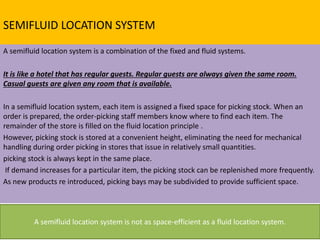
SEMIFLUID LOCATION SYSTEM
A semifluid location system is a combination of the fixed and fluid systems.
It is like a hotel that has regular guests. Regular guests are always given the same room.
Casual guests are given any room that is available.
In a semifluid location system, each item is assigned a fixed space for picking stock. When an
order is prepared, the order-picking staff members know where to find each item. The
remainder of the store is filled on the fluid location principle .
However, picking stock is stored at a convenient height, eliminating the need for mechanical
handling during order picking in stores that issue in relatively small quantities.
picking stock is always kept in the same place.
If demand increases for a particular item, the picking stock can be replenished more frequently.
As new products re introduced, picking bays may be subdivided to provide sufficient space.
A semifluid location system is not as space-efficient as a fluid location system.
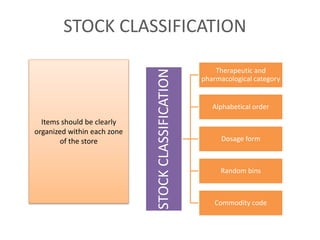
STOCK CLASSIFICATION
STOCKCLASSIFICATION
Therapeutic and
pharmacological category
Alphabetical order
Dosage form
Random bins
Commodity code
Items should be clearly
organized within each zone
of the store
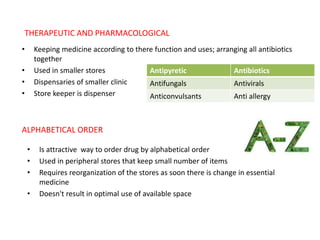
THERAPEUTIC AND PHARMACOLOGICAL
• Keeping medicine according to there function and uses; arranging all antibiotics
together
• Used in smaller stores
• Dispensaries of smaller clinic
• Store keeper is dispenser
ALPHABETICAL ORDER
• Is attractive way to order drug by alphabetical order
• Used in peripheral stores that keep small number of items
• Requires reorganization of the stores as soon there is change in essential
medicine
• Doesn't result in optimal use of available space
Antipyretic Antibiotics
Antifungals Antivirals
Anticonvulsants Anti allergy
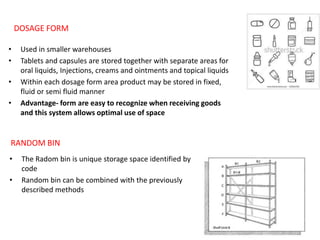
DOSAGE FORM
• Used in smaller warehouses
• Tablets and capsules are stored together with separate areas for
oral liquids, Injections, creams and ointments and topical liquids
• Within each dosage form area product may be stored in fixed,
fluid or semi fluid manner
• Advantage- form are easy to recognize when receiving goods
and this system allows optimal use of space
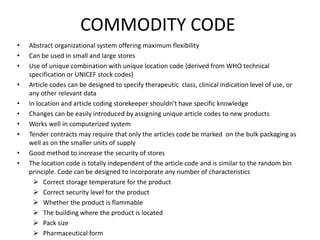
RANDOM BIN
• The Radom bin is unique storage space identified by
code
• Random bin can be combined with the previously
described methods
COMMODITY CODE
• Abstract organizational system offering maximum flexibility
• Can be used in small and large stores
• Use of unique combination with unique location code {derived from WHO technical
specification or UNICEF stock codes}
• Article codes can be designed to specify therapeutic class, clinical indication level of use, or
any other relevant data
• In location and article coding storekeeper shouldn't have specific knowledge
• Changes can be easily introduced by assigning unique article codes to new products
• Works well in computerized system
• Tender contracts may require that only the articles code be marked on the bulk packaging as
well as on the smaller units of supply
• Good method to increase the security of stores
• The location code is totally independent of the article code and is similar to the random bin
principle. Code can be designed to incorporate any number of characteristics
 Correct storage temperature for the product
 Correct security level for the product
 Whether the product is flammable
 The building where the product is located
 Pack size
 Pharmaceutical form
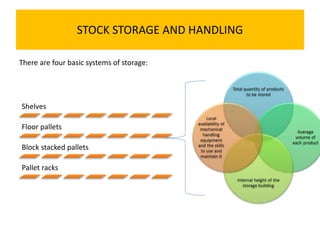
STOCK STORAGE AND HANDLING
There are four basic systems of storage:
Shelves
Floor pallets
Block stacked pallets
Pallet racks
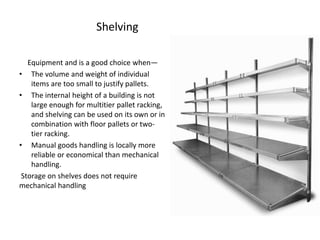
Shelving
Equipment and is a good choice when—
• The volume and weight of individual
items are too small to justify pallets.
• The internal height of a building is not
large enough for multitier pallet racking,
and shelving can be used on its own or in
combination with floor pallets or two-
tier racking.
• Manual goods handling is locally more
reliable or economical than mechanical
handling.
Storage on shelves does not require
mechanical handling
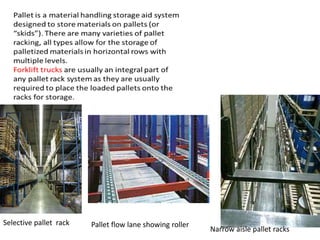
Selective pallet rack
Narrow aisle pallet racks
Pallet flow lane showing roller
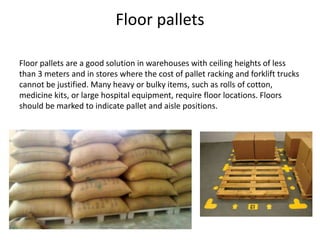
Floor pallets
Floor pallets are a good solution in warehouses with ceiling heights of less
than 3 meters and in stores where the cost of pallet racking and forklift trucks
cannot be justified. Many heavy or bulky items, such as rolls of cotton,
medicine kits, or large hospital equipment, require floor locations. Floors
should be marked to indicate pallet and aisle positions.
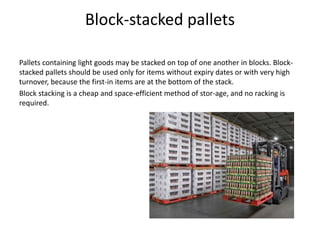
Block-stacked pallets
Pallets containing light goods may be stacked on top of one another in blocks. Block-
stacked pallets should be used only for items without expiry dates or with very high
turnover, because the first-in items are at the bottom of the stack.
Block stacking is a cheap and space-efficient method of stor-age, and no racking is
required.
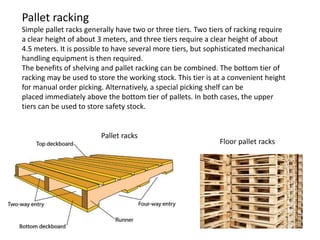
Floor pallet racks
Pallet racks
Pallet racking
Simple pallet racks generally have two or three tiers. Two tiers of racking require
a clear height of about 3 meters, and three tiers require a clear height of about
4.5 meters. It is possible to have several more tiers, but sophisticated mechanical
handling equipment is then required.
The benefits of shelving and pallet racking can be combined. The bottom tier of
racking may be used to store the working stock. This tier is at a convenient height
for manual order picking. Alternatively, a special picking shelf can be
placed immediately above the bottom tier of pallets. In both cases, the upper
tiers can be used to store safety stock.
ADVANTAGES—
• They keep goods together and impose a disciplined method of
storage.
• Large loads can be moved easily using mechanical handling
equipment.
• Pallets are easy to trans ship because they do not require any
unpacking and repacking.
• Pallets isolate goods from floors, which may be damp.
• If goods are supplied by the manufacturer on shrink-wrapped
pallets, it is easy to see when tampering has occurred.
• Inspection for damage and for short shipments is easy to perform.
• When stock rearrangement is necessary, it is mucheasier to move
pallets with mechanical handling
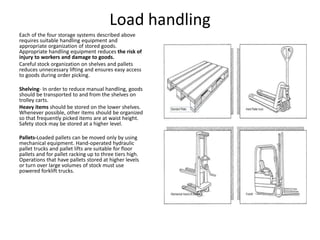
Load handling
Each of the four storage systems described above
requires suitable handling equipment and
appropriate organization of stored goods.
Appropriate handling equipment reduces the risk of
injury to workers and damage to goods.
Careful stock organization on shelves and pallets
reduces unnecessary lifting and ensures easy access
to goods during order picking.
Shelving- In order to reduce manual handling, goods
should be transported to and from the shelves on
trolley carts.
Heavy items should be stored on the lower shelves.
Whenever possible, other items should be organized
so that frequently picked items are at waist height.
Safety stock may be stored at a higher level.
Pallets-Loaded pallets can be moved only by using
mechanical equipment. Hand-operated hydraulic
pallet trucks and pallet lifts are suitable for floor
pallets and for pallet racking up to three tiers high.
Operations that have pallets stored at higher levels
or turn over large volumes of stock must use
powered forklift trucks.
Reference- WHO- apps.who.int/medicine docs
Thank you

STORES MANAGEMENT22

  • 1.
  • 2.
    Modern day storesmanagement has assumed multifaceted roles and dimensions. Stores of health care institutions have a special role since they transact in life saving products and are high cost centers.
  • 3.
    The elements ofmaterials management as applicable to healthcare institutions may be grouped as: Materials planning and programming Purchasing Receiving and warehousing Store keeping Inventory control Value analysis and standardization Condemnation and disposal Materials management is the integrated functioning of an organization dealing with supply of materials and allied activities in order to achieve the maximum coordination and optimum expenditure on materials. Materials management may also be interchangeably termed as stores management.
  • 4.
    OBJECTIVES OF STORES Storesfunctions focus on the physical movement and storage of goods and materials. This involves managing the physical flow of materials into and out of the organization and developing and managing networks of warehouses when needed. components, tools, equipments spare parts, maintenance, gen. stores receive and issue material accept and store scrape and discarded material HUB STORES-ACTIVITIES PURCHASING MAINTENANCE DISTRIBUTION INVENTORY CONTROL
  • 5.
    The stores functionshould be organized as follows: To receive raw materials, components, equipments, etc. To meet the demand of user departments by issuing the same. Account the transactions correctly. Minimize obsolescence, surplus and scrap by proper identification and using correct preservation methods. Ensure good housekeeping, compromising receipts, issues, handling and storage.
  • 6.
    WAREHOUSE DESIGN PRINCIPLES Theadvantages of warehousing can be maximized if the design is optimum keeping in mind the specific functions of the warehouse. The basic warehouse design principles are based on incorporating in the design the four principles described below. These are: Product movement Handling technology Storage plan Future expansion
  • 7.
    Manual versus computerizedsystems The information system must include data on products entering and leaving the warehouse, products in stock, products on order, and ways to monitor the progress of orders in the supply pipeline. Key elements of the system are well-designed forms, computerized information systems, and clearly defined procedures. Stock records Stock records contain information about suppliers, customers, prices, stock receipts, stock issues, stock losses, and stock balances. These data are essential for planning distribution. A stock record (manual or computerized) must be maintained for each item in the inventory. The stock record documents all transactions relating to an item. Many stores also maintain bin cards for each product in each storage area to record information on issues, receipts, and stock balances.
  • 10.
    Performance monitoring andreporting A store should monitor and evaluate its operations to identify problems in the system that need to be addressed. Stock records are a vital source of information on how effectively the distribution system is being managed; therefore, maintaining these records accurately and keeping them up-to-date is vital. Communications The medical stores must maintain effective communications with suppliers, with procurement and inventory control units, with lower-level warehouses and health facilities. Periodic meetings with the staff members of client facilities can help ensure good communications and a more effective supply system.
  • 11.
    Flow of stockand information Stock, and the information that accompanies it, should flow through the warehouse in an orderly manner. This process has six stages— 1. Receiving:Goods that arrive in the receiving room are quarantined, inspected, and if found to be acceptable, entered into the stock-recording system. Receiving reports are prepared. 2. Storage: Accepted goods are moved to their allocated storage positions in the warehouse, where they are stored in first-in/first-out (FIFO) or first-expiry/first- out (FEFO) order. Records for stocks on hand and on order are adjusted. 3. Allocation of stock: In most medical stores, the manager determines whether to allocate the complete quantities requested when a requisition is received. The decision can be made in collaboration with the requesting facility but generally depends on stock status, a review of facility consumption patterns, and, in some cases, budget status.
  • 13.
    4. Order picking:An order-picking list is prepared (this may be the original requisition form rather than a separate list). Workers use this list to identify and collect the allocated items from the warehouse. 5. Order assembly: Individual orders are assembled and checked in the packing area. They are then packed for delivery. delivery documentation is prepared. 6. Dispatch and delivery: The packed goods are held in designated secure areas pending shipment, then loaded onto the transport and dispatched, accompanied by the necessary documentation, including a packing list recording all items and quantities. Ideally, an invoice showing unit costs of medicines and total value should accompany the shipment. Signed delivery notes are checked when the vehicle returns. If errors or damage have been reported, appropriate action is taken.
  • 14.
    ZONING STOCK WITHINTHE STORE • Correct combination of temperature and security is important • Initial zoning process is the most basic way supplies are arranged • Zone can be separate o building or rooms o Locked cupboard o A refrigerator o A freezer o A cold room
  • 15.
    TYPE OF STORAGE Theproduct manufactures Uncontrolled room temperature Controlled temperature and humidity Cold storage Flammables • Storage instructions should be followed to the extent possible .If no specific instruction are given normal storage conditions apply • Normal condition for medicines have been defined as “ storage in dry, well-ventilated premises at temperature of +15 degree C to +25 degree C (WHO) • Each storage zone must have thermometer and temperature should be recorded at the hottest time of the day
  • 16.
    STORAGE AT UNCONTROLLEDROOM TEMPERATURE • Many product can be safely stored at uncontrolled room temperature. • Sometime the temperature at upper store can exceed +40 degree C even in temperate climate and in winter it drop below freezing • Extreme condition can damage some items STORAGE AT CONTROLLED TEMPERATURE AND HUMIDITY • In hot climate it is necessary to store many items in air conditioned rooms • Humid climate de-humifers are useful for preventing moisture • In winters the store may be heated to protects the products
  • 17.
    COLD STORAGE • Thepotency of vaccines ,sera, test kits and many others item depend on cold storage • Vaccines are temperature sensitive and must be kept at precisely controlled temperatures from the point of manufacture to the point of administration • Cold chain defects are frequent problem of immunization programs • National and regional vaccine stores should be equipped with stand by generators SECURE STORAGE • Narcotics and other controlled substances (antiretroviral ) should be kept in secure room • Red active lights or warning bells will activate when doors is unlocked • Entry to the store is controlled • No more than two officers have access
  • 18.
    FLAMMABLES Flammables like alcoholand ether must be stored in special buildings or room Separate location is best as it reduces the risk of fire spreading to the main store Must be well ventilated and fire roof Explosion hatch part of roof or wall Fuel should never be stores in or near medical store
  • 19.
    STOCK LOCATION WITHINZONE • Simplest to manage{each stock item is always stored in the same place}. • More space utilization Fixed location •Requires sophisticated stock management{the location of each stock item varies over time.} •Make better use of available space Fluid location • Combine features of both systems. Semifluid location
  • 20.
    FIXED LOCATION SYSTEM Eachstock item is allocated to specific shelves, pallet racking, or an area of floor. A fixed location system is like a house in which each family member has his or her own room. A room is left empty if a person is not at home. The administration : The store has to be large enough to accommodate the maximum possible level of stock for every item, including safety stock. As stock is used up, the storage location is emptied and left vacant until a new shipment of the item is received. With a fixed location system, stock administration is relatively easy. Goods can always be found in the same place. Disadvantages— • Fixed location systems are inflexible. • If a new item is ordered, there may be no place to store it. • Theft may increase because all store staff are familiar with the locations of valuable items. • Storage space may be wasted, because at times it is largely empty.
  • 21.
    FLUID LOCATION SYSTEM •the store is divided into many designated locations. Each location is assigned a code. • Individual items are stored wherever space is available at the time of delivery. A fluid location system is like a hotel rooms are assigned only when guests arrive. A fluid location system uses available space efficiently, but it requires sophisticated stock administration. The administration of a fluid location system works as follows—  The procurement unit provides information on the type, volume, and weight of goods arriving.  The storekeeper assesses which locations will be empty when the new stock arrives and assigns an appropriate location. These data are recorded in the stock control system.  If insufficient space is available, other goods may be moved to create more space.  The stock control location records are updated. Fluid location systems require a classification system that allocates a unique identifier code to each stock item and to each location. Also, the stock record for each batch of each item must always indicate the physical location of the item in the store. In a fluid location system, different batches of a particular item may be stored in several different places. For example, if item number 150-050-48 is 500 mg amoxicillin, 150-050-48: B1-B could be a batch of this product stored in aisle B, bay 1, cell B, and 150-050-48: C2-B could be another batch of the same product stored in aisle C, bay 2, cell B.
  • 22.
    SEMIFLUID LOCATION SYSTEM Asemifluid location system is a combination of the fixed and fluid systems. It is like a hotel that has regular guests. Regular guests are always given the same room. Casual guests are given any room that is available. In a semifluid location system, each item is assigned a fixed space for picking stock. When an order is prepared, the order-picking staff members know where to find each item. The remainder of the store is filled on the fluid location principle . However, picking stock is stored at a convenient height, eliminating the need for mechanical handling during order picking in stores that issue in relatively small quantities. picking stock is always kept in the same place. If demand increases for a particular item, the picking stock can be replenished more frequently. As new products re introduced, picking bays may be subdivided to provide sufficient space. A semifluid location system is not as space-efficient as a fluid location system.
  • 23.
    STOCK CLASSIFICATION STOCKCLASSIFICATION Therapeutic and pharmacologicalcategory Alphabetical order Dosage form Random bins Commodity code Items should be clearly organized within each zone of the store
  • 24.
    THERAPEUTIC AND PHARMACOLOGICAL •Keeping medicine according to there function and uses; arranging all antibiotics together • Used in smaller stores • Dispensaries of smaller clinic • Store keeper is dispenser ALPHABETICAL ORDER • Is attractive way to order drug by alphabetical order • Used in peripheral stores that keep small number of items • Requires reorganization of the stores as soon there is change in essential medicine • Doesn't result in optimal use of available space Antipyretic Antibiotics Antifungals Antivirals Anticonvulsants Anti allergy
  • 25.
    DOSAGE FORM • Usedin smaller warehouses • Tablets and capsules are stored together with separate areas for oral liquids, Injections, creams and ointments and topical liquids • Within each dosage form area product may be stored in fixed, fluid or semi fluid manner • Advantage- form are easy to recognize when receiving goods and this system allows optimal use of space RANDOM BIN • The Radom bin is unique storage space identified by code • Random bin can be combined with the previously described methods
  • 26.
    COMMODITY CODE • Abstractorganizational system offering maximum flexibility • Can be used in small and large stores • Use of unique combination with unique location code {derived from WHO technical specification or UNICEF stock codes} • Article codes can be designed to specify therapeutic class, clinical indication level of use, or any other relevant data • In location and article coding storekeeper shouldn't have specific knowledge • Changes can be easily introduced by assigning unique article codes to new products • Works well in computerized system • Tender contracts may require that only the articles code be marked on the bulk packaging as well as on the smaller units of supply • Good method to increase the security of stores • The location code is totally independent of the article code and is similar to the random bin principle. Code can be designed to incorporate any number of characteristics  Correct storage temperature for the product  Correct security level for the product  Whether the product is flammable  The building where the product is located  Pack size  Pharmaceutical form
  • 27.
    STOCK STORAGE ANDHANDLING There are four basic systems of storage: Shelves Floor pallets Block stacked pallets Pallet racks
  • 28.
    Shelving Equipment and isa good choice when— • The volume and weight of individual items are too small to justify pallets. • The internal height of a building is not large enough for multitier pallet racking, and shelving can be used on its own or in combination with floor pallets or two- tier racking. • Manual goods handling is locally more reliable or economical than mechanical handling. Storage on shelves does not require mechanical handling
  • 29.
    Selective pallet rack Narrowaisle pallet racks Pallet flow lane showing roller
  • 30.
    Floor pallets Floor palletsare a good solution in warehouses with ceiling heights of less than 3 meters and in stores where the cost of pallet racking and forklift trucks cannot be justified. Many heavy or bulky items, such as rolls of cotton, medicine kits, or large hospital equipment, require floor locations. Floors should be marked to indicate pallet and aisle positions.
  • 31.
    Block-stacked pallets Pallets containinglight goods may be stacked on top of one another in blocks. Block- stacked pallets should be used only for items without expiry dates or with very high turnover, because the first-in items are at the bottom of the stack. Block stacking is a cheap and space-efficient method of stor-age, and no racking is required.
  • 32.
    Floor pallet racks Palletracks Pallet racking Simple pallet racks generally have two or three tiers. Two tiers of racking require a clear height of about 3 meters, and three tiers require a clear height of about 4.5 meters. It is possible to have several more tiers, but sophisticated mechanical handling equipment is then required. The benefits of shelving and pallet racking can be combined. The bottom tier of racking may be used to store the working stock. This tier is at a convenient height for manual order picking. Alternatively, a special picking shelf can be placed immediately above the bottom tier of pallets. In both cases, the upper tiers can be used to store safety stock.
  • 33.
    ADVANTAGES— • They keepgoods together and impose a disciplined method of storage. • Large loads can be moved easily using mechanical handling equipment. • Pallets are easy to trans ship because they do not require any unpacking and repacking. • Pallets isolate goods from floors, which may be damp. • If goods are supplied by the manufacturer on shrink-wrapped pallets, it is easy to see when tampering has occurred. • Inspection for damage and for short shipments is easy to perform. • When stock rearrangement is necessary, it is mucheasier to move pallets with mechanical handling
  • 34.
    Load handling Each ofthe four storage systems described above requires suitable handling equipment and appropriate organization of stored goods. Appropriate handling equipment reduces the risk of injury to workers and damage to goods. Careful stock organization on shelves and pallets reduces unnecessary lifting and ensures easy access to goods during order picking. Shelving- In order to reduce manual handling, goods should be transported to and from the shelves on trolley carts. Heavy items should be stored on the lower shelves. Whenever possible, other items should be organized so that frequently picked items are at waist height. Safety stock may be stored at a higher level. Pallets-Loaded pallets can be moved only by using mechanical equipment. Hand-operated hydraulic pallet trucks and pallet lifts are suitable for floor pallets and for pallet racking up to three tiers high. Operations that have pallets stored at higher levels or turn over large volumes of stock must use powered forklift trucks.
  • 35.