Presented by:
KAMAL SINGH
Classification
The materials procured by a firm must be
classified and coded before the materials are
inspected, accounted in stores ledgers and
stored ,hence materials are broadly
classified according to their nature, use and
service before the job codification is taken
up.
Codification
• This is the system adopted for accurate
identification of materials by allotting a
numerical number for each item procured
and stored.
Definitions
• Codification in an industry is the systematic
concise representation of equipment, raw
materials, tools, spares, supplies etc.in an
abbreviated form employing alphabets,
numerals, colours, symbols etc.
Characteristics of Codes
Code should be Simple.
Code should be unique.
Coding should be compact, concise and
consistent.
Code should be sufficiently flexible to meet
future demands
Objectives of Codification
• Accurate and logical identification
• Prevention of duplication
• Standardisation and reduction of varieties
• Efficient purchasing
• Easy computerization
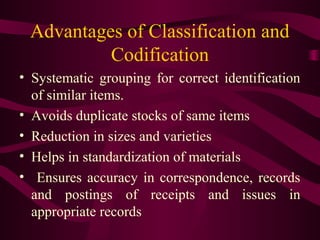
Advantages of Classification and
Codification
• Systematic grouping for correct identification
of similar items.
• Avoids duplicate stocks of same items
• Reduction in sizes and varieties
• Helps in standardization of materials
• Ensures accuracy in correspondence, records
and postings of receipts and issues in
appropriate records
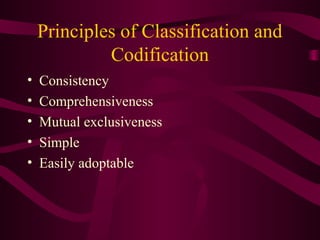
Principles of Classification and
Codification
• Consistency
• Comprehensiveness
• Mutual exclusiveness
• Simple
• Easily adoptable
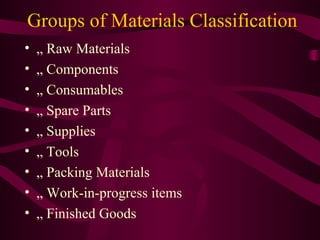
Groups of Materials Classification
• „ Raw Materials
• „ Components
• „ Consumables
• „ Spare Parts
• „ Supplies
• „ Tools
• „ Packing Materials
• „ Work-in-progress items
• „ Finished Goods
• Completely knocked down items
• „ Hard ware items
• „ Fasteners
• „ Subcontracted items
• „ Wires and cables
• „ Paints and chemicals
Benefits
• Important factor in indenting, purchasing
and issuing activities.
• Wrong identification results in wrong
purchases.
• Words description can be used but they are
too long,totally inadequate and Prone to
errors.
• Accurate and logical identification.
• Avoidance of Long and unweilding
description.
• Prevention of duplication.
• Product Simplification.
• Efficient Purchasing.
Benefits
• Minimizing of clerical work.
• Efficient Purchasing.
• Accurate ane reliable accounting and
recording.
• Easier computerisation.
• Better alternative selection
• Simplifies Costing
Benefits
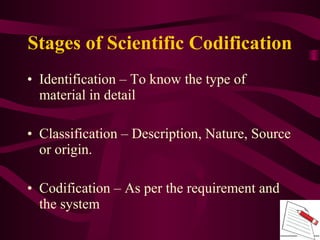
• Identification – To know the type of
material in detail
• Classification – Description, Nature, Source
or origin.
• Codification – As per the requirement and
the system
Stages of Scientific Codification
• Simple
• Brief
• Flexible
• Unique
• Layout should be easy to handle
• Self Decoding
• Objective Oriented
Special Characteristics
Need for codification
Speed
Saving of efforts
Space saving on forms
 Ease of classification,
 Mechanization
Common methods of store codification
• „Alphabetical codification
• Numerical codification
• Mnemonic codification
• Combined alphabetical & numerical
codification
• Decimal codification
• British/Brisch codification
• Kodak codification
• Colour codification
1. Alphabetical codification: In this method,
letters of the alphabet are used to describe an item.
Sometimes combinations of alphabets are designed to give a
mnemonic meaning e.g.BT-Bolt
2. Numerical codification: the numerical
system is based on numbers, simple numbers, block
numbers or dash/stroke numbers.
1. Simple Number
2. Block Number
3. Dash/Stroke Number
3. Mnemonic Codification: When we use letters to
help memory, we call such a system a mnemonic system.
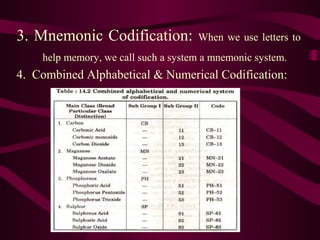
4. Combined Alphabetical & Numerical Codification:
5. Decimal Codification: Under this system of
codification, within the range often numerals 0-9, some
significance is attached to every digit in the code.
(digital numbering order will be first digit will signify the
broad class, the second digit, will signify the group, third digit
will signify the sub-group, fourth digit will signify the type,
fifth digit will signify the size, sixth digit will signify the
grade, seventh digit will signify the shape and eighth digit will
signify the condition and so on.)
6. Colour Codification:
7. British/Brisch Codification: The Brisch system
named after a prominent consulting engineer in the UK
consists of seven digits and is applied in three phases. The
items are grouped into suitable preliminary categories, such
as assemblies, sub assemblies, components, off the shelf
items.
8. Kodak Codification: The Kodak system has been
developed by East Man Kodak Company of New York
which consists of 10 digits of numerical code.
Variety Reduction of Materials
• The process of standardization logically leads to
simplification and variety reduction.
• Variety reduction defined as a form of
standardization consisting of the reduction of the
number of types of products, or materials or parts
within a definite range to a lesser number which is
adequate to meet prevailing needs at a given time.
How to control Variety?
• „ By Simplifications
• „By Standardization „
• By Specialization
• Value Analysis
Benefits of Variety Control
• „ Better after sales service
• „ Greater technical productivity „
• Better understanding of technical problems
• „ Lesser set up times
• „ Higher equipment utilization „
• Reduction in inventory „
• effort
• Higher equipment utilization
• „ Easier inventory control „
• Better use of storage space
• „ Quicker stock-checking „
• Reduction in purchasing effort
Benefits of Variety Control
count…..

Codification

  • 1.
  • 2.
    Classification The materials procuredby a firm must be classified and coded before the materials are inspected, accounted in stores ledgers and stored ,hence materials are broadly classified according to their nature, use and service before the job codification is taken up.
  • 3.
    Codification • This isthe system adopted for accurate identification of materials by allotting a numerical number for each item procured and stored.
  • 4.
    Definitions • Codification inan industry is the systematic concise representation of equipment, raw materials, tools, spares, supplies etc.in an abbreviated form employing alphabets, numerals, colours, symbols etc.
  • 5.
    Characteristics of Codes Codeshould be Simple. Code should be unique. Coding should be compact, concise and consistent. Code should be sufficiently flexible to meet future demands
  • 6.
    Objectives of Codification •Accurate and logical identification • Prevention of duplication • Standardisation and reduction of varieties • Efficient purchasing • Easy computerization
  • 7.
    Advantages of Classificationand Codification • Systematic grouping for correct identification of similar items. • Avoids duplicate stocks of same items • Reduction in sizes and varieties • Helps in standardization of materials • Ensures accuracy in correspondence, records and postings of receipts and issues in appropriate records
  • 8.
    Principles of Classificationand Codification • Consistency • Comprehensiveness • Mutual exclusiveness • Simple • Easily adoptable
  • 9.
    Groups of MaterialsClassification • „ Raw Materials • „ Components • „ Consumables • „ Spare Parts • „ Supplies • „ Tools • „ Packing Materials • „ Work-in-progress items • „ Finished Goods
  • 10.
    • Completely knockeddown items • „ Hard ware items • „ Fasteners • „ Subcontracted items • „ Wires and cables • „ Paints and chemicals
  • 11.
    Benefits • Important factorin indenting, purchasing and issuing activities. • Wrong identification results in wrong purchases. • Words description can be used but they are too long,totally inadequate and Prone to errors.
  • 12.
    • Accurate andlogical identification. • Avoidance of Long and unweilding description. • Prevention of duplication. • Product Simplification. • Efficient Purchasing. Benefits
  • 13.
    • Minimizing ofclerical work. • Efficient Purchasing. • Accurate ane reliable accounting and recording. • Easier computerisation. • Better alternative selection • Simplifies Costing Benefits
  • 14.
    • Identification –To know the type of material in detail • Classification – Description, Nature, Source or origin. • Codification – As per the requirement and the system Stages of Scientific Codification
  • 15.
    • Simple • Brief •Flexible • Unique • Layout should be easy to handle • Self Decoding • Objective Oriented Special Characteristics
  • 16.
    Need for codification Speed Savingof efforts Space saving on forms  Ease of classification,  Mechanization
  • 17.
    Common methods ofstore codification • „Alphabetical codification • Numerical codification • Mnemonic codification • Combined alphabetical & numerical codification • Decimal codification • British/Brisch codification • Kodak codification • Colour codification
  • 18.
    1. Alphabetical codification:In this method, letters of the alphabet are used to describe an item. Sometimes combinations of alphabets are designed to give a mnemonic meaning e.g.BT-Bolt 2. Numerical codification: the numerical system is based on numbers, simple numbers, block numbers or dash/stroke numbers. 1. Simple Number 2. Block Number 3. Dash/Stroke Number
  • 19.
    3. Mnemonic Codification:When we use letters to help memory, we call such a system a mnemonic system. 4. Combined Alphabetical & Numerical Codification:
  • 20.
    5. Decimal Codification:Under this system of codification, within the range often numerals 0-9, some significance is attached to every digit in the code. (digital numbering order will be first digit will signify the broad class, the second digit, will signify the group, third digit will signify the sub-group, fourth digit will signify the type, fifth digit will signify the size, sixth digit will signify the grade, seventh digit will signify the shape and eighth digit will signify the condition and so on.) 6. Colour Codification:
  • 21.
    7. British/Brisch Codification:The Brisch system named after a prominent consulting engineer in the UK consists of seven digits and is applied in three phases. The items are grouped into suitable preliminary categories, such as assemblies, sub assemblies, components, off the shelf items. 8. Kodak Codification: The Kodak system has been developed by East Man Kodak Company of New York which consists of 10 digits of numerical code.
  • 22.
    Variety Reduction ofMaterials • The process of standardization logically leads to simplification and variety reduction. • Variety reduction defined as a form of standardization consisting of the reduction of the number of types of products, or materials or parts within a definite range to a lesser number which is adequate to meet prevailing needs at a given time.
  • 23.
    How to controlVariety? • „ By Simplifications • „By Standardization „ • By Specialization • Value Analysis
  • 24.
    Benefits of VarietyControl • „ Better after sales service • „ Greater technical productivity „ • Better understanding of technical problems • „ Lesser set up times • „ Higher equipment utilization „ • Reduction in inventory „ • effort
  • 25.
    • Higher equipmentutilization • „ Easier inventory control „ • Better use of storage space • „ Quicker stock-checking „ • Reduction in purchasing effort Benefits of Variety Control count…..