Chapter 19
Metals and Their Reactivity
   LEARNING OUTCOMES

        Describe the physical and chemical properties of
         metals;
        Explain why metal alloys are often used in place of
         metals;
        Discuss the reactivity of metals, and deduce the order
         of reactivity of metals based on experimental results
         of data supplied
        Describe the reactions of metallic hydroxides, nitrates
         and carbonates
Chapter 19
Metals and Their Reactivity
Physical Properties of metals
   Metals are usually hard and shiny.
   They are malleable (can be bent or hammered
    into sheets) and ductile (can be stretched or
    drawn into wires).
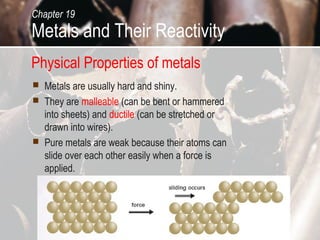
   Pure metals are weak because their atoms can
    slide over each other easily when a force is
    applied.
Chapter 19
Metals and Their Reactivity
Physical Properties of metals
   Metals are good conductors of heat and electricity.
   Metals have high density.
 They have high melting points and boiling points.

    E.g. iron has a melting point of 1538 oC and
    tungsten has a melting point of 3422 oC.
Chapter 19
Metals and Their Reactivity
Chemical Properties of metals
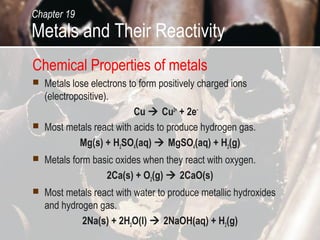
   Metals lose electrons to form positively charged ions
    (electropositive).
                           Cu  Cu2+ + 2e−
   Most metals react with acids to produce hydrogen gas.
             Mg(s) + H2SO4(aq)  MgSO4(aq) + H2(g)
   Metals form basic oxides when they react with oxygen.
                   2Ca(s) + O2(g)  2CaO(s)
   Most metals react with water to produce metallic hydroxides
    and hydrogen gas.
             2Na(s) + 2H2O(l)  2NaOH(aq) + H2(g)
Chapter 19
Metals and Their Reactivity
Structure of metals
   The atoms of metals are packed
    very closely together in neat layers.
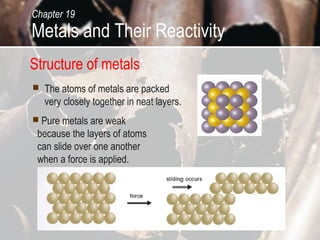
 Pure metals are weak
 because the layers of atoms
 can slide over one another
 when a force is applied.
Chapter 19
Metals and Their Reactivity
Alloys of metals
 A mixture of a metal with
  another metal (or non-metal) is
  called an alloy.
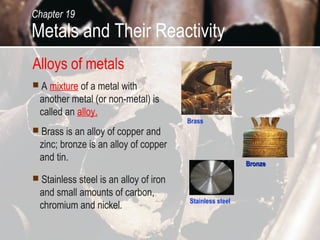
                                        Brass
 Brass is an alloy of copper and
  zinc; bronze is an alloy of copper
  and tin.
                                                          Bronze

 Stainless steel is an alloy of iron
  and small amounts of carbon,
                                        Stainless steel
  chromium and nickel.
Chapter 19
Metals and Their Reactivity
Structure of alloys
   In alloys, the atoms of different
    metals or elements are of
    different sizes.
    This disrupts the orderly layers
    of atoms and makes it harder
    for the layers of atoms to slide
    over one another when a force
    is applied.
 This explains why alloys are
    harder and stronger than the
    pure metals.
Chapter 19
Metals and Their Reactivity
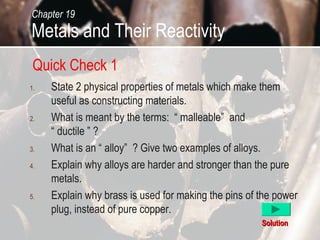
 Quick Check 1
1.   State 2 physical properties of metals which make them
     useful as constructing materials.
2.   What is meant by the terms: “ malleable” and
     “ ductile ” ?
3.   What is an “ alloy” ? Give two examples of alloys.
4.   Explain why alloys are harder and stronger than the pure
     metals.
5.   Explain why brass is used for making the pins of the power
     plug, instead of pure copper.
                                                      Solution
Chapter 19
Metals and Their Reactivity
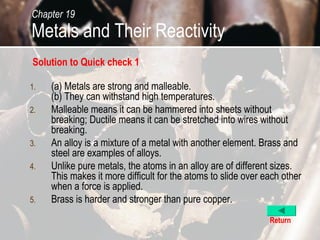
Solution to Quick check 1

1.   (a) Metals are strong and malleable.
     (b) They can withstand high temperatures.
2.   Malleable means it can be hammered into sheets without
     breaking; Ductile means it can be stretched into wires without
     breaking.
3.   An alloy is a mixture of a metal with another element. Brass and
     steel are examples of alloys.
4.   Unlike pure metals, the atoms in an alloy are of different sizes.
     This makes it more difficult for the atoms to slide over each other
     when a force is applied.
5.   Brass is harder and stronger than pure copper.
                                                               Return
Chapter 19
Metals and Their Reactivity
The Reactivity Series
   The Reactivity Series     Potassium (K)      Most reactive
    shows the order of        Sodium      (Na)
    reactivity of metals in   Calcium    (Ca)
    their reactions with      Magnesium (Mg)
    water, steam, and         Aluminium (Al)
    dilute acids.             Zinc       (Zn)
                              Iron      (Fe)
                              Lead       (Pb)
                              Copper    (Cu)
                              Silver    (Ag)      Least reactive
Chapter 19
Metals and Their Reactivity
How to remember the Reactivity Series
 Potassium (K)      Katty’s          Most reactive
 Sodium      (Na)   Naughty
 Calcium    (Ca)    Cat
 Magnesium (Mg)     Mingled with
 Aluminium (Al)     Alice and
 Zinc       (Zn)    Zarina;
 Iron      (Fe)     Fearlessly
 Lead       (Pb)    Plundering her
 Copper    (Cu)     Cupboard of
 Silver   (Ag)      Silver            Least reactive
Chapter 19
Metals and Their Reactivity
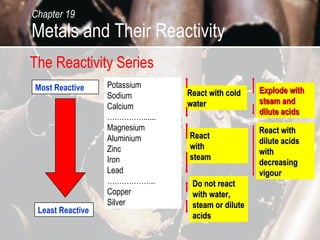
The Reactivity Series
Most Reactive     Potassium
                                React with cold    Explode with
                  Sodium
                                water              steam and
                  Calcium
                                                   dilute acids
                  ……………......
                  Magnesium                        React with
                  Aluminium     React
                                                   dilute acids
                  Zinc          with
                                                   with
                  Iron          steam
                                                   decreasing
                  Lead                             vigour
                  ………………..       Do not react
                  Copper         with water,
                  Silver         steam or dilute
 Least Reactive
                                 acids
Chapter 19
Metals and Their Reactivity
Reaction of potassium with water
 The first three metals: potassium, sodium and calcium   react
very vigorously with cold water to produce hydrogen gas and an
alkali.
 When a small piece of potassium is placed into a trough of
water, it immediately bursts into flames, and moves rapidly on
the water surface. The hydrogen gas given off makes it burn
explosively. An alkali, potassium hydroxide, is also formed.
             2K(s) + 2H2O(l)  2KOH(aq) + H2(g)
Chapter 19
Metals and Their Reactivity
Reaction of sodium with water
   Sodium reacts less vigorously than
    potassium with cold water.
  When a small piece of sodium is placed into a
trough of water, it melts into a silvery ball and
darts about on the water surface. It may
occasionally burst into flame. An alkali, sodium
hydroxide, is left in the solution.
 2Na(s) + 2H2O(l)  2NaOH(aq) + H2(g)
Chapter 19
Metals and Their Reactivity
Reaction of calcium with water
   When a small piece of calcium is placed in a
beaker of water, it sinks to the bottom of the water.
It reacts vigorously with the water, producing
bubbles of hydrogen.
  The water turns slightly milky due to the
formation of calcium hydroxide, which is not
very soluble in water.
                                                        pop
    Ca(s) + 2H2O(l)  Ca(OH)2 (aq) + H2 (g)
 The hydrogen can be collected in a
    test tube and tested with a lighted splint.
Chapter 19
Metals and Their Reactivity
Reactions with steam
   Magnesium, zinc and iron do not react with cold
    water but react with steam when heated to
    produce hydrogen and a metal oxide:

   Equations:
 Mg(s) + H2O(g)  MgO(s) + H2(g)
     Zn(s) + H2O(g)  ZnO(s) + H2(g)
 3Fe(s) + 4H2O(g)  Fe3O4(s) + 4H2(g)
Chapter 19
Metals and Their Reactivity
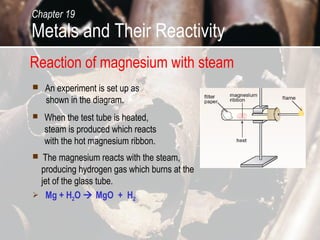
Reaction of magnesium with steam
   An experiment is set up as
    shown in the diagram.
   When the test tube is heated,
    steam is produced which reacts
    with the hot magnesium ribbon.
 The magnesium reacts with the steam,
 producing hydrogen gas which burns at the
 jet of the glass tube.
 Mg + H2O  MgO + H2
Chapter 19
Metals and Their Reactivity
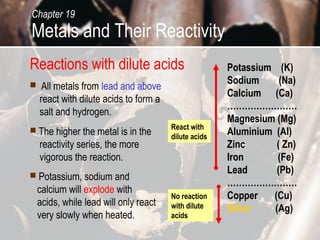
Reactions with dilute acids                            Potassium (K)
                                                       Sodium      (Na)
    All metals from lead and above
                                                       Calcium (Ca)
    react with dilute acids to form a
                                                       ……………………
    salt and hydrogen.
                                                       Magnesium (Mg)
                                        React with
 The higher the metal is in the
                                        dilute acids
                                                       Aluminium (Al)
    reactivity series, the more                        Zinc       ( Zn)
    vigorous the reaction.                             Iron       (Fe)
 Potassium, sodium and
                                                       Lead       (Pb)
                                                       ……………………
    calcium will explode with
                                        No reaction    Copper    (Cu)
    acids, while lead will only react   with dilute    Silver    (Ag)
    very slowly when heated.            acids
Chapter 19
Metals and Their Reactivity
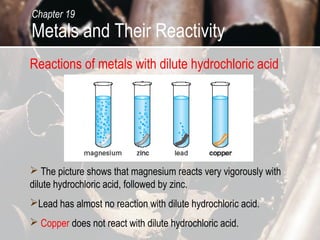
Reactions of metals with dilute hydrochloric acid


 The picture shows that magnesium reacts very vigorously with
dilute hydrochloric acid, followed by zinc.
Lead has almost no reaction with dilute hydrochloric acid.
 Copper does not react with dilute hydrochloric acid.
Chapter 19
Metals and Their Reactivity
Non-reactivity of Aluminium             Potassium (K)
 Aluminium which is                    Sodium     (Na)
 relatively high in the                 Calcium (Ca)
 Reactivity Series seems to             ……………………
 have no reaction with water,           Magnesium (Mg)
 steam and dilute acids.                Aluminium (Al)
                                        Zinc      ( Zn)
This is because aluminium is
                                        Iron      (Fe)
coated with a thin layer of aluminium   …………………
oxide that is invisible to the naked    Lead      (Pb)
eye. This layer protects the metal      Copper   (Cu)
from contact with the reagents.         Silver   (Ag)
Chapter 19
Metals and Their Reactivity
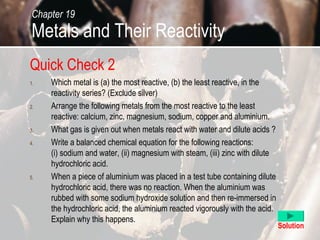
Quick Check 2
1.   Which metal is (a) the most reactive, (b) the least reactive, in the
     reactivity series? (Exclude silver)
2.   Arrange the following metals from the most reactive to the least
     reactive: calcium, zinc, magnesium, sodium, copper and aluminium.
3.   What gas is given out when metals react with water and dilute acids ?
4.   Write a balanced chemical equation for the following reactions:
     (i) sodium and water, (ii) magnesium with steam, (iii) zinc with dilute
     hydrochloric acid.
5.   When a piece of aluminium was placed in a test tube containing dilute
     hydrochloric acid, there was no reaction. When the aluminium was
     rubbed with some sodium hydroxide solution and then re-immersed in
     the hydrochloric acid, the aluminium reacted vigorously with the acid.
     Explain why this happens.
                                                                               Solution
Chapter 19
Metals and Their Reactivity
Solution to Quick check 2
1.   (a) Potassium, (b) copper
2.   Sodium, calcium, magnesium, aluminium, zinc, copper
3.   Hydrogen gas
4.   (i) 2Na(s) + 2H2O(l)  2NaOH(aq) + H2(g)
     (ii) Mg(s) + H2O(l)  MgO(s) + H2(g)
     (iii) Zn(s) + 2HCl(aq)  ZnCl2(aq) + H2(g)
5.   The piece of aluminium was coated with a layer of
     aluminium oxide which protects it from the hydrochloric
     acid. Rubbing it with sodium hydroxide removed the layer
     of aluminium oxide, and hence the aluminium was able to
     react with the hydrochloric acid.                        Return
Chapter 19
Metals and Their Reactivity
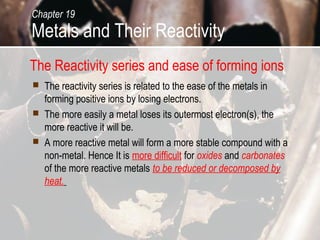
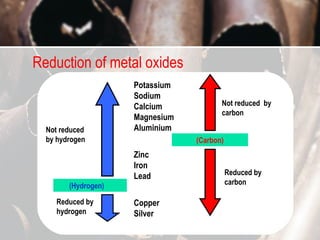
The Reactivity series and ease of forming ions
   The reactivity series is related to the ease of the metals in
    forming positive ions by losing electrons.
   The more easily a metal loses its outermost electron(s), the
    more reactive it will be.
   A more reactive metal will form a more stable compound with a
    non-metal. Hence It is more difficult for oxides and carbonates
    of the more reactive metals to be reduced or decomposed by
    heat.
Reduction of metal oxides
                     Potassium
                     Sodium
                     Calcium            Not reduced by
                                        carbon
                     Magnesium
  Not reduced        Aluminium
  by hydrogen                    (Carbon)
                     Zinc
                     Iron
                     Lead                   Reduced by
        (Hydrogen)                          carbon

    Reduced by       Copper
    hydrogen         Silver
Chapter 19
Metals and Their Reactivity
Reduction of metal oxides by carbon
 Oxides of metals which are below carbon in the
    reactivity series are reduced to the metal when
    heated with carbon.
 This process is used in the industry to obtain the
    metals from their ores.
 Examples:

        ZnO(s) + C(s)  Zn(s) + CO(g)
        CuO(s) + C(s)  Cu(s) + CO(g)
Chapter 19
Metals and Their Reactivity
Reduction of metal oxides by hydrogen
 Oxides of metals which are  below hydrogen in the
 reactivity series are reduced to the metal when
 heated with hydrogen.
 Examples:

 CuO(s)   + H2(g)  Cu(s) + H2O (g)
 AgO(s) + H2(g)    Ag(s) + H2O(g)
Chapter 19
Metals and Their Reactivity
Displacement Reactions                                        Zinc metal
   When a piece of zinc is placed in copper(II)
    sulphate solution, a brown layer of copper
    is formed on the surface of the zinc.

Zn + CuSO4  ZnSO4 + Cu
                                                                        Copper
The zinc has displaced the copper from the                              coating
copper(II) sulphate solution because zinc is
more reactive than copper.
                                                           Copper(II)
 In general, a more reactive metal will displace a less   sulphate
reactive metal from their salts in solution.               solution
Chapter 19
Metals and Their Reactivity
Displacement Reactions
                                             Zinc metal
    If a piece of zinc is placed in
     magnesium sulphate solution,
     no reaction will take place.
 This is because zinc is less
     reactive than magnesium                       No reaction
    (lower in the reactivity
    series than magnesium) and
    hence cannot displace
    magnesium ions from its            magnesium
                                       sulphate
    solution.                          solution
Chapter 19
Metals and Their Reactivity
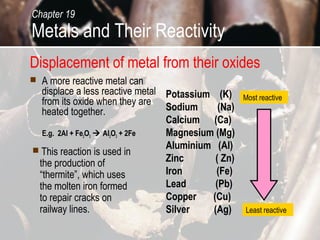
Displacement of metal from their oxides
 A more reactive metal can
  displace a less reactive metal Potassium (K)
                                                   Most reactive
  from its oxide when they are
  heated together.               Sodium     (Na)
                                 Calcium (Ca)
  E.g. 2Al + Fe2O3  Al2O3 + 2Fe Magnesium (Mg)
 This reaction is used in
                                 Aluminium (Al)
 the production of               Zinc      ( Zn)
 “thermite”, which uses          Iron      (Fe)
 the molten iron formed          Lead      (Pb)
 to repair cracks on             Copper   (Cu)
 railway lines.                  Silver   (Ag)     Least reactive
Chapter 19
Metals and Their Reactivity
Action of heat on metal carbonates
   Carbonates decompose
    when heated to produce    Potassium (K)     Carbonates not
                                                decomposed by
    the metal oxides and                        heat
    carbon dioxide.           Sodium     (Na)
    E.g. CaCO3  CaO + CO2                       More difficult
                              Calcium (Ca)
  However, the more          Magnesium (Mg)    Carbonates
  reactive the metals         Aluminium (Al)    decomposed
                                                by heat
  are, the more               Zinc      ( Zn)
  difficult it is for their   Iron      (Fe)
  carbonates to               Lead      (Pb)
decompose.                    Copper   (Cu)      Easier

                              Silver   (Ag)
Chapter 19
Metals and Their Reactivity
Thermal stability of metallic compounds
Chapter 19
Metals and Their Reactivity
Reactions of metallic compounds
with acids and alkalis
Chapter 19
Metals and Their Reactivity
Quick Check 3
1. Arrange the following metals in order of their ease of forming positive
    ions, starting from the most difficult:
    lead, magnesium, sodium, iron, calcium, copper, potassium, zinc.
2. State what will happen when a piece of iron is placed in a beaker of
    copper(II) sulphate solution. Write a chemical equation for the reaction.
3. Complete the following reactions.
    (a) Mg(s) + ZnSO4(aq) 
    (b) Zn(s) + Pb(NO3)2(aq) 
    (c) Al(s)+ Zn(NO3)2(aq 
    (d) Cu(s) + ZnSO4(aq) 
                 heat
   (e) ZnCO3(s) 
                                                                    Solution
   (f) Mg(s) + Al2O3(s) 
Chapter 19
Metals and Their Reactivity
Solution to Quick check 3
1. Copper, lead, iron, zinc, magnesium, calcium, sodium and potassium.
2. The iron will turn reddish-brown as it has displaced copper from the
    copper(II) sulphate solution. The blue copper(II) sulphate will become
    pale green in colour.
          Fe(s) + CuSO4(aq)  FeSO4(aq) + Cu(s)
3. (a)   Mg(s) + ZnSO4(aq) MgSO4(aq) + Zn(s)
   (b)   Zn(s) + Pb(NO3)2(aq)  Zn(NO3)2(aq) + Pb(s)
   (c)   2Al(s)+ 3Zn(NO3)2(aq)  2Al(NO3)3(aq) + 3Zn(s)
   (d)   Cu(s) + ZnSO4(aq)  No reaction
                  heat

   (e) ZnCO3(s)  ZnO(s) + CO2(g)
   (f) 3Mg(s) + Al2O3(s)  3MgO(s) + 2Al(s)                          Return
Chapter 19
Metals and Their Reactivity

 To Learn more about Metals, click on the
 links below!
 1.   http://www.chemicalelements.com/groups/alkali.html
 2.   http://www.ndt-
      ed.org/EducationResources/CommunityCollege/Materials/Introduction
      /metals.htm

C19 metals and their reactivity

  • 1.
    Chapter 19 Metals andTheir Reactivity LEARNING OUTCOMES  Describe the physical and chemical properties of metals;  Explain why metal alloys are often used in place of metals;  Discuss the reactivity of metals, and deduce the order of reactivity of metals based on experimental results of data supplied  Describe the reactions of metallic hydroxides, nitrates and carbonates
  • 2.
    Chapter 19 Metals andTheir Reactivity Physical Properties of metals  Metals are usually hard and shiny.  They are malleable (can be bent or hammered into sheets) and ductile (can be stretched or drawn into wires).  Pure metals are weak because their atoms can slide over each other easily when a force is applied.
  • 3.
    Chapter 19 Metals andTheir Reactivity Physical Properties of metals  Metals are good conductors of heat and electricity.  Metals have high density.  They have high melting points and boiling points. E.g. iron has a melting point of 1538 oC and tungsten has a melting point of 3422 oC.
  • 4.
    Chapter 19 Metals andTheir Reactivity Chemical Properties of metals  Metals lose electrons to form positively charged ions (electropositive). Cu  Cu2+ + 2e−  Most metals react with acids to produce hydrogen gas. Mg(s) + H2SO4(aq)  MgSO4(aq) + H2(g)  Metals form basic oxides when they react with oxygen. 2Ca(s) + O2(g)  2CaO(s)  Most metals react with water to produce metallic hydroxides and hydrogen gas. 2Na(s) + 2H2O(l)  2NaOH(aq) + H2(g)
  • 5.
    Chapter 19 Metals andTheir Reactivity Structure of metals  The atoms of metals are packed very closely together in neat layers.  Pure metals are weak because the layers of atoms can slide over one another when a force is applied.
  • 6.
    Chapter 19 Metals andTheir Reactivity Alloys of metals  A mixture of a metal with another metal (or non-metal) is called an alloy. Brass  Brass is an alloy of copper and zinc; bronze is an alloy of copper and tin. Bronze  Stainless steel is an alloy of iron and small amounts of carbon, Stainless steel chromium and nickel.
  • 7.
    Chapter 19 Metals andTheir Reactivity Structure of alloys  In alloys, the atoms of different metals or elements are of different sizes.  This disrupts the orderly layers of atoms and makes it harder for the layers of atoms to slide over one another when a force is applied.  This explains why alloys are harder and stronger than the pure metals.
  • 8.
    Chapter 19 Metals andTheir Reactivity Quick Check 1 1. State 2 physical properties of metals which make them useful as constructing materials. 2. What is meant by the terms: “ malleable” and “ ductile ” ? 3. What is an “ alloy” ? Give two examples of alloys. 4. Explain why alloys are harder and stronger than the pure metals. 5. Explain why brass is used for making the pins of the power plug, instead of pure copper. Solution
  • 9.
    Chapter 19 Metals andTheir Reactivity Solution to Quick check 1 1. (a) Metals are strong and malleable. (b) They can withstand high temperatures. 2. Malleable means it can be hammered into sheets without breaking; Ductile means it can be stretched into wires without breaking. 3. An alloy is a mixture of a metal with another element. Brass and steel are examples of alloys. 4. Unlike pure metals, the atoms in an alloy are of different sizes. This makes it more difficult for the atoms to slide over each other when a force is applied. 5. Brass is harder and stronger than pure copper. Return
  • 10.
    Chapter 19 Metals andTheir Reactivity The Reactivity Series  The Reactivity Series Potassium (K) Most reactive shows the order of Sodium (Na) reactivity of metals in Calcium (Ca) their reactions with Magnesium (Mg) water, steam, and Aluminium (Al) dilute acids. Zinc (Zn) Iron (Fe) Lead (Pb) Copper (Cu) Silver (Ag) Least reactive
  • 11.
    Chapter 19 Metals andTheir Reactivity How to remember the Reactivity Series Potassium (K) Katty’s Most reactive Sodium (Na) Naughty Calcium (Ca) Cat Magnesium (Mg) Mingled with Aluminium (Al) Alice and Zinc (Zn) Zarina; Iron (Fe) Fearlessly Lead (Pb) Plundering her Copper (Cu) Cupboard of Silver (Ag) Silver Least reactive
  • 12.
    Chapter 19 Metals andTheir Reactivity The Reactivity Series Most Reactive Potassium React with cold Explode with Sodium water steam and Calcium dilute acids ……………...... Magnesium React with Aluminium React dilute acids Zinc with with Iron steam decreasing Lead vigour ……………….. Do not react Copper with water, Silver steam or dilute Least Reactive acids
  • 13.
    Chapter 19 Metals andTheir Reactivity Reaction of potassium with water  The first three metals: potassium, sodium and calcium react very vigorously with cold water to produce hydrogen gas and an alkali.  When a small piece of potassium is placed into a trough of water, it immediately bursts into flames, and moves rapidly on the water surface. The hydrogen gas given off makes it burn explosively. An alkali, potassium hydroxide, is also formed. 2K(s) + 2H2O(l)  2KOH(aq) + H2(g)
  • 14.
    Chapter 19 Metals andTheir Reactivity Reaction of sodium with water  Sodium reacts less vigorously than potassium with cold water.  When a small piece of sodium is placed into a trough of water, it melts into a silvery ball and darts about on the water surface. It may occasionally burst into flame. An alkali, sodium hydroxide, is left in the solution.  2Na(s) + 2H2O(l)  2NaOH(aq) + H2(g)
  • 15.
    Chapter 19 Metals andTheir Reactivity Reaction of calcium with water  When a small piece of calcium is placed in a beaker of water, it sinks to the bottom of the water. It reacts vigorously with the water, producing bubbles of hydrogen.  The water turns slightly milky due to the formation of calcium hydroxide, which is not very soluble in water. pop Ca(s) + 2H2O(l)  Ca(OH)2 (aq) + H2 (g)  The hydrogen can be collected in a test tube and tested with a lighted splint.
  • 16.
    Chapter 19 Metals andTheir Reactivity Reactions with steam  Magnesium, zinc and iron do not react with cold water but react with steam when heated to produce hydrogen and a metal oxide:  Equations:  Mg(s) + H2O(g)  MgO(s) + H2(g)  Zn(s) + H2O(g)  ZnO(s) + H2(g)  3Fe(s) + 4H2O(g)  Fe3O4(s) + 4H2(g)
  • 17.
    Chapter 19 Metals andTheir Reactivity Reaction of magnesium with steam  An experiment is set up as shown in the diagram.  When the test tube is heated, steam is produced which reacts with the hot magnesium ribbon.  The magnesium reacts with the steam, producing hydrogen gas which burns at the jet of the glass tube.  Mg + H2O  MgO + H2
  • 18.
    Chapter 19 Metals andTheir Reactivity Reactions with dilute acids Potassium (K) Sodium (Na)  All metals from lead and above Calcium (Ca) react with dilute acids to form a …………………… salt and hydrogen. Magnesium (Mg) React with  The higher the metal is in the dilute acids Aluminium (Al) reactivity series, the more Zinc ( Zn) vigorous the reaction. Iron (Fe)  Potassium, sodium and Lead (Pb) …………………… calcium will explode with No reaction Copper (Cu) acids, while lead will only react with dilute Silver (Ag) very slowly when heated. acids
  • 19.
    Chapter 19 Metals andTheir Reactivity Reactions of metals with dilute hydrochloric acid  The picture shows that magnesium reacts very vigorously with dilute hydrochloric acid, followed by zinc. Lead has almost no reaction with dilute hydrochloric acid.  Copper does not react with dilute hydrochloric acid.
  • 20.
    Chapter 19 Metals andTheir Reactivity Non-reactivity of Aluminium Potassium (K)  Aluminium which is Sodium (Na) relatively high in the Calcium (Ca) Reactivity Series seems to …………………… have no reaction with water, Magnesium (Mg) steam and dilute acids. Aluminium (Al) Zinc ( Zn) This is because aluminium is Iron (Fe) coated with a thin layer of aluminium ………………… oxide that is invisible to the naked Lead (Pb) eye. This layer protects the metal Copper (Cu) from contact with the reagents. Silver (Ag)
  • 21.
    Chapter 19 Metals andTheir Reactivity Quick Check 2 1. Which metal is (a) the most reactive, (b) the least reactive, in the reactivity series? (Exclude silver) 2. Arrange the following metals from the most reactive to the least reactive: calcium, zinc, magnesium, sodium, copper and aluminium. 3. What gas is given out when metals react with water and dilute acids ? 4. Write a balanced chemical equation for the following reactions: (i) sodium and water, (ii) magnesium with steam, (iii) zinc with dilute hydrochloric acid. 5. When a piece of aluminium was placed in a test tube containing dilute hydrochloric acid, there was no reaction. When the aluminium was rubbed with some sodium hydroxide solution and then re-immersed in the hydrochloric acid, the aluminium reacted vigorously with the acid. Explain why this happens. Solution
  • 22.
    Chapter 19 Metals andTheir Reactivity Solution to Quick check 2 1. (a) Potassium, (b) copper 2. Sodium, calcium, magnesium, aluminium, zinc, copper 3. Hydrogen gas 4. (i) 2Na(s) + 2H2O(l)  2NaOH(aq) + H2(g) (ii) Mg(s) + H2O(l)  MgO(s) + H2(g) (iii) Zn(s) + 2HCl(aq)  ZnCl2(aq) + H2(g) 5. The piece of aluminium was coated with a layer of aluminium oxide which protects it from the hydrochloric acid. Rubbing it with sodium hydroxide removed the layer of aluminium oxide, and hence the aluminium was able to react with the hydrochloric acid. Return
  • 23.
    Chapter 19 Metals andTheir Reactivity The Reactivity series and ease of forming ions  The reactivity series is related to the ease of the metals in forming positive ions by losing electrons.  The more easily a metal loses its outermost electron(s), the more reactive it will be.  A more reactive metal will form a more stable compound with a non-metal. Hence It is more difficult for oxides and carbonates of the more reactive metals to be reduced or decomposed by heat.
  • 24.
    Reduction of metaloxides Potassium Sodium Calcium Not reduced by carbon Magnesium Not reduced Aluminium by hydrogen (Carbon) Zinc Iron Lead Reduced by (Hydrogen) carbon Reduced by Copper hydrogen Silver
  • 25.
    Chapter 19 Metals andTheir Reactivity Reduction of metal oxides by carbon  Oxides of metals which are below carbon in the reactivity series are reduced to the metal when heated with carbon.  This process is used in the industry to obtain the metals from their ores.  Examples:  ZnO(s) + C(s)  Zn(s) + CO(g)  CuO(s) + C(s)  Cu(s) + CO(g)
  • 26.
    Chapter 19 Metals andTheir Reactivity Reduction of metal oxides by hydrogen  Oxides of metals which are below hydrogen in the reactivity series are reduced to the metal when heated with hydrogen. Examples:  CuO(s) + H2(g)  Cu(s) + H2O (g)  AgO(s) + H2(g)  Ag(s) + H2O(g)
  • 27.
    Chapter 19 Metals andTheir Reactivity Displacement Reactions Zinc metal  When a piece of zinc is placed in copper(II) sulphate solution, a brown layer of copper is formed on the surface of the zinc. Zn + CuSO4  ZnSO4 + Cu Copper The zinc has displaced the copper from the coating copper(II) sulphate solution because zinc is more reactive than copper. Copper(II)  In general, a more reactive metal will displace a less sulphate reactive metal from their salts in solution. solution
  • 28.
    Chapter 19 Metals andTheir Reactivity Displacement Reactions Zinc metal  If a piece of zinc is placed in magnesium sulphate solution, no reaction will take place.  This is because zinc is less reactive than magnesium No reaction (lower in the reactivity series than magnesium) and hence cannot displace magnesium ions from its magnesium sulphate solution. solution
  • 29.
    Chapter 19 Metals andTheir Reactivity Displacement of metal from their oxides  A more reactive metal can displace a less reactive metal Potassium (K) Most reactive from its oxide when they are heated together. Sodium (Na) Calcium (Ca) E.g. 2Al + Fe2O3  Al2O3 + 2Fe Magnesium (Mg)  This reaction is used in Aluminium (Al) the production of Zinc ( Zn) “thermite”, which uses Iron (Fe) the molten iron formed Lead (Pb) to repair cracks on Copper (Cu) railway lines. Silver (Ag) Least reactive
  • 30.
    Chapter 19 Metals andTheir Reactivity Action of heat on metal carbonates  Carbonates decompose when heated to produce Potassium (K) Carbonates not decomposed by the metal oxides and heat carbon dioxide. Sodium (Na) E.g. CaCO3  CaO + CO2 More difficult Calcium (Ca)  However, the more Magnesium (Mg) Carbonates reactive the metals Aluminium (Al) decomposed by heat are, the more Zinc ( Zn) difficult it is for their Iron (Fe) carbonates to Lead (Pb) decompose. Copper (Cu) Easier Silver (Ag)
  • 31.
    Chapter 19 Metals andTheir Reactivity Thermal stability of metallic compounds
  • 32.
    Chapter 19 Metals andTheir Reactivity Reactions of metallic compounds with acids and alkalis
  • 33.
    Chapter 19 Metals andTheir Reactivity Quick Check 3 1. Arrange the following metals in order of their ease of forming positive ions, starting from the most difficult: lead, magnesium, sodium, iron, calcium, copper, potassium, zinc. 2. State what will happen when a piece of iron is placed in a beaker of copper(II) sulphate solution. Write a chemical equation for the reaction. 3. Complete the following reactions. (a) Mg(s) + ZnSO4(aq)  (b) Zn(s) + Pb(NO3)2(aq)  (c) Al(s)+ Zn(NO3)2(aq  (d) Cu(s) + ZnSO4(aq)  heat (e) ZnCO3(s)  Solution (f) Mg(s) + Al2O3(s) 
  • 34.
    Chapter 19 Metals andTheir Reactivity Solution to Quick check 3 1. Copper, lead, iron, zinc, magnesium, calcium, sodium and potassium. 2. The iron will turn reddish-brown as it has displaced copper from the copper(II) sulphate solution. The blue copper(II) sulphate will become pale green in colour. Fe(s) + CuSO4(aq)  FeSO4(aq) + Cu(s) 3. (a) Mg(s) + ZnSO4(aq) MgSO4(aq) + Zn(s) (b) Zn(s) + Pb(NO3)2(aq)  Zn(NO3)2(aq) + Pb(s) (c) 2Al(s)+ 3Zn(NO3)2(aq)  2Al(NO3)3(aq) + 3Zn(s) (d) Cu(s) + ZnSO4(aq)  No reaction heat (e) ZnCO3(s)  ZnO(s) + CO2(g) (f) 3Mg(s) + Al2O3(s)  3MgO(s) + 2Al(s) Return
  • 35.
    Chapter 19 Metals andTheir Reactivity To Learn more about Metals, click on the links below! 1. http://www.chemicalelements.com/groups/alkali.html 2. http://www.ndt- ed.org/EducationResources/CommunityCollege/Materials/Introduction /metals.htm