THE KINETIC MOLECULAR THEORY
BASIC ASSUMPTIONS 1. Matter is made up of tiny, basic units of structure called  “atoms” 2. Atoms are neither divided, created, nor destroyed during a physical or chemical change. 3. An element is made up of its own kind of atom,  which is different from the atoms of  other elements. A. Molecules
4. Compounds are composed of atoms of two or more elements that join together in definite proportions. Molecule  – a tightly bound group of atoms in which the atoms maintain their identity; smallest ultimate particle of matter than can exist; smallest particle of a compound, or a gaseous element that can exist and still retain the characteristic properties of a substance.
Take Note:   Some atoms of gases exist in nature as  diatomic molecules  – 2 atoms of the same element paired together. B. Molecules Interact  1. Cohesion forces  – (n. cohesion) attractive force between molecules of the same kind. 2. Adhesive force   – (n. adhesion) attractive  force between molecules of the same  kind.
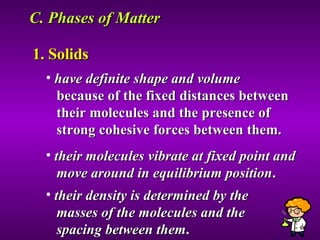
C. Phases of Matter  1. Solids have definite shape and volume because of the fixed distances between  their molecules and the presence of  strong cohesive forces between them. their molecules vibrate at fixed point and  move around in equilibrium position . their density is determined by the  masses of the molecules and the  spacing between them .
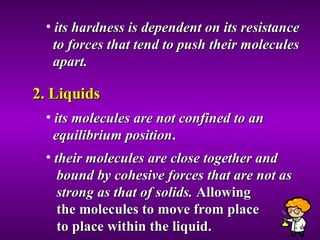
its hardness is dependent on its resistance  to forces that tend to push their molecules  apart.  2. Liquids its molecules are not confined to an  equilibrium position . their molecules are close together and  bound by cohesive forces that are not as  strong as that of solids.  Allowing  the molecules to move from place  to place within the liquid.
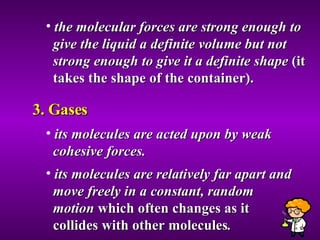
the molecular forces are strong enough to  give the liquid a definite volume but not  strong enough to give it a definite shape  (it  takes the shape of the container). 3. Gases its molecules are acted upon by weak  cohesive forces. its molecules are relatively far apart and  move freely in a constant, random  motion  which often changes as it  collides with other molecules .
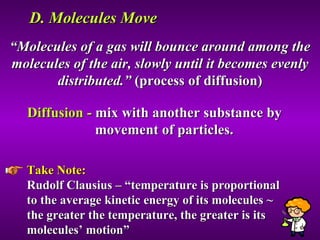
D. Molecules Move “ Molecules of a gas will bounce around among the molecules of the air, slowly until it becomes evenly distributed.”  (process of diffusion) Diffusion -  mix with another substance by  movement of particles. Take Note:   Rudolf Clausius – “temperature is proportional to the average kinetic energy of its molecules ~ the greater the temperature, the greater is its molecules’ motion”
TEMPERATURE The degree or intensity of heat present in a substance or object ~ how hot or how cold is something. A. Thermometers An instrument for measuring the hotness or coldness of an object. 1. Dial thermometer – bimetallic strips 2. Glass thermometer – Mercury or  Colored alcohol
B. Thermometer Scales Fahrenheit Scale  – (named after Ger. physicist  Gabriel Daniel Fahrenheit ) based on the freezing and boiling point of water at normal atmospheric pressure ~ 32 ºF - freezing pt. and 212ºF – boiling pt.
2. Celsius Scale  – (named after Swed. astronomer  Anders C. Celsius ) based on the freezing and boiling point of water at normal atmospheric pressure ~  0 ºC - freezing pt. and 100ºC – boiling pt.
3. Kelvin Scale  – (named after Brit. physicist  William T. Kelvin ) erased the arbitrary assigned reference points, thus called not a  relative scale  but an  Absolute temperature scale . 0  = nothing –  Absolute Zero  ~ lowest temperature possible, occurring when all random motion of molecules has ceased. In this scale: 273K – freezing pt. of water; 373K – boiling pt.
HEAT Used to describe the movement of energy between objects of different temperature are brought together;  is the measure of the internal energy that has been absorbed or transferred from one body to another.
A. Measures of Heat Calorie  – the amount of energy required to increase the temperature of 1 g of water by 1 °C. Kilocalorie  – the amount of energy required to increase the temperature of 1 kg of water by 1 °C.
British Thermal Unit (BTU)  – the amount of energy required to increase the temperature of 1 lb of water by 1 °F.
SPECIFIC HEAT Variables that Influence the amount  of Heat 1. Initial temperature of the liquid 2. Amount of liquid in a container 3. Nature of the liquid
B. Significance of the variables 1. The amount of heat required is proportional to the change in temperature. 2. The amount of heat required is proportional to the amount of liquid. 3. Different materials require different amounts of heat .
HEAT FLOW A. Conduction - the transfer of energy from a region of  high temperature to a region of low  temperature ~ energy is transferred from  one molecule to another . B. Convection -  transference of mass or heat within a fluid caused by the tendency of warmer and less dense material to rise.
C. Radiation -  energy emitted as electromagnetic waves or subatomic particles ;  (radiant energy ~ energy that can move through space).
HEAT, ENERGY, AND MOLECULAR THEORY Phase Change A type of change that takes place when solid/liquid/gas change interchangeably i.e. solid to liquid, liquid to gas, gas to liquid etc.  A phase change always absorbs or release the energy ~ a type of heat not associated with a temperature change.
1. Evaporation  – liquid to gas 2. Condensation  – gas to liquid 3. Freezing  – Liquid to solid 4. Melting  – solid to liquid 5. Sublimation  – solid to gas 6. Deposition  – gas to solid B. Latent Heat of Fusion The heat involved in a solid-liquid phase change in melting or freezing.
B. Latent Heat of Vaporazation The heat involved in a liquid-gas phase change where there is evaporation or condensation.  EVAPORATION AND CONDENSATION A. Increasing the rate of evaporation  1. Increasing the temperature
2. Increasing the surface area 3. Removal of water vapor from the surface of the liquid 4. Increasing pressure
 

Kinetic Molecular Theory

  • 1.
  • 2.
    BASIC ASSUMPTIONS 1.Matter is made up of tiny, basic units of structure called “atoms” 2. Atoms are neither divided, created, nor destroyed during a physical or chemical change. 3. An element is made up of its own kind of atom, which is different from the atoms of other elements. A. Molecules
  • 3.
    4. Compounds arecomposed of atoms of two or more elements that join together in definite proportions. Molecule – a tightly bound group of atoms in which the atoms maintain their identity; smallest ultimate particle of matter than can exist; smallest particle of a compound, or a gaseous element that can exist and still retain the characteristic properties of a substance.
  • 4.
    Take Note: Some atoms of gases exist in nature as diatomic molecules – 2 atoms of the same element paired together. B. Molecules Interact 1. Cohesion forces – (n. cohesion) attractive force between molecules of the same kind. 2. Adhesive force – (n. adhesion) attractive force between molecules of the same kind.
  • 5.
    C. Phases ofMatter 1. Solids have definite shape and volume because of the fixed distances between their molecules and the presence of strong cohesive forces between them. their molecules vibrate at fixed point and move around in equilibrium position . their density is determined by the masses of the molecules and the spacing between them .
  • 6.
    its hardness isdependent on its resistance to forces that tend to push their molecules apart. 2. Liquids its molecules are not confined to an equilibrium position . their molecules are close together and bound by cohesive forces that are not as strong as that of solids. Allowing the molecules to move from place to place within the liquid.
  • 7.
    the molecular forcesare strong enough to give the liquid a definite volume but not strong enough to give it a definite shape (it takes the shape of the container). 3. Gases its molecules are acted upon by weak cohesive forces. its molecules are relatively far apart and move freely in a constant, random motion which often changes as it collides with other molecules .
  • 8.
    D. Molecules Move“ Molecules of a gas will bounce around among the molecules of the air, slowly until it becomes evenly distributed.” (process of diffusion) Diffusion - mix with another substance by movement of particles. Take Note: Rudolf Clausius – “temperature is proportional to the average kinetic energy of its molecules ~ the greater the temperature, the greater is its molecules’ motion”
  • 9.
    TEMPERATURE The degreeor intensity of heat present in a substance or object ~ how hot or how cold is something. A. Thermometers An instrument for measuring the hotness or coldness of an object. 1. Dial thermometer – bimetallic strips 2. Glass thermometer – Mercury or Colored alcohol
  • 10.
    B. Thermometer ScalesFahrenheit Scale – (named after Ger. physicist Gabriel Daniel Fahrenheit ) based on the freezing and boiling point of water at normal atmospheric pressure ~ 32 ºF - freezing pt. and 212ºF – boiling pt.
  • 11.
    2. Celsius Scale – (named after Swed. astronomer Anders C. Celsius ) based on the freezing and boiling point of water at normal atmospheric pressure ~ 0 ºC - freezing pt. and 100ºC – boiling pt.
  • 12.
    3. Kelvin Scale – (named after Brit. physicist William T. Kelvin ) erased the arbitrary assigned reference points, thus called not a relative scale but an Absolute temperature scale . 0 = nothing – Absolute Zero ~ lowest temperature possible, occurring when all random motion of molecules has ceased. In this scale: 273K – freezing pt. of water; 373K – boiling pt.
  • 13.
    HEAT Used todescribe the movement of energy between objects of different temperature are brought together; is the measure of the internal energy that has been absorbed or transferred from one body to another.
  • 14.
    A. Measures ofHeat Calorie – the amount of energy required to increase the temperature of 1 g of water by 1 °C. Kilocalorie – the amount of energy required to increase the temperature of 1 kg of water by 1 °C.
  • 15.
    British Thermal Unit(BTU) – the amount of energy required to increase the temperature of 1 lb of water by 1 °F.
  • 16.
    SPECIFIC HEAT Variablesthat Influence the amount of Heat 1. Initial temperature of the liquid 2. Amount of liquid in a container 3. Nature of the liquid
  • 17.
    B. Significance ofthe variables 1. The amount of heat required is proportional to the change in temperature. 2. The amount of heat required is proportional to the amount of liquid. 3. Different materials require different amounts of heat .
  • 18.
    HEAT FLOW A.Conduction - the transfer of energy from a region of high temperature to a region of low temperature ~ energy is transferred from one molecule to another . B. Convection - transference of mass or heat within a fluid caused by the tendency of warmer and less dense material to rise.
  • 19.
    C. Radiation - energy emitted as electromagnetic waves or subatomic particles ; (radiant energy ~ energy that can move through space).
  • 20.
    HEAT, ENERGY, ANDMOLECULAR THEORY Phase Change A type of change that takes place when solid/liquid/gas change interchangeably i.e. solid to liquid, liquid to gas, gas to liquid etc. A phase change always absorbs or release the energy ~ a type of heat not associated with a temperature change.
  • 21.
    1. Evaporation – liquid to gas 2. Condensation – gas to liquid 3. Freezing – Liquid to solid 4. Melting – solid to liquid 5. Sublimation – solid to gas 6. Deposition – gas to solid B. Latent Heat of Fusion The heat involved in a solid-liquid phase change in melting or freezing.
  • 22.
    B. Latent Heatof Vaporazation The heat involved in a liquid-gas phase change where there is evaporation or condensation. EVAPORATION AND CONDENSATION A. Increasing the rate of evaporation 1. Increasing the temperature
  • 23.
    2. Increasing thesurface area 3. Removal of water vapor from the surface of the liquid 4. Increasing pressure
  • 24.