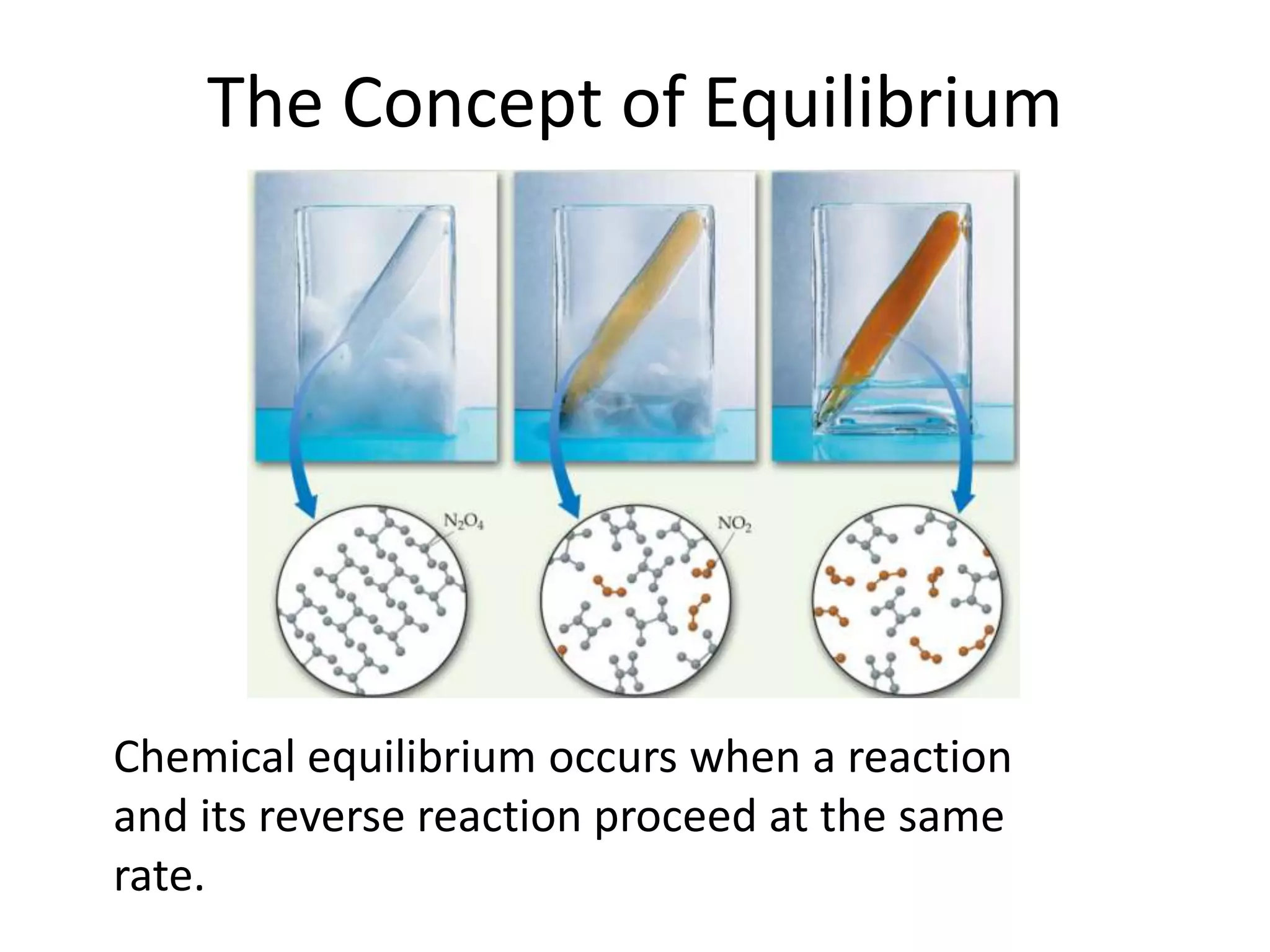
The Concept of Equilibrium	Chemical equilibrium occurs when a reaction and its reverse reaction proceed at the same rate.
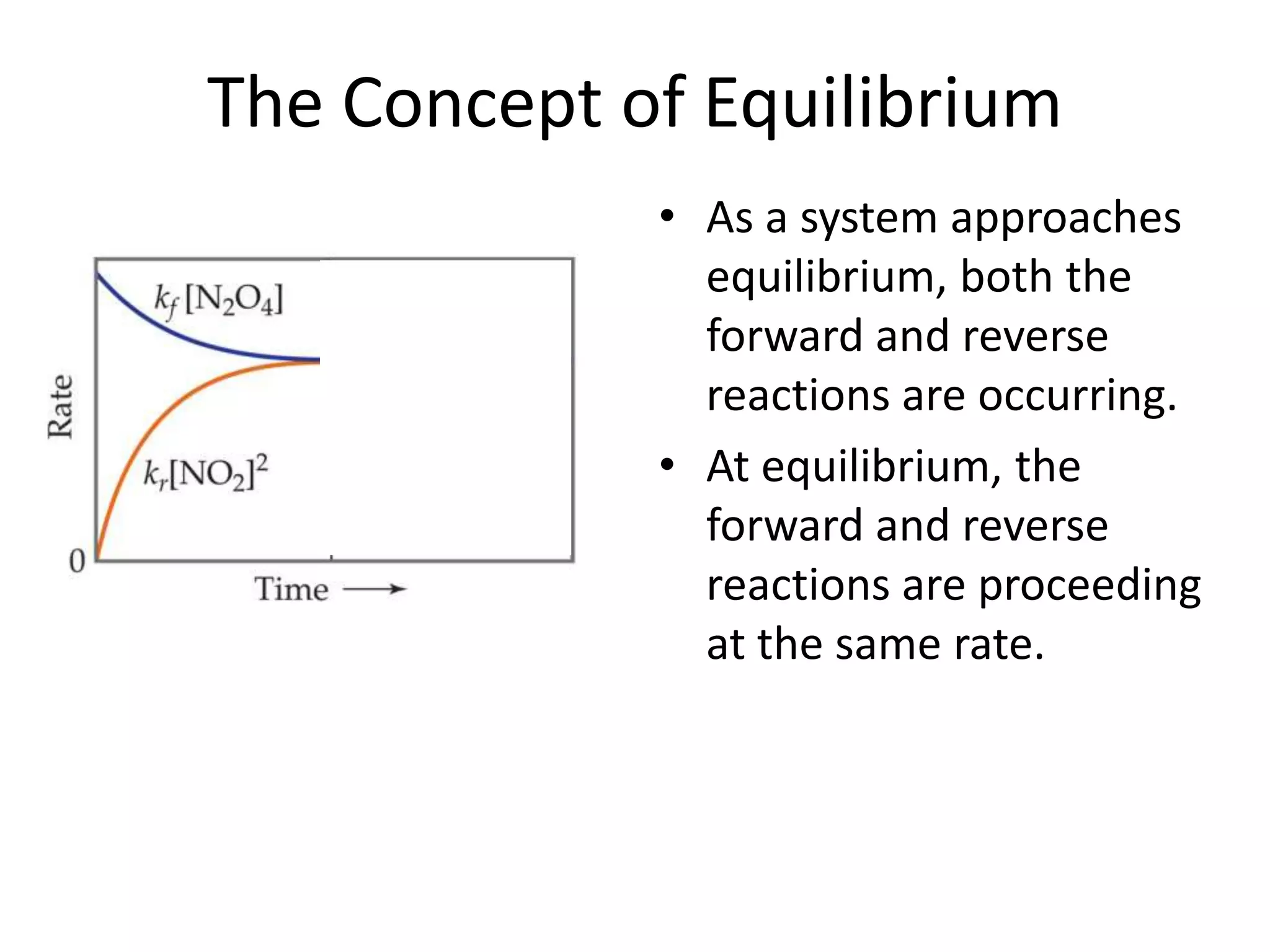
The Concept of EquilibriumAs a system approaches equilibrium, both the forward and reverse reactions are occurring.At equilibrium, the forward and reverse reactions are proceeding at the same rate.
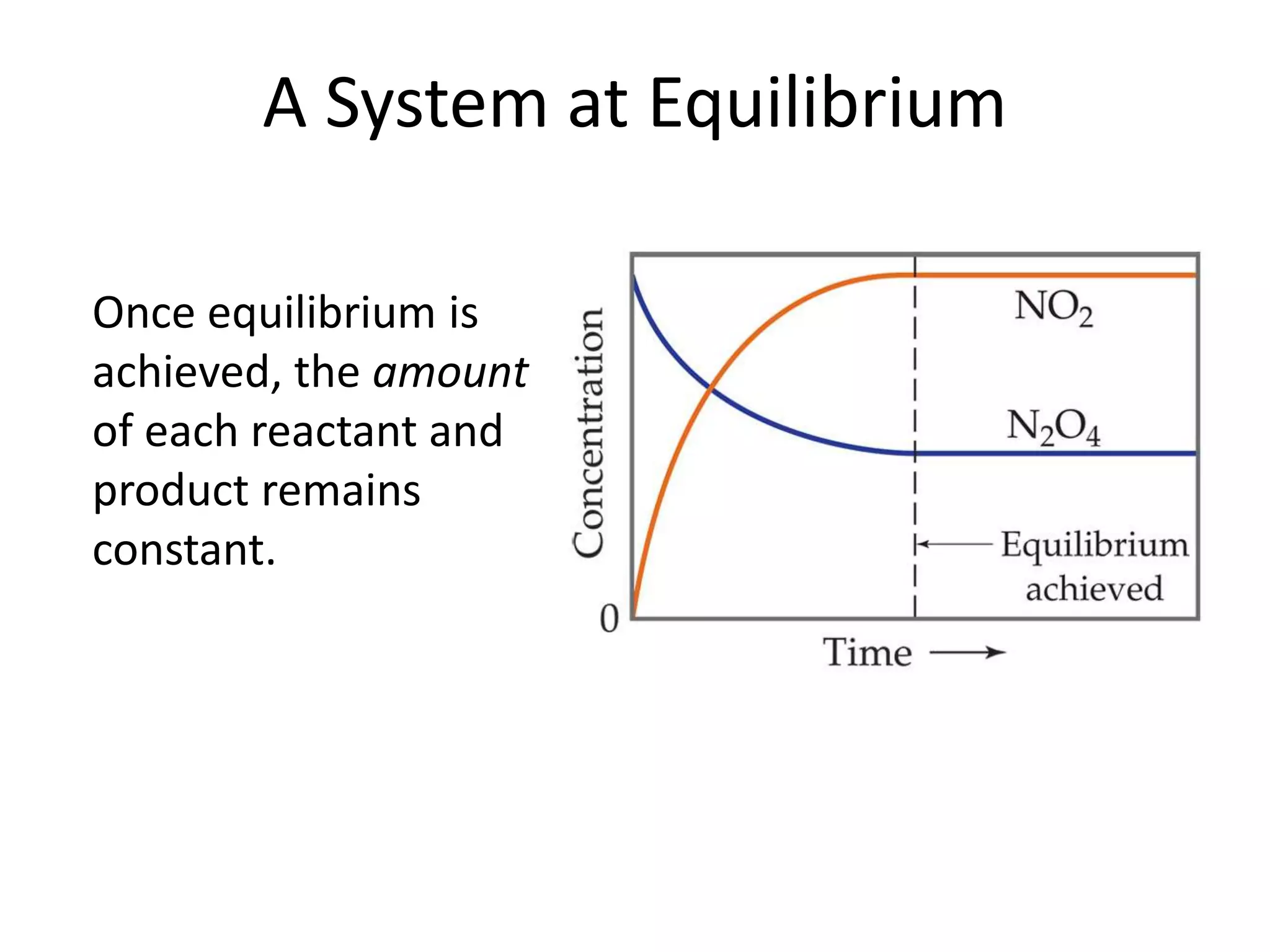
A System at Equilibrium	Once equilibrium is achieved, the amount of each reactant and product remains constant.
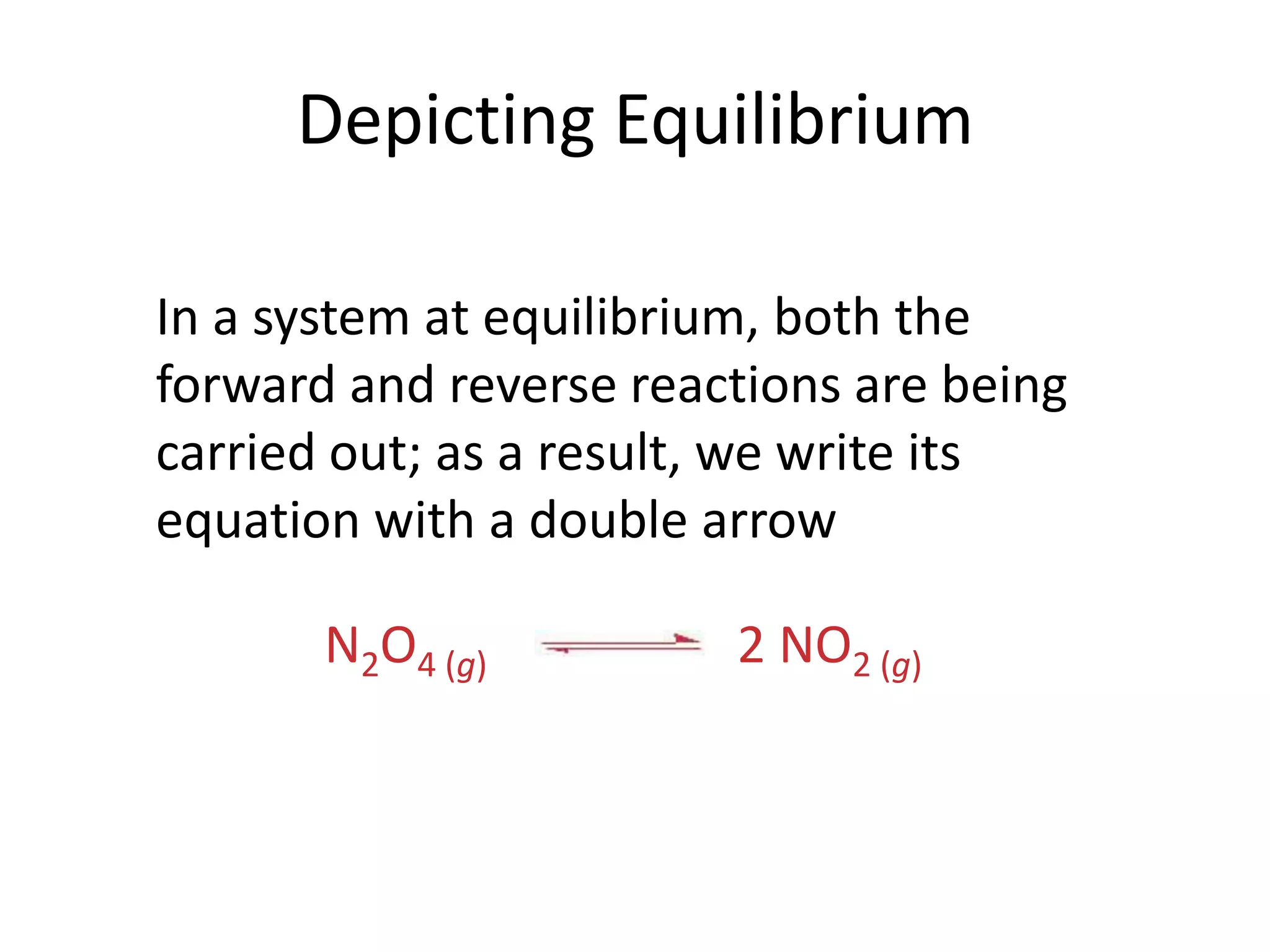
Depicting EquilibriumN2O4 (g)2 NO2 (g)	In a system at equilibrium, both the forward and reverse reactions are being carried out; as a result, we write its equation with a double arrow
The Equilibrium ConstantForward reaction:N2O4 (g) 2 NO2 (g)Rate law:Rate = kf [N2O4]Reverse reaction:2 NO2 (g) N2O4 (g)Rate law:Rate = kr [NO2]2
The Equilibrium Constant[NO2]2[N2O4]kfkr=Therefore, at equilibriumRatef = Raterkf [N2O4] = kr [NO2]2Rewriting this, it becomes
The Equilibrium Constant[NO2]2[N2O4]Keq =kfkr=	The ratio of the rate constants is a constant at that temperature, and the expression becomes
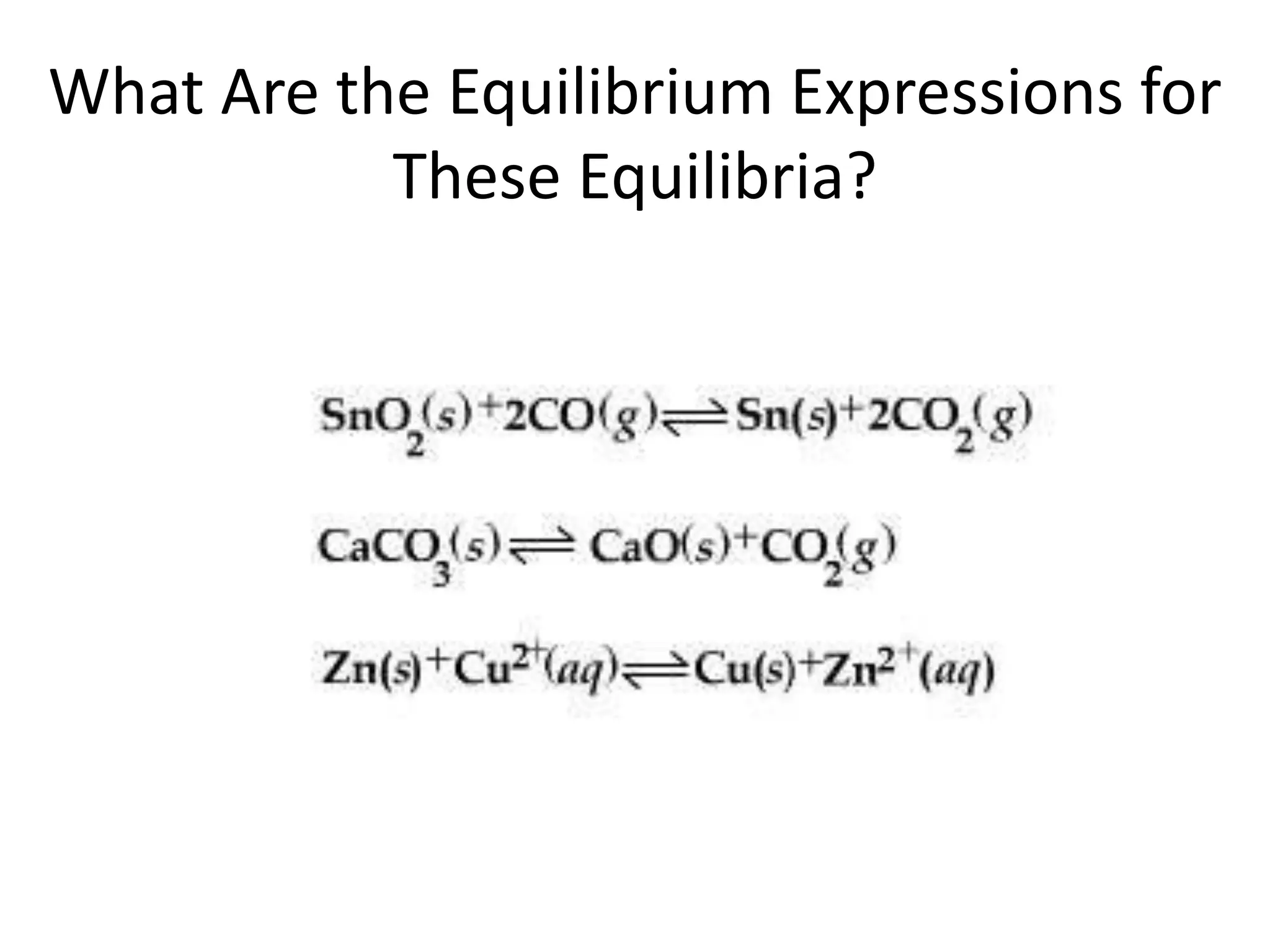
The Equilibrium ConstantaA + bBcC + dD[C]c[D]d[A]a[B]bKc = To generalize this expression, consider the reactionThe equilibrium expression for this reaction would beWhat Are the Equilibrium Expressions for These Equilibria?
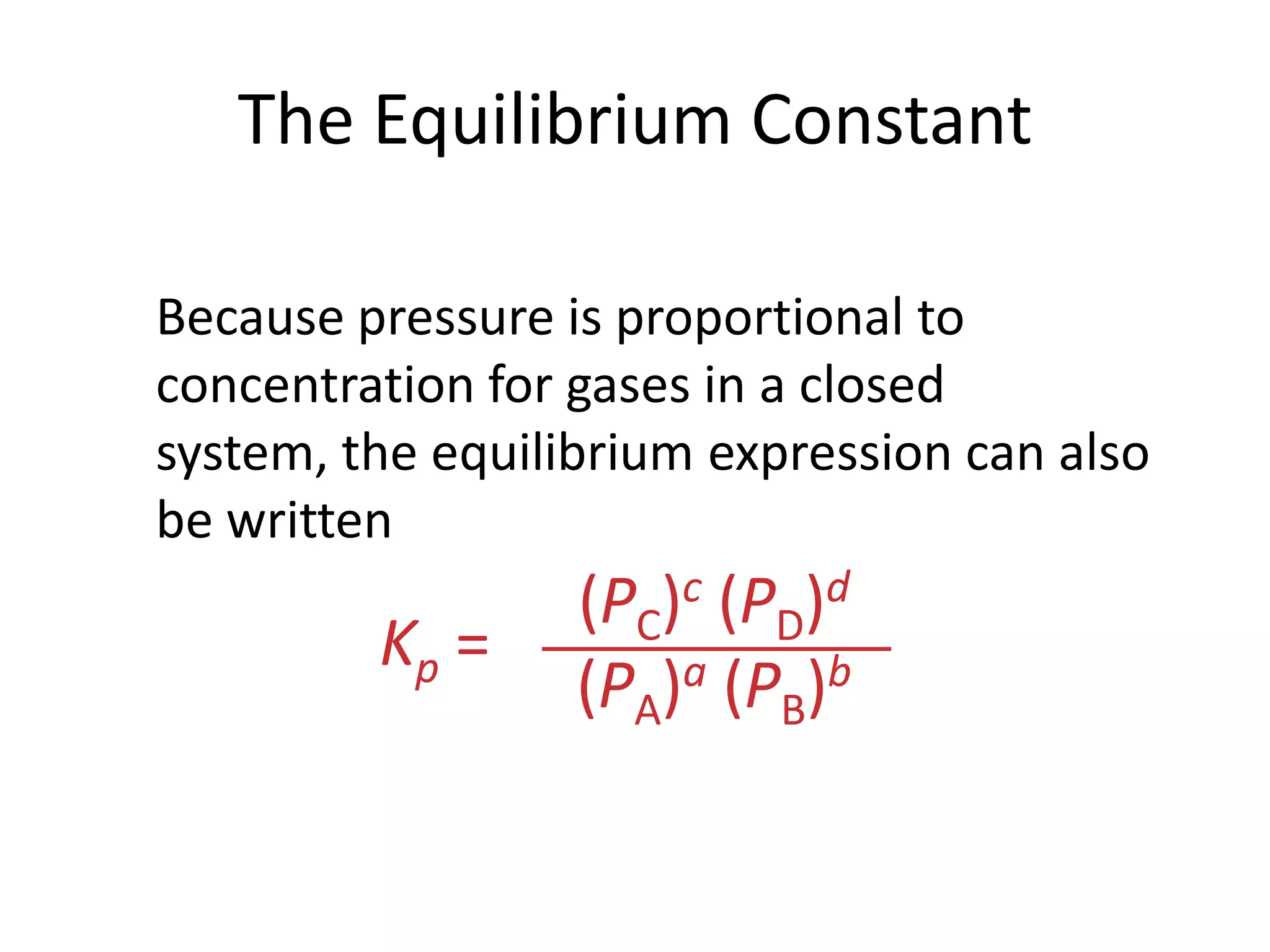
The Equilibrium Constant(PC)c (PD)d(PA)a (PB)bKp =	Because pressure is proportional to concentration for gases in a closed system, the equilibrium expression can also be written
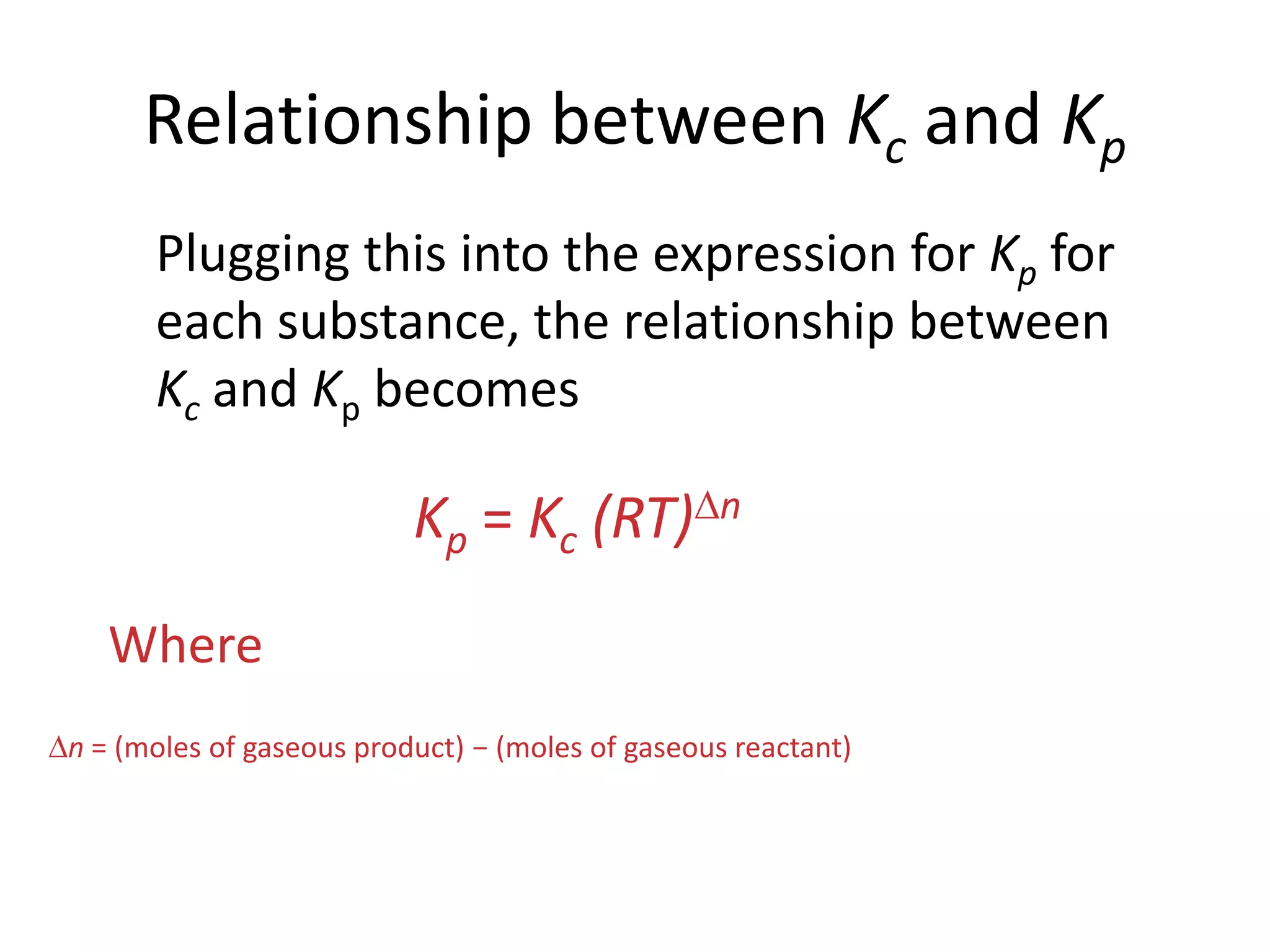
Relationship between Kc and Kp	Plugging this into the expression for Kp for each substance, the relationship between Kc and Kp becomesKp= Kc(RT)nWheren = (moles of gaseous product) − (moles of gaseous reactant)
What Does the Value of K Mean?If K >> 1, the reaction is product-favored; product predominates at equilibrium.
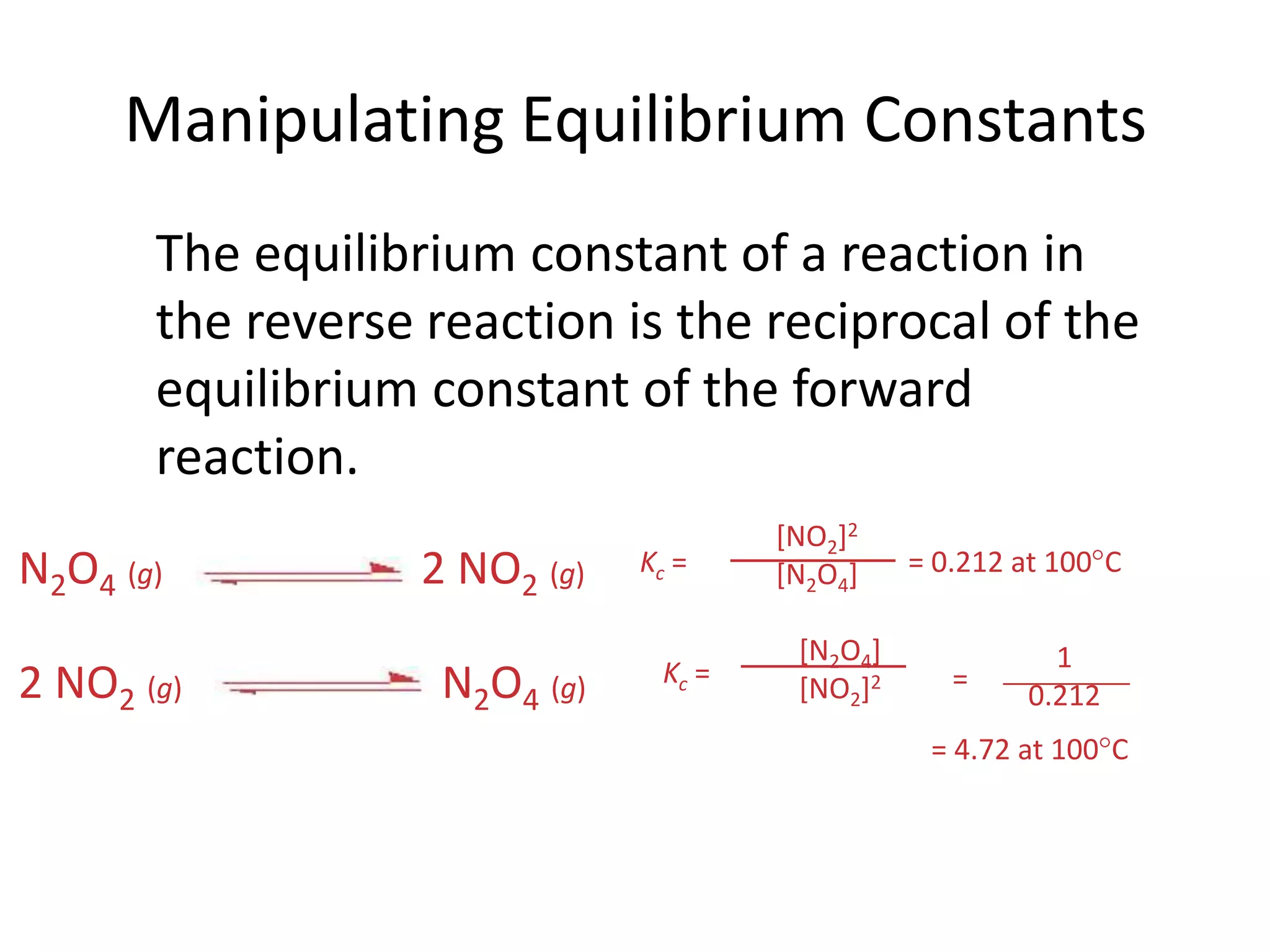
What Does the Value of K Mean?If K >> 1, the reaction is product-favored; product predominates at equilibrium.If K << 1, the reaction is reactant-favored; reactant predominates at equilibrium.Manipulating Equilibrium ConstantsKc = 		  		  = 4.72 at 100CKc = 		  = 0.212 at 100CN2O4(g)2 NO2(g)N2O4(g)2 NO2(g)[NO2]2[N2O4][N2O4][NO2]210.212=	The equilibrium constant of a reaction in the reverse reaction is the reciprocal of the equilibrium constant of the forward reaction.
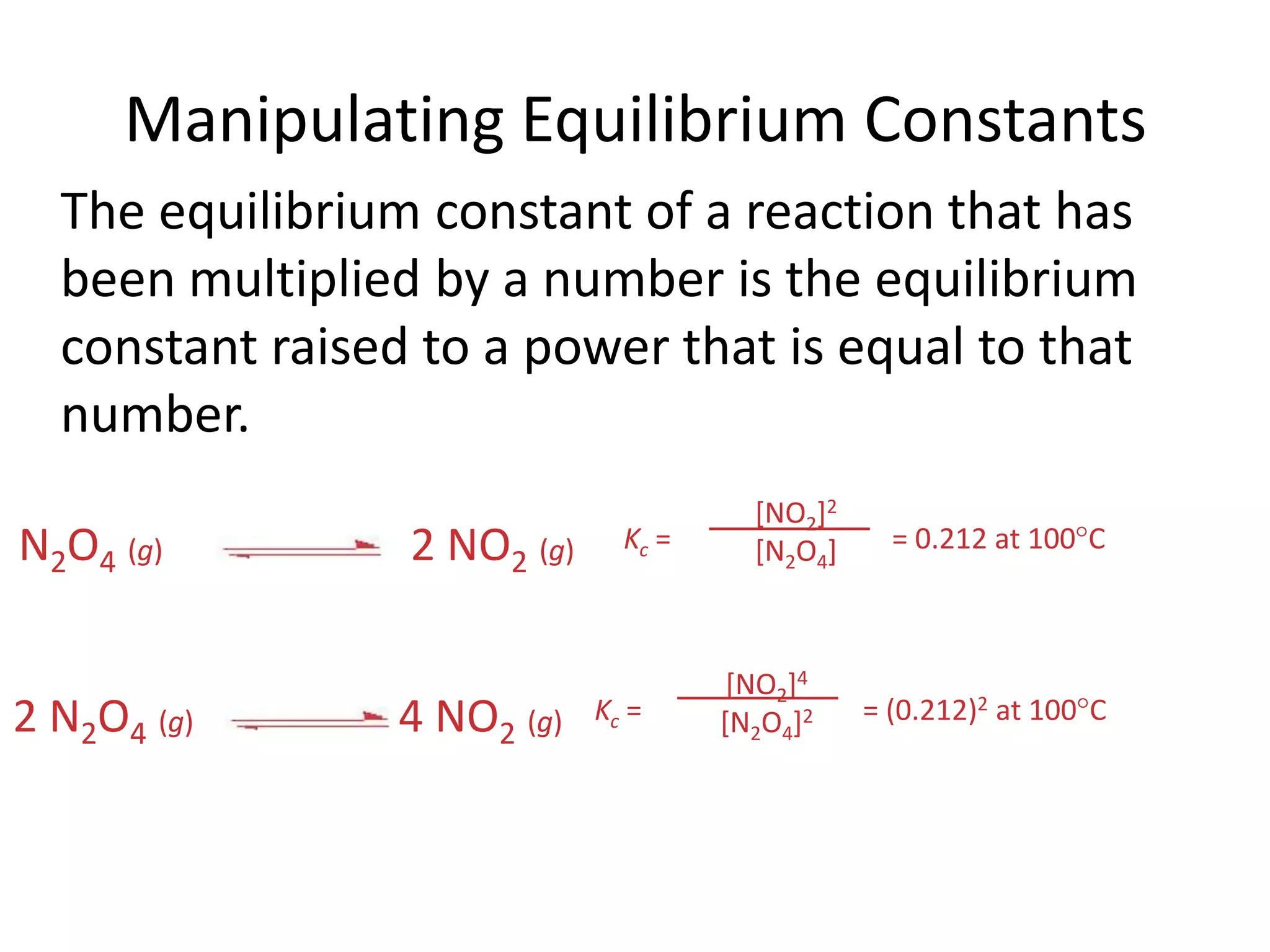
Manipulating Equilibrium ConstantsKc = 		  = 0.212 at 100CKc = 		  = (0.212)2 at 100CN2O4(g)2 NO2(g)2 N2O4(g)4 NO2(g)[NO2]2[N2O4][NO2]4[N2O4]2	The equilibrium constant of a reaction that has been multiplied by a number is the equilibrium constant raised to a power that is equal to that number.
Manipulating Equilibrium Constants	The equilibrium constant for a net reaction made up of two or more steps is the product of the equilibrium constants for the individual steps.
The Concentrations of Solids and Liquids Are Essentially Constant	Both can be obtained by dividing the density of the substance by its molar mass—and both of these are constants at constant temperature.
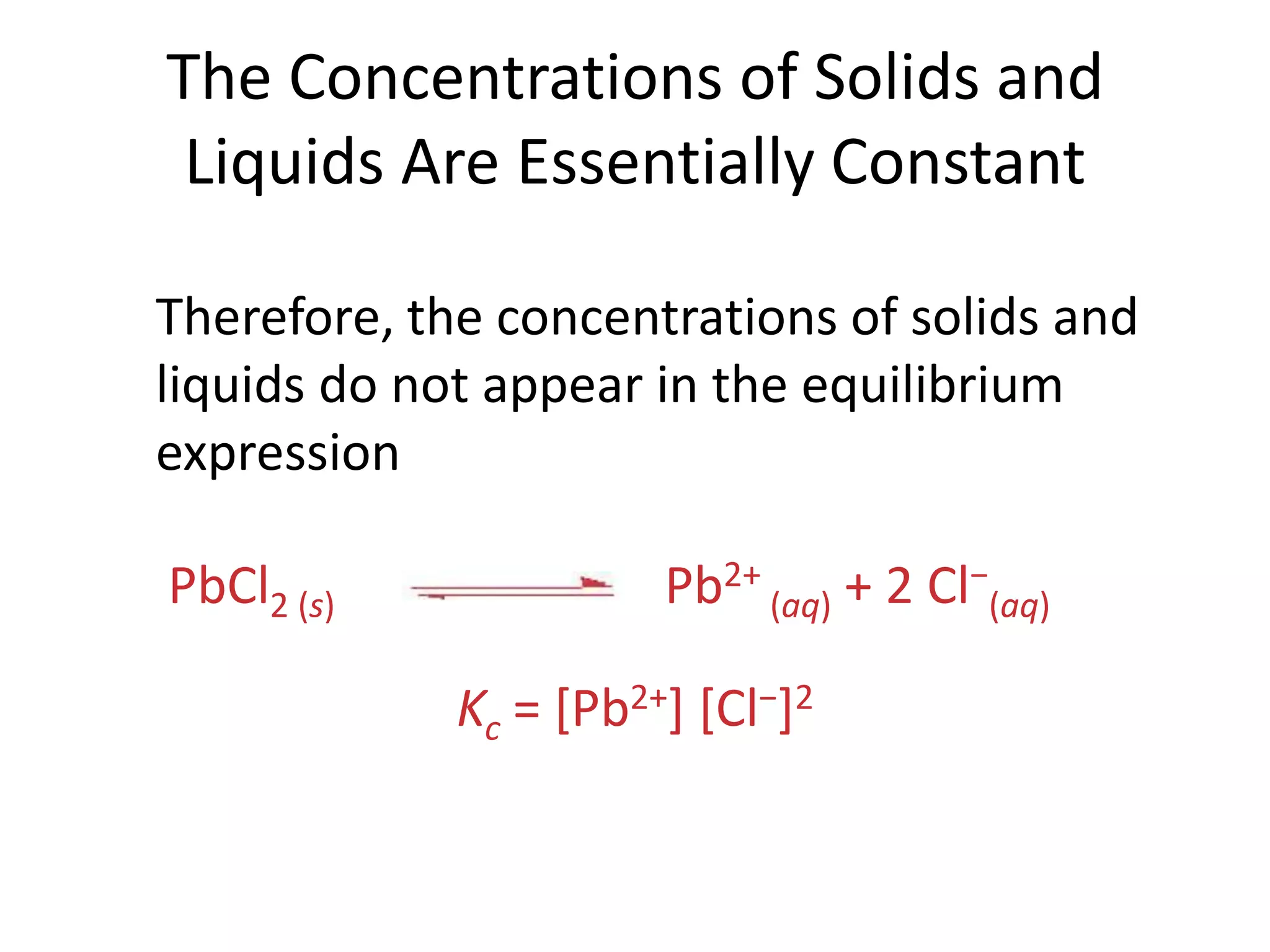
The Concentrations of Solids and Liquids Are Essentially ConstantPbCl2 (s)Pb2+ (aq) + 2 Cl−(aq)	Therefore, the concentrations of solids and liquids do not appear in the equilibrium expressionKc = [Pb2+] [Cl−]2
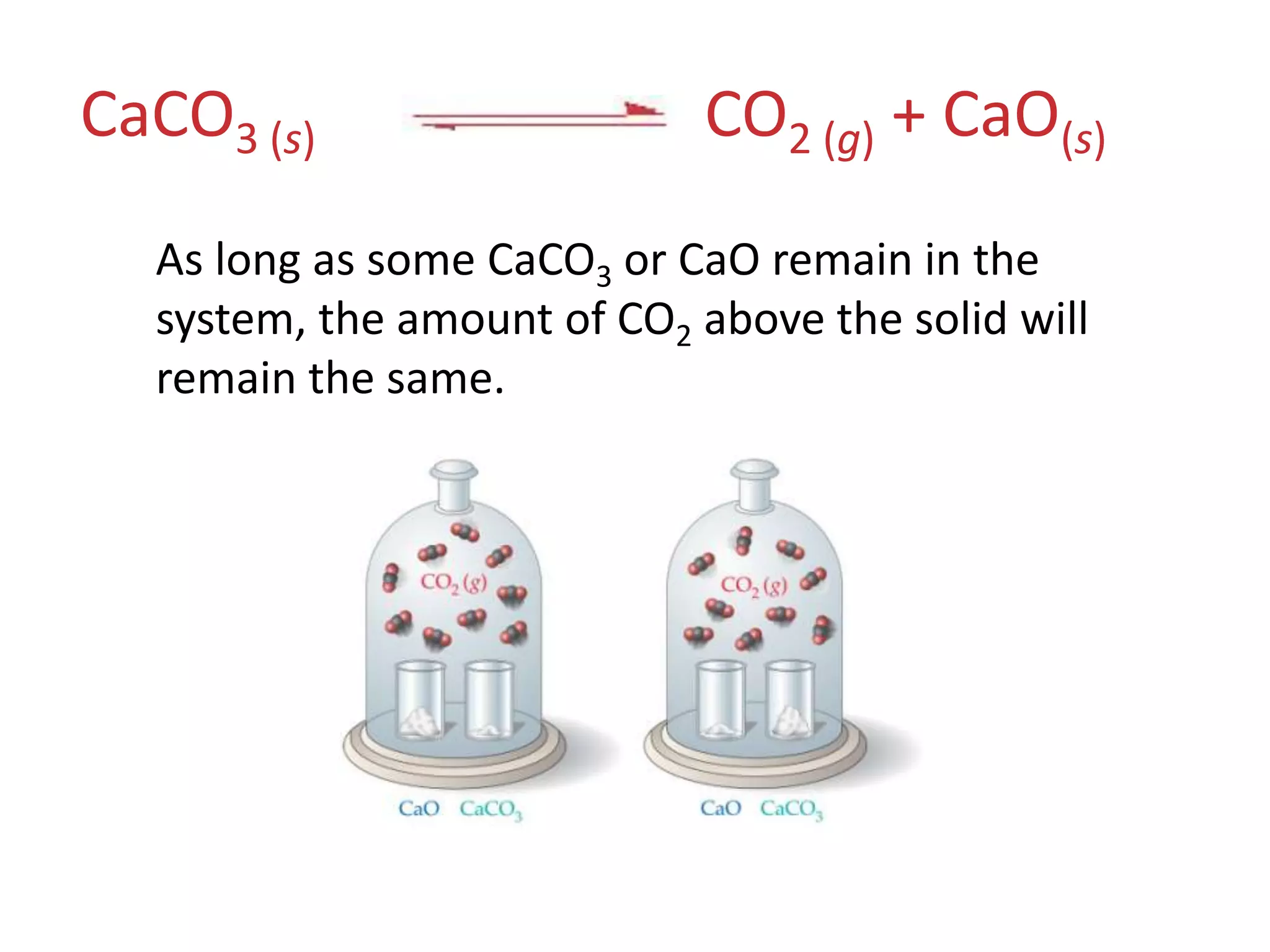
CaCO3 (s)CO2 (g) + CaO(s)	As long as some CaCO3 or CaO remain in the system, the amount of CO2 above the solid will remain the same.
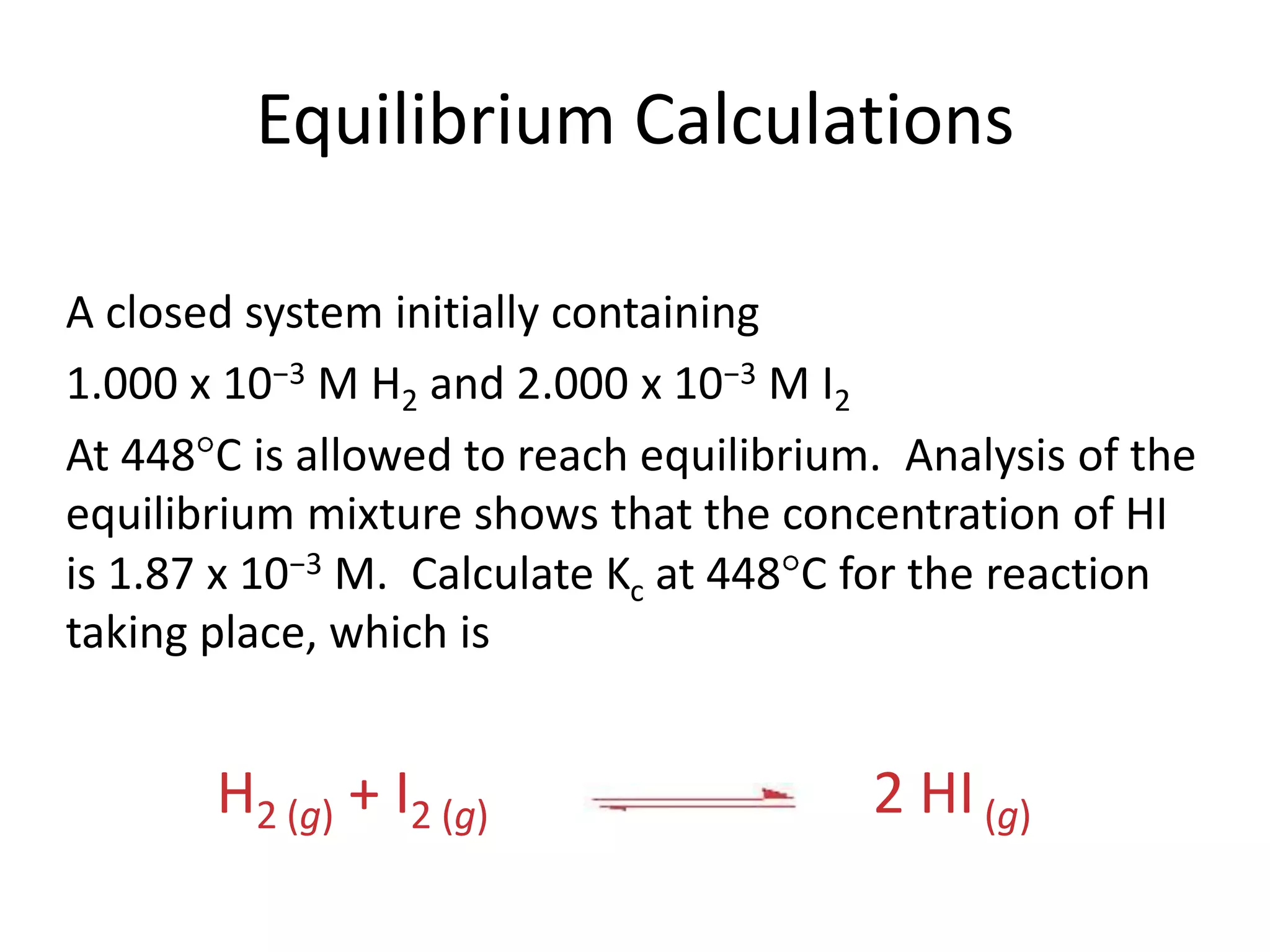
Equilibrium CalculationsH2 (g) + I2 (g)2 HI (g)A closed system initially containing1.000 x 10−3 M H2 and 2.000 x 10⁻³ M I2At 448C is allowed to reach equilibrium.  Analysis of the equilibrium mixture shows that the concentration of HI is 1.87 x 10⁻³ M.  Calculate Kc at 448C for the reaction taking place, which is
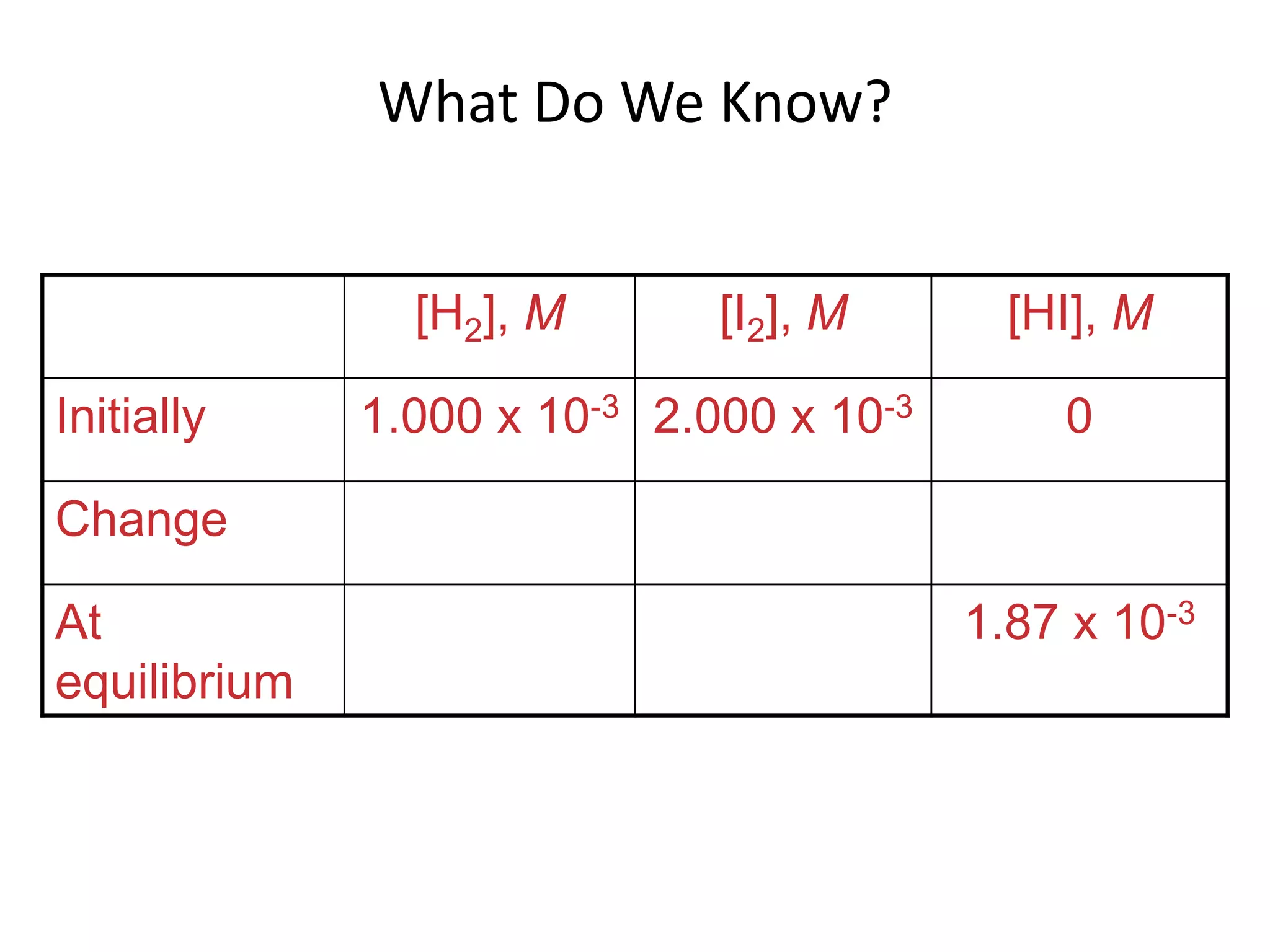
What Do We Know?
The Reaction Quotient (Q)To calculate Q, one substitutes the initial concentrations on reactants and products into the equilibrium expression.Q gives the same ratio the equilibrium expression gives, but for a system that is not at equilibrium.
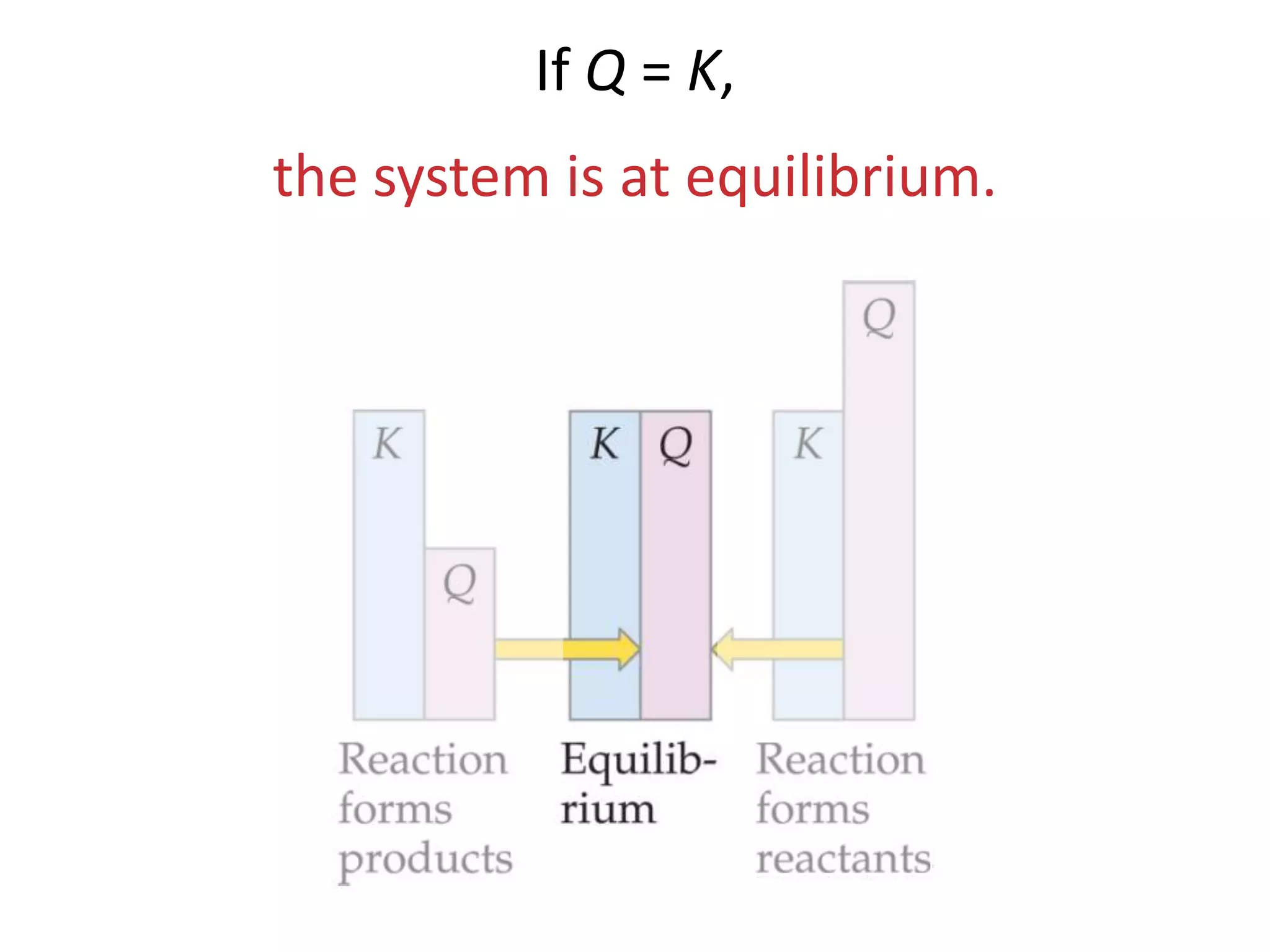
If Q = K,the system is at equilibrium.
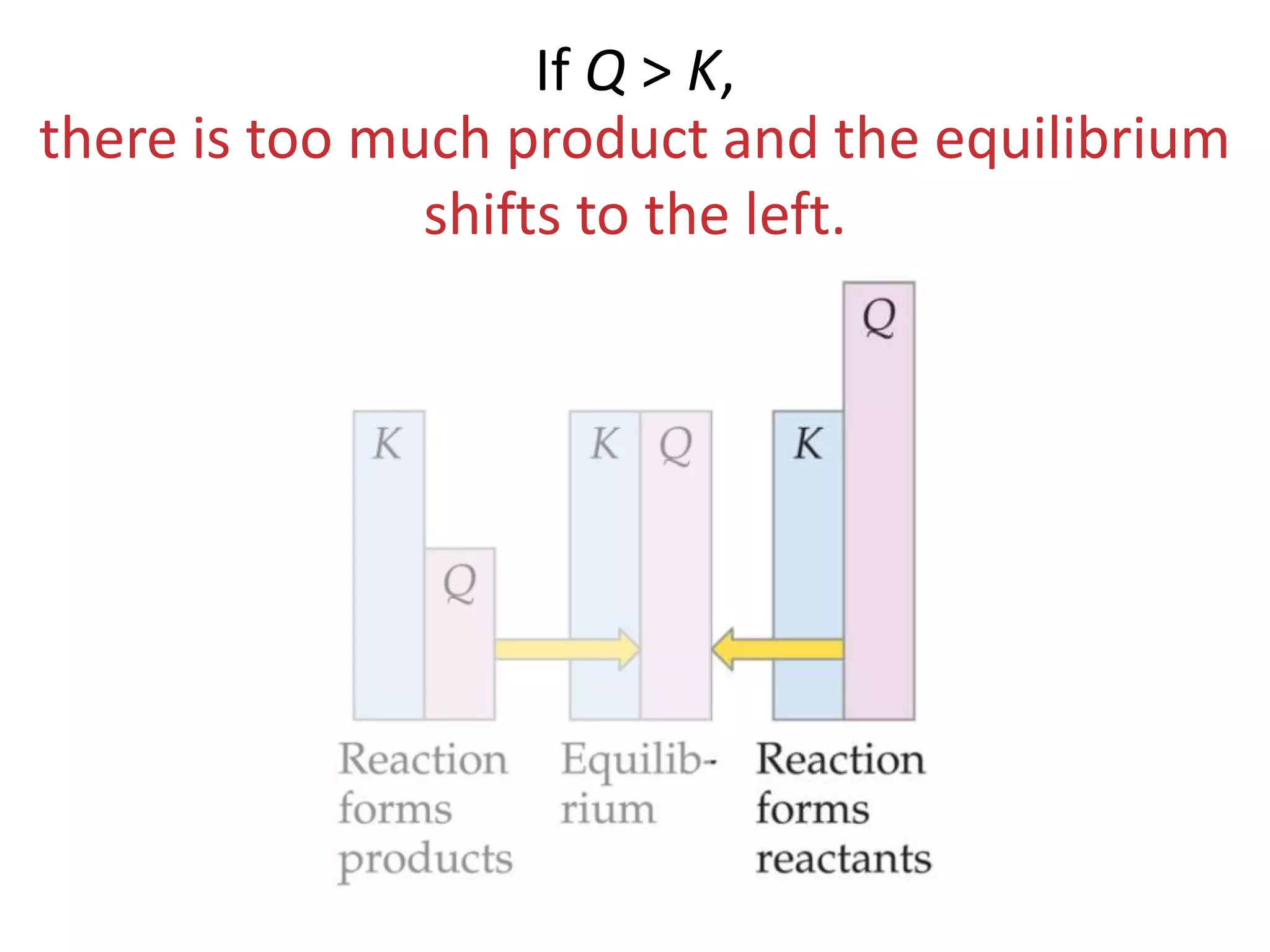
If Q > K,there is too much product and the equilibrium shifts to the left.
If Q < K,there is too much reactant, and the equilibrium shifts to the right.
The concept of equilibrium

The concept of equilibrium

  • 1.
    The Concept ofEquilibrium Chemical equilibrium occurs when a reaction and its reverse reaction proceed at the same rate.
  • 2.
    The Concept ofEquilibriumAs a system approaches equilibrium, both the forward and reverse reactions are occurring.At equilibrium, the forward and reverse reactions are proceeding at the same rate.
  • 3.
    A System atEquilibrium Once equilibrium is achieved, the amount of each reactant and product remains constant.
  • 4.
    Depicting EquilibriumN2O4 (g)2NO2 (g) In a system at equilibrium, both the forward and reverse reactions are being carried out; as a result, we write its equation with a double arrow
  • 5.
    The Equilibrium ConstantForwardreaction:N2O4 (g) 2 NO2 (g)Rate law:Rate = kf [N2O4]Reverse reaction:2 NO2 (g) N2O4 (g)Rate law:Rate = kr [NO2]2
  • 6.
    The Equilibrium Constant[NO2]2[N2O4]kfkr=Therefore,at equilibriumRatef = Raterkf [N2O4] = kr [NO2]2Rewriting this, it becomes
  • 7.
    The Equilibrium Constant[NO2]2[N2O4]Keq=kfkr= The ratio of the rate constants is a constant at that temperature, and the expression becomes
  • 8.
    The Equilibrium ConstantaA+ bBcC + dD[C]c[D]d[A]a[B]bKc = To generalize this expression, consider the reactionThe equilibrium expression for this reaction would beWhat Are the Equilibrium Expressions for These Equilibria?
  • 9.
    The Equilibrium Constant(PC)c(PD)d(PA)a (PB)bKp = Because pressure is proportional to concentration for gases in a closed system, the equilibrium expression can also be written
  • 10.
    Relationship between Kcand Kp Plugging this into the expression for Kp for each substance, the relationship between Kc and Kp becomesKp= Kc(RT)nWheren = (moles of gaseous product) − (moles of gaseous reactant)
  • 11.
    What Does theValue of K Mean?If K >> 1, the reaction is product-favored; product predominates at equilibrium.
  • 12.
    What Does theValue of K Mean?If K >> 1, the reaction is product-favored; product predominates at equilibrium.If K << 1, the reaction is reactant-favored; reactant predominates at equilibrium.Manipulating Equilibrium ConstantsKc = = 4.72 at 100CKc = = 0.212 at 100CN2O4(g)2 NO2(g)N2O4(g)2 NO2(g)[NO2]2[N2O4][N2O4][NO2]210.212= The equilibrium constant of a reaction in the reverse reaction is the reciprocal of the equilibrium constant of the forward reaction.
  • 13.
    Manipulating Equilibrium ConstantsKc= = 0.212 at 100CKc = = (0.212)2 at 100CN2O4(g)2 NO2(g)2 N2O4(g)4 NO2(g)[NO2]2[N2O4][NO2]4[N2O4]2 The equilibrium constant of a reaction that has been multiplied by a number is the equilibrium constant raised to a power that is equal to that number.
  • 14.
    Manipulating Equilibrium Constants Theequilibrium constant for a net reaction made up of two or more steps is the product of the equilibrium constants for the individual steps.
  • 15.
    The Concentrations ofSolids and Liquids Are Essentially Constant Both can be obtained by dividing the density of the substance by its molar mass—and both of these are constants at constant temperature.
  • 16.
    The Concentrations ofSolids and Liquids Are Essentially ConstantPbCl2 (s)Pb2+ (aq) + 2 Cl−(aq) Therefore, the concentrations of solids and liquids do not appear in the equilibrium expressionKc = [Pb2+] [Cl−]2
  • 17.
    CaCO3 (s)CO2 (g)+ CaO(s) As long as some CaCO3 or CaO remain in the system, the amount of CO2 above the solid will remain the same.
  • 18.
    Equilibrium CalculationsH2 (g)+ I2 (g)2 HI (g)A closed system initially containing1.000 x 10−3 M H2 and 2.000 x 10⁻³ M I2At 448C is allowed to reach equilibrium. Analysis of the equilibrium mixture shows that the concentration of HI is 1.87 x 10⁻³ M. Calculate Kc at 448C for the reaction taking place, which is
  • 19.
  • 20.
    The Reaction Quotient(Q)To calculate Q, one substitutes the initial concentrations on reactants and products into the equilibrium expression.Q gives the same ratio the equilibrium expression gives, but for a system that is not at equilibrium.
  • 21.
    If Q =K,the system is at equilibrium.
  • 22.
    If Q >K,there is too much product and the equilibrium shifts to the left.
  • 23.
    If Q <K,there is too much reactant, and the equilibrium shifts to the right.