STEROIDS
&
ANABOLIC STEROIDS
By: Mrs. Kalaivani Sathish,
Asst Professor,
PIMS - Panipat
INTRODUCTION
• Corticosteroids are a class of steroid
hormones that are produced in the
adrenal cortex.
• Corticosteroids includes natural
glucocorticoids and mineralocorticoids,
and their synthetic analogues.
Functions of Steroids
• Stress response
• Immune response
• Regulation of inflammation
• Carbohydrate metabolism
• Protein catabolism
• Blood electrolyte level maintenance
• Control of behavior
Biosynthesis
• Synthesis of steroids are from adrenal cortical
cells from cholesterol.
• Adrenal cortex is divided into three zones
– Zona glomerulosa – mineralocorticoids such as
aldosterone, which regulates sodium and water are
produced.
– Zona fasiculata – glucocorticoids such as
hydrocortisone and corticosterone, which regulates
carbohydrate and protein metabolism and Na+ &
H20 balance are produced.
Biosynthesis (Cont..)
– Zona reticularis– involved in the biosynthesis of
androgens.
STEROIDS CLASSIFICATIONS
Mineralocorticoids (Cortisone, Fludrocortisone)
Glucocorticoids (Betamethasone,
Methylprednisolone)
Sex Steroids (Estrogen, Progestins)
MECHANISM OF
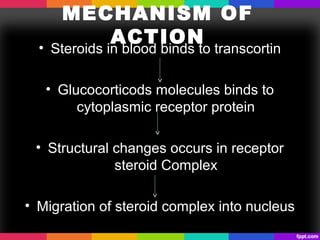
ACTION• Steroids in blood binds to transcortin
• Glucocorticods molecules binds to
cytoplasmic receptor protein
• Structural changes occurs in receptor
steroid Complex
• Migration of steroid complex into nucleus
MECHANISM OF ACTION
• Binding of glucocorticoid response
elements on the chromatin.
• Suppression of genes
• Genes inhibition contributes to their anti-
inflammatory & Immunosuppressive
action.
PHARMACOLOGIC ACTION
• Carbohydrate and Protein Metabolism
• Fat Metabolism – promotes lipolysis
• Calcium metabolism & water excretion
• Cardiovascular – permissive effects
• Skeletal muscles – weakness in case of hypo
and hypercorticism
• CNS – Precipitates seizure in epileptic patients.
• Stomach – increased secretion of gastric acid
and pepsin.
PHARMACOLOGIC ACTION
• Hemopoitic System - ↑se in number of
RBC’s & Platelets, but decrease in
lymphocytes, eosinophills and basophils.
• Inflammatory Response– reduction of
phagocytic activity.
• Immunologic and allergic response –
Suppresses all types of allergic phenomenon
and hypersensitization.
Pharmacokinetics
• Absorption – effective in oral route, acts rapidly
by IV / IM.
• Bioavailability – oral bioavailability of synthetic
corticosteroids are high.
• Plasma protein binding is 90 %.
• Metabolism by hepatic microsomal enzymes.
• Excretion – urine
• Distribution – widely distributed – 10L/Kg
• Plasma t ½ - 66 minutes.
Preparations & Doses
• Synthetic steroids have largely replaced the
natural compounds in therapeutic use
because they are potent, longer acting and
more selective for glucocorticoid /
mineralocorticoid actions.
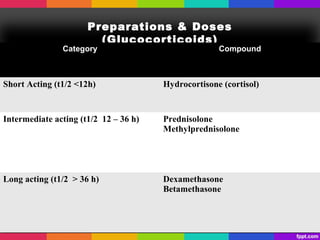
Preparations & Doses
(Glucocorticoids)
Category Compound
Short Acting (t1/2 <12h) Hydrocortisone (cortisol)
Intermediate acting (t1/2 12 – 36 h) Prednisolone
Methylprednisolone
Long acting (t1/2 > 36 h) Dexamethasone
Betamethasone
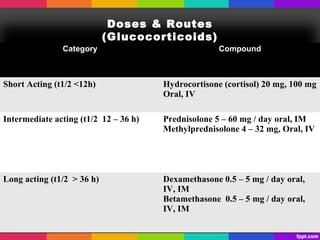
Doses & Routes
(Glucocorticoids)
Category Compound
Short Acting (t1/2 <12h) Hydrocortisone (cortisol) 20 mg, 100 mg
Oral, IV
Intermediate acting (t1/2 12 – 36 h) Prednisolone 5 – 60 mg / day oral, IM
Methylprednisolone 4 – 32 mg, Oral, IV
Long acting (t1/2 > 36 h) Dexamethasone 0.5 – 5 mg / day oral,
IV, IM
Betamethasone 0.5 – 5 mg / day oral,
IV, IM
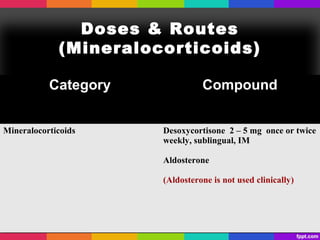
Doses & Routes
(Mineralocorticoids)
Category Compound
Mineralocorticoids Desoxycortisone 2 – 5 mg once or twice
weekly, sublingual, IM
Aldosterone
(Aldosterone is not used clinically)
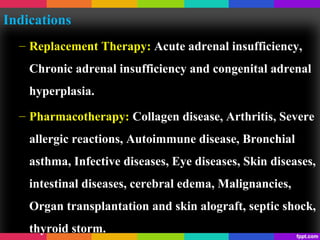
Indications
– Replacement Therapy: Acute adrenal insufficiency,
Chronic adrenal insufficiency and congenital adrenal
hyperplasia.
– Pharmacotherapy: Collagen disease, Arthritis, Severe
allergic reactions, Autoimmune disease, Bronchial
asthma, Infective diseases, Eye diseases, Skin diseases,
intestinal diseases, cerebral edema, Malignancies,
Organ transplantation and skin alograft, septic shock,
thyroid storm.
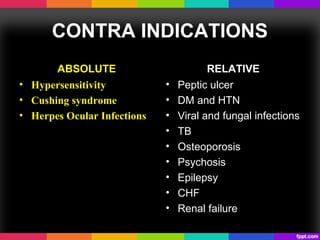
CONTRA INDICATIONS
ABSOLUTE
• Hypersensitivity
• Cushing syndrome
• Herpes Ocular Infections
RELATIVE
• Peptic ulcer
• DM and HTN
• Viral and fungal infections
• TB
• Osteoporosis
• Psychosis
• Epilepsy
• CHF
• Renal failure
ADVERSE EFFECTS
• Occurs usually with prolonged therapy
• Mineralocorticoids
• Na and water retention, edema,
hypokalemic alkalosis and HTN.
• Glucocorticoids
• Cushing habitus – Characterized by moon
like face, accumulation of fat in the truncal
region.
ADVERSE EFFECTS
• Glucocorticoids
• Hyperglycemia and Glycosuria
• Myopathy & Muscle
• Susceptibility to infections
• Peptic ulceration
• Osteoporosis
• Glaucoma
• Growth retardation in children
• Fetal abnormality (IUGR)
NURSES ROLE
• Check vital signs, lung sounds, BP and
weight.
• Conduct MSE, to assess for depression,
withdrawal, Insomnia and anorexia.
• Advise regular opthalmic examination
• Check stool for occult blood periodically.
• Administer suitable antibiotics as
prescribed.
•
ANABOLIC
STEROIDS
DEFINITION
• These are androgens with anabolic
properties and are rarely prescribed., but
are commonly abused by athletes in an
attempt to enhance performance.
• They are developed in replace of androgens.
MECHANISM OF
ACTION
• Testosterone is converted to active metabolite
dihydrotestosterone
• Increased synthesis of RNA & Cellular protein
• Stimulate growth of muscle, bone, skin and
hair and accelerate closure of epiphyses at ends
of long bones. (↑ed the RBC production)
• Indications
– Growth and development retardation.
– Ulcerative colitis
– Osteoporosis
– Aplastic anemia
– After trauma & surgery
– Prolonged immobilization
• Contra Indications
• Pregnancy, Lactation, CHF, Renal failure,
Liver failure and prostate enlargement.
• Adverse Effects
• Hepatotoxicity
• Hepatitis B & C
• Abusers of anabolic steroids use same needles so risk of
HIV / AIDS.
• Nurses Role
• Do not administer for more than 90 days.
• Assess the client for Liver function edema, weight gain
and skin changes
• Evaluate the client for signs of depression.
• Warm and shake vials before administer to prevent
crystals. Administer in deep into gluteal muscles
Steroids and anabolic steroids

Steroids and anabolic steroids

  • 1.
    STEROIDS & ANABOLIC STEROIDS By: Mrs.Kalaivani Sathish, Asst Professor, PIMS - Panipat
  • 2.
    INTRODUCTION • Corticosteroids area class of steroid hormones that are produced in the adrenal cortex. • Corticosteroids includes natural glucocorticoids and mineralocorticoids, and their synthetic analogues.
  • 3.
    Functions of Steroids •Stress response • Immune response • Regulation of inflammation • Carbohydrate metabolism • Protein catabolism • Blood electrolyte level maintenance • Control of behavior
  • 4.
    Biosynthesis • Synthesis ofsteroids are from adrenal cortical cells from cholesterol. • Adrenal cortex is divided into three zones – Zona glomerulosa – mineralocorticoids such as aldosterone, which regulates sodium and water are produced. – Zona fasiculata – glucocorticoids such as hydrocortisone and corticosterone, which regulates carbohydrate and protein metabolism and Na+ & H20 balance are produced.
  • 5.
    Biosynthesis (Cont..) – Zonareticularis– involved in the biosynthesis of androgens. STEROIDS CLASSIFICATIONS Mineralocorticoids (Cortisone, Fludrocortisone) Glucocorticoids (Betamethasone, Methylprednisolone) Sex Steroids (Estrogen, Progestins)
  • 6.
    MECHANISM OF ACTION• Steroidsin blood binds to transcortin • Glucocorticods molecules binds to cytoplasmic receptor protein • Structural changes occurs in receptor steroid Complex • Migration of steroid complex into nucleus
  • 7.
    MECHANISM OF ACTION •Binding of glucocorticoid response elements on the chromatin. • Suppression of genes • Genes inhibition contributes to their anti- inflammatory & Immunosuppressive action.
  • 8.
    PHARMACOLOGIC ACTION • Carbohydrateand Protein Metabolism • Fat Metabolism – promotes lipolysis • Calcium metabolism & water excretion • Cardiovascular – permissive effects • Skeletal muscles – weakness in case of hypo and hypercorticism • CNS – Precipitates seizure in epileptic patients. • Stomach – increased secretion of gastric acid and pepsin.
  • 9.
    PHARMACOLOGIC ACTION • HemopoiticSystem - ↑se in number of RBC’s & Platelets, but decrease in lymphocytes, eosinophills and basophils. • Inflammatory Response– reduction of phagocytic activity. • Immunologic and allergic response – Suppresses all types of allergic phenomenon and hypersensitization.
  • 10.
    Pharmacokinetics • Absorption –effective in oral route, acts rapidly by IV / IM. • Bioavailability – oral bioavailability of synthetic corticosteroids are high. • Plasma protein binding is 90 %. • Metabolism by hepatic microsomal enzymes. • Excretion – urine • Distribution – widely distributed – 10L/Kg • Plasma t ½ - 66 minutes.
  • 11.
    Preparations & Doses •Synthetic steroids have largely replaced the natural compounds in therapeutic use because they are potent, longer acting and more selective for glucocorticoid / mineralocorticoid actions.
  • 12.
    Preparations & Doses (Glucocorticoids) CategoryCompound Short Acting (t1/2 <12h) Hydrocortisone (cortisol) Intermediate acting (t1/2 12 – 36 h) Prednisolone Methylprednisolone Long acting (t1/2 > 36 h) Dexamethasone Betamethasone
  • 13.
    Doses & Routes (Glucocorticoids) CategoryCompound Short Acting (t1/2 <12h) Hydrocortisone (cortisol) 20 mg, 100 mg Oral, IV Intermediate acting (t1/2 12 – 36 h) Prednisolone 5 – 60 mg / day oral, IM Methylprednisolone 4 – 32 mg, Oral, IV Long acting (t1/2 > 36 h) Dexamethasone 0.5 – 5 mg / day oral, IV, IM Betamethasone 0.5 – 5 mg / day oral, IV, IM
  • 14.
    Doses & Routes (Mineralocorticoids) CategoryCompound Mineralocorticoids Desoxycortisone 2 – 5 mg once or twice weekly, sublingual, IM Aldosterone (Aldosterone is not used clinically)
  • 15.
    Indications – Replacement Therapy:Acute adrenal insufficiency, Chronic adrenal insufficiency and congenital adrenal hyperplasia. – Pharmacotherapy: Collagen disease, Arthritis, Severe allergic reactions, Autoimmune disease, Bronchial asthma, Infective diseases, Eye diseases, Skin diseases, intestinal diseases, cerebral edema, Malignancies, Organ transplantation and skin alograft, septic shock, thyroid storm.
  • 16.
    CONTRA INDICATIONS ABSOLUTE • Hypersensitivity •Cushing syndrome • Herpes Ocular Infections RELATIVE • Peptic ulcer • DM and HTN • Viral and fungal infections • TB • Osteoporosis • Psychosis • Epilepsy • CHF • Renal failure
  • 17.
    ADVERSE EFFECTS • Occursusually with prolonged therapy • Mineralocorticoids • Na and water retention, edema, hypokalemic alkalosis and HTN. • Glucocorticoids • Cushing habitus – Characterized by moon like face, accumulation of fat in the truncal region.
  • 18.
    ADVERSE EFFECTS • Glucocorticoids •Hyperglycemia and Glycosuria • Myopathy & Muscle • Susceptibility to infections • Peptic ulceration • Osteoporosis • Glaucoma • Growth retardation in children • Fetal abnormality (IUGR)
  • 19.
    NURSES ROLE • Checkvital signs, lung sounds, BP and weight. • Conduct MSE, to assess for depression, withdrawal, Insomnia and anorexia. • Advise regular opthalmic examination • Check stool for occult blood periodically. • Administer suitable antibiotics as prescribed. •
  • 20.
  • 21.
    DEFINITION • These areandrogens with anabolic properties and are rarely prescribed., but are commonly abused by athletes in an attempt to enhance performance. • They are developed in replace of androgens.
  • 22.
    MECHANISM OF ACTION • Testosteroneis converted to active metabolite dihydrotestosterone • Increased synthesis of RNA & Cellular protein • Stimulate growth of muscle, bone, skin and hair and accelerate closure of epiphyses at ends of long bones. (↑ed the RBC production)
  • 23.
    • Indications – Growthand development retardation. – Ulcerative colitis – Osteoporosis – Aplastic anemia – After trauma & surgery – Prolonged immobilization • Contra Indications • Pregnancy, Lactation, CHF, Renal failure, Liver failure and prostate enlargement.
  • 24.
    • Adverse Effects •Hepatotoxicity • Hepatitis B & C • Abusers of anabolic steroids use same needles so risk of HIV / AIDS. • Nurses Role • Do not administer for more than 90 days. • Assess the client for Liver function edema, weight gain and skin changes • Evaluate the client for signs of depression. • Warm and shake vials before administer to prevent crystals. Administer in deep into gluteal muscles