Pharmacology of the Selected Endocrine Drugs
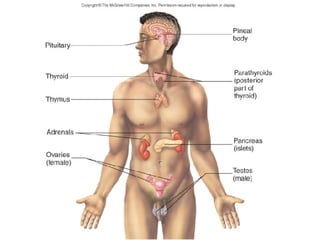
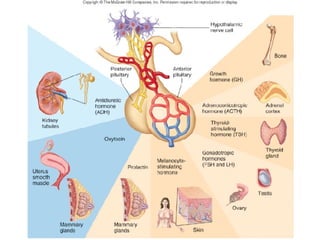
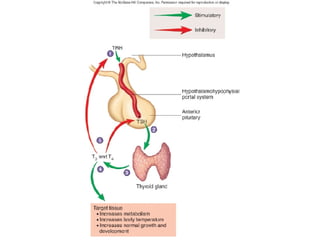
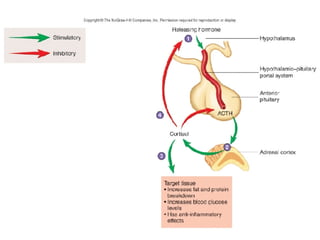
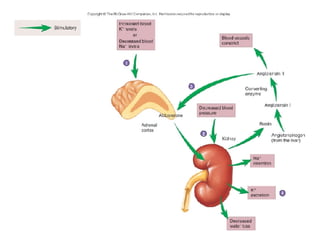
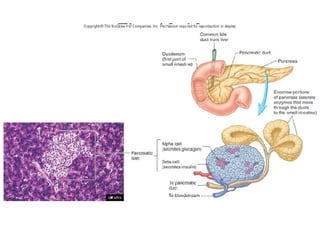
Fig. 10.9
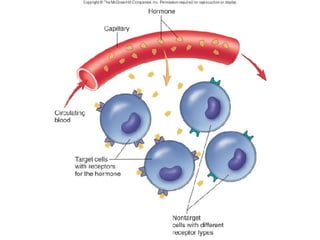
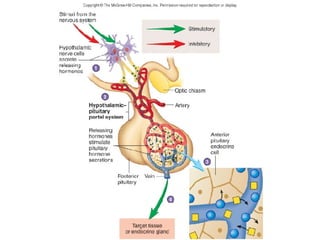
Fig. 10.10
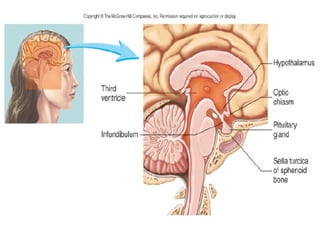
Fig. 10.11a
 
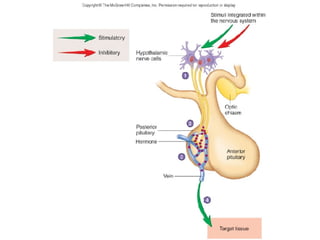
Fig. 10.12a
Fig. 10.12b
 
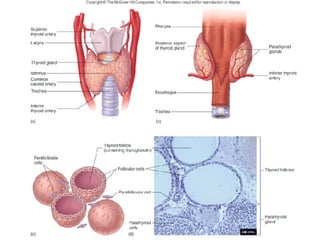
Fig. 10.14
Fig. 10.17
Fig. 10.18
Fig. 10.19
Endocrine Medications Hormonal replacement
ADH
Endocrine Medications Anti-diuretic hormones Enhance re-absorption of water in the kidneys Increases water permeability in the renal collecting ducts Also stimulates VASOCONSTRICTION and increases the blood pressure
Endocrine Medications Therapeutic Indications Hormonal replacement Used in diagnostic procedure Used to control the hemorrhage in variceal bleeding  Treatment of enuresis
Endocrine Medications Used in DI 1. Desmopressin and Lypressin  intranasally 2. Pitressin  IntraMuscularly
Endocrine Medications Anti-diuretic hormones SIDE-effects Flushing and headache Water intoxication CVS: heart block, MI Renal:  hyponatremia Gangrene due to vasoconstriction
Thyroid Medications
Thyroid Medications Thyroid hormones These products are used to treat the manifestations of hypothyroidism Replace hormonal deficit in the treatment of HYPOTHYROIDSM
Thyroid Medications Thyroid hormones Levothyroxine (Synthroid) Liothyroxine (Cytomel) Thyroid dessicated Liotrix (Thyrolar)
Thyroid Medications Thyroid hormones: Actions Replaces both T3 and T4 Increases metabolic rate
Thyroid Medications Thyroid hormones: Actions Increase the metabolic rate Increase O2 consumption Increase HR, RR, BP
Thyroid Medications Thyroid hormones:  Indications Hypothyroidism Diagnostic suppression test
Thyroid Medications Thyroid hormones Side-effects Nausea and Vomiting Signs of increased metabolism= tachycardia, hypertension, cardiac arrhythmias, anxiety, headache, tremors, palpitations
Thyroid Medications Thyroid hormones  : Nursing responsibility 1. Monitor weight, VS 2. Instruct client to take daily medication the same time  each morning WITHOUT FOOD Monitor blood tests to check the activity of thyroid
Thyroid Medications Thyroid hormones: Nursing responsibility 3.  Advise to report palpitation, tachycardia, and chest pain 4. Instruct to avoid foods that inhibit thyroid secretions like  cabbage, spinach and radishes
ANTI-Thyroid Medications ANTI-THYROID medications The thyroid becomes oversaturated with iodine and stop producing thyroid hormone
ANTI-Thyroid Medications ANTI-THYROID medications Drugs used to  BLOCK the thyroid hormones and treat hyperthyroidism Inhibit the synthesis of thyroid hormones
ANTI-Thyroid Medications ANTI-THYROID medications 1. Methimazole (Tapazole) 2. PTU (prophylthiouracil) 3. Iodine solution- SSKI and  Lugol’s solution
ANTI-Thyroid Medications ANTI-THYROID medications: Indications Grave’s dosease Thyrotoxicosis
ANTI-Thyroid Medications ANTI-THYROID medications: Absorption is good orally
ANTI-Thyroid Medications ANTI-THYROID medications Side-effects of  thionamides N/V, drowsiness, lethargy, bradycardia, skin rash GI complaints Arthralgia, myalgia AGRANULOCYTOSIS Most important to monitor
ANTI-Thyroid Medications ANTI-THYROID medications Side-effects of  Iodine solutions  Lugol’s Most common adverse effects is  HYPOTHYROIDISM Iodism= metallic taste, burning in the mouth, sore teeth and gums, diarrhea, stomach upset
ANTI-Thyroid Medications ANTI-THYROID medications Nursing responsibilities 1. Monitor VS, T3 and T4, weight 2.  The medications  WITH MEALS  to avoid gastric upset
ANTI-Thyroid Medications ANTI-THYROID medications Nursing responsibilities 3. Instruct to  report SORE THROAT or unexplained FEVER 4. Monitor for signs of hypothyroidism.  Instruct not to stop abrupt medication
ANTI-Thyroid Medications ANTI-THYROID medications Lugol’s Solution Used to  decrease the vascularity and size  of the thyroid (in preparation for thyroid surgery)  T3 and T4 production diminishes Given per orem, can be diluted with juice, administered WITH foods Use straw to decrease staining Monitor iodism
Steroids
STEROIDS Replaces the steroids in the body Cortisol, cortisone, betamethasone, and hydrocortisone
STEROIDS These drugs enter the cells and bind to receptors They inhibit the enzyme phospholipase
STEROIDS Corticosteroids are used topically and locally to achieve the desired anti-inflammatory effects at a particular site Examples: Prednisone Bethamethasone Prednisolone Fludrocortisone
STEROIDS Side-effects HYPERglycemia Increased susceptibility to infection (immunosuppression) Hypokalemia Edema Peptic ulceration
STEROIDS Side-effects If high doses- osteoporosis, growth retardation, peptic ulcer, hypertension, cataract, mood changes, hirsutism, and fragile skin
STEROIDS Nursing responsibilities 1. Monitor VS, electrolytes,  glucose 2. Monitor weight edema and I/O
STEROIDS Nursing responsibilities 3. Protect patient from infection 4. Handle patient gently 5. Instruct to take meds  WITH MEALS  to prevent gastric ulcer formation
STEROIDS Nursing responsibilities 6. Caution the patient NOT to abruptly stop the drug 7.  Drug is tapered to allow the adrenal gland to secrete endogenous hormones
STEROIDS Evaluation: The drugs are effective if there is:  Relief of  signs and symptoms of inflammation Return of adrenal function to normal
DM Drug therapy
DRUG THERAPY and MANAGEMENT Usually, this type of management is employed if diet modification and exercise cannot control the blood glucose level.
DRUG THERAPY and MANAGEMENT These agents are employed to control the blood glucose level They can be insulin and oral agents These are given to replace the hormone in the body If hormone is still present BUT decreased, Oral agents are given
Diabetes Mellitus DRUG THERAPY and MANAGEMENT Because the patient with TYPE 1 DM cannot produce insulin, exogenous insulin must be administered for life.
Diabetes Mellitus DRUG THERAPY and MANAGEMENT TYPE 2 DM may have decreased insulin production, ORAL agents that stimulate insulin production are usually employed.
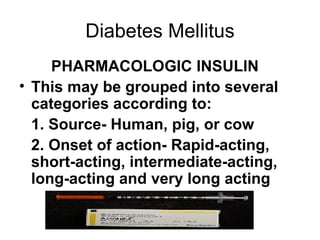
Diabetes Mellitus PHARMACOLOGIC INSULIN This may be grouped into several categories according to: 1. Source- Human, pig, or cow 2. Onset of action- Rapid-acting, short-acting, intermediate-acting, long-acting and very long acting
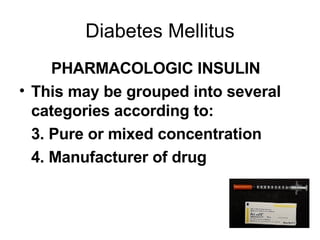
Diabetes Mellitus PHARMACOLOGIC INSULIN This may be grouped into several categories according to: 3. Pure or mixed concentration 4. Manufacturer of drug
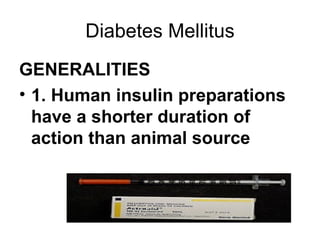
Diabetes Mellitus GENERALITIES 1. Human insulin preparations have a shorter duration of action than animal source
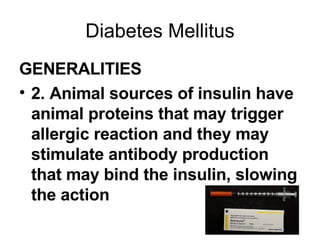
Diabetes Mellitus GENERALITIES 2. Animal sources of insulin have animal proteins that may trigger allergic reaction and they may stimulate antibody production that may bind the insulin, slowing the action
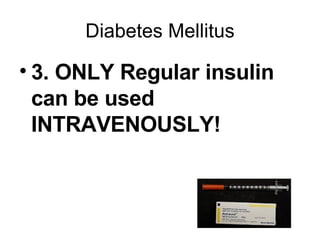
Diabetes Mellitus 3. ONLY Regular insulin can be used INTRAVENOUSLY!
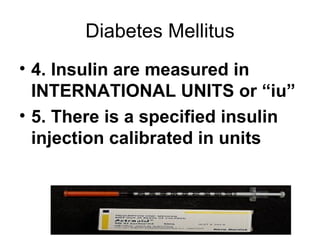
Diabetes Mellitus 4. Insulin are measured in INTERNATIONAL UNITS or “iu” 5. There is a specified insulin injection calibrated in units
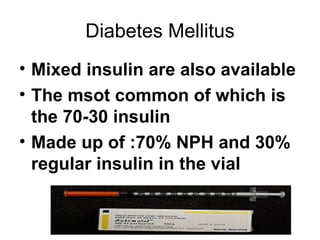
Diabetes Mellitus Mixed insulin are also available The msot common of which is the 70-30 insulin Made up of :70% NPH and 30% regular insulin in the vial
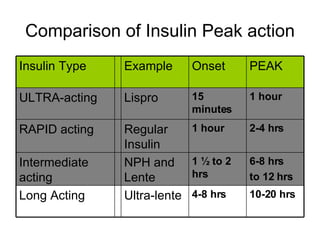
Comparison of Insulin Peak action 10-20 hrs 4-8 hrs Ultra-lente Long Acting 6-8 hrs to 12 hrs 1 ½ to 2 hrs NPH and Lente Intermediate acting 2-4 hrs 1 hour Regular Insulin RAPID acting 1 hour 15 minutes Lispro ULTRA-acting PEAK Onset Example Insulin Type
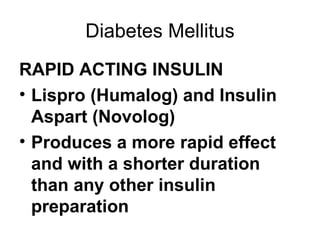
Diabetes Mellitus RAPID ACTING INSULIN Lispro (Humalog) and Insulin Aspart (Novolog) Produces a more rapid effect and with a shorter duration than any other insulin preparation
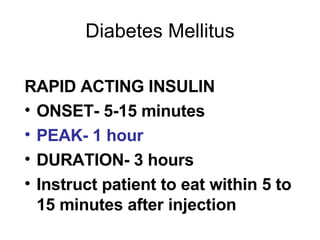
Diabetes Mellitus RAPID ACTING INSULIN ONSET- 5-15 minutes PEAK- 1 hour DURATION- 3 hours Instruct patient to eat within 5 to 15 minutes after injection
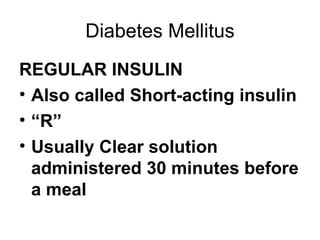
Diabetes Mellitus REGULAR INSULIN Also called Short-acting insulin “ R” Usually Clear solution administered 30 minutes before a meal
Diabetes Mellitus REGULAR INSULIN ONSET- 30 minutes to 1 hour PEAK- 2 to 4 hours DURATION- 4 to 6 hours
Diabetes Mellitus INTERMEDIATE ACTING INSULIN Called “NPH” or “LENTE” Appears white and cloudy
Diabetes Mellitus INTERMEDIATE ACTING INSULIN ONSET- 2-4 hours PEAK- 4 to 6-12 hours DURATION- 16-20 hours
Diabetes Mellitus LONG- ACTING INSULIN “ UltraLENTE” Referred to as “peakless” insulin
Diabetes Mellitus LONG- ACTING INSULIN ONSET- 6-8 hours PEAK- 12-16 hours DURATION- 20-30 hours
Diabetes Mellitus HEALTH TEACHING Regarding Insulin SELF- Administration 1. Insulin is administered at home  subcutaneously
Diabetes Mellitus HEALTH TEACHING Regarding Insulin SELF- Administration 2. Cloudy insulin should be thoroughly mixed by gently inverting the vial or  ROLLING between the hands
Diabetes Mellitus HEALTH TEACHING Regarding Insulin SELF- Administration 3. Insulin NOT IN USE should be stored in the refrigerator, BUT  avoid  freezing/extreme temperature
Diabetes Mellitus 4. Insulin IN USE should be kept at room temperature to reduce local irritation at the injection site
Diabetes Mellitus 5. INSULIN may be kept at room temperature up to 1 month
Diabetes Mellitus 6. Select syringes that match the insulin concentration. U-100 means 100 units per mL
Diabetes Mellitus 7. Instruct the client to draw up the REGULAR (clear) Insulin FIRST before drawing the intermediate acting (cloudy) insulin
Diabetes Mellitus 8. Pre-filled syringes can be prepared and should be kept in the refrigerator with the needle in the UPRIGHT position to avoid clogging the needle
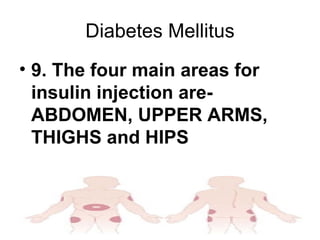
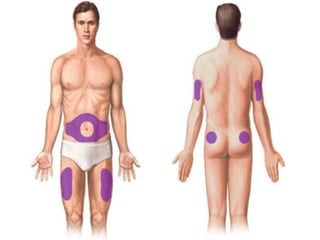
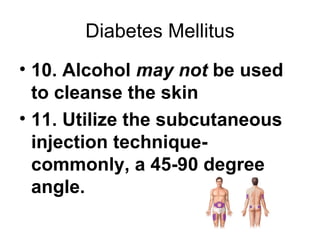
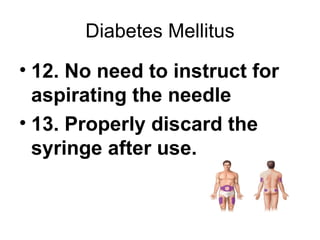
Diabetes Mellitus 9. The four main areas for insulin injection are- ABDOMEN, UPPER ARMS, THIGHS and HIPS
 
Diabetes Mellitus Insulin is absorbed fastest in the abdomen  and slowest in the hips Instruct the client to rotate the areas of injection, but exhaust all available sites in one area first before moving into another area.
Diabetes Mellitus 10. Alcohol  may not  be used to cleanse the skin 11. Utilize the subcutaneous injection technique- commonly, a 45-90 degree angle.
Diabetes Mellitus 12. No need to instruct for aspirating the needle 13. Properly discard the syringe after use.
Diabetes Mellitus T-I-E T est blood    I nject insulin     E at food
Diabetes Mellitus ORAL HYPOGLYCEMIC AGENTS These may be effective when used in TYPE 2 DM that cannot be treated with diet and exercise These are NEVER used in pregnancy!
Diabetes Mellitus ORAL HYPOGLYCEMIC AGENTS There are several agents: Sulfonylureas Biguanides Alpha-glucosidase inhibitors Thiazolidinediones Meglitinides
Diabetes Mellitus ORAL HYPOGLYCEMIC AGENTS These drugs are given per orem and are effective only in type 2 DM Common adverse effects include: Hypoglycemia Diarrhea, jaundice, nausea and heartburn Anemia , photosensitivity
Diabetes Mellitus ORAL HYPOGLYCEMIC AGENTS General Nursing Consideration Observe for manifestations of hypoglycemia Assess for allergic reaction Instruct to take the medication at the same time each day Caution to avoid taking other drugs without consultation with physician
Diabetes Mellitus ORAL HYPOGLYCEMIC AGENTS General Nursing Consideration 5. THESE medications SHOULD NEVER be given to pregnant women, so rule out pregnancy 6. Instruct to wear sunscreen 7. Advise to bring simple sugar to be taken when hypoglycemic episodes occur
Diabetes Mellitus SULFONYLUREAS MOA-  stimulates the beta cells of the pancreas to secrete insulin Classified as to generations- first and second generations
Diabetes Mellitus SULFONYLUREAS FIRST GENERATION- Acetoheximide, Chlorpropamide, Tolazamide and  Tolbutamide SECOND GENERATION- Glipizide, Glyburide, Glibenclamide, Glimepiride
Diabetes Mellitus: Sulfonylureas The most common side –effects of these medications are Gastro-intestinal upset and dermatologic reactions. HYPOGLYCEMIA is also a very important side-effect Given 30 minutes before meals- breakfast
Diabetes Mellitus: Sulfonylureas Chlorpropamide has a very long duration of action. This also produces a disulfiram-like reaction when taken with alcohol Second generation drugs have shorter duration with metabolism in the kidney and liver and are the choice for elderly patients
Diabetes Mellitus BIGUANIDES MOA- Facilitate the action of insulin on the peripheral receptors These can only be used in the presence of insulin
Diabetes Mellitus BIGUANIDES= “ formin” They have no effect on the beta cells of the pancreas  Metformin (Glucophage) and Phenformin are examples
Diabetes Mellitus: Biguanides The most important side effect is LACTIC ACIDOSIS! These are not given to patient with renal impairment
Diabetes Mellitus: Biguanides These drugs are usually given with a sulfonylurea to enhance the glucose-lowering effect more than the use of each drug individually
Diabetes Mellitus ALPHA-GLUCOSIDASE INHIBITORS MOA- Delay the absorption of glucose in the GIT  Result is a lower post-prandial blood glucose level They do not affect insulin secretion or action! Side-effect: DIARRHEA and FLATULENCE
Diabetes Mellitus Examples of AGI are Acarbose  and Miglitol They are not absorbed systemically and are very safe They can be used alone or in combination with other OHA
Diabetes Mellitus Side-effect if used with other drug is HYPOGLYCEMIA Note that sucrose absorption is impaired and IV glucose is the therapy for the hypoglycemia
Diabetes Mellitus THIAZOLIDINEDIONES MOA- Enhance insulin action at the receptor site They  do not  stimulate insulin secretion
Diabetes Mellitus THIAZOLIDINEDIONES Examples- Rosiglitazone, Pioglitazone These drugs affect LIVER FUNCTION Can cause resumption of OVULATION in peri-menopausal anovulatory women