:By:
Ankit sharmA
M.Pharma (Pharmacology)
Bhupal Nobles University
Udaipur, Rajasthan
Steroids: Introduction
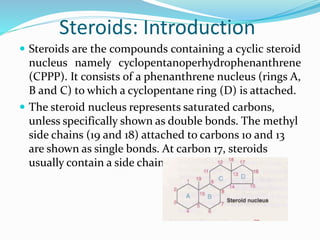
 Steroids are the compounds containing a cyclic steroid
nucleus namely cyclopentanoperhydrophenanthrene
(CPPP). It consists of a phenanthrene nucleus (rings A,
B and C) to which a cyclopentane ring (D) is attached.
 The steroid nucleus represents saturated carbons,
unless specifically shown as double bonds. The methyl
side chains (19 and 18) attached to carbons 10 and 13
are shown as single bonds. At carbon 17, steroids
usually contain a side chain.
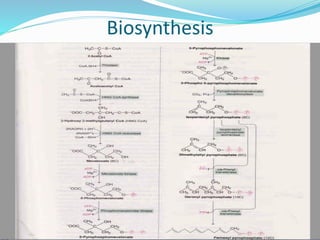
Biosynthesis
Biosynthesis (contd.)
Classification
Action of Mineralocorticoid
 Major endogenous mineralocorticoid is aldosterone. It
acts in DCT of the kidney to cause reabsorption of Na+
and excretion of K+ and H+.
 Thus, excess of mineralocorticoids can lead to retention of
sodium and water (hypertension and edema),
hypokalemia and alkalosis whereas Addison’s disease
(deficiency of adrenal corticoids) is characterized by
hyperkalemia, acidosis and hypotension.
 Aldosterone is also involved in causing myocardial
remodeling associated with CHF and the drugs
blocking this effect [spironolactone, ACE inhibitors,
angiotensin receptor antagonists (ARBs) and β blockers]
decrease the mortality in patients with CHF.
Action of Glucocorticoid
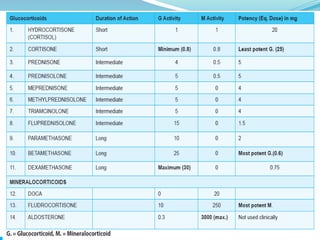
 Major endogenous glucocorticoid is hydrocortisone (cortisol).
 Many of the effects of glucocorticoids are dose-dependent
whereas some are permissive effects (without these, many
normal functions become deficient) e.g. response of vascular
and bronchial smooth muscle to catecholamines is diminished
in the absence of cortisol.
 Effect on metabolism: Glucocorticoids are catabolic in
nature and thus cause breakdown of carbohydrates
(hyperglycemia), proteins (muscle wasting) and fat. There is
redistribution of fat; deposition over face (moon face), mouth
(fish mouth) and back (buffalo hump) whereas removal from
the extremities is seen. Glucocorticoids cause negative Ca2+
balance (by inhibiting intestinal absorption, enhancing renal
excretion and causing loss of Ca2+ from the bones) and can
predispose to osteoporosis.
Action of Glucocorticoid
 Effect on CVS and CNS: Glucocorticoids prevent the
increase in the permeability of capillaries. These have mild
euphoric effect and high doses can lower seizure threshold.
 Effect on GIT: These hormones may aggravate peptic
ulcer by increasing the secretion of HCl and pepsin in
stomach.
 Effect on hematopoietic system: Glucocorticoids cause
destruction of T cells and B cells (less sensitive) in
malignancies whereas little effect is exerted on normal cells.
These drugs cause sequestration of lymphocytes, eosinophils,
monocytes and basophils in tissues (and thus decrease
circulating levels of these cells) whereas circulating
neutrophils are increased due to release from bone marrow.
Action of Glucocorticoid
 Effect on inflammatory response: Glucocorticoids are powerful
anti-inflammatory agents. Most important mechanism is the
inhibition of chemotaxis (recruitment of the cells at the site of
inflammation). These hormones also induce the production of
annexins (previously called, lipocortins) that are responsible
for the inhibition of phospholipase A2 (involved in the production
of prostaglandins and leukotrienes). They also delay the healing of
wounds and scar formation.
 Effect on immunity: These hormones suppress cell mediated
immunity (CMI) more than humoral immunity. Main effect is due
to inhibition of recruitment of immune cells, but they also
inhibit the release of IL-1 and IL-2. Antibody production is
affected at high doses and continuous administration of
glucocorticoids can result in catabolism of IgG. Immunosuppressive
effect of glucocorticoids is the basis of their use in graft rejection and
various hypersensitivity reactions.
Gene mediated cellular actions of glucocorticoids
PHARMACOKINETICS
 All natural and synthetic corticoids, except DOCA are
absorbed and are effective by the oral route.
 Water soluble esters, e.g. hydrocortisone hemisuccinate,
dexamethasone sod. phosphate can be given or i.m., act rapidly
and achieve high concentrations in tissue fluids.
 Insoluble esters, e.g. hydrocortisone acetate, triamcinolone
acetonide cannot be injected i.v., but are slowly absorbed from
i.m. site and produce more prolonged effects.i.v.
 Hydrocortisone is 90% bound to plasma protein, mostly to a
specific cortisol-binding globulin (CBG; transcortin) as well as
to albumin. Transcortin concentration is increased during
pregnancy and by oral contraceptives—corticoid levels in
blood are increased but hypercorticism does not occur,
because free cortisol levels are normal.
PHARMACOKINETICS
 The corticosteroids are metabolized primarily by hepatic
microsomal enzymes. Pathways are—
 (i) Reduction of 4, 5 double bond and hydroxylation of 3-keto
group.
 (ii) Reduction of 20-keto to 20-hydroxy form.
 (iii) Oxidative cleavage of 20C side chain (only in case of
compounds having a 17-hydroxyl group) to yield 17-ketosteroids.
 These metabolites are further conjugated with glucuronic acid or
sulfate and are excreted in urine.
 The plasma t½ of hydrocortisone is 1.5 hours. However, the
biological t½ is longer because of action through intracellular
receptors and regulation of protein synthesis—effects that persist
long after the steroid is removed from plasma.
Important points
Uses:
Non Adrenal Uses
Points to Remember for Systemic Use of Steroids
 • Long term use (for more than 2 weeks) can lead to HPA axis
suppression. Steroids should not be withdrawn abruptly because
it may precipitate acute adrenal insufficiency.
 Many patients recover from HPA-axis suppression within several
weeks to months but recovery may take one year or longer in
some patients.
 Large single dose is less harmful than small doses given for long
periods. Thus 80mg prednisolone for 2 days is much less harmful
than 20mg dose for 6 months.
 During condition of stress like infection or trauma, steroid dose
should be unchanged or increased (2 to 10 fold). It should not be
reduced.
 To prevent HPA axis suppression, steroids can be given on
alternate days but long acting steroids like betamethasone and
dexamethasone cause HPA axis suppression even when
administered on alternate days.
Important points
Adverse Effects
Glucocorticoid Synthesis Inhibitors
Case Study
 A 35-year female patient of inflammatory bowel disease was
treated with prednisolone 40 mg/day and mesalazine 800
mg TDS. After 4 weeks, the symptoms subsided and
prednisolone dose was tapered at the rate of 10 mg every 2
weeks. When she was taking 10 mg prednisolone/ day, she
met with a road-side accident and suffered compound
fracture of both bones of the right leg. Internal fixation of the
fracture and suturing of wounds under general anaesthesia is
planned.
(a) Whether any additional measure needs to be taken during
surgery in view of her corticosteroid therapy?
(b) Does the prednisolone therapy need discontinuation or any
alteration in the postoperative period? Give reasons.
Solution
 a. The patient has received supraphysiological doses of a
corticosteroid for more than 3 weeks, and is likely to have
developed hypothalamo-pituitary-adrenal (HPA) suppression.
The injury and surgery are a stress which need excess corticoid
activity. The depressed HPA axis may not be able to cope up with
increased demand, and there is risk of developing acute adrenal
insufficiency. As such, hydrocortisone hemisuccinate 100 mg
should be infused i.v. during surgery and repeated 8 hourly till the
patient is stable.
 b. Prednisolone therapy must not be stopped in the postoperative
period apprehending spread of infection and delayed healing.
Effective antibiotic medication to prevent wound infection should
be given and prednisolone dose should be increased temporarily
(for a week or so) to 20 mg/day, till the stress of the trauma and
surgery subsides.

Steroids converted

  • 1.
    :By: Ankit sharmA M.Pharma (Pharmacology) BhupalNobles University Udaipur, Rajasthan
  • 2.
    Steroids: Introduction  Steroidsare the compounds containing a cyclic steroid nucleus namely cyclopentanoperhydrophenanthrene (CPPP). It consists of a phenanthrene nucleus (rings A, B and C) to which a cyclopentane ring (D) is attached.  The steroid nucleus represents saturated carbons, unless specifically shown as double bonds. The methyl side chains (19 and 18) attached to carbons 10 and 13 are shown as single bonds. At carbon 17, steroids usually contain a side chain.
  • 3.
  • 4.
  • 5.
  • 7.
    Action of Mineralocorticoid Major endogenous mineralocorticoid is aldosterone. It acts in DCT of the kidney to cause reabsorption of Na+ and excretion of K+ and H+.  Thus, excess of mineralocorticoids can lead to retention of sodium and water (hypertension and edema), hypokalemia and alkalosis whereas Addison’s disease (deficiency of adrenal corticoids) is characterized by hyperkalemia, acidosis and hypotension.  Aldosterone is also involved in causing myocardial remodeling associated with CHF and the drugs blocking this effect [spironolactone, ACE inhibitors, angiotensin receptor antagonists (ARBs) and β blockers] decrease the mortality in patients with CHF.
  • 8.
    Action of Glucocorticoid Major endogenous glucocorticoid is hydrocortisone (cortisol).  Many of the effects of glucocorticoids are dose-dependent whereas some are permissive effects (without these, many normal functions become deficient) e.g. response of vascular and bronchial smooth muscle to catecholamines is diminished in the absence of cortisol.  Effect on metabolism: Glucocorticoids are catabolic in nature and thus cause breakdown of carbohydrates (hyperglycemia), proteins (muscle wasting) and fat. There is redistribution of fat; deposition over face (moon face), mouth (fish mouth) and back (buffalo hump) whereas removal from the extremities is seen. Glucocorticoids cause negative Ca2+ balance (by inhibiting intestinal absorption, enhancing renal excretion and causing loss of Ca2+ from the bones) and can predispose to osteoporosis.
  • 9.
    Action of Glucocorticoid Effect on CVS and CNS: Glucocorticoids prevent the increase in the permeability of capillaries. These have mild euphoric effect and high doses can lower seizure threshold.  Effect on GIT: These hormones may aggravate peptic ulcer by increasing the secretion of HCl and pepsin in stomach.  Effect on hematopoietic system: Glucocorticoids cause destruction of T cells and B cells (less sensitive) in malignancies whereas little effect is exerted on normal cells. These drugs cause sequestration of lymphocytes, eosinophils, monocytes and basophils in tissues (and thus decrease circulating levels of these cells) whereas circulating neutrophils are increased due to release from bone marrow.
  • 10.
    Action of Glucocorticoid Effect on inflammatory response: Glucocorticoids are powerful anti-inflammatory agents. Most important mechanism is the inhibition of chemotaxis (recruitment of the cells at the site of inflammation). These hormones also induce the production of annexins (previously called, lipocortins) that are responsible for the inhibition of phospholipase A2 (involved in the production of prostaglandins and leukotrienes). They also delay the healing of wounds and scar formation.  Effect on immunity: These hormones suppress cell mediated immunity (CMI) more than humoral immunity. Main effect is due to inhibition of recruitment of immune cells, but they also inhibit the release of IL-1 and IL-2. Antibody production is affected at high doses and continuous administration of glucocorticoids can result in catabolism of IgG. Immunosuppressive effect of glucocorticoids is the basis of their use in graft rejection and various hypersensitivity reactions.
  • 11.
    Gene mediated cellularactions of glucocorticoids
  • 12.
    PHARMACOKINETICS  All naturaland synthetic corticoids, except DOCA are absorbed and are effective by the oral route.  Water soluble esters, e.g. hydrocortisone hemisuccinate, dexamethasone sod. phosphate can be given or i.m., act rapidly and achieve high concentrations in tissue fluids.  Insoluble esters, e.g. hydrocortisone acetate, triamcinolone acetonide cannot be injected i.v., but are slowly absorbed from i.m. site and produce more prolonged effects.i.v.  Hydrocortisone is 90% bound to plasma protein, mostly to a specific cortisol-binding globulin (CBG; transcortin) as well as to albumin. Transcortin concentration is increased during pregnancy and by oral contraceptives—corticoid levels in blood are increased but hypercorticism does not occur, because free cortisol levels are normal.
  • 13.
    PHARMACOKINETICS  The corticosteroidsare metabolized primarily by hepatic microsomal enzymes. Pathways are—  (i) Reduction of 4, 5 double bond and hydroxylation of 3-keto group.  (ii) Reduction of 20-keto to 20-hydroxy form.  (iii) Oxidative cleavage of 20C side chain (only in case of compounds having a 17-hydroxyl group) to yield 17-ketosteroids.  These metabolites are further conjugated with glucuronic acid or sulfate and are excreted in urine.  The plasma t½ of hydrocortisone is 1.5 hours. However, the biological t½ is longer because of action through intracellular receptors and regulation of protein synthesis—effects that persist long after the steroid is removed from plasma.
  • 15.
  • 16.
  • 19.
  • 20.
    Points to Rememberfor Systemic Use of Steroids  • Long term use (for more than 2 weeks) can lead to HPA axis suppression. Steroids should not be withdrawn abruptly because it may precipitate acute adrenal insufficiency.  Many patients recover from HPA-axis suppression within several weeks to months but recovery may take one year or longer in some patients.  Large single dose is less harmful than small doses given for long periods. Thus 80mg prednisolone for 2 days is much less harmful than 20mg dose for 6 months.  During condition of stress like infection or trauma, steroid dose should be unchanged or increased (2 to 10 fold). It should not be reduced.  To prevent HPA axis suppression, steroids can be given on alternate days but long acting steroids like betamethasone and dexamethasone cause HPA axis suppression even when administered on alternate days.
  • 21.
  • 22.
  • 23.
  • 24.
    Case Study  A35-year female patient of inflammatory bowel disease was treated with prednisolone 40 mg/day and mesalazine 800 mg TDS. After 4 weeks, the symptoms subsided and prednisolone dose was tapered at the rate of 10 mg every 2 weeks. When she was taking 10 mg prednisolone/ day, she met with a road-side accident and suffered compound fracture of both bones of the right leg. Internal fixation of the fracture and suturing of wounds under general anaesthesia is planned. (a) Whether any additional measure needs to be taken during surgery in view of her corticosteroid therapy? (b) Does the prednisolone therapy need discontinuation or any alteration in the postoperative period? Give reasons.
  • 25.
    Solution  a. Thepatient has received supraphysiological doses of a corticosteroid for more than 3 weeks, and is likely to have developed hypothalamo-pituitary-adrenal (HPA) suppression. The injury and surgery are a stress which need excess corticoid activity. The depressed HPA axis may not be able to cope up with increased demand, and there is risk of developing acute adrenal insufficiency. As such, hydrocortisone hemisuccinate 100 mg should be infused i.v. during surgery and repeated 8 hourly till the patient is stable.  b. Prednisolone therapy must not be stopped in the postoperative period apprehending spread of infection and delayed healing. Effective antibiotic medication to prevent wound infection should be given and prednisolone dose should be increased temporarily (for a week or so) to 20 mg/day, till the stress of the trauma and surgery subsides.