CORTICOSTEROIDS
Sanjaya Mani Dixit
Assistant Prof of Pharmacology
Corticosteroids
• Corticosteroids are a class of steroidal
hormones released by the adrenal cortex,
which includes
– Glucocorticoids, &
– Mineralocorticoids.
• However, the term “corticosteroids” is
generally used to refer to glucocorticoids.
Glucocorticoids
• Glucocorticoids are primary stress hormones that regulate a
variety of physiologic processes and are essential for life.
• The actions of glucocorticoids are predominantly mediated
through glucocorticoid receptor (GR).
• A diverse collection of receptor isoforms have been identified.
• Glucocorticoids regulate diverse cellular functions:
– development,
– homeostasis,
– metabolism,
– cognition and
– Inflammation.
Glucocorticoids
• Glucocorticoids (cortisol in man and corticosterone in rodents)
are steroid hormones synthesized and released by the adrenal
glands in a circadian manner, in response to physiological cues
and stress.
* Cortisol when used as medication is k/a Hydrocortisone.
• Due to its lipophilic nature, glucocorticoids cannot be pre-
synthesized and stored in adrenal glands, but have to be rapidly
synthesized (using a number of enzymatic reactions) upon ACTH
stimulation.
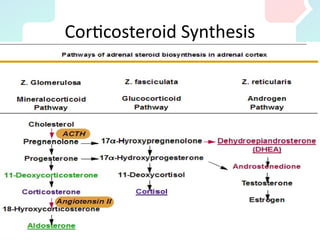
• Biologically active glucocorticoids are synthesized from cholesterol
through a multienzyme process termed steroidogenesis.
Steroids
• Steroid: A group of compound, having a
common structure based on the steroid
nucleus.
• For examples:
– Sex hormones [androgen and estrogens],
– Hormones of the adrenal cortex [cortisone].
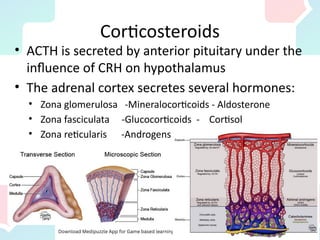
Corticosteroids
• ACTH is secreted by anterior pituitary under the
influence of CRH on hypothalamus
• The adrenal cortex secretes several hormones:
• Zona glomerulosa -Mineralocorticoids - Aldosterone
• Zona fasciculata -Glucocorticoids - Cortisol
• Zona reticularis -Androgens
Corticosteroid Synthesis
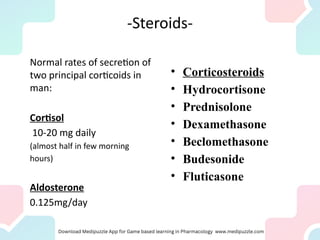
-Steroids-
Normal rates of secretion of
two principal corticoids in
man:
Cortisol
10-20 mg daily
(almost half in few morning
hours)
Aldosterone
0.125mg/day
• Corticosteroids
• Hydrocortisone
• Prednisolone
• Dexamethasone
• Beclomethasone
• Budesonide
• Fluticasone
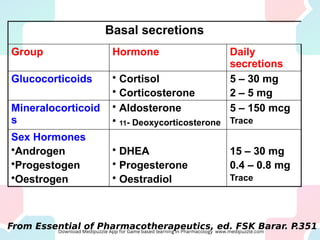
Basal secretions
Group Hormone Daily
secretions
Glucocorticoids • Cortisol
• Corticosterone
5 – 30 mg
2 – 5 mg
Mineralocorticoid
s
• Aldosterone
• 11- Deoxycorticosterone
5 – 150 mcg
Trace
Sex Hormones
•Androgen
•Progestogen
•Oestrogen
• DHEA
• Progesterone
• Oestradiol
15 – 30 mg
0.4 – 0.8 mg
Trace
From Essential of Pharmacotherapeutics, ed. FSK Barar. P
.351
Steroids-MOA
Steroids-MOA
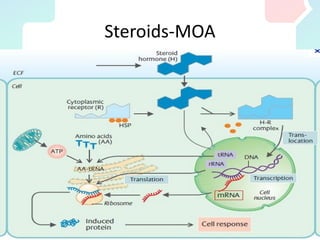
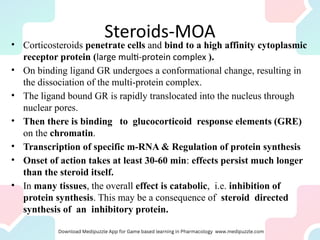
• Corticosteroids penetrate cells and bind to a high affinity cytoplasmic
receptor protein (large multi-protein complex ).
• On binding ligand GR undergoes a conformational change, resulting in
the dissociation of the multi-protein complex.
• The ligand bound GR is rapidly translocated into the nucleus through
nuclear pores.
• Then there is binding to glucocorticoid response elements (GRE)
on the chromatin.
• Transcription of specific m-RNA & Regulation of protein synthesis
• Onset of action takes at least 30-60 min: effects persist much longer
than the steroid itself.
• In many tissues, the overall effect is catabolic, i.e. inhibition of
protein synthesis. This may be a consequence of steroid directed
synthesis of an inhibitory protein.
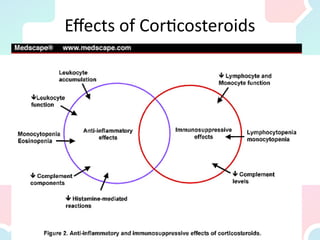
Effects of Corticosteroids
Pharmacological Actions
• The corticoids have widespread actions.
• They maintain fluid-electrolyte, cardiovascular
and energy substrate homeostasis and
functional status of skeletal muscles and nervous
system.
• They prepare the body to withstand effects of all
kinds of noxious stimuli and stress.
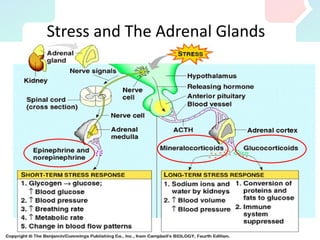
Stress and The Adrenal Glands
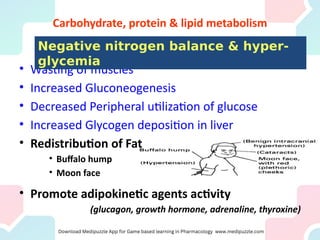
Carbohydrate, protein & lipid metabolism
• Wasting of muscles
• Increased Gluconeogenesis
• Decreased Peripheral utilization of glucose
• Increased Glycogen deposition in liver
• Redistribution of Fat
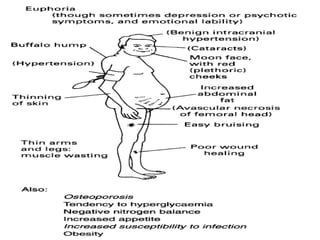
• Buffalo hump
• Moon face
• Promote adipokinetic agents activity
(glucagon, growth hormone, adrenaline, thyroxine)
Negative nitrogen balance & hyper-
glycemia
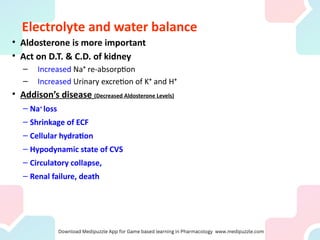
Electrolyte and water balance
• Aldosterone is more important
• Act on D.T. & C.D. of kidney
– Increased Na+
re-absorption
– Increased Urinary excretion of K+
and H+
• Addison’s disease (Decreased Aldosterone Levels)
– Na+
loss
– Shrinkage of ECF
– Cellular hydration
– Hypodynamic state of CVS
– Circulatory collapse,
– Renal failure, death
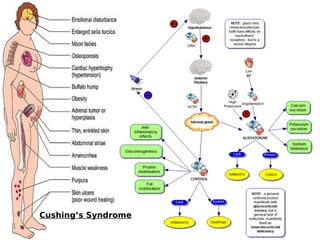
Cushing’s Syndrome
• Decreased Recruitment of WBC & monocyte-
macrophage into affected area & increase of
chemotactic substances
• Decreased TNF from phagocytic cells
• Decreased IL1 from monocyte-macrophage
• Decreased Formation of Plasminogen Activator
• Decreased Action of MIF (Migration Inhibiting factor) &
decreased fibroblastic activity
• Decreased Expression of cyclooxygenase II
Actions: Anti-inflammatory
Immunosuppressive & anti-allergic actions
• Suppresses all types of hypersensitivity &
allergic phenomenon
• At High dose: Interfere with all steps of
immunological response
• Causes greater suppression of CMI (graft
rejection & delayed hypersensitivity)
• Transplant rejection: Decreased antigen expression
from grafted tissues, delay revascularization,
decreased sensitization of T lymphocytes etc.
• Inhibit cell division or synthesis of DNA
• Delay the process of healing
• Retard the growth of children
• Cause peptic ulcerations on prolonged exposure
Actions: Growth & Cell divi-
sion
Pharmacological Actions
• For most clinical purposes, synthetic
glucocorticoids are used because they have a
higher affinity for the receptor, are less
activated and have little or no salt-retaining
properties.
• Hydrocortisone orally for replacement
therapy, i.v. for shock and asthma, topically for
eczema (ointment) and enemas (ulcerative
colitis).
• Prednisolone the most widely used drug given
orally in inflammation and allergic diseases.
Pharmacological Actions
• Betamethasone and dexamethasone: very
potent, w/o salt-retaining properties; thus,
very useful for high-dose therapies (e.g.,
cerebral edemas).
• Beclometasone diproprionate, budesonide:
pass membranes poorly; more active when
applied topically (severe eczema for local anti-
inflammatory effects) than orally; used in
asthma, (aerosol).
• Triamcinolone: used for severe asthma and for
local joint inflammation (intra-articular inj.).
Uses
• Corticosteroids are used:
· To reduce inflammation (asthma, arthritis) and swelling
(cerebral oedema)
· To suppress the immune response SLE (systemic lupus
erythematosus)
· To reduce nausea and vomiting (as in cancer chemo-
therapy)
· To reduce terminal pain (associated with cancer)
· As replacement therapy (in Addison’s disease)
Unwanted Effects
Metabolic:
– growth suppression
– diabetes mellitus
– muscle wasting
– osteoporosis
– fat redistribution
– Hirsutism
– Acne
– hypertension
– hypokalaemia
– menstrual irregularities
Other:
– infection
– emotional disturbances
(psychosis, depression, mania)
– cataract, glaucoma
– GI bleeding, perforation
Withdrawal symptoms:
– Addisonian crisis
– raised ICP
– Arthralgia/myalgia
– Pustular rash
Avoiding unwanted effects
of corticosteroids
• Modification of dose/dose regimen
· Use short courses/low doses if possible
· Use steroid sparing drugs
· Withdraw chronic’ steroids slowly
· Give dose once daily and in morning
· Give on alternate days if possible
· Give prophylactics if possible
· Give product locally
· Remember contraindications
Giving products locally can
still cause problems!
• systemic dosing can occur
• local toxicity can develop -
–skin: infection, thinning, bruising.
–eye: viral infection, cataract, glaucoma.
–inhalation: fungal infection, hoarseness
–joints: infection, necrosis
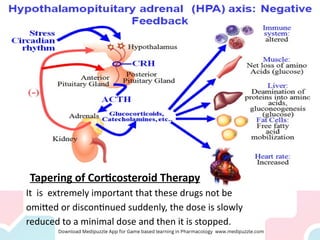
Tapering of Corticosteroid Therapy
It is extremely important that these drugs not be
omitted or discontinued suddenly, the dose is slowly
reduced to a minimal dose and then it is stopped.
www.medipuzzle.com
Trusted by
10K +
Students
That’s All
ENJOY
31
Endo-_CORTICOSTEROIDS.pdf

Endo-_CORTICOSTEROIDS.pdf

  • 1.
  • 2.
    Corticosteroids • Corticosteroids area class of steroidal hormones released by the adrenal cortex, which includes – Glucocorticoids, & – Mineralocorticoids. • However, the term “corticosteroids” is generally used to refer to glucocorticoids.
  • 3.
    Glucocorticoids • Glucocorticoids areprimary stress hormones that regulate a variety of physiologic processes and are essential for life. • The actions of glucocorticoids are predominantly mediated through glucocorticoid receptor (GR). • A diverse collection of receptor isoforms have been identified. • Glucocorticoids regulate diverse cellular functions: – development, – homeostasis, – metabolism, – cognition and – Inflammation.
  • 4.
    Glucocorticoids • Glucocorticoids (cortisolin man and corticosterone in rodents) are steroid hormones synthesized and released by the adrenal glands in a circadian manner, in response to physiological cues and stress. * Cortisol when used as medication is k/a Hydrocortisone. • Due to its lipophilic nature, glucocorticoids cannot be pre- synthesized and stored in adrenal glands, but have to be rapidly synthesized (using a number of enzymatic reactions) upon ACTH stimulation. • Biologically active glucocorticoids are synthesized from cholesterol through a multienzyme process termed steroidogenesis.
  • 5.
    Steroids • Steroid: Agroup of compound, having a common structure based on the steroid nucleus. • For examples: – Sex hormones [androgen and estrogens], – Hormones of the adrenal cortex [cortisone].
  • 6.
    Corticosteroids • ACTH issecreted by anterior pituitary under the influence of CRH on hypothalamus • The adrenal cortex secretes several hormones: • Zona glomerulosa -Mineralocorticoids - Aldosterone • Zona fasciculata -Glucocorticoids - Cortisol • Zona reticularis -Androgens
  • 7.
  • 8.
    -Steroids- Normal rates ofsecretion of two principal corticoids in man: Cortisol 10-20 mg daily (almost half in few morning hours) Aldosterone 0.125mg/day • Corticosteroids • Hydrocortisone • Prednisolone • Dexamethasone • Beclomethasone • Budesonide • Fluticasone
  • 9.
    Basal secretions Group HormoneDaily secretions Glucocorticoids • Cortisol • Corticosterone 5 – 30 mg 2 – 5 mg Mineralocorticoid s • Aldosterone • 11- Deoxycorticosterone 5 – 150 mcg Trace Sex Hormones •Androgen •Progestogen •Oestrogen • DHEA • Progesterone • Oestradiol 15 – 30 mg 0.4 – 0.8 mg Trace From Essential of Pharmacotherapeutics, ed. FSK Barar. P .351
  • 10.
  • 11.
    Steroids-MOA • Corticosteroids penetratecells and bind to a high affinity cytoplasmic receptor protein (large multi-protein complex ). • On binding ligand GR undergoes a conformational change, resulting in the dissociation of the multi-protein complex. • The ligand bound GR is rapidly translocated into the nucleus through nuclear pores. • Then there is binding to glucocorticoid response elements (GRE) on the chromatin. • Transcription of specific m-RNA & Regulation of protein synthesis • Onset of action takes at least 30-60 min: effects persist much longer than the steroid itself. • In many tissues, the overall effect is catabolic, i.e. inhibition of protein synthesis. This may be a consequence of steroid directed synthesis of an inhibitory protein.
  • 12.
  • 13.
    Pharmacological Actions • Thecorticoids have widespread actions. • They maintain fluid-electrolyte, cardiovascular and energy substrate homeostasis and functional status of skeletal muscles and nervous system. • They prepare the body to withstand effects of all kinds of noxious stimuli and stress.
  • 14.
    Stress and TheAdrenal Glands
  • 15.
    Carbohydrate, protein &lipid metabolism • Wasting of muscles • Increased Gluconeogenesis • Decreased Peripheral utilization of glucose • Increased Glycogen deposition in liver • Redistribution of Fat • Buffalo hump • Moon face • Promote adipokinetic agents activity (glucagon, growth hormone, adrenaline, thyroxine) Negative nitrogen balance & hyper- glycemia
  • 16.
    Electrolyte and waterbalance • Aldosterone is more important • Act on D.T. & C.D. of kidney – Increased Na+ re-absorption – Increased Urinary excretion of K+ and H+ • Addison’s disease (Decreased Aldosterone Levels) – Na+ loss – Shrinkage of ECF – Cellular hydration – Hypodynamic state of CVS – Circulatory collapse, – Renal failure, death
  • 17.
  • 18.
    • Decreased Recruitmentof WBC & monocyte- macrophage into affected area & increase of chemotactic substances • Decreased TNF from phagocytic cells • Decreased IL1 from monocyte-macrophage • Decreased Formation of Plasminogen Activator • Decreased Action of MIF (Migration Inhibiting factor) & decreased fibroblastic activity • Decreased Expression of cyclooxygenase II Actions: Anti-inflammatory
  • 19.
    Immunosuppressive & anti-allergicactions • Suppresses all types of hypersensitivity & allergic phenomenon • At High dose: Interfere with all steps of immunological response • Causes greater suppression of CMI (graft rejection & delayed hypersensitivity) • Transplant rejection: Decreased antigen expression from grafted tissues, delay revascularization, decreased sensitization of T lymphocytes etc.
  • 20.
    • Inhibit celldivision or synthesis of DNA • Delay the process of healing • Retard the growth of children • Cause peptic ulcerations on prolonged exposure Actions: Growth & Cell divi- sion
  • 21.
    Pharmacological Actions • Formost clinical purposes, synthetic glucocorticoids are used because they have a higher affinity for the receptor, are less activated and have little or no salt-retaining properties. • Hydrocortisone orally for replacement therapy, i.v. for shock and asthma, topically for eczema (ointment) and enemas (ulcerative colitis). • Prednisolone the most widely used drug given orally in inflammation and allergic diseases.
  • 22.
    Pharmacological Actions • Betamethasoneand dexamethasone: very potent, w/o salt-retaining properties; thus, very useful for high-dose therapies (e.g., cerebral edemas). • Beclometasone diproprionate, budesonide: pass membranes poorly; more active when applied topically (severe eczema for local anti- inflammatory effects) than orally; used in asthma, (aerosol). • Triamcinolone: used for severe asthma and for local joint inflammation (intra-articular inj.).
  • 23.
    Uses • Corticosteroids areused: · To reduce inflammation (asthma, arthritis) and swelling (cerebral oedema) · To suppress the immune response SLE (systemic lupus erythematosus) · To reduce nausea and vomiting (as in cancer chemo- therapy) · To reduce terminal pain (associated with cancer) · As replacement therapy (in Addison’s disease)
  • 24.
    Unwanted Effects Metabolic: – growthsuppression – diabetes mellitus – muscle wasting – osteoporosis – fat redistribution – Hirsutism – Acne – hypertension – hypokalaemia – menstrual irregularities Other: – infection – emotional disturbances (psychosis, depression, mania) – cataract, glaucoma – GI bleeding, perforation Withdrawal symptoms: – Addisonian crisis – raised ICP – Arthralgia/myalgia – Pustular rash
  • 26.
    Avoiding unwanted effects ofcorticosteroids • Modification of dose/dose regimen · Use short courses/low doses if possible · Use steroid sparing drugs · Withdraw chronic’ steroids slowly · Give dose once daily and in morning · Give on alternate days if possible · Give prophylactics if possible · Give product locally · Remember contraindications
  • 27.
    Giving products locallycan still cause problems! • systemic dosing can occur • local toxicity can develop - –skin: infection, thinning, bruising. –eye: viral infection, cataract, glaucoma. –inhalation: fungal infection, hoarseness –joints: infection, necrosis
  • 28.
    Tapering of CorticosteroidTherapy It is extremely important that these drugs not be omitted or discontinued suddenly, the dose is slowly reduced to a minimal dose and then it is stopped.
  • 30.
  • 31.