ADRENAL
CORTICOSTEROIDS
Dr.Saathvi D
Lecturer
MVM college of Naturopathy and Yogic Sciences
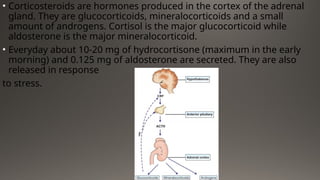
• Corticosteroids are hormones produced in the cortex of the adrenal
gland. They are glucocorticoids, mineralocorticoids and a small
amount of androgens. Cortisol is the major glucocorticoid while
aldosterone is the major mineralocorticoid.
• Everyday about 10-20 mg of hydrocortisone (maximum in the early
morning) and 0.125 mg of aldosterone are secreted. They are also
released in response
to stress.
ACTIONS
• Glucocorticoid Actions
1. Metabolic effects
Carbohydrate, protein and fat metabolism–Promotes gluconeogenesis
and glycogen deposition in the liver and inhibit peripheral utilization of
glucose. Also Promotes lipolysis and redistribution of fat takes place–fat is
mobilised from extremities and deposited over the face, neck and shoulder
2. Anti-inflammatory and immunosuppressive effects
Glucocorticoids suppress the development of inflammatory response to all
types of stimuli like chemical, mechanical and immunological stimuli.
Glucocorticoids thus suppress cell mediated immunity, prevent
manifestations
of allergy and prevent homograft rejection.
Large doses also inhibit antibody production
3. Other actions
Enhance the secretion of gastric acid and pepsin in the
stomach
Inhibit absorption and enhance the renal excretion of
calcium
4. Mineralocorticoid action
Glucocorticoids also have a weak mineralocorticoid
action–cause some salt and water retention and
potassium excretion.
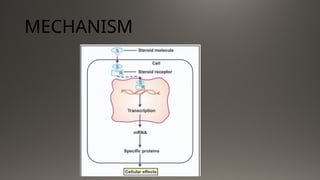
MECHANISM
PHARMACOKINETICS
• Well-absorbed orally.
• Hydrocortisone undergoes high first pass metabolism. It is 95%
bound to plasma Proteins–corticosteroid binding globulin (CBG) or
transcortin.
• Glucocorticoids are metabolised in the liver by oxidation and
reduction followed by conjugation.
• Metabolites are excreted by the kidneys.
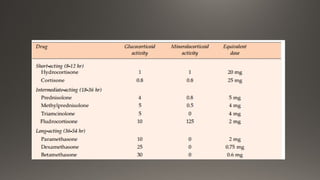
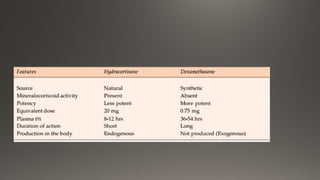
• t½ varies with each agent and we have short,intermediate and long-
acting agents
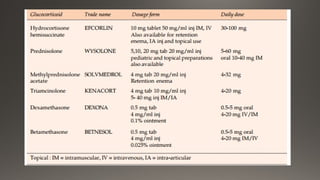
Preparations
• Glucocorticoids are given by many routes - orally, parenterally, topically,
by inhalation and nasal spray.
• They may also be injected intra-articularly.
• Hydrocortisone,----the chief natural glucocorticoid is used orally and
parenterally; in emergencies it is used intravenously
• Prednisolone - potent glucocorticoid with mild mineralocorticoid
activity. It is
the most commonly used glucocorticoid.
Topical Preparations
Several glucocorticoids like hydrocortisone, dexamethasone and
betamethasone are available for topical use as creams, ointments, nasal
and eye drops.
Some of them also contain antibiotics.
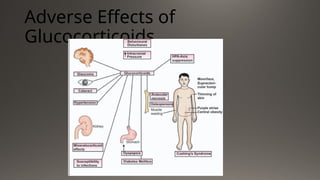
Adverse Effects of
Glucocorticoids
Uses
• I. Replacement therapy
• Acute adrenal insufficiency is an emergency condition
that could be precipitated by an infection or sudden
withdrawal of steroids. Intravenous hydrocortisone
hemisuccinate 100 mg bolus followed by infusion is given
immediately
• B. Chronic adrenal insufficiency (Addison’s disease). Oral
hydrocortisone 20-40 mg daily is given.
• C. Congenital adrenal hyperplasia Hydrocortisone and if
required
• mineralocorticoids are given daily
II. Pharmacotherapy
• 1. Rheumatoid arthritis – If 1-2 joints are involved, intra-articular injections are
preferred.
• 2. Osteoarthritis -Steroids are given as intraarticular injections with strict aseptic
precautions
• 3. Rheumatic carditis
• 4. Acute gout
• 5. Allergic diseases like angioneurotic edema,hay fever, serum sickness, contact
dermatitis,urticaria, drug reactions and anaphylaxis–steroids are indicated
• 6. Bronchial asthma
• • Acute exacerbations – a short course of prednisolone
• • Status asthmaticus – intravenous hydrocortisone hemisuccinate 100-200 mg
repeated after 8 hrs 40-60 mg per day.
• • Chronic asthma–Inhalational steroids are used and in more severe cases low dose
oral prednisolone is indicated.
• COPD– exacerbation may be treated with short course of prednisolone.
• 7. Collagen diseases--- Glucocorticoids are the first-line drugs.
Prednisolone is given for 6 weeks and tapered over another 6 weeks
• 8. Eye diseases -----Allergic conjunctivitis, uveitis, optic neuritis and
other inflammatory conditions are treated with steroid eye drops.
• 9. Renal diseases ----nephrotic syndrome are treated with steroids.
Glucocorticoids are the first line drugs
• 10. Skin diseases------ Atopic dermatitis, seborrheic dermatitis,
inflammatory dermatoses and other local skin conditions are
treated with topical steroid.
• 11. Gastrointestinal diseases -----Mild inflammatory bowel
diseases like ulcerative colitis are treated with steroid retention
enema while severe cases need oral prednisolone.
• 12. Liver diseases ----Steroids are useful in conditions like
autoimmune chronic active hepatitis and alcoholic hepatitis.
• 13. Haematologic disorders
• 14. Cerebral oedema
• 15. Malignancies
• 16. Lung diseases
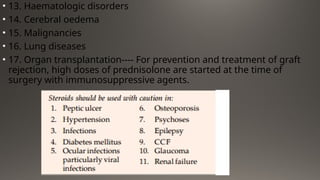
• 17. Organ transplantation---- For prevention and treatment of graft
rejection, high doses of prednisolone are started at the time of
surgery with immunosuppressive agents.
MINERALOCORTICOIDS
• Natural mineralocorticoid is aldosterone synthesized in
zona glomerulosa of the adrenal cortex
• Actions----- Mineralocorticoids promote sodium and water
retention by distal renal tubules with loss of potassium.
• Adverse effects include weight gain, oedema,hypertension
and hypokalaemia
• Fludrocortisone has predominantly mineralocorticoid
properties and is used for replacement therapy in
aldosterone deficiency as in Addison’s disease.
INHIBITORS OF ADRENAL STEROIDS
SYNTHESIS
• Metyrapone, trilastane, aminoglutethimide and ketoconazole
• These drugs inhibit the synthesis of adrenal steroids by inhibiting
certain enzymes involved in steroid synthesis.
• They are used in Cushing’s syndrome and some prostatic and breast
cancers.

ADRENAL CORTICOSTEROIDS.pptx naturopathy bnys

  • 1.
  • 2.
    • Corticosteroids arehormones produced in the cortex of the adrenal gland. They are glucocorticoids, mineralocorticoids and a small amount of androgens. Cortisol is the major glucocorticoid while aldosterone is the major mineralocorticoid. • Everyday about 10-20 mg of hydrocortisone (maximum in the early morning) and 0.125 mg of aldosterone are secreted. They are also released in response to stress.
  • 3.
    ACTIONS • Glucocorticoid Actions 1.Metabolic effects Carbohydrate, protein and fat metabolism–Promotes gluconeogenesis and glycogen deposition in the liver and inhibit peripheral utilization of glucose. Also Promotes lipolysis and redistribution of fat takes place–fat is mobilised from extremities and deposited over the face, neck and shoulder 2. Anti-inflammatory and immunosuppressive effects Glucocorticoids suppress the development of inflammatory response to all types of stimuli like chemical, mechanical and immunological stimuli. Glucocorticoids thus suppress cell mediated immunity, prevent manifestations of allergy and prevent homograft rejection. Large doses also inhibit antibody production
  • 4.
    3. Other actions Enhancethe secretion of gastric acid and pepsin in the stomach Inhibit absorption and enhance the renal excretion of calcium 4. Mineralocorticoid action Glucocorticoids also have a weak mineralocorticoid action–cause some salt and water retention and potassium excretion.
  • 5.
  • 6.
    PHARMACOKINETICS • Well-absorbed orally. •Hydrocortisone undergoes high first pass metabolism. It is 95% bound to plasma Proteins–corticosteroid binding globulin (CBG) or transcortin. • Glucocorticoids are metabolised in the liver by oxidation and reduction followed by conjugation. • Metabolites are excreted by the kidneys. • t½ varies with each agent and we have short,intermediate and long- acting agents
  • 10.
    Preparations • Glucocorticoids aregiven by many routes - orally, parenterally, topically, by inhalation and nasal spray. • They may also be injected intra-articularly. • Hydrocortisone,----the chief natural glucocorticoid is used orally and parenterally; in emergencies it is used intravenously • Prednisolone - potent glucocorticoid with mild mineralocorticoid activity. It is the most commonly used glucocorticoid. Topical Preparations Several glucocorticoids like hydrocortisone, dexamethasone and betamethasone are available for topical use as creams, ointments, nasal and eye drops. Some of them also contain antibiotics.
  • 11.
  • 12.
    Uses • I. Replacementtherapy • Acute adrenal insufficiency is an emergency condition that could be precipitated by an infection or sudden withdrawal of steroids. Intravenous hydrocortisone hemisuccinate 100 mg bolus followed by infusion is given immediately • B. Chronic adrenal insufficiency (Addison’s disease). Oral hydrocortisone 20-40 mg daily is given. • C. Congenital adrenal hyperplasia Hydrocortisone and if required • mineralocorticoids are given daily
  • 13.
    II. Pharmacotherapy • 1.Rheumatoid arthritis – If 1-2 joints are involved, intra-articular injections are preferred. • 2. Osteoarthritis -Steroids are given as intraarticular injections with strict aseptic precautions • 3. Rheumatic carditis • 4. Acute gout • 5. Allergic diseases like angioneurotic edema,hay fever, serum sickness, contact dermatitis,urticaria, drug reactions and anaphylaxis–steroids are indicated • 6. Bronchial asthma • • Acute exacerbations – a short course of prednisolone • • Status asthmaticus – intravenous hydrocortisone hemisuccinate 100-200 mg repeated after 8 hrs 40-60 mg per day. • • Chronic asthma–Inhalational steroids are used and in more severe cases low dose oral prednisolone is indicated. • COPD– exacerbation may be treated with short course of prednisolone.
  • 14.
    • 7. Collagendiseases--- Glucocorticoids are the first-line drugs. Prednisolone is given for 6 weeks and tapered over another 6 weeks • 8. Eye diseases -----Allergic conjunctivitis, uveitis, optic neuritis and other inflammatory conditions are treated with steroid eye drops. • 9. Renal diseases ----nephrotic syndrome are treated with steroids. Glucocorticoids are the first line drugs • 10. Skin diseases------ Atopic dermatitis, seborrheic dermatitis, inflammatory dermatoses and other local skin conditions are treated with topical steroid. • 11. Gastrointestinal diseases -----Mild inflammatory bowel diseases like ulcerative colitis are treated with steroid retention enema while severe cases need oral prednisolone. • 12. Liver diseases ----Steroids are useful in conditions like autoimmune chronic active hepatitis and alcoholic hepatitis.
  • 15.
    • 13. Haematologicdisorders • 14. Cerebral oedema • 15. Malignancies • 16. Lung diseases • 17. Organ transplantation---- For prevention and treatment of graft rejection, high doses of prednisolone are started at the time of surgery with immunosuppressive agents.
  • 16.
    MINERALOCORTICOIDS • Natural mineralocorticoidis aldosterone synthesized in zona glomerulosa of the adrenal cortex • Actions----- Mineralocorticoids promote sodium and water retention by distal renal tubules with loss of potassium. • Adverse effects include weight gain, oedema,hypertension and hypokalaemia • Fludrocortisone has predominantly mineralocorticoid properties and is used for replacement therapy in aldosterone deficiency as in Addison’s disease.
  • 17.
    INHIBITORS OF ADRENALSTEROIDS SYNTHESIS • Metyrapone, trilastane, aminoglutethimide and ketoconazole • These drugs inhibit the synthesis of adrenal steroids by inhibiting certain enzymes involved in steroid synthesis. • They are used in Cushing’s syndrome and some prostatic and breast cancers.