SKELETAL MUSCLE
RELAXANTS
By: Mrs. Kalaivani Sathish, M. Pharm
Assistant Professor,
PIMS - PANIPAT
INTRODUCTION
• SMRs are drugs that reduce the muscle
tone either by acting peripherally at the
neuromuscular junction or centrally in the
cerebrospinal axis or directly on the
contractile mechanism. They reduce the
spasticity in a variety of neurological
conditions and are also useful in surgeries.
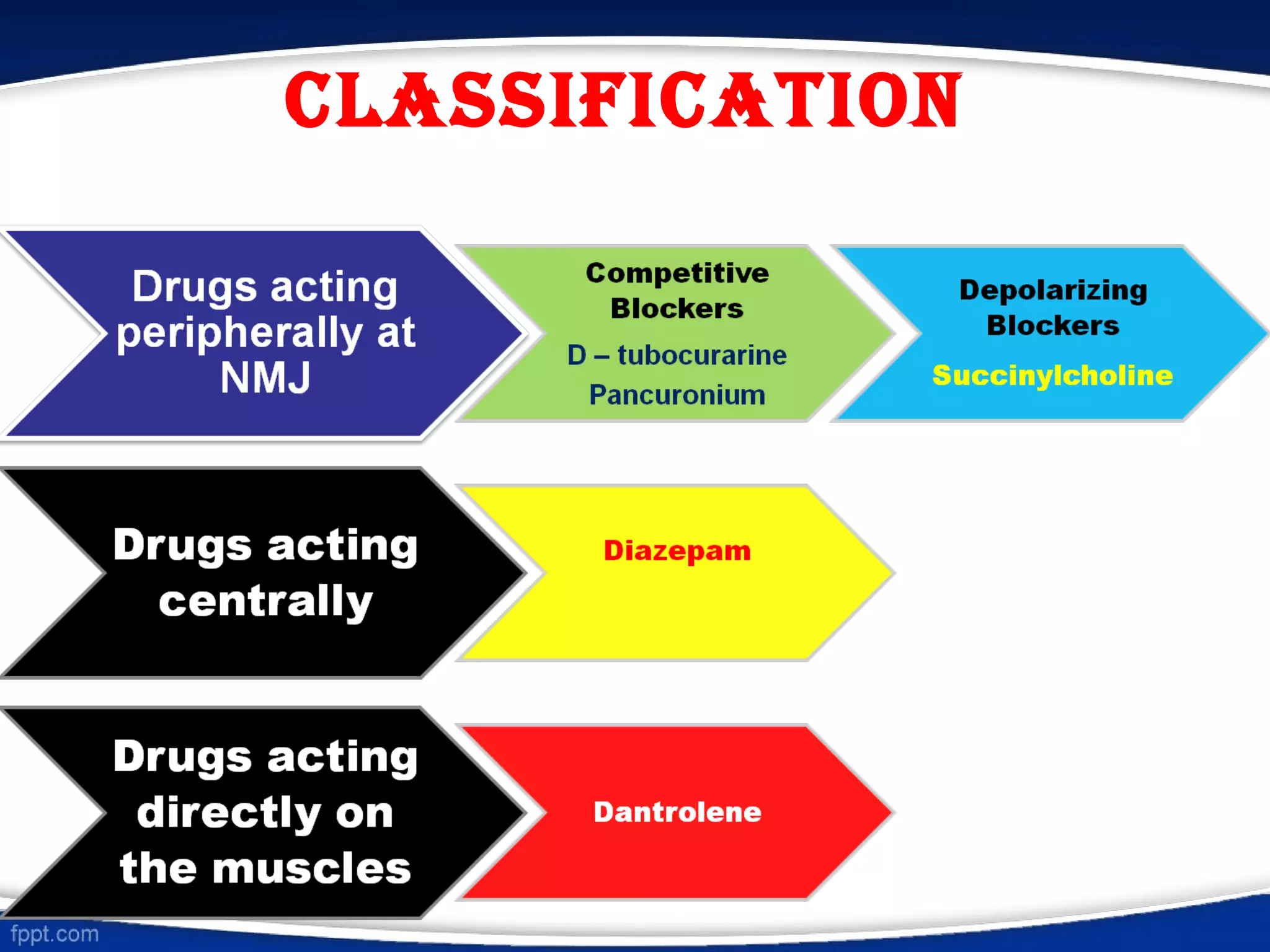
CLASSIFICATION
PERIPHERALLY ACTING
SKELETAL MUSCLE
RELAXANTS
• NEUROMUSCULAR BLOCKERS (NMB)
• Competitive Blockers
D – Tubocurarine (d-Tc) is obtained from the
plant Chondrodendrum tomentosum.
It is a quaternary ammonium compounds
because of which they are not well-
absorbed and are quickly excreted.
MECHANISM OF
ACTION
• Non depolarizing blockers binds to
nicotinic receptors
• Blocks the action of Ach
PHARMACOLOGICAL ACTION OF
TUBOCURARINE
• Skeletal muscles: On parenteral administration,
tubocurarine initially causes muscular weakness
followed by flaccid paralysis.
• Autonomic Ganglia: in high doses tubocurarine can
block autonomic ganglia and adrenal medulla and
causes hypotension.
• Histamine Release – Bronchospasm, ↑ed tracheo
bronchial and gastric secretions occurs due to the
release of histamine. This in turn leads to hypotension.
PHARMACOKINETICS
&
ADVERSE EFFECTS
• Pharmacokinetics – D – Tc is a quaternary
compound, hence not absorbed orally. It is given
in IM or IV.
• Adverse Effects – Respiratory Paralysis,
Prolonged apnea, Hypotension, Flushing and
bronchospasm.
• Neostigmine is used to treat toxicity as it reverse
the skeletal muscle paralysis and it is the antidote
in Curare poisoning. Anti histamines are given to
counter effect of histamine.
• TREATMENT OF TOXICITY:
• Neostigmine may be used to reverse the skeletal
muscle paralysis and it is the antidote in curare
poisoning .anti histamine give to counter the effect
of histamine.
• Synthetic competitive blocker :
• Pancuronium, vecuronium, atracuronium, have
intermediate onset ( 2 – 4 minutes ) while
rapacuronium and rocuronium have fast onset of
action ( 1 – 2 minutes ) .
Depolarising Blocker
• Succinyl choline is a quaternary ammonium
compound with the struture resembling two
molecules of acetyl choline joined together.
• Mechanism of action :
• The neuromusular effects of SCh are like those of
Ach .SCh stimulate the nicitinic receptor and
depolarise the skeletal muscle membrane. But,
unlike Ach succinyl choline is destroyed very
slowly by pseudocholinesterase . Presence of the
drug causes peristant depolarisation resulting
flaccid paralysis .
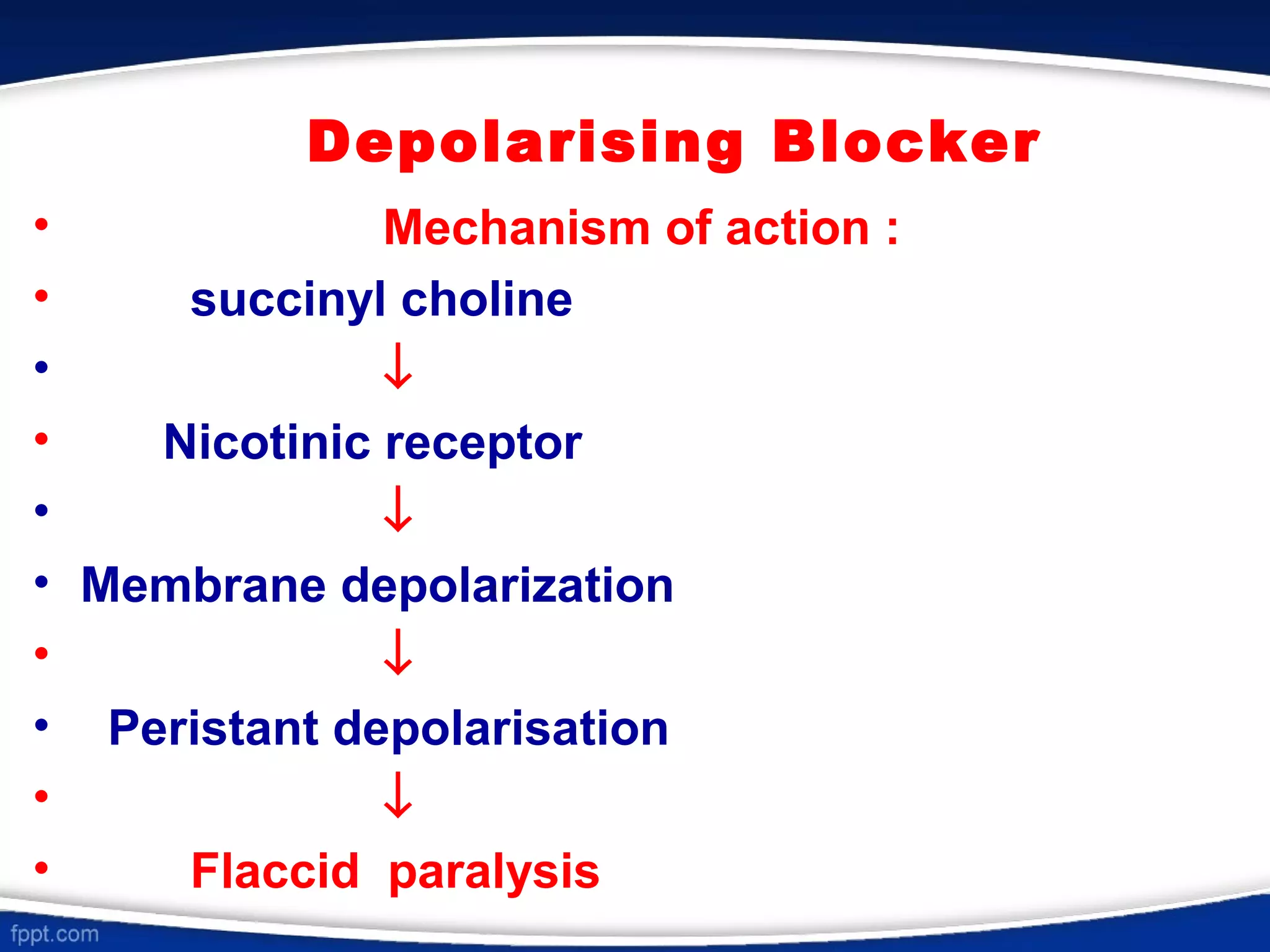
Depolarising Blocker
• Mechanism of action :
• succinyl choline
• ↓
• Nicotinic receptor
• ↓
• Membrane depolarization
• ↓
• Peristant depolarisation
• ↓
• Flaccid paralysis
Depolarising Blocker
• Pharmacological action
• skeletal muscle:
• On IV administration onset of action is very rapid –
with in 1 minute.Initial transient muscular
fasciculation and twitching, mostly in the chest
and abdominal regions are followed by skeletal
muscle paralysis.
• CVS:
• Initially hypotension and bradycardia may result
from stimulation of vagal ganglia .this is followed
by hypertension and tachycardia due to
stimulation of sympathetic ganglia.
Depolarising Blocker
• Pharmacokinetics :
• SCh is rapidly hydrolysed by
pseudocholinesterase - hence it is short acting
about 5 min.heriditary defect such people ,SCh
does not metabolized even the usual dose result
prolonged apnea and paralysis .Artificial
ventilation and fresh blood transfusion are needed
to supply pseudocholinesterase.
•
Depolarising Blocker
• Adverse effect:
• Post operative muscle pain is acommon AE of SCh
.
• Hyper kalemia :
• Depolarizing blocker can cause hyperkalemia due
to sudden release of K from thhe intracellular
sites.
• Cardiac arrhythmias :
• SCh can cause cardiac arrhythmias.
•
Depolarising Blocker
• Adverse effect:
• Malignant hyperthermia :
• It is a rare genetically determined condition where
there is a sudden↑ in the body temperature and
severe muscle spasm due to release of
intracellular Ca from the sacroplasmic reticulam.
• Drug interaction :
• 1. GA augment the action of SMRs.
• 2.Anticholinesterase like neostigmine reverse the
action of competitive blockers.
• 3.Aminoglycoside and calcium channel blocker
potentiate the action of SMRs.
Drugs acting peripherally at NMJ
1. Adjuvant to anesthesia :
Adequate muscle relaxation is essential during
surgeries.SMR are used as adjuants to GA.
2. In ECT (Electroconvulsive Therapy)
SMR protects the patient from convulsion and
trauma during ECT.
3. In Spastic Disorder: SMR are used to overcome
the spasm of tetanus.
4. In Minor Procedure:  SMR are useful in
laryngoscopy, bronchoscopy and esophagoscopy.
Drugs acting peripherally at NMJ
5. Status Epilepticus – Used with anticonvulsant
drug.
6. Ventilators: SMR are used to enhance artificial
respiration.
CENTRALLY ACTING MUSCLE RELAXANTS
These drugs acts on higher centre and cause muscle
relaxation without loss of consciousness. They also have
sedative properties.
CENTRALLY ACTING MUSCLE
RELAXANTS
MEChANISM of ACTIoN
CAMR
↓
Depress the polysynaptic reflexes (This reflex
maintains muscle tone)
↓
Muscle tone decreases
• DIAZEPAM - It has useful antispastic
activity. Can be used in relieving muscle
spasm and muscle trauma.
• BACLofEN – It is a GABA –B Agonist. It
depress the mono synaptic and polysypnatic
reflexes in the spinal cord. It also relieves
painful spasm.
• Uses: Musculo skeletal disorder, Sprain,
Myalgia, Low backache, Arthritis etc.
– Spastic Neurological disorder - Polio,
hemiplegia, quadriplegia are treated wil
diazepam or baclofen.
• Tetanus – Diazepam given IV.
• ECT – Diazepam given along with
peripherally acting SMR.
• Orthopaedic – Used for fracture
reduction.
DIRECTLY ACTING MUSCLE
RELAXANTS
It directly affects the skeletal muscles
contractile mechanism.
It inhibits the muscle contraction by
preventing Ca release
• Adverse Effects – It includes
– Drowsiness, Dizziness, Fatigue, Muscle
weakness, rarely hepato toxicity.
Uses: In spastic disorders like hemiplegia and
paraplegia, Spinal injury, Multiple Sclerosis
and cerebral palsy.
Nursing Implications:
Monitor respiration while on SMR.
Do not withdraw the drugs suddenly
Patient should avoid driving while taking drugs.

Smooth muscle relaxants

  • 1.
    SKELETAL MUSCLE RELAXANTS By: Mrs.Kalaivani Sathish, M. Pharm Assistant Professor, PIMS - PANIPAT
  • 2.
    INTRODUCTION • SMRs aredrugs that reduce the muscle tone either by acting peripherally at the neuromuscular junction or centrally in the cerebrospinal axis or directly on the contractile mechanism. They reduce the spasticity in a variety of neurological conditions and are also useful in surgeries.
  • 3.
  • 4.
    PERIPHERALLY ACTING SKELETAL MUSCLE RELAXANTS •NEUROMUSCULAR BLOCKERS (NMB) • Competitive Blockers D – Tubocurarine (d-Tc) is obtained from the plant Chondrodendrum tomentosum. It is a quaternary ammonium compounds because of which they are not well- absorbed and are quickly excreted.
  • 5.
    MECHANISM OF ACTION • Nondepolarizing blockers binds to nicotinic receptors • Blocks the action of Ach
  • 6.
    PHARMACOLOGICAL ACTION OF TUBOCURARINE •Skeletal muscles: On parenteral administration, tubocurarine initially causes muscular weakness followed by flaccid paralysis. • Autonomic Ganglia: in high doses tubocurarine can block autonomic ganglia and adrenal medulla and causes hypotension. • Histamine Release – Bronchospasm, ↑ed tracheo bronchial and gastric secretions occurs due to the release of histamine. This in turn leads to hypotension.
  • 7.
    PHARMACOKINETICS & ADVERSE EFFECTS • Pharmacokinetics– D – Tc is a quaternary compound, hence not absorbed orally. It is given in IM or IV. • Adverse Effects – Respiratory Paralysis, Prolonged apnea, Hypotension, Flushing and bronchospasm. • Neostigmine is used to treat toxicity as it reverse the skeletal muscle paralysis and it is the antidote in Curare poisoning. Anti histamines are given to counter effect of histamine.
  • 8.
    • TREATMENT OFTOXICITY: • Neostigmine may be used to reverse the skeletal muscle paralysis and it is the antidote in curare poisoning .anti histamine give to counter the effect of histamine. • Synthetic competitive blocker : • Pancuronium, vecuronium, atracuronium, have intermediate onset ( 2 – 4 minutes ) while rapacuronium and rocuronium have fast onset of action ( 1 – 2 minutes ) .
  • 9.
    Depolarising Blocker • Succinylcholine is a quaternary ammonium compound with the struture resembling two molecules of acetyl choline joined together. • Mechanism of action : • The neuromusular effects of SCh are like those of Ach .SCh stimulate the nicitinic receptor and depolarise the skeletal muscle membrane. But, unlike Ach succinyl choline is destroyed very slowly by pseudocholinesterase . Presence of the drug causes peristant depolarisation resulting flaccid paralysis .
  • 10.
    Depolarising Blocker • Mechanismof action : • succinyl choline • ↓ • Nicotinic receptor • ↓ • Membrane depolarization • ↓ • Peristant depolarisation • ↓ • Flaccid paralysis
  • 11.
    Depolarising Blocker • Pharmacologicalaction • skeletal muscle: • On IV administration onset of action is very rapid – with in 1 minute.Initial transient muscular fasciculation and twitching, mostly in the chest and abdominal regions are followed by skeletal muscle paralysis. • CVS: • Initially hypotension and bradycardia may result from stimulation of vagal ganglia .this is followed by hypertension and tachycardia due to stimulation of sympathetic ganglia.
  • 12.
    Depolarising Blocker • Pharmacokinetics: • SCh is rapidly hydrolysed by pseudocholinesterase - hence it is short acting about 5 min.heriditary defect such people ,SCh does not metabolized even the usual dose result prolonged apnea and paralysis .Artificial ventilation and fresh blood transfusion are needed to supply pseudocholinesterase. •
  • 13.
    Depolarising Blocker • Adverseeffect: • Post operative muscle pain is acommon AE of SCh . • Hyper kalemia : • Depolarizing blocker can cause hyperkalemia due to sudden release of K from thhe intracellular sites. • Cardiac arrhythmias : • SCh can cause cardiac arrhythmias. •
  • 14.
    Depolarising Blocker • Adverseeffect: • Malignant hyperthermia : • It is a rare genetically determined condition where there is a sudden↑ in the body temperature and severe muscle spasm due to release of intracellular Ca from the sacroplasmic reticulam. • Drug interaction : • 1. GA augment the action of SMRs. • 2.Anticholinesterase like neostigmine reverse the action of competitive blockers. • 3.Aminoglycoside and calcium channel blocker potentiate the action of SMRs.
  • 15.
    Drugs acting peripherallyat NMJ 1. Adjuvant to anesthesia : Adequate muscle relaxation is essential during surgeries.SMR are used as adjuants to GA. 2. In ECT (Electroconvulsive Therapy) SMR protects the patient from convulsion and trauma during ECT. 3. In Spastic Disorder: SMR are used to overcome the spasm of tetanus. 4. In Minor Procedure:  SMR are useful in laryngoscopy, bronchoscopy and esophagoscopy.
  • 16.
    Drugs acting peripherallyat NMJ 5. Status Epilepticus – Used with anticonvulsant drug. 6. Ventilators: SMR are used to enhance artificial respiration. CENTRALLY ACTING MUSCLE RELAXANTS These drugs acts on higher centre and cause muscle relaxation without loss of consciousness. They also have sedative properties.
  • 17.
    CENTRALLY ACTING MUSCLE RELAXANTS MEChANISMof ACTIoN CAMR ↓ Depress the polysynaptic reflexes (This reflex maintains muscle tone) ↓ Muscle tone decreases
  • 18.
    • DIAZEPAM -It has useful antispastic activity. Can be used in relieving muscle spasm and muscle trauma. • BACLofEN – It is a GABA –B Agonist. It depress the mono synaptic and polysypnatic reflexes in the spinal cord. It also relieves painful spasm. • Uses: Musculo skeletal disorder, Sprain, Myalgia, Low backache, Arthritis etc. – Spastic Neurological disorder - Polio, hemiplegia, quadriplegia are treated wil diazepam or baclofen.
  • 19.
    • Tetanus –Diazepam given IV. • ECT – Diazepam given along with peripherally acting SMR. • Orthopaedic – Used for fracture reduction. DIRECTLY ACTING MUSCLE RELAXANTS It directly affects the skeletal muscles contractile mechanism. It inhibits the muscle contraction by preventing Ca release
  • 20.
    • Adverse Effects– It includes – Drowsiness, Dizziness, Fatigue, Muscle weakness, rarely hepato toxicity. Uses: In spastic disorders like hemiplegia and paraplegia, Spinal injury, Multiple Sclerosis and cerebral palsy. Nursing Implications: Monitor respiration while on SMR. Do not withdraw the drugs suddenly Patient should avoid driving while taking drugs.