
STEAM STERILIZATION
( AUTO CLAVING)
Prof.Nagamani.T
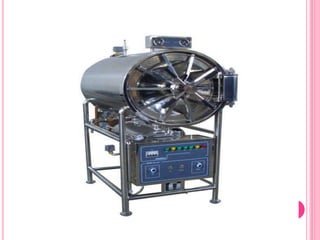
Steam sterilization (also called
autoclaving) is conducted in an
autoclave which is a container that
can with stand high pressure and
temperature.
Steam sterilization is typically
conducted at the hospital or clinical
for reusable devices.
Using steam is one of the most
reliable sterilization methods.
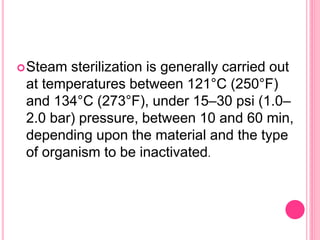
Steam sterilization is generally carried out
at temperatures between 121°C (250°F)
and 134°C (273°F), under 15–30 psi (1.0–
2.0 bar) pressure, between 10 and 60 min,
depending upon the material and the type
of organism to be inactivated.
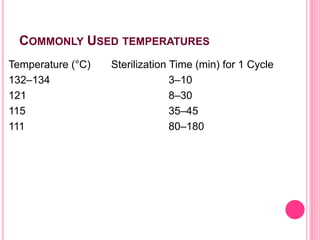
COMMONLY USED TEMPERATURES
Temperature (°C) Sterilization Time (min) for 1 Cycle
132–134 3–10
121 8–30
115 35–45
111 80–180
INSTRUCTIONS
 Do not over load the autoclave.
 Use appropriate temperature and pressure. The
lower the temperature, the longer the exposure time
required for sterilization.
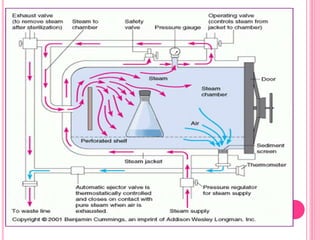
 Remove all the air from the autoclave before
introducing steam because air is heavier than
steam and will reduce the steam concentration (and
hence the effectiveness) of the sterilization.
 Dynamic air removal has been shown to be more
efficient because the machine can pump in
conditioning air
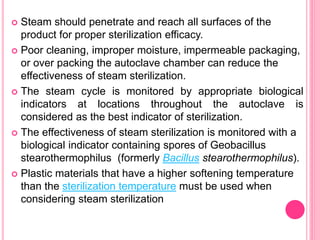
 Steam should penetrate and reach all surfaces of the
product for proper sterilization efficacy.
 Poor cleaning, improper moisture, impermeable packaging,
or over packing the autoclave chamber can reduce the
effectiveness of steam sterilization.
 The steam cycle is monitored by appropriate biological
indicators at locations throughout the autoclave is
considered as the best indicator of sterilization.
 The effectiveness of steam sterilization is monitored with a
biological indicator containing spores of Geobacillus
stearothermophilus (formerly Bacillus stearothermophilus).
 Plastic materials that have a higher softening temperature
than the sterilization temperature must be used when
considering steam sterilization
PROCEDURE
 All the instruments must be properly washed and dried.
 Pack each tray according to the hospital procedures.
 Fill the boiler chamber with sufficient amount of water.
 Put on the autoclave switch
 A draw down vacuum is used to remove the conditioning
air cycles from the packaged product and the chamber.
 Ambient air is removed from the chamber in what is
known as a ‘pre-vac’ cycle, which is typically a series of
pressure and vacuum excursions.
 These serial staged cycles provide the time and
conditions necessary to ensure the entrapped chamber
atmosphere can be withdrawn from within the package
and from within the product itself.
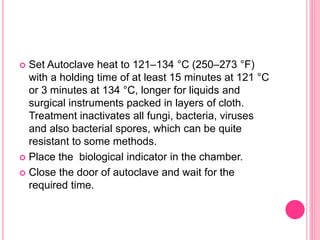
 Set Autoclave heat to 121–134 °C (250–273 °F)
with a holding time of at least 15 minutes at 121 °C
or 3 minutes at 134 °C, longer for liquids and
surgical instruments packed in layers of cloth.
Treatment inactivates all fungi, bacteria, viruses
and also bacterial spores, which can be quite
resistant to some methods.
 Place the biological indicator in the chamber.
 Close the door of autoclave and wait for the
required time.
 After completion of the specified time reduce the
pressure valve and wait for the steam to completely
evaporate.
 When the gauze shows ‘0’level, open the door on
the other side of the autoclave on the sterile area.
 Unload the autoclave and store the sterilized trays
in the sterile cabins.
 Check for the color change of the biological
indicator for effectiveness of the procedure.
 Record the date and time along with the batch for
future references.
ADVANTAGES
 Efficient method to destroy micro organisms.
 Cheap cost, so econimal to use.
 microbicidal, sporicidal, nontoxic
 Easy and safe to use.
 Moist heat kills microorganisms by irreversible
coagulation and denaturation of enzymes and structural
proteins.
 This process of sterilization rapidly destroys resistant
strains spores, however, there are limitations.
DIS ADVANTAGES
 This method damages many plastics, electronics,
fibre optics and biological materials. So, check for
the instructions on the material regarding the
sterilization.
 Careful monitoring is required for measurement of
water level, temperature and pressure.
 Skilled personnel required to handle the autoclave.
Thank You