STERILIZATION
STERILIZATION
100% removal and killing of micro organisms.
OR
Sterilization is making a substance free from all
micro organisms both in vegetative and sporing
state.
TERMS USED IN STERILIZATION
 Disinfection
 Antisepsis
 Bactericidal agents/germicides
 Bacteriostatic agents
 Cleaning
 Decontamination
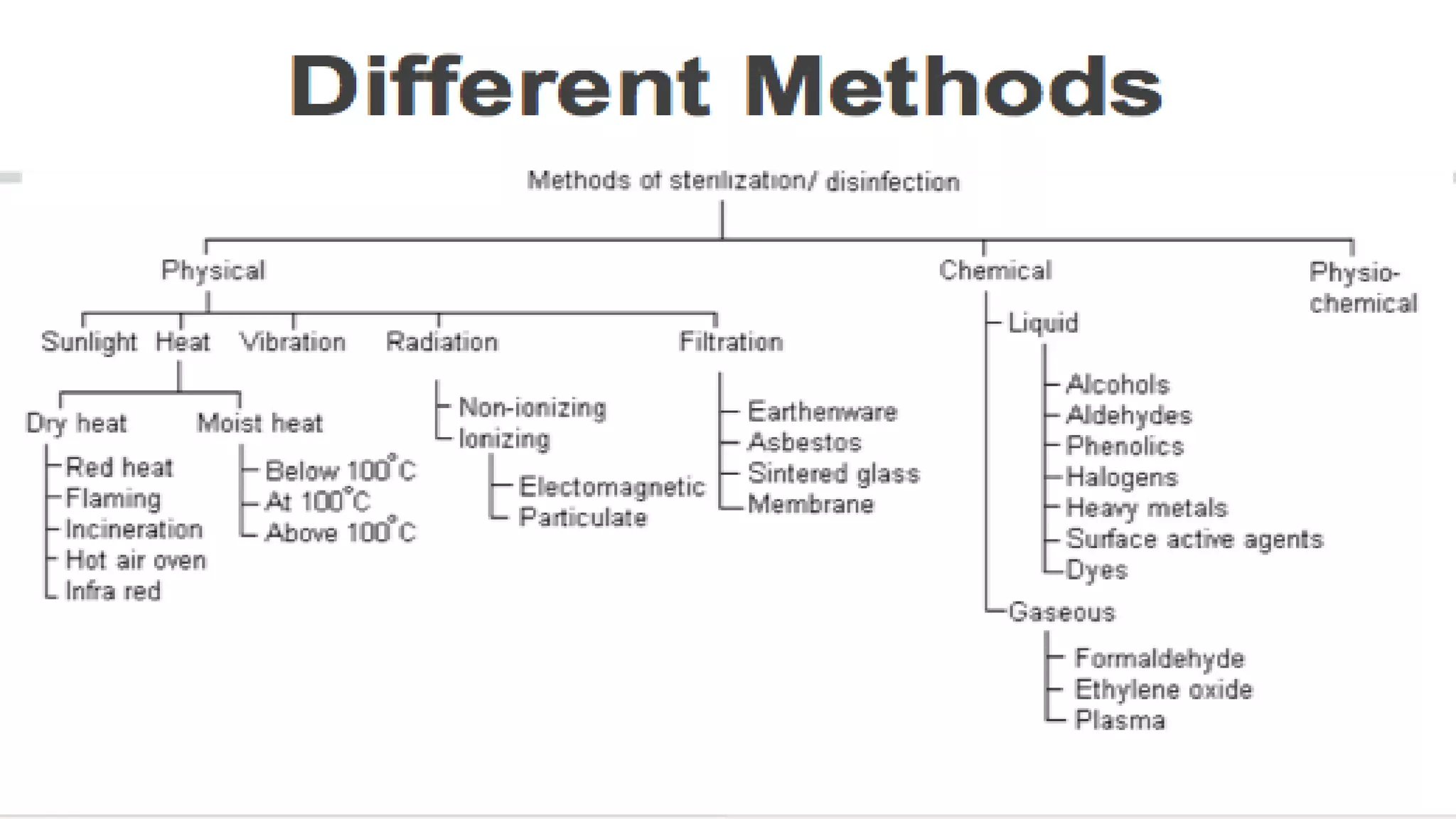
SUNLIGHT
 Actions primarily due to ultraviolet rays,effect vary due to
places
 Bacteria in water are readily absorbed by sunlight.
DRYING
 Moisture is essential for growth of bacteria.
 Drying in air has deleterious effect on many bacteria.
 However,spores are unaffected.
 Therefore,it is not really unrealible.
HEAT
 Most realible method of sterilization.
DRY HEAT
 Heating over fire till they become red hot.
 Instruments like : point of forceps,spatulas,inoculating
loops,wires.
INCENERATION
 Destruction of something usually waste material by burning.
 ITEMS : Contaminated cloth, PVC
 Polystyrene will emit black smoke. Hence should be
autoclaved in appropriate container.
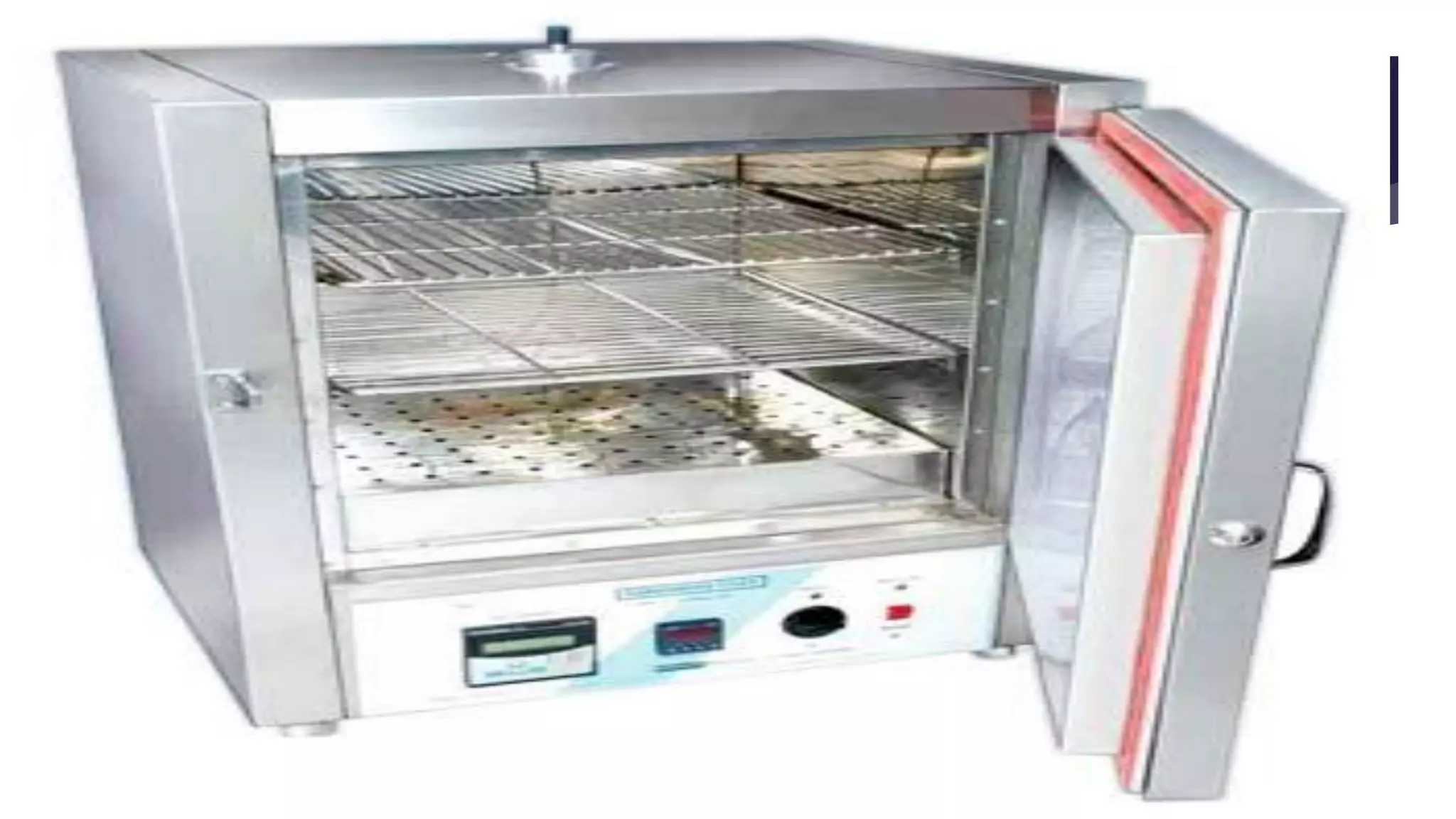
HOT AIR OVEN
 The oven uses dry heat to sterilize articles.
 Articles to be sterilized are exposed to high temperature (160o
C) for duration of one hour in an electrically heated oven.
 Since air is poor conductor of heat, even distribution of heat
throughout the chamber is achieved by a fan
 There is thermostat controlling the temperature.
 This is the most widely used method of sterilization.
 ITEMS: glass wares, forceps, scissors, liquid paraffin.
 Glasswares should be dry.
 Articles are to be arranged in a a manner to
allow free circulation of air.
 holding times are :
 60 minutes at 160oC,
 40 minutes at 170oC and
 20 minutes at 180oC.
ADVANTAGES AND DISADVANTAGES
 Advantages: It is an effective method of sterilization of heat stable
articles. The articles remain dry after sterilization.
 This is the only method of sterilizing oils and powders.
 Disadvantages:
 Since air is poor conductor of heat, hot air has poor penetration.
 Cotton wool and paper may get slightly charred.
 Glasses may become smoky.
 Takes longer time compared to autoclave.
Moist Heat
 Temperature below 100 C ( Serum Bath,Vaccum
Bath,Pasteurization)
 Temperature above 100 C ( Autoclaving)
 Temperature at 100 C ( Boiling)
BOILING
Not recommended for sterilization but used for disinfection.
Sterilization may be promoted by addition of 2% sodium bicarbonate
to water.
HOLDING PERIOD: 100C, 20 minutes or 3 successive days.
Above 100 0c
 AUTOCLAVING
 Autoclave is a device that uses steam to sterilize
equipment and other objects.
 All bacteria,fungi and spores are inactivated.
 Prions may be killed by autoclaving at the typical 134 C
for 3 minutes or 121 C for 15 minutes.
PRINCIPLE
Water boils when its vapour pressure becomes equal to
surrounding atmospheric pressure.Thus,when pressure inside
closed vessel increases,the temperature at which water boils
increases too.
Below 100 0c
pasteurization
There are two methods of pasteurization,
 the holder method (heated at 63oC for 30 minutes) and
 flash method (heated at 72oC for 15 seconds) followed
by quickly cooling to 13oC.
 Other pasteurization methods include Ultra-High
Temperature (UHT), 140oC for 15 sec and 149oC for 0.5
sec. This method is suitable to destroy most milk borne
pathogens like Salmonella, Mycobacteria,
 Vaccine bath: The contaminating bacteria in a vaccine preparation can
be inactivated by heating in a water bath at 60oC for one hour. Only
vegetative bacteria are killed and spores survive.
 Serum bath: The contaminating bacteria in a serum preparation can be
inactivated by heating in a water bath at 56oC for one hour on several
successive days.
 Proteins in the serum will coagulate at higher temperature.
 Only vegetative bacteria are killed and spores survive
FILTERATION
 Help to remove bacteria from heat liable liquids.
 Examples Sera or solution of sugar or antibiotics.
PRINCIPLE
 All viruses passes through the ordinary filters,filteration can be used
to obtain bacteria free filtrates of clinical samples for virus isolation.
TYPES OF FILTERS
 Candle filters ( Used for purification of water for industrial and
drinking purposes)
 Asbestos filters ( Disposable,Single glass disc.Tend to alkalanise
filtered liquid)
 Sintered glass filters ( Low absorptive properties, Expensive)
 Membrane filters ( Made of cellulose esters and polymers, used for
water purification)
RADIATION
 Non-Ionizing radiation ( Infrared used for sterilization of
syringes,catheters), UV
 Disadvantages of using UV rays include low penetrative power,
 limited life of the UV bulb, some bacteria have DNA repair enzymes that
can overcome damage caused by UV rays
 rays are harmful to skin and eyes. It doesn't penetrate glass, paper or
plastic.
 Ionizing Radiation ( Gamma rays, X rays)
Ionizing rays
 Ionizing rays are of two types, particulate and electromagnetic rays.
 Electron beams are particulate in nature.
 High speed electrons are produced by a linear accelerator from a heated cathode.
Electron beams are employed to sterilize articles like syringes, gloves, dressing packs,
foods and pharmaceuticals.
 Sterilization is accomplished in few seconds. Unlike electromagnetic rays, the
instruments can be switched off. Disadvantage includes poor penetrative power
Electromagnetic rays
 gamma rays emanate from nuclear disintegration of certain radioactive isotopes
(Co60, Cs137).
 They have more penetrative power than electron beam but require longer time of
exposure.
 These high-energy radiations damage the nucleic acid of the microorganism.
 It is used commercially to sterilize disposable petri dishes, plastic syringes,
antibiotics, vitamins, hormones, glassware and fabrics.
 Disadvantages include; unlike electron beams, instruments can’t be switched off,
 glass wares tend to become brownish, loss of tensile strength in fabric.
Chemical Method
 Chemical agents
 Alcohol ( isopropyl alcohol, Ethyl alcohol)
 Aldehyde Acts through alkylation of amino-, carboxyl- or hydroxyl group,
and probably damages nucleic acids. It kills all microorganisms, including
spores.
 Glutaldehyde ( Effective against fungi,viruses,bacilli.Irritant to eyes)
 Halogens ( Iodine, Chlorine)
 PhenolsAc t by :::
Act by disruption of membranes, precipitation of proteins and
inactivation of enzymes.
GASES
Ethylene Oxide
Formaldehyde gas
Beta propiolactone (BPL)
HYDROGEN PEROXIDE:
 Mode of action: It acts on the microorganisms through its release of nascent oxygen.
Hydrogen peroxide produces hydroxyl-free radical that damages proteins and DNA.
 Application: It is used at 6% concentration to decontaminate the instruments,
equipments such as ventilators
 DYES:
 Mode of action:Acridine dyes are bactericidal because of their interaction with
bacterial nucleic acids.
 Examples: Aniline dyes such as crystal violet, malachite green and brilliant green.
Acridine dyes such as acriflavin
 Applications: They may be used topically as antiseptics to treat mild burns. They are
used as paint on the skin to treat bacterial skin infections
Surface Active Agents
 Substance that alter the energy relationship at interfaces,producing
a reduction of surface or interfacial tension is called surface active
agents.
 These are widely used as wetting agents,detergents and
emulsifiers.
 There are 4 main groups
 Anionic
 Cationic
 Non ionic
 Amphoteric
BETA-PROPIOLACTONE (BPL):
 Mode of action: It is an alkylating agent and acts through alkylation of carboxyl-
and hydroxyl- groups.
 Properties: It is a colorless liquid with pungent to slightly sweetish smell.
 Application: It is an effective sporicidal agent, and has broad-spectrum activity.
0.2% is used to sterilize biological products. It is more efficient in fumigation that
formaldehyde. It is used to sterilize vaccines, tissue grafts, surgical instruments
and enzymes
 Disadvantages: It has poor penetrating power and is a carcinogen.
METALLIC SALTS
 All salts have a certain amount of germicidal action
depending on their concentration,salts of heavy metals
have a greater action.
 Examples
 Salts of silver,copper,mercury.
Advantages of heat sterilization
 Sterilization is very effective
 Instrumentsare standardized to deliver the required effective heat
 Heat deliver system can be monitored effectively with various
controls like pressure gauge, temperature meters etc4. Established
quality control methods available
Disadvantages
 Steam impermeable materials like fats, oils and powders can not
be sterilized by autoclaving.
 Heat sensitive materials can not be sterilized by heat
CONCLUSION
 Sterilization is the most important procedure.
 Hints are given to perform surgeries under aseptic
conditions.
 Sterilization has major share in success of surgical
management.
 An attempt to evolve Ayurvedic sterilization procedures
is absolute necessity.
REFERENCES
 https://www.your-life.com/en/contraception-
methods/other-methods/sterilization.
 https://en.wikipedia.org/wiki/Sterilization_(medicine).
STERILIZATION.pdf

STERILIZATION.pdf

  • 1.
  • 2.
    STERILIZATION 100% removal andkilling of micro organisms. OR Sterilization is making a substance free from all micro organisms both in vegetative and sporing state.
  • 3.
    TERMS USED INSTERILIZATION  Disinfection  Antisepsis  Bactericidal agents/germicides  Bacteriostatic agents  Cleaning  Decontamination
  • 5.
    SUNLIGHT  Actions primarilydue to ultraviolet rays,effect vary due to places  Bacteria in water are readily absorbed by sunlight. DRYING  Moisture is essential for growth of bacteria.  Drying in air has deleterious effect on many bacteria.  However,spores are unaffected.  Therefore,it is not really unrealible.
  • 6.
    HEAT  Most realiblemethod of sterilization. DRY HEAT  Heating over fire till they become red hot.  Instruments like : point of forceps,spatulas,inoculating loops,wires. INCENERATION  Destruction of something usually waste material by burning.  ITEMS : Contaminated cloth, PVC  Polystyrene will emit black smoke. Hence should be autoclaved in appropriate container.
  • 7.
    HOT AIR OVEN The oven uses dry heat to sterilize articles.  Articles to be sterilized are exposed to high temperature (160o C) for duration of one hour in an electrically heated oven.  Since air is poor conductor of heat, even distribution of heat throughout the chamber is achieved by a fan  There is thermostat controlling the temperature.  This is the most widely used method of sterilization.  ITEMS: glass wares, forceps, scissors, liquid paraffin.
  • 9.
     Glasswares shouldbe dry.  Articles are to be arranged in a a manner to allow free circulation of air.  holding times are :  60 minutes at 160oC,  40 minutes at 170oC and  20 minutes at 180oC.
  • 10.
    ADVANTAGES AND DISADVANTAGES Advantages: It is an effective method of sterilization of heat stable articles. The articles remain dry after sterilization.  This is the only method of sterilizing oils and powders.  Disadvantages:  Since air is poor conductor of heat, hot air has poor penetration.  Cotton wool and paper may get slightly charred.  Glasses may become smoky.  Takes longer time compared to autoclave.
  • 11.
    Moist Heat  Temperaturebelow 100 C ( Serum Bath,Vaccum Bath,Pasteurization)  Temperature above 100 C ( Autoclaving)  Temperature at 100 C ( Boiling) BOILING Not recommended for sterilization but used for disinfection. Sterilization may be promoted by addition of 2% sodium bicarbonate to water. HOLDING PERIOD: 100C, 20 minutes or 3 successive days.
  • 12.
    Above 100 0c AUTOCLAVING  Autoclave is a device that uses steam to sterilize equipment and other objects.  All bacteria,fungi and spores are inactivated.  Prions may be killed by autoclaving at the typical 134 C for 3 minutes or 121 C for 15 minutes. PRINCIPLE Water boils when its vapour pressure becomes equal to surrounding atmospheric pressure.Thus,when pressure inside closed vessel increases,the temperature at which water boils increases too.
  • 13.
    Below 100 0c pasteurization Thereare two methods of pasteurization,  the holder method (heated at 63oC for 30 minutes) and  flash method (heated at 72oC for 15 seconds) followed by quickly cooling to 13oC.  Other pasteurization methods include Ultra-High Temperature (UHT), 140oC for 15 sec and 149oC for 0.5 sec. This method is suitable to destroy most milk borne pathogens like Salmonella, Mycobacteria,
  • 14.
     Vaccine bath:The contaminating bacteria in a vaccine preparation can be inactivated by heating in a water bath at 60oC for one hour. Only vegetative bacteria are killed and spores survive.  Serum bath: The contaminating bacteria in a serum preparation can be inactivated by heating in a water bath at 56oC for one hour on several successive days.  Proteins in the serum will coagulate at higher temperature.  Only vegetative bacteria are killed and spores survive
  • 15.
    FILTERATION  Help toremove bacteria from heat liable liquids.  Examples Sera or solution of sugar or antibiotics. PRINCIPLE  All viruses passes through the ordinary filters,filteration can be used to obtain bacteria free filtrates of clinical samples for virus isolation. TYPES OF FILTERS  Candle filters ( Used for purification of water for industrial and drinking purposes)  Asbestos filters ( Disposable,Single glass disc.Tend to alkalanise filtered liquid)  Sintered glass filters ( Low absorptive properties, Expensive)  Membrane filters ( Made of cellulose esters and polymers, used for water purification)
  • 16.
    RADIATION  Non-Ionizing radiation( Infrared used for sterilization of syringes,catheters), UV  Disadvantages of using UV rays include low penetrative power,  limited life of the UV bulb, some bacteria have DNA repair enzymes that can overcome damage caused by UV rays  rays are harmful to skin and eyes. It doesn't penetrate glass, paper or plastic.  Ionizing Radiation ( Gamma rays, X rays)
  • 17.
    Ionizing rays  Ionizingrays are of two types, particulate and electromagnetic rays.  Electron beams are particulate in nature.  High speed electrons are produced by a linear accelerator from a heated cathode. Electron beams are employed to sterilize articles like syringes, gloves, dressing packs, foods and pharmaceuticals.  Sterilization is accomplished in few seconds. Unlike electromagnetic rays, the instruments can be switched off. Disadvantage includes poor penetrative power
  • 18.
    Electromagnetic rays  gammarays emanate from nuclear disintegration of certain radioactive isotopes (Co60, Cs137).  They have more penetrative power than electron beam but require longer time of exposure.  These high-energy radiations damage the nucleic acid of the microorganism.  It is used commercially to sterilize disposable petri dishes, plastic syringes, antibiotics, vitamins, hormones, glassware and fabrics.  Disadvantages include; unlike electron beams, instruments can’t be switched off,  glass wares tend to become brownish, loss of tensile strength in fabric.
  • 19.
    Chemical Method  Chemicalagents  Alcohol ( isopropyl alcohol, Ethyl alcohol)  Aldehyde Acts through alkylation of amino-, carboxyl- or hydroxyl group, and probably damages nucleic acids. It kills all microorganisms, including spores.  Glutaldehyde ( Effective against fungi,viruses,bacilli.Irritant to eyes)  Halogens ( Iodine, Chlorine)  PhenolsAc t by ::: Act by disruption of membranes, precipitation of proteins and inactivation of enzymes. GASES Ethylene Oxide Formaldehyde gas Beta propiolactone (BPL)
  • 20.
    HYDROGEN PEROXIDE:  Modeof action: It acts on the microorganisms through its release of nascent oxygen. Hydrogen peroxide produces hydroxyl-free radical that damages proteins and DNA.  Application: It is used at 6% concentration to decontaminate the instruments, equipments such as ventilators  DYES:  Mode of action:Acridine dyes are bactericidal because of their interaction with bacterial nucleic acids.  Examples: Aniline dyes such as crystal violet, malachite green and brilliant green. Acridine dyes such as acriflavin  Applications: They may be used topically as antiseptics to treat mild burns. They are used as paint on the skin to treat bacterial skin infections
  • 21.
    Surface Active Agents Substance that alter the energy relationship at interfaces,producing a reduction of surface or interfacial tension is called surface active agents.  These are widely used as wetting agents,detergents and emulsifiers.  There are 4 main groups  Anionic  Cationic  Non ionic  Amphoteric
  • 22.
    BETA-PROPIOLACTONE (BPL):  Modeof action: It is an alkylating agent and acts through alkylation of carboxyl- and hydroxyl- groups.  Properties: It is a colorless liquid with pungent to slightly sweetish smell.  Application: It is an effective sporicidal agent, and has broad-spectrum activity. 0.2% is used to sterilize biological products. It is more efficient in fumigation that formaldehyde. It is used to sterilize vaccines, tissue grafts, surgical instruments and enzymes  Disadvantages: It has poor penetrating power and is a carcinogen.
  • 23.
    METALLIC SALTS  Allsalts have a certain amount of germicidal action depending on their concentration,salts of heavy metals have a greater action.  Examples  Salts of silver,copper,mercury.
  • 25.
    Advantages of heatsterilization  Sterilization is very effective  Instrumentsare standardized to deliver the required effective heat  Heat deliver system can be monitored effectively with various controls like pressure gauge, temperature meters etc4. Established quality control methods available
  • 26.
    Disadvantages  Steam impermeablematerials like fats, oils and powders can not be sterilized by autoclaving.  Heat sensitive materials can not be sterilized by heat
  • 27.
    CONCLUSION  Sterilization isthe most important procedure.  Hints are given to perform surgeries under aseptic conditions.  Sterilization has major share in success of surgical management.  An attempt to evolve Ayurvedic sterilization procedures is absolute necessity.
  • 28.