by
DR. HO KW
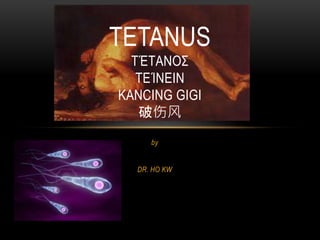
TETANUS
ΤΈΤΑΝΟΣ
ΤΕΊΝΕΙΝ
KANCING GIGI
破伤风
TOPIC
1. INTRODUCTION
2. EPIDEMIOLOGY
3. PATHOGENESIS
4. CLINICAL FEATURES
5. DIFFERENTIAL DIAGNOSIS
6. TREATMENT
7. IMMUNOPROPHYLAXIS
8. SUMMARY
2
1. INTRODUCTION
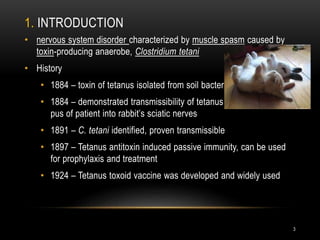
• nervous system disorder characterized by muscle spasm caused by
toxin-producing anaerobe, Clostridium tetani
• History
• 1884 – toxin of tetanus isolated from soil bacteria
• 1884 – demonstrated transmissibility of tetanus toxin, by injecting
pus of patient into rabbit’s sciatic nerves
• 1891 – C. tetani identified, proven transmissible
• 1897 – Tetanus antitoxin induced passive immunity, can be used
for prophylaxis and treatment
• 1924 – Tetanus toxoid vaccine was developed and widely used
3
• Present in 4 clinical patterns
• Generalized
• Local
• Cephalic
• Neonatal
• Rare, but remains a threat to unvaccinated person
• C. tetani spores cannot be eliminated from the environment,
therefore, immunization and proper treatment of wounds are
crucial fro tetanus prevention
4
2. EPIDEMIOLOGY
• Occurs sporadically
• Affects unimmunized, partially immunized, fully immunized but
fail to maintain adequate immunity with booster doses
• Remains endemic in developing countries
• Estimated 1 million cases of tetanus / year, with 300,000 to
500,000 deaths (Ann Intern Med 2011; 154:329)
• Neonatal tetanus: WHO targeted for elimination by 1995, still 31
countries have not reached elimination status by November’12
(http://www.who.int/immunization_monitoring/diseases/MNTE_initiat
ive/en/index.html)
5
3. PATHOGENESIS
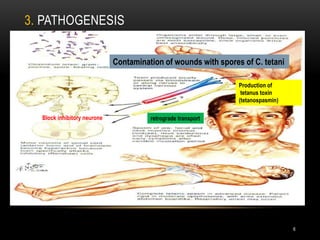
Contamination of wounds with spores of C. tetani
Production of
tetanus toxin
(tetanospasmin)
retrograde transportBlock inhibitory neurone
6
7
• Contamination of wounds with spores of C. tetani
• Production of tetanus toxin (tetanospasmin)
• Binds to peripheral motor neurone terminals, transported to
spinal cord and brain stem. (retrograde transport)
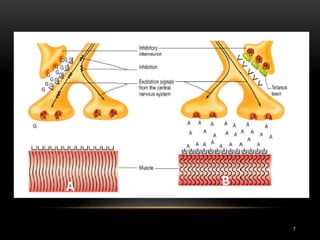
• Toxin migrates across the synapse, to presynaptic terminals,
bind irreversibily to the receptors, blocks the release of Glycine
and GABA
• Disinhibition of anterior horn cells and autonomic neurones 
increased muscle tone, painful spasms, widespread autonomic
instability
8
• Predisposing factors
• Penetrating injury resulting in the inoculation of C. tetani
spores
• Coinfection with other bacteria
• Devitalized tissue
• Foreign body
• Localized ischaemia
9
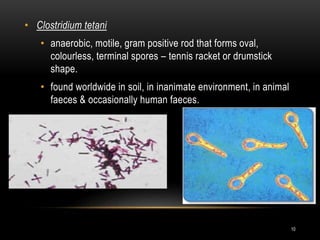
• Clostridium tetani
• anaerobic, motile, gram positive rod that forms oval,
colourless, terminal spores – tennis racket or drumstick
shape.
• found worldwide in soil, in inanimate environment, in animal
faeces & occasionally human faeces.
10
4. CLINICAL FEATURES
• Incubation period : as short as 1 day, as long as months ( most
cases within 8 days)
• Hands and feet = longer incubation period
• Head and neck = shorter incubation period
Present in 4 clinical patterns
• Generalized
• Local
• Cephalic
• Neonatal
11
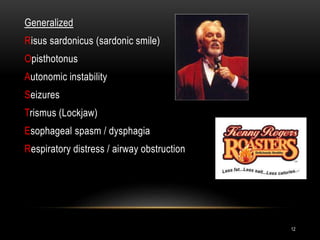
Generalized
Risus sardonicus (sardonic smile)
Opisthotonus
Autonomic instability
Seizures
Trismus (Lockjaw)
Esophageal spasm / dysphagia
Respiratory distress / airway obstruction
12
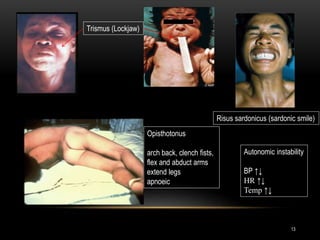
Trismus (Lockjaw)
Risus sardonicus (sardonic smile)
Opisthotonus
arch back, clench fists,
flex and abduct arms
extend legs
apnoeic
Autonomic instability
BP ↑↓
HR ↑↓
Temp ↑↓
13
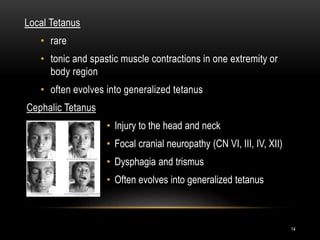
Local Tetanus
• rare
• tonic and spastic muscle contractions in one extremity or
body region
• often evolves into generalized tetanus
Cephalic Tetanus
• Injury to the head and neck
• Focal cranial neuropathy (CN VI, III, IV, XII)
• Dysphagia and trismus
• Often evolves into generalized tetanus
14
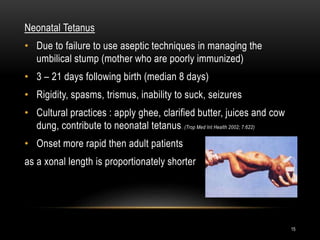
Neonatal Tetanus
• Due to failure to use aseptic techniques in managing the
umbilical stump (mother who are poorly immunized)
• 3 – 21 days following birth (median 8 days)
• Rigidity, spasms, trismus, inability to suck, seizures
• Cultural practices : apply ghee, clarified butter, juices and cow
dung, contribute to neonatal tetanus. (Trop Med Int Health 2002; 7:622)
• Onset more rapid then adult patients
as a xonal length is proportionately shorter
15
Severity of Illness
Depends upon:
1) Amount of tetanus toxin that reaches the CNS
2) Incubation period (shorter = more severe) J Neurol Neurosurg Psychiatry
2000;69:292-301 doi:10.1136/jnnp.69.3.292
3) Interval from the onset of the symptoms to appearace of
spasms. (shorter = more severe) J Neurol Neurosurg Psychiatry 2000;69:292-301
doi:10.1136/jnnp.69.3.292
4) Preexisting anti-tetanus antibodies (Nouv Presse Med. 1972 Dec 16;1(45):3049-50.
[Antitetanus antibodies. Assay before ... Goulon M, Girard O, Grosbuis S, Desormeau JP, Capponi MF.)
- present and protective level = no symptoms
- present but non-protective level = milder symptoms
- absent = more severe
16
 Mild ds ( muscle rigidity , no / few spasms )
 Moderate ds (trismus, dysphagia, rigidity, spasm)
 Severe ds ( freq explosive paroxysms )
 Autonomic dysfn complicates severe cases - labile BP,
hyperpyrexia, profuse sweating, peripheral vasoconstriction,
raised catecholamines.
Duration of Illness
• Recovery required the growth of new axonal nerve terminals
• Usually 4 to 6 weeks
17
5. DIFFERENTIAL DIAGNOSES
• Drug-induced dystonia
• Meningoencephalitis
• Stroke
• Epilepsy
• Mandible dislocation
• Dental infection
• Neuroleptic Malignant Syndrome
• Conversion disorder
18
6. TREATMENT
Little evidence exists to support any particular therapeutic
intervention in tetanus.
ONLY 9 RCTs reported in the literature over the past 30 years
Goals of treatment
A) General supportive management
B) Halting the toxin production
C) Neutralization of the unbound toxin
D) Control of muscle spasms
E) Management of dysautonomia
19
A) General supportive management
Feeding
Analgesia
Sedation
Thromboembolic prophylaxis
Head of bed elevation
Ulcer (Stress) prophylaxis
Glycemic control
20
• Prolonged immobility, intubation in ICU
• Prolonged mechanical ventilation, may last for weeks
• Early tracheostomy  allows better tracheal suctioning and
pulmonary toilet
21
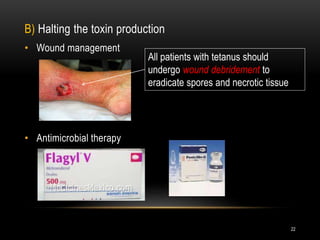
B) Halting the toxin production
• Wound management
• Antimicrobial therapy
All patients with tetanus should
undergo wound debridement to
eradicate spores and necrotic tissue
22
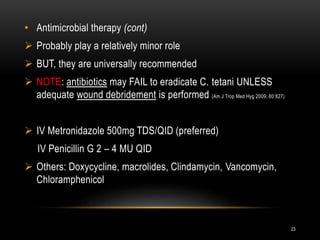
• Antimicrobial therapy (cont)
 Probably play a relatively minor role
 BUT, they are universally recommended
 NOTE: antibiotics may FAIL to eradicate C. tetani UNLESS
adequate wound debridement is performed (Am J Trop Med Hyg 2009; 80:827)
 IV Metronidazole 500mg TDS/QID (preferred)
IV Penicillin G 2 – 4 MU QID
 Others: Doxycycline, macrolides, Clindamycin, Vancomycin,
Chloramphenicol
23
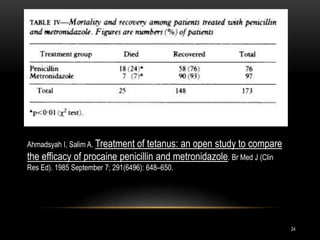
Ahmadsyah I, Salim A. Treatment of tetanus: an open study to compare
the efficacy of procaine penicillin and metronidazole. Br Med J (Clin
Res Ed). 1985 September 7; 291(6496): 648–650.
24
• Yen LM, Dao LM, Day NPJ. Management of tetanus: a
comparison of penicillin and metronidazole. Symposium of
antimicrobial resistance in southern Viet Nam, 1997
• Saltoglu N, Tasova Y, Midikli D, Burgut R, Dündar IH. Prognostic
factors affecting deaths from adult tetanus. Clin Microbiol Infect.
2004 Mar;10(3):229-33.
These 2 subsequent studies show no difference in mortality in
patients treated with Metronidazole and Penicillin
25
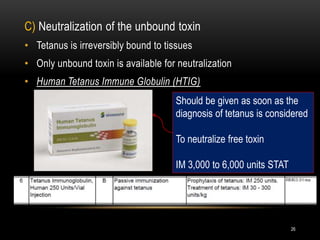
C) Neutralization of the unbound toxin
• Tetanus is irreversibly bound to tissues
• Only unbound toxin is available for neutralization
• Human Tetanus Immune Globulin (HTIG)
Should be given as soon as the
diagnosis of tetanus is considered
To neutralize free toxin
IM 3,000 to 6,000 units STAT
26
Passive Immunization  HTIG
Active Immunization  ATT (adsorbed tetanus toxoid)
• All patients with tetanus should receive active immunization
• IM ATT 0.5 ml STAT, then at 6/52, then at 6/12 after 2nd dose,
then every 10 years
Passive
Active
HTIG
ATT
27
D) Control of muscle spasms
Muscle spasm is painful
Life-threatening, can lead to respi failure, aspiration, exhaustion
• Nurse in quiet dark room / Avoid noise and other stimuli
• Sedatives: Diazepam / Lorazepam / Midazolam
Diazepam is the drug of choice
IV infusion of 0.05-0.2mg/kg/hr OR
IV slow bolus 10 to 20mg q3hr
28
D) Control of muscle spasms (cont)
• MgSO4
- control spasm and autonomic dysfunction
- its use may avoid the need for sedation and ventilation
- 5g as IV loading dose over 20 mins, then infusion 1-2.5g/h
- Monitor patellar tendon reflexes (loss of reflxes if overdose)
- Keep Serum Mg level 2-4 mmol/L
• Propofol, baclofen, muscle relaxants can be tried
29
E) Management of dysautonomia
• MgSO4
• Labetalol (0.25 to 1 mg/min) – dual alpha and beta blocker
* beta blockade alone (e.g. propanolol alone) shoud be
avoided because of reports of sudden death
• Atropine, clonidine, morhpine sulphate can be used
30
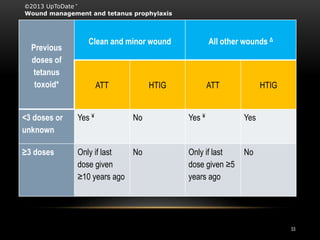
7. IMMUNOPROPHYLAXIS
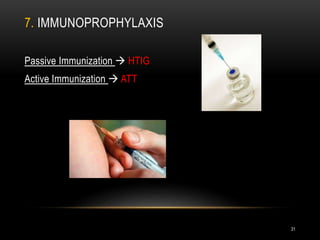
Passive Immunization  HTIG
Active Immunization  ATT
31
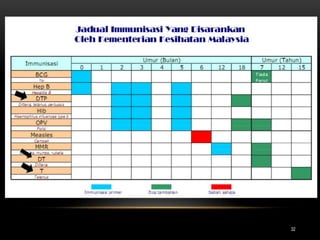
32
Previous
doses of
tetanus
toxoid*
Clean and minor wound All other wounds Δ
ATT HTIG ATT HTIG
<3 doses or
unknown
Yes ¥ No Yes ¥ Yes
≥3 doses Only if last
dose given
≥10 years ago
No Only if last
dose given ≥5
years ago
No
©2013 UpToDate ®
Wound management and tetanus prophylaxis
33
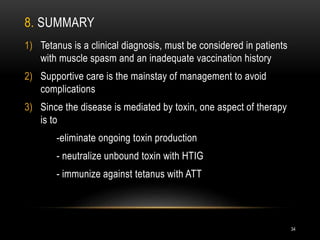
8. SUMMARY
1) Tetanus is a clinical diagnosis, must be considered in patients
with muscle spasm and an inadequate vaccination history
2) Supportive care is the mainstay of management to avoid
complications
3) Since the disease is mediated by toxin, one aspect of therapy
is to
-eliminate ongoing toxin production
- neutralize unbound toxin with HTIG
- immunize against tetanus with ATT
34
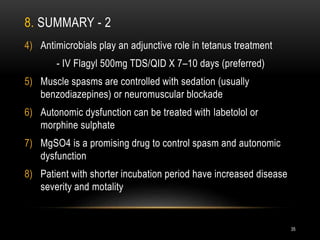
8. SUMMARY - 2
4) Antimicrobials play an adjunctive role in tetanus treatment
- IV Flagyl 500mg TDS/QID X 7–10 days (preferred)
5) Muscle spasms are controlled with sedation (usually
benzodiazepines) or neuromuscular blockade
6) Autonomic dysfunction can be treated with labetolol or
morphine sulphate
7) MgSO4 is a promising drug to control spasm and autonomic
dysfunction
8) Patient with shorter incubation period have increased disease
severity and motality
35
36
THANK YOU
37

Tetanus

  • 1.
  • 2.
    TOPIC 1. INTRODUCTION 2. EPIDEMIOLOGY 3.PATHOGENESIS 4. CLINICAL FEATURES 5. DIFFERENTIAL DIAGNOSIS 6. TREATMENT 7. IMMUNOPROPHYLAXIS 8. SUMMARY 2
  • 3.
    1. INTRODUCTION • nervoussystem disorder characterized by muscle spasm caused by toxin-producing anaerobe, Clostridium tetani • History • 1884 – toxin of tetanus isolated from soil bacteria • 1884 – demonstrated transmissibility of tetanus toxin, by injecting pus of patient into rabbit’s sciatic nerves • 1891 – C. tetani identified, proven transmissible • 1897 – Tetanus antitoxin induced passive immunity, can be used for prophylaxis and treatment • 1924 – Tetanus toxoid vaccine was developed and widely used 3
  • 4.
    • Present in4 clinical patterns • Generalized • Local • Cephalic • Neonatal • Rare, but remains a threat to unvaccinated person • C. tetani spores cannot be eliminated from the environment, therefore, immunization and proper treatment of wounds are crucial fro tetanus prevention 4
  • 5.
    2. EPIDEMIOLOGY • Occurssporadically • Affects unimmunized, partially immunized, fully immunized but fail to maintain adequate immunity with booster doses • Remains endemic in developing countries • Estimated 1 million cases of tetanus / year, with 300,000 to 500,000 deaths (Ann Intern Med 2011; 154:329) • Neonatal tetanus: WHO targeted for elimination by 1995, still 31 countries have not reached elimination status by November’12 (http://www.who.int/immunization_monitoring/diseases/MNTE_initiat ive/en/index.html) 5
  • 6.
    3. PATHOGENESIS Contamination ofwounds with spores of C. tetani Production of tetanus toxin (tetanospasmin) retrograde transportBlock inhibitory neurone 6
  • 7.
  • 8.
    • Contamination ofwounds with spores of C. tetani • Production of tetanus toxin (tetanospasmin) • Binds to peripheral motor neurone terminals, transported to spinal cord and brain stem. (retrograde transport) • Toxin migrates across the synapse, to presynaptic terminals, bind irreversibily to the receptors, blocks the release of Glycine and GABA • Disinhibition of anterior horn cells and autonomic neurones  increased muscle tone, painful spasms, widespread autonomic instability 8
  • 9.
    • Predisposing factors •Penetrating injury resulting in the inoculation of C. tetani spores • Coinfection with other bacteria • Devitalized tissue • Foreign body • Localized ischaemia 9
  • 10.
    • Clostridium tetani •anaerobic, motile, gram positive rod that forms oval, colourless, terminal spores – tennis racket or drumstick shape. • found worldwide in soil, in inanimate environment, in animal faeces & occasionally human faeces. 10
  • 11.
    4. CLINICAL FEATURES •Incubation period : as short as 1 day, as long as months ( most cases within 8 days) • Hands and feet = longer incubation period • Head and neck = shorter incubation period Present in 4 clinical patterns • Generalized • Local • Cephalic • Neonatal 11
  • 12.
    Generalized Risus sardonicus (sardonicsmile) Opisthotonus Autonomic instability Seizures Trismus (Lockjaw) Esophageal spasm / dysphagia Respiratory distress / airway obstruction 12
  • 13.
    Trismus (Lockjaw) Risus sardonicus(sardonic smile) Opisthotonus arch back, clench fists, flex and abduct arms extend legs apnoeic Autonomic instability BP ↑↓ HR ↑↓ Temp ↑↓ 13
  • 14.
    Local Tetanus • rare •tonic and spastic muscle contractions in one extremity or body region • often evolves into generalized tetanus Cephalic Tetanus • Injury to the head and neck • Focal cranial neuropathy (CN VI, III, IV, XII) • Dysphagia and trismus • Often evolves into generalized tetanus 14
  • 15.
    Neonatal Tetanus • Dueto failure to use aseptic techniques in managing the umbilical stump (mother who are poorly immunized) • 3 – 21 days following birth (median 8 days) • Rigidity, spasms, trismus, inability to suck, seizures • Cultural practices : apply ghee, clarified butter, juices and cow dung, contribute to neonatal tetanus. (Trop Med Int Health 2002; 7:622) • Onset more rapid then adult patients as a xonal length is proportionately shorter 15
  • 16.
    Severity of Illness Dependsupon: 1) Amount of tetanus toxin that reaches the CNS 2) Incubation period (shorter = more severe) J Neurol Neurosurg Psychiatry 2000;69:292-301 doi:10.1136/jnnp.69.3.292 3) Interval from the onset of the symptoms to appearace of spasms. (shorter = more severe) J Neurol Neurosurg Psychiatry 2000;69:292-301 doi:10.1136/jnnp.69.3.292 4) Preexisting anti-tetanus antibodies (Nouv Presse Med. 1972 Dec 16;1(45):3049-50. [Antitetanus antibodies. Assay before ... Goulon M, Girard O, Grosbuis S, Desormeau JP, Capponi MF.) - present and protective level = no symptoms - present but non-protective level = milder symptoms - absent = more severe 16
  • 17.
     Mild ds( muscle rigidity , no / few spasms )  Moderate ds (trismus, dysphagia, rigidity, spasm)  Severe ds ( freq explosive paroxysms )  Autonomic dysfn complicates severe cases - labile BP, hyperpyrexia, profuse sweating, peripheral vasoconstriction, raised catecholamines. Duration of Illness • Recovery required the growth of new axonal nerve terminals • Usually 4 to 6 weeks 17
  • 18.
    5. DIFFERENTIAL DIAGNOSES •Drug-induced dystonia • Meningoencephalitis • Stroke • Epilepsy • Mandible dislocation • Dental infection • Neuroleptic Malignant Syndrome • Conversion disorder 18
  • 19.
    6. TREATMENT Little evidenceexists to support any particular therapeutic intervention in tetanus. ONLY 9 RCTs reported in the literature over the past 30 years Goals of treatment A) General supportive management B) Halting the toxin production C) Neutralization of the unbound toxin D) Control of muscle spasms E) Management of dysautonomia 19
  • 20.
    A) General supportivemanagement Feeding Analgesia Sedation Thromboembolic prophylaxis Head of bed elevation Ulcer (Stress) prophylaxis Glycemic control 20
  • 21.
    • Prolonged immobility,intubation in ICU • Prolonged mechanical ventilation, may last for weeks • Early tracheostomy  allows better tracheal suctioning and pulmonary toilet 21
  • 22.
    B) Halting thetoxin production • Wound management • Antimicrobial therapy All patients with tetanus should undergo wound debridement to eradicate spores and necrotic tissue 22
  • 23.
    • Antimicrobial therapy(cont)  Probably play a relatively minor role  BUT, they are universally recommended  NOTE: antibiotics may FAIL to eradicate C. tetani UNLESS adequate wound debridement is performed (Am J Trop Med Hyg 2009; 80:827)  IV Metronidazole 500mg TDS/QID (preferred) IV Penicillin G 2 – 4 MU QID  Others: Doxycycline, macrolides, Clindamycin, Vancomycin, Chloramphenicol 23
  • 24.
    Ahmadsyah I, SalimA. Treatment of tetanus: an open study to compare the efficacy of procaine penicillin and metronidazole. Br Med J (Clin Res Ed). 1985 September 7; 291(6496): 648–650. 24
  • 25.
    • Yen LM,Dao LM, Day NPJ. Management of tetanus: a comparison of penicillin and metronidazole. Symposium of antimicrobial resistance in southern Viet Nam, 1997 • Saltoglu N, Tasova Y, Midikli D, Burgut R, Dündar IH. Prognostic factors affecting deaths from adult tetanus. Clin Microbiol Infect. 2004 Mar;10(3):229-33. These 2 subsequent studies show no difference in mortality in patients treated with Metronidazole and Penicillin 25
  • 26.
    C) Neutralization ofthe unbound toxin • Tetanus is irreversibly bound to tissues • Only unbound toxin is available for neutralization • Human Tetanus Immune Globulin (HTIG) Should be given as soon as the diagnosis of tetanus is considered To neutralize free toxin IM 3,000 to 6,000 units STAT 26
  • 27.
    Passive Immunization HTIG Active Immunization  ATT (adsorbed tetanus toxoid) • All patients with tetanus should receive active immunization • IM ATT 0.5 ml STAT, then at 6/52, then at 6/12 after 2nd dose, then every 10 years Passive Active HTIG ATT 27
  • 28.
    D) Control ofmuscle spasms Muscle spasm is painful Life-threatening, can lead to respi failure, aspiration, exhaustion • Nurse in quiet dark room / Avoid noise and other stimuli • Sedatives: Diazepam / Lorazepam / Midazolam Diazepam is the drug of choice IV infusion of 0.05-0.2mg/kg/hr OR IV slow bolus 10 to 20mg q3hr 28
  • 29.
    D) Control ofmuscle spasms (cont) • MgSO4 - control spasm and autonomic dysfunction - its use may avoid the need for sedation and ventilation - 5g as IV loading dose over 20 mins, then infusion 1-2.5g/h - Monitor patellar tendon reflexes (loss of reflxes if overdose) - Keep Serum Mg level 2-4 mmol/L • Propofol, baclofen, muscle relaxants can be tried 29
  • 30.
    E) Management ofdysautonomia • MgSO4 • Labetalol (0.25 to 1 mg/min) – dual alpha and beta blocker * beta blockade alone (e.g. propanolol alone) shoud be avoided because of reports of sudden death • Atropine, clonidine, morhpine sulphate can be used 30
  • 31.
    7. IMMUNOPROPHYLAXIS Passive Immunization HTIG Active Immunization  ATT 31
  • 32.
  • 33.
    Previous doses of tetanus toxoid* Clean andminor wound All other wounds Δ ATT HTIG ATT HTIG <3 doses or unknown Yes ¥ No Yes ¥ Yes ≥3 doses Only if last dose given ≥10 years ago No Only if last dose given ≥5 years ago No ©2013 UpToDate ® Wound management and tetanus prophylaxis 33
  • 34.
    8. SUMMARY 1) Tetanusis a clinical diagnosis, must be considered in patients with muscle spasm and an inadequate vaccination history 2) Supportive care is the mainstay of management to avoid complications 3) Since the disease is mediated by toxin, one aspect of therapy is to -eliminate ongoing toxin production - neutralize unbound toxin with HTIG - immunize against tetanus with ATT 34
  • 35.
    8. SUMMARY -2 4) Antimicrobials play an adjunctive role in tetanus treatment - IV Flagyl 500mg TDS/QID X 7–10 days (preferred) 5) Muscle spasms are controlled with sedation (usually benzodiazepines) or neuromuscular blockade 6) Autonomic dysfunction can be treated with labetolol or morphine sulphate 7) MgSO4 is a promising drug to control spasm and autonomic dysfunction 8) Patient with shorter incubation period have increased disease severity and motality 35
  • 36.
  • 37.