DISINFECTION
BY,
Dr.M.Malathi
I year PG- M.D. Microbiology
Chengalpattu medical college
chengalpattu
Definition:
 The selective elimination of certain
undesirable organisms in order to
prevent their transmission, achieved by
action on their structure or metabolism,
irrespective of their functional state.
(European committee)
 Disinfection does not necessarily kill all
microorganisms but reduces them to a
level acceptable for a defined purpose.
(British standards)
An ideal disinfectant should:
 Have a wide spectrum of activity
 Be active in the presence of organic
matter
 Have speedy action
 High penetrating power
 Be stable
 Not be toxic
 Not corrosive
 inexpensive
Factors determining the potency
of disinfectant:
 Concentration of the substance
 Time of action
 pH of the medium
 Temperature
 Nature of the organisms
 Presence of extraneous material
Chemical agents
1. Alcohols: Ethyl, isopropyl, methyl
2. Aldehydes: Formaldehyde,
Glutaraldehyde
3. Dyes
4. Halogens
5. Phenols
6. Surface active agents
7. Metallic salts
8. Gases: Ethylene oxide, Formaldehyde,
Beta propiolactone.
 HIGH:
Kills all the organisms except high
number of Spores, Prions – Eg. Aldehydes,
ethyleneoxide
 INTERMEDIATE:
Kills Mycobacteria, most viruses and
bacteria, fungi but not spores – Eg. Iodine,
ethanol, chlorine
 LOW:
Kills some viruses and bacteria but
not mycobacteria, spores – Eg. Quarterly
ammonium compounds, mercurials.
LEVELS OF DISINFECTION:
ALCOHOLS:
 Ethyl alcohol
 Methyl alcohol
 Isopropyl alcohol
 Bactericidal, tuberculocidal, fungicidal,
virucidal. Donot act on spores
 Optimum concentration is 60 – 90 %
 Mechanism of action: denaturation of
proteins
 Microbicidal activity:
Pseudomonas 10 sec 30 – 100%
E.coli, S.typhi 10 sec 40 – 100 %
S.aureus,
Strep.
pyogenes
10 sec 60 – 95%
 Ethyl alcohol (60 – 80%) is virucidal for
all lipophilic viruses and hydrophilic
viruses except hepatitis A and polio
virus
 Isopropanol is active against all
lipophilic viruses.
 70% ethanol is active against
cryptococcus, blastomyces,
coccidiodes
 20% isopropanol is used for killed
 Uses:
◦ Oral thermometers
◦ Scissors
◦ Sthethescopes
Disadvantages:
As they lack sporicidal action, they are
not recommended for equipments and
surgical materials. They damage the
lensed instruments and tonometer tips.
Methyl alcohol is toxic and not used
nowadays.
CAVI WIPES:
 Low alcohol (17% isopropanol)
surface disinfectants:
 non abrasive towelettes
 easy to use
 ideal for operating rooms, surgical
centres,
neonatal centres
 saves time and convenient
ALDEHYDES:
 Formaldehyde
 Glutaraldehyde
 Ortho – phthalaldehyde
Formaldehyde:
Bactericidal, sporicidal, virucidal
Used to preserve specimens
For destroying anthrax spores in hair and
wool
10% formalin containing 0.5% sodium
tetraborate is used to clean metal
Formalin:
Glutaraldehyde:
 High level disinfectant & chemical
sterilant
 In aqueous solutions – not sporicidal
if activated by using alkalinising
agents to change the pH to 7.5 to 8.5
becomes sporicidal
 Disadvantage of activation:
Once activated the shelf life of
glutaraldehyde is only 14 days and
after that polymerisation of the
glutaraldehyde molecules takes place
and it blocks the active aldehyde
groups.
To overcome the above problem:
Glutaraldehde phenol sodium phenate
or stabilised alkaline glutaraldehyde
can be used.
 Mechanism of action:
Alkylation of sulfhydryl, hydroxyl,
carboxyl and amino groups of micro
organisms which alter the RNA,DNA
and protein synthesis
 > 2% aqueous solution of
glutaraldehyde buffered to alkaline pH
with sodium bicarbonate kills:
Vegetative bacteria <2 min
TB, Fungi, Viruses < 10 min
Bacillus,
Clostridial, spores
3 hours
 Uses:
Endoscopes,Spirometry,Dialyzers,Transducers
,Anaesthesia equipments ,Plastic trocars.
Advantage: non corrosive
Disadvantage:
◦ If not properly cleansed- colitis occurs in
endoscopy patients
◦ In eye equipments – keratopathy
◦ Health care workers with chronic exposure
– dermatitis, asthma and rhinitis
Endoscope:
Glutaraldehyde disposal:
 If glutaraldehyde disposal is restricted
through the sanitary sewer system,
sodium bisulfate can be used to
neutralise glutaraldehyde and make it
safer for disposal
TRADE NAMES:
cidex, Asep, clinicide, totacide, triocide
Ortho-phthalaldehyde:
 High level disinfectant
 Superior than glutaraldehyde
 Excellent stability over wide range of
pH
 Not irritant
 No need of activation
DYES:
Aniline dyes
- Brilliant green, malachite green, crystal
violet
- more active against gram positive
- non toxic, non irritant
- inactivated by organic material (pus)
Acridine dyes
- Proflavine, acriflavine, euflavine,
aminacrine
- active against gram positive
HALOGENS:
 Bactericidal, virucidal and sporicidal
 CHLORINE:
- used as chlorine tablets for
disinfection of water
- sodium hypochlorite for
disinfection of equipment soiled with
blood
Hypochlorites:
 Readily inactivated by organic material
 Corrosive to metals and textiles
 Should not be mixed with acids, as
they emit toxic amounts of chlorine
gas
 Very active against bacteria, viruses
including HIV and HBV
 Trade names: chloros, domestos,
diversol BX, milton
Iodine:
 Iodine is more sporicidal than chlorine
 Used in aqueous and alcoholic
solution as skin disinfectant
 Eg. Povidone iodine preparations
 Iodophores:
Organic compounds that slow the
release of iodine. Steadily supplies the
iodine over long periods, increases the
penetration, more active.
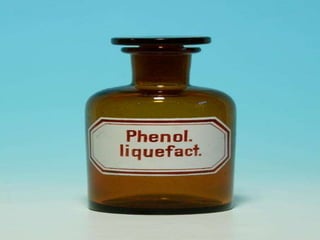
Phenols:
 Phenol was initially used by Lister as a
germicide in his pioneering work on
antiseptic surgery.
 Mechanism of action:
Protoplasmic poison – penetrates
the cell wall and precipitates the cell
proteins.
 Active against bacteria, mycobacteria but
little activity against endospores, viruses
 Will not inactivate HIV within 30min
 Resistant to inactivation by organic
matter
 Activity reduced in alkaline pH
 Useful to disinfect environmental
surfaces
 Names: Clearsol, hycolin, stericol, lysol,
dettol
Phenolics – disadvantage :
 Phenolics in nurseries causes
hyperbilirubinemia in infants.
 If phenolics are used to terminally
clean infant bassinets and incubators,
the surfaces should be rinsed
throughly with water and dried before
reuse of infant bassinets and
incubators
FORMALDEHYDE FUMIGATION :
Commonly used to sterilize the OT.
Requirement (For an area of 1000 cubic
feet)
- 500 ml of 40% formaldehyde in one liter of
water
- Stove or hot plate for heating formalin
- 300 ml of 10% Ammonia
 Procedure
 Close all doors & windows air tight and
switch off fans and A.C.
 Heat formalin solution till boiling dry
 Leave the OT unentered over night
 Enter the OT next day morning with 300ml
of ammonia
 Keep the ammonia solution for 2-3 hrs to
neutralize formalin vapours
 Open the OT to start surgery
 Advised fumigation at weekly intervals
 Mode of Action
 Formaldehyde inactivates
microorganisms by alkylating the
aminoacid and sulfhydryl groups of
proteins and ring nitrogen atoms of
purine bases.
 Disadvantages
 It acts as a potential carcinogen
 Toxic
 Irritant
Duration:
 In case of any construction in O.T. 
48 hrs
 In case of infected cases
 24hr
 For routine clean cases  12
hrs.
 Alternatively 250 ml of formalin and 3000
ml of tap water are put into a machine
(auto mist) and time is set for 2 hrs. The
mist is circulated for 2hrs inside the
closed room.
Commercially available disinfectant
 Baccilocid rasant
 A newer and effective compound in
environmental decontamination with very
good cost/benefit ratio, good material
compatibility, excellent cleaning
properties . It is a Formaldehyde-free
disinfectant cleaner with low use
concentration.
 Active ingredients:
Glutaral 100 mg/g, benzyl-C12-18-
alkyldimethylammonium chlorides 60
mg/ g, didecyldimethylammonium
chloride 60 mg/g.
 Aldekol
A new method of fumigation
has been evolved using ‘Aldekol’, a
mixture containing 6% formaldehyde,
6% glutaraldehyde and 5%
benzalkonium120 chloride
 Advantages
 - Provides complete asepsis within 30
to 60 minutes.
 - Cleaning with detergent or carbolic
acid not required.
 - Formalin fumigation not required.
 - Shutdown of O.T. for 24 hrs not
required.
 Ethylene Oxide :
 Widely used for re -sterilizing ‘packaged
heat sensitive devices’ like sharp knives
and blades.
 It is non-corrosive and safe for most plastic
and polyethylene materials. It is the
preferred method for sterilizing heat labile
tubings, vitrectomy cutters, cryoprobes,
light pipes, laser probes, diathermy leads,
Gas:
 Ethylene oxide sterilisation:
cold cycle - 37±5ºC
Warm cycle – 54 ±5ºC
In these cycles, the relative
humidity is maintained at 40 to 50%
and ethylene oxide concentration is
kept at 700mg/litre.
Testing of ethylene oxide steriliser:
Bacillus subtilis subsp niger
Hydrogen peroxide:
 Bactericidal, virucidal – 1 minute
 sporicidal, fungicidal – 5 minutes
 Mechanism of action:
Targets cell wall, cytoplasm
 Works by producing destructive
hydroxyl free radicals that can attack
membrane lipids, DNA.
 Hydrogen Peroxide which must be
diluted to a 6% solution, is less
expensive . The 3% H2O2 solutions
used as antiseptics, however, should
not be used as a disinfectant.
 For disinfecting soft contact lenses,
tonometer biprisms, ventilators,
fabrics, endoscopes.
Disadvantages:
 H2O2 soaked tonometer tip caused
corneal damage.
 Gastrointestinal endoscopy unit
rinsing with 3% H2O2 caused enteritis
& pseudomembranous colits.
Surface active agents:
 Substances that alter the energy
relationship at interfaces, producing a
reduction of surface or interfacial tension.
 Classification:
anionic, cationic, non-ionic and
amphoteric
 Mechanism of action:
Act on the phosphate groups of the cell
membrane and enter the cell.
 Common compounds:
Acetyl trimethyl ammonium bromide
(cetavlon)
Benzalkonium chloride
Disinfection of spillages:
 Contamination with Blood –
hypochlorite 5%-10% ( 10,000ppm ) –
contact period 30 min
 Liquid spillages – immediately cover
with a disposable cloth or absorbent
paper soaked in disinfectant and leave
for 10 min. The area should be rinsed
with fresh disinfectant and dried.
Disinfection of rooms:
 Formaldehyde vapours
Disinfection of safety
cabinets:
 Safety cabinets should be washed
down with an appropriate disinfectant
after each day`s use.
 When fittings are done or filters are
changed – fumigation is necessary
 Place 25ml formaldehyde solution in
an electrically heated dish inside the
cabinet.
 Replace the front closure of the
cabinet and if necessary, seal with
 Vaporize the formaldehyde and leave
the cabinet closed overnight
 The next day, switch on the extract fan
to remove the formaldehyde vapour
and expel it through the HEPA filter
into the exhaust duct.
 Open the front closure
 Remove the front closure and check
the rate of airflow before using the
cabinet
Disinfection of sputum:
 Autoclaving is the best method
 Incineration or burning
 Sputum container disinfection:
- Autoclaving
- put in hypochlorite or 5%phenol in
bucket then incinerate or dump in dump
hole
Sporicidal agents:
 Glutaraldehyde
 Formaldehyde
 Halogens
 Ethylene oxide
 Peroxygens
 Betopropiolactone
Skin disinfectants /
antiseptics:
 Povidone iodine
 Isopropyl alcohol
 Chlorhexidine (hibitane)
 Quaternary ammonium compounds
 Peroxides
 Phenol and its derivatives
 Quinolone derivatives
Disinfection – HIV:
 HIV is completely inactivated by
treatment for 10minutes at room
temperature with any of the following:
 10% household bleach
 50% ethanol, 35% isopropanol
 0.5% lysol
 0.3% hydrogen peroxide
Thank you…….

Disinfection

  • 1.
    DISINFECTION BY, Dr.M.Malathi I year PG-M.D. Microbiology Chengalpattu medical college chengalpattu
  • 2.
    Definition:  The selectiveelimination of certain undesirable organisms in order to prevent their transmission, achieved by action on their structure or metabolism, irrespective of their functional state. (European committee)  Disinfection does not necessarily kill all microorganisms but reduces them to a level acceptable for a defined purpose. (British standards)
  • 3.
    An ideal disinfectantshould:  Have a wide spectrum of activity  Be active in the presence of organic matter  Have speedy action  High penetrating power  Be stable  Not be toxic  Not corrosive  inexpensive
  • 4.
    Factors determining thepotency of disinfectant:  Concentration of the substance  Time of action  pH of the medium  Temperature  Nature of the organisms  Presence of extraneous material
  • 5.
    Chemical agents 1. Alcohols:Ethyl, isopropyl, methyl 2. Aldehydes: Formaldehyde, Glutaraldehyde 3. Dyes 4. Halogens 5. Phenols 6. Surface active agents 7. Metallic salts 8. Gases: Ethylene oxide, Formaldehyde, Beta propiolactone.
  • 6.
     HIGH: Kills allthe organisms except high number of Spores, Prions – Eg. Aldehydes, ethyleneoxide  INTERMEDIATE: Kills Mycobacteria, most viruses and bacteria, fungi but not spores – Eg. Iodine, ethanol, chlorine  LOW: Kills some viruses and bacteria but not mycobacteria, spores – Eg. Quarterly ammonium compounds, mercurials. LEVELS OF DISINFECTION:
  • 7.
    ALCOHOLS:  Ethyl alcohol Methyl alcohol  Isopropyl alcohol  Bactericidal, tuberculocidal, fungicidal, virucidal. Donot act on spores  Optimum concentration is 60 – 90 %  Mechanism of action: denaturation of proteins
  • 8.
     Microbicidal activity: Pseudomonas10 sec 30 – 100% E.coli, S.typhi 10 sec 40 – 100 % S.aureus, Strep. pyogenes 10 sec 60 – 95%
  • 9.
     Ethyl alcohol(60 – 80%) is virucidal for all lipophilic viruses and hydrophilic viruses except hepatitis A and polio virus  Isopropanol is active against all lipophilic viruses.  70% ethanol is active against cryptococcus, blastomyces, coccidiodes  20% isopropanol is used for killed
  • 10.
     Uses: ◦ Oralthermometers ◦ Scissors ◦ Sthethescopes Disadvantages: As they lack sporicidal action, they are not recommended for equipments and surgical materials. They damage the lensed instruments and tonometer tips. Methyl alcohol is toxic and not used nowadays.
  • 11.
  • 12.
     Low alcohol(17% isopropanol) surface disinfectants:  non abrasive towelettes  easy to use  ideal for operating rooms, surgical centres, neonatal centres  saves time and convenient
  • 13.
    ALDEHYDES:  Formaldehyde  Glutaraldehyde Ortho – phthalaldehyde Formaldehyde: Bactericidal, sporicidal, virucidal Used to preserve specimens For destroying anthrax spores in hair and wool 10% formalin containing 0.5% sodium tetraborate is used to clean metal
  • 14.
  • 15.
    Glutaraldehyde:  High leveldisinfectant & chemical sterilant  In aqueous solutions – not sporicidal if activated by using alkalinising agents to change the pH to 7.5 to 8.5 becomes sporicidal
  • 16.
     Disadvantage ofactivation: Once activated the shelf life of glutaraldehyde is only 14 days and after that polymerisation of the glutaraldehyde molecules takes place and it blocks the active aldehyde groups. To overcome the above problem: Glutaraldehde phenol sodium phenate or stabilised alkaline glutaraldehyde can be used.
  • 17.
     Mechanism ofaction: Alkylation of sulfhydryl, hydroxyl, carboxyl and amino groups of micro organisms which alter the RNA,DNA and protein synthesis
  • 18.
     > 2%aqueous solution of glutaraldehyde buffered to alkaline pH with sodium bicarbonate kills: Vegetative bacteria <2 min TB, Fungi, Viruses < 10 min Bacillus, Clostridial, spores 3 hours
  • 19.
     Uses: Endoscopes,Spirometry,Dialyzers,Transducers ,Anaesthesia equipments,Plastic trocars. Advantage: non corrosive Disadvantage: ◦ If not properly cleansed- colitis occurs in endoscopy patients ◦ In eye equipments – keratopathy ◦ Health care workers with chronic exposure – dermatitis, asthma and rhinitis
  • 20.
  • 21.
    Glutaraldehyde disposal:  Ifglutaraldehyde disposal is restricted through the sanitary sewer system, sodium bisulfate can be used to neutralise glutaraldehyde and make it safer for disposal TRADE NAMES: cidex, Asep, clinicide, totacide, triocide
  • 22.
    Ortho-phthalaldehyde:  High leveldisinfectant  Superior than glutaraldehyde  Excellent stability over wide range of pH  Not irritant  No need of activation
  • 23.
    DYES: Aniline dyes - Brilliantgreen, malachite green, crystal violet - more active against gram positive - non toxic, non irritant - inactivated by organic material (pus) Acridine dyes - Proflavine, acriflavine, euflavine, aminacrine - active against gram positive
  • 24.
    HALOGENS:  Bactericidal, virucidaland sporicidal  CHLORINE: - used as chlorine tablets for disinfection of water - sodium hypochlorite for disinfection of equipment soiled with blood
  • 26.
    Hypochlorites:  Readily inactivatedby organic material  Corrosive to metals and textiles  Should not be mixed with acids, as they emit toxic amounts of chlorine gas  Very active against bacteria, viruses including HIV and HBV  Trade names: chloros, domestos, diversol BX, milton
  • 27.
    Iodine:  Iodine ismore sporicidal than chlorine  Used in aqueous and alcoholic solution as skin disinfectant  Eg. Povidone iodine preparations  Iodophores: Organic compounds that slow the release of iodine. Steadily supplies the iodine over long periods, increases the penetration, more active.
  • 29.
    Phenols:  Phenol wasinitially used by Lister as a germicide in his pioneering work on antiseptic surgery.  Mechanism of action: Protoplasmic poison – penetrates the cell wall and precipitates the cell proteins.
  • 31.
     Active againstbacteria, mycobacteria but little activity against endospores, viruses  Will not inactivate HIV within 30min  Resistant to inactivation by organic matter  Activity reduced in alkaline pH  Useful to disinfect environmental surfaces  Names: Clearsol, hycolin, stericol, lysol, dettol
  • 32.
    Phenolics – disadvantage:  Phenolics in nurseries causes hyperbilirubinemia in infants.  If phenolics are used to terminally clean infant bassinets and incubators, the surfaces should be rinsed throughly with water and dried before reuse of infant bassinets and incubators
  • 33.
    FORMALDEHYDE FUMIGATION : Commonlyused to sterilize the OT. Requirement (For an area of 1000 cubic feet) - 500 ml of 40% formaldehyde in one liter of water - Stove or hot plate for heating formalin - 300 ml of 10% Ammonia
  • 34.
     Procedure  Closeall doors & windows air tight and switch off fans and A.C.  Heat formalin solution till boiling dry  Leave the OT unentered over night  Enter the OT next day morning with 300ml of ammonia  Keep the ammonia solution for 2-3 hrs to neutralize formalin vapours  Open the OT to start surgery  Advised fumigation at weekly intervals
  • 36.
     Mode ofAction  Formaldehyde inactivates microorganisms by alkylating the aminoacid and sulfhydryl groups of proteins and ring nitrogen atoms of purine bases.  Disadvantages  It acts as a potential carcinogen  Toxic  Irritant
  • 37.
    Duration:  In caseof any construction in O.T.  48 hrs  In case of infected cases  24hr  For routine clean cases  12 hrs.  Alternatively 250 ml of formalin and 3000 ml of tap water are put into a machine (auto mist) and time is set for 2 hrs. The mist is circulated for 2hrs inside the closed room.
  • 38.
    Commercially available disinfectant Baccilocid rasant  A newer and effective compound in environmental decontamination with very good cost/benefit ratio, good material compatibility, excellent cleaning properties . It is a Formaldehyde-free disinfectant cleaner with low use concentration.  Active ingredients: Glutaral 100 mg/g, benzyl-C12-18- alkyldimethylammonium chlorides 60 mg/ g, didecyldimethylammonium chloride 60 mg/g.
  • 39.
     Aldekol A newmethod of fumigation has been evolved using ‘Aldekol’, a mixture containing 6% formaldehyde, 6% glutaraldehyde and 5% benzalkonium120 chloride
  • 40.
     Advantages  -Provides complete asepsis within 30 to 60 minutes.  - Cleaning with detergent or carbolic acid not required.  - Formalin fumigation not required.  - Shutdown of O.T. for 24 hrs not required.
  • 41.
     Ethylene Oxide:  Widely used for re -sterilizing ‘packaged heat sensitive devices’ like sharp knives and blades.  It is non-corrosive and safe for most plastic and polyethylene materials. It is the preferred method for sterilizing heat labile tubings, vitrectomy cutters, cryoprobes, light pipes, laser probes, diathermy leads, Gas:
  • 43.
     Ethylene oxidesterilisation: cold cycle - 37±5ºC Warm cycle – 54 ±5ºC In these cycles, the relative humidity is maintained at 40 to 50% and ethylene oxide concentration is kept at 700mg/litre. Testing of ethylene oxide steriliser: Bacillus subtilis subsp niger
  • 44.
    Hydrogen peroxide:  Bactericidal,virucidal – 1 minute  sporicidal, fungicidal – 5 minutes  Mechanism of action: Targets cell wall, cytoplasm  Works by producing destructive hydroxyl free radicals that can attack membrane lipids, DNA.
  • 45.
     Hydrogen Peroxidewhich must be diluted to a 6% solution, is less expensive . The 3% H2O2 solutions used as antiseptics, however, should not be used as a disinfectant.  For disinfecting soft contact lenses, tonometer biprisms, ventilators, fabrics, endoscopes.
  • 46.
    Disadvantages:  H2O2 soakedtonometer tip caused corneal damage.  Gastrointestinal endoscopy unit rinsing with 3% H2O2 caused enteritis & pseudomembranous colits.
  • 47.
    Surface active agents: Substances that alter the energy relationship at interfaces, producing a reduction of surface or interfacial tension.  Classification: anionic, cationic, non-ionic and amphoteric
  • 48.
     Mechanism ofaction: Act on the phosphate groups of the cell membrane and enter the cell.  Common compounds: Acetyl trimethyl ammonium bromide (cetavlon) Benzalkonium chloride
  • 49.
    Disinfection of spillages: Contamination with Blood – hypochlorite 5%-10% ( 10,000ppm ) – contact period 30 min  Liquid spillages – immediately cover with a disposable cloth or absorbent paper soaked in disinfectant and leave for 10 min. The area should be rinsed with fresh disinfectant and dried.
  • 50.
    Disinfection of rooms: Formaldehyde vapours
  • 51.
    Disinfection of safety cabinets: Safety cabinets should be washed down with an appropriate disinfectant after each day`s use.  When fittings are done or filters are changed – fumigation is necessary  Place 25ml formaldehyde solution in an electrically heated dish inside the cabinet.  Replace the front closure of the cabinet and if necessary, seal with
  • 52.
     Vaporize theformaldehyde and leave the cabinet closed overnight  The next day, switch on the extract fan to remove the formaldehyde vapour and expel it through the HEPA filter into the exhaust duct.  Open the front closure  Remove the front closure and check the rate of airflow before using the cabinet
  • 53.
    Disinfection of sputum: Autoclaving is the best method  Incineration or burning  Sputum container disinfection: - Autoclaving - put in hypochlorite or 5%phenol in bucket then incinerate or dump in dump hole
  • 54.
    Sporicidal agents:  Glutaraldehyde Formaldehyde  Halogens  Ethylene oxide  Peroxygens  Betopropiolactone
  • 55.
    Skin disinfectants / antiseptics: Povidone iodine  Isopropyl alcohol  Chlorhexidine (hibitane)  Quaternary ammonium compounds  Peroxides  Phenol and its derivatives  Quinolone derivatives
  • 56.
    Disinfection – HIV: HIV is completely inactivated by treatment for 10minutes at room temperature with any of the following:  10% household bleach  50% ethanol, 35% isopropanol  0.5% lysol  0.3% hydrogen peroxide
  • 57.