DISINFECTION
Prepared by : Parvathy Krishnan ( 3 rd Year BDS )
Roll No - 39
CONTENTS
• Introduction
• Methods
• Levels of disinfectant
• Antiseptics
• References
INTRODUCTION
Disinfection: “It is the term used for destruction of all pathogenic
organisms such as vegetative forms of bacteria ,mycobacteria,fungi
and viruses,but not bacterial endospores.”
METHODS
• Disinfection by cleaning
-Cleaning with a detergent and clean water removes almost all
pathogens.
• Disinfection by heat
- Heat is a simple and reliable disinfectant for almost anything
except living tissues.
- Cleaning with heat provides an excellent quality of disinfection
for a wide variety of purposes
• Disinfection by low temperature steam
-Most vegetative microorganisms and viruses are killed when exposed to
at a temperature of 73℃ for 20 minutes below atmospheric pressure.
-This makes it a useful procedure to make spoiled instruments safe to handle
prior to sterilization.
• Disinfection by chemical agents
-They are used to disinfect the skin of a patient prior to surgery and to
the hands of the operator.
-Disadvantages include that no chemical solution sterilizes the instruments
immersed in it.There is a risk of protecting tissue damage if residual solution is
carried into the wound.
LEVELS OF DISINFECTANT
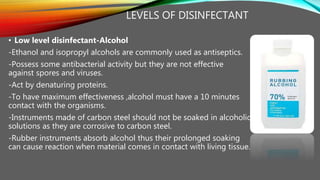
• Low level disinfectant-Alcohol
-Ethanol and isopropyl alcohols are commonly used as antiseptics.
-Possess some antibacterial activity but they are not effective
against spores and viruses.
-Act by denaturing proteins.
-To have maximum effectiveness ,alcohol must have a 10 minutes
contact with the organisms.
-Instruments made of carbon steel should not be soaked in alcoholic
solutions as they are corrosive to carbon steel.
-Rubber instruments absorb alcohol thus their prolonged soaking
can cause reaction when material comes in contact with living tissue.
• Intermediate level- Phenolic compounds
-Phenolic compounds are used for disinfection of inanimate
objects such as walls,floors,furnitures.
-Their spectrum of activity includes lipophilic viruses ,fungi and
bacteria but not spores.Newer synthetic combinations are active
against hydrophilic viruses; hence these are approved by ADA
use as surface or immersion disinfectant.
-Phenolic compounds have unique action, which keeps them
active for longer period after initial application, known as
“Residual Activity”
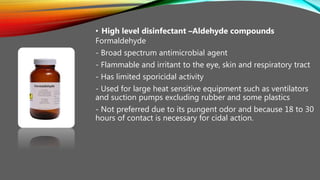
• High level disinfectant –Aldehyde compounds
Formaldehyde
- Broad spectrum antimicrobial agent
- Flammable and irritant to the eye, skin and respiratory tract
- Has limited sporicidal activity
- Used for large heat sensitive equipment such as ventilators
and suction pumps excluding rubber and some plastics
- Not preferred due to its pungent odor and because 18 to 30
hours of contact is necessary for cidal action.
Glutaraldehyde
-Toxic, irritant and allergenic
- A high level disinfectant
-Active against most vegetative bacteria, fungi and bacterial spores
- Frequently used for heat sensitive material
- A solution of 2 percent glutaraldehyde (Cidex), requires immersion of 20
minutes for disinfection; and 6 to 10 hours of immersion for sterilization
- Safely used on metal instruments, rubber, plastics and porcelain
- Activated by addition of sodium bicarbonate but in its activated form, it
remains potent only for 14 days.
ANTISPETICS
“Antiseptic is a chemical disinfectant that can be diluted sufficiently to be
safe for application to living tissues like intact skin,mucousmembranes
and wounds “
Alcohols
-Two types of alcohols are used—ethyl alcohol and isopropyl alcohol.
- Their benefit is derived primarily in their cleansing action.
- Alcohols must have a prolonged contact with the organisms to have an
antibacterial effect.
-Ethyl alcohol is used as 70% as skin antiseptic.
- Isopropyl alcohol is used in 60 to 70% for disinfection of skin.
• Aqueous Quarternary Ammonium Compounds
-Benzalkonium chloride (Zephiran) is the most commonly used antiseptic. It
well-tolerated by living tissues.
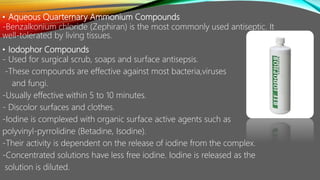
• Iodophor Compounds
- Used for surgical scrub, soaps and surface antisepsis.
-These compounds are effective against most bacteria,viruses
and fungi.
-Usually effective within 5 to 10 minutes.
- Discolor surfaces and clothes.
-Iodine is complexed with organic surface active agents such as
polyvinyl-pyrrolidine (Betadine, Isodine).
-Their activity is dependent on the release of iodine from the complex.
-Concentrated solutions have less free iodine. Iodine is released as the
solution is diluted.
• Chloride Compounds
- Commonly used are sodium hypochlorite and chlorine dioxide.
-Sodium hypochlorite has rapid action.
- A solution of 1 part of 5 percent sodium hypochlorite with 9 parts of water
used.
- Chlorous acid and chlorine dioxide provide disinfection in 3 minutes.
• Diguanides
-Chlorhexidine is active against many bacteria
-Gets inactivated in the presence of soap, pus, plastics, etc.
-Mainly used for cleaning skin and mucous membrane.
-As a 0.2 percent aqueous solution or 1 percent gel, it can be used for
suppression of plaque and postoperative infection
REFERENCES
• Sturdevant's Art & Science of Operative Dentistry,2 nd South Asian Edition
• Clinical Operative Dentistry: Principles and Practice,Ramya Raghu,2 nd
edition
• Textbook of operative dentistry , Nisha Garg ,3 rd Edition
THANK YOU

Disinfection

  • 1.
    DISINFECTION Prepared by :Parvathy Krishnan ( 3 rd Year BDS ) Roll No - 39
  • 2.
    CONTENTS • Introduction • Methods •Levels of disinfectant • Antiseptics • References
  • 3.
    INTRODUCTION Disinfection: “It isthe term used for destruction of all pathogenic organisms such as vegetative forms of bacteria ,mycobacteria,fungi and viruses,but not bacterial endospores.”
  • 4.
    METHODS • Disinfection bycleaning -Cleaning with a detergent and clean water removes almost all pathogens. • Disinfection by heat - Heat is a simple and reliable disinfectant for almost anything except living tissues. - Cleaning with heat provides an excellent quality of disinfection for a wide variety of purposes
  • 5.
    • Disinfection bylow temperature steam -Most vegetative microorganisms and viruses are killed when exposed to at a temperature of 73℃ for 20 minutes below atmospheric pressure. -This makes it a useful procedure to make spoiled instruments safe to handle prior to sterilization. • Disinfection by chemical agents -They are used to disinfect the skin of a patient prior to surgery and to the hands of the operator. -Disadvantages include that no chemical solution sterilizes the instruments immersed in it.There is a risk of protecting tissue damage if residual solution is carried into the wound.
  • 6.
    LEVELS OF DISINFECTANT •Low level disinfectant-Alcohol -Ethanol and isopropyl alcohols are commonly used as antiseptics. -Possess some antibacterial activity but they are not effective against spores and viruses. -Act by denaturing proteins. -To have maximum effectiveness ,alcohol must have a 10 minutes contact with the organisms. -Instruments made of carbon steel should not be soaked in alcoholic solutions as they are corrosive to carbon steel. -Rubber instruments absorb alcohol thus their prolonged soaking can cause reaction when material comes in contact with living tissue.
  • 7.
    • Intermediate level-Phenolic compounds -Phenolic compounds are used for disinfection of inanimate objects such as walls,floors,furnitures. -Their spectrum of activity includes lipophilic viruses ,fungi and bacteria but not spores.Newer synthetic combinations are active against hydrophilic viruses; hence these are approved by ADA use as surface or immersion disinfectant. -Phenolic compounds have unique action, which keeps them active for longer period after initial application, known as “Residual Activity”
  • 8.
    • High leveldisinfectant –Aldehyde compounds Formaldehyde - Broad spectrum antimicrobial agent - Flammable and irritant to the eye, skin and respiratory tract - Has limited sporicidal activity - Used for large heat sensitive equipment such as ventilators and suction pumps excluding rubber and some plastics - Not preferred due to its pungent odor and because 18 to 30 hours of contact is necessary for cidal action.
  • 9.
    Glutaraldehyde -Toxic, irritant andallergenic - A high level disinfectant -Active against most vegetative bacteria, fungi and bacterial spores - Frequently used for heat sensitive material - A solution of 2 percent glutaraldehyde (Cidex), requires immersion of 20 minutes for disinfection; and 6 to 10 hours of immersion for sterilization - Safely used on metal instruments, rubber, plastics and porcelain - Activated by addition of sodium bicarbonate but in its activated form, it remains potent only for 14 days.
  • 10.
    ANTISPETICS “Antiseptic is achemical disinfectant that can be diluted sufficiently to be safe for application to living tissues like intact skin,mucousmembranes and wounds “ Alcohols -Two types of alcohols are used—ethyl alcohol and isopropyl alcohol. - Their benefit is derived primarily in their cleansing action. - Alcohols must have a prolonged contact with the organisms to have an antibacterial effect. -Ethyl alcohol is used as 70% as skin antiseptic. - Isopropyl alcohol is used in 60 to 70% for disinfection of skin.
  • 11.
    • Aqueous QuarternaryAmmonium Compounds -Benzalkonium chloride (Zephiran) is the most commonly used antiseptic. It well-tolerated by living tissues. • Iodophor Compounds - Used for surgical scrub, soaps and surface antisepsis. -These compounds are effective against most bacteria,viruses and fungi. -Usually effective within 5 to 10 minutes. - Discolor surfaces and clothes. -Iodine is complexed with organic surface active agents such as polyvinyl-pyrrolidine (Betadine, Isodine). -Their activity is dependent on the release of iodine from the complex. -Concentrated solutions have less free iodine. Iodine is released as the solution is diluted.
  • 12.
    • Chloride Compounds -Commonly used are sodium hypochlorite and chlorine dioxide. -Sodium hypochlorite has rapid action. - A solution of 1 part of 5 percent sodium hypochlorite with 9 parts of water used. - Chlorous acid and chlorine dioxide provide disinfection in 3 minutes. • Diguanides -Chlorhexidine is active against many bacteria -Gets inactivated in the presence of soap, pus, plastics, etc. -Mainly used for cleaning skin and mucous membrane. -As a 0.2 percent aqueous solution or 1 percent gel, it can be used for suppression of plaque and postoperative infection
  • 13.
    REFERENCES • Sturdevant's Art& Science of Operative Dentistry,2 nd South Asian Edition • Clinical Operative Dentistry: Principles and Practice,Ramya Raghu,2 nd edition • Textbook of operative dentistry , Nisha Garg ,3 rd Edition
  • 14.