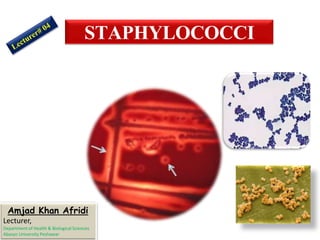
STAPHYLOCOCCI
Amjad Khan Afridi
Lecturer,
Department of Health & Biological Sciences
Abasyn University Peshawar
INTRODUCTION
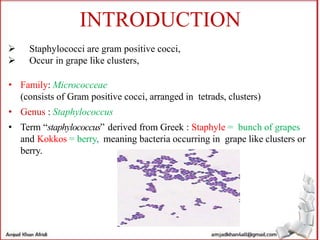
 Staphylococci are gram positive cocci,
 Occur in grape like clusters,
• Family: Micrococceae
(consists of Gram positive cocci, arranged in tetrads, clusters)
• Genus : Staphylococcus
• Term “staphylococcus” derived from Greek : Staphyle = bunch of grapes
and Kokkos = berry, meaning bacteria occurring in grape like clusters or
berry.
History
• Robert Koch (1878)- first to
see staphylococci in pus
specimen
• Louis Pasteur (1880)- first
to cultivate in liquid
medium
• Sir Alexander Ongston
(1881)- named the
bacteria as
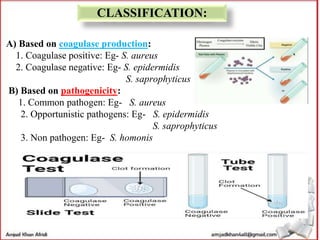
A) Based on coagulase production:
1. Coagulase positive: Eg- S. aureus
2. Coagulase negative: Eg- S. epidermidis
S. saprophyticus
B) Based on pathogenicity:
1. Common pathogen: Eg- S. aureus
2. Opportunistic pathogens: Eg- S. epidermidis
S. saprophyticus
3. Non pathogen: Eg- S. homonis
CLASSIFICATION:
Biochemical Properties
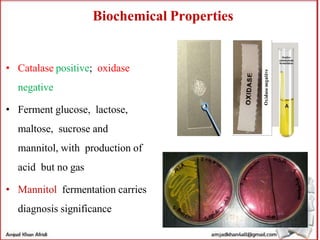
• Catalase positive; oxidase
negative
• Ferment glucose, lactose,
maltose, sucrose and
mannitol, with production of
acid but no gas
• Mannitol fermentation carries
diagnosis significance
Staphylococcus aureus
• Natural habitat:-Nostril and skin
Morphology:-
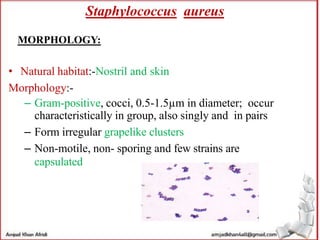
– Gram-positive, cocci, 0.5-1.5µm in diameter; occur
characteristically in group, also singly and in pairs
– Form irregular grapelike clusters
– Non-motile, non- sporing and few strains are
capsulated
MORPHOLOGY:
Culture
• Aerobes and facultative anaerobes
• Opt. Temp. For growth= 37°C
• Opt. pH for growth= 7.5
• On Nutrient agar,
– Golden yellow and opaque colonies with smooth glistening
surface, 1-2 mm in diameter (max. pigment production 22°C)
Cultural Characteristics:
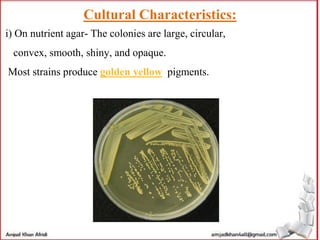
i) On nutrient agar- The colonies are large, circular,
convex, smooth, shiny, and opaque.
Most strains produce golden yellow pigments.
CULTURE
Media used :-
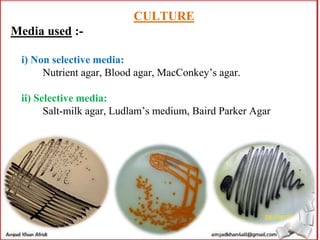
i) Non selective media:
Nutrient agar, Blood agar, MacConkey’s agar.
ii) Selective media:
Salt-milk agar, Ludlam’s medium, Baird Parker Agar
Culture (contd...)
• On Blood agar
– Golden yellow colonies, surrounded by a clear zone of
hemolysis (β/beta- hemolysis),esp. When incubated in
sheep or rabbit blood agar in atmosphere of 20% CO2
• On MacConkey agar
– Smaller colonies than those on NA (0.1-0.5 mm) and
are pink coloured due to lactose fermentation
Culture (....contd)
• On Mannitol Salt Agar,
– S. aureus ferments mannitol
and appear as yellow
colonies
– Mannitol Salt Agar (MSA) is a
useful selective medium for
recovering S. aureus from
faecal specimens, when
investigating food poisoning
Biochemical Properties(....contd)
• Indole test= negative
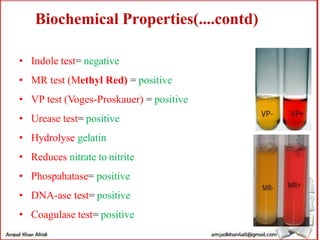
• MR test (Methyl Red) = positive
• VP test (Voges-Proskauer) = positive
• Urease test= positive
• Hydrolyse gelatin
• Reduces nitrate to nitrite
• Phospahatase= positive
• DNA-ase test= positive
• Coagulase test= positive
PATHOGENICITY:
Source of infection:
A) Exogenous: patients or carriers
B) Endogenous: From colonized site
Mode of transmission:
A) Contact: Direct or indirect (through fomites)
B) Inhalation of air borne droplets
 INFECTIONS:
Mechanism of pathogenesis:
Cocci gain access to damaged skin, mucosal or tissue site
Colonize by adhering to cells or extracellular matrix
Evade the host defense mechanisms and multiply
Cause tissue damage
Clinical Syndromes
1. Cutaneous infections
– Folliculitis
– Boils/furuncles
– Carbuncle
– Impetigo
– Wound infections
2. Deep infections
– Osteomyelitis
– Periostitis
– Endocarditis
3. Exfoliative diseases
4. Toxic Shock Syndrome
5. Staphylococcal food intoxication
Impetigo Paronychia
Cellulitis
Wound infection
1) Cutaneous Infections
• Folliculitis: It is inflammation of the hair follicles.
• A small red bump or pimple develops at infection sites
of hair follicle.
•Sty: A sty is folliculitis affecting one
or more hair follicles on the edge of
the upper or lower eyelid.
Cutaneous Infections(contd....)
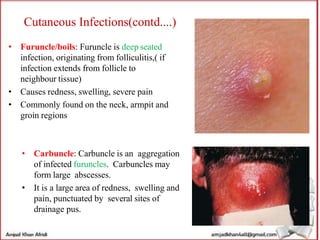
• Furuncle/boils: Furuncle is deep seated
infection, originating from folliculitis,( if
infection extends from follicle to
neighbour tissue)
• Causes redness, swelling, severe pain
• Commonly found on the neck, armpit and
groin regions
• Carbuncle: Carbuncle is an aggregation
of infected furuncles. Carbuncles may
form large abscesses.
• It is a large area of redness, swelling and
pain, punctuated by several sites of
drainage pus.
Cutaneous Infections (contd....)
• Impetigo: a very superficial skin infection common in children,
usually produces blisters or sores on the face, neck, hands, and
diaper area.
• It is characterized by watery bristles, which become pustules
and then honey coloured crust
impetigo with vesicles, pustules, and sharply
demarcated regions of honey-colored crusts.
2) Deep Infections
• Osteomyelitis: inflammation of
bone
• Bacteria can get to the bone
– Via bloodstream
– Following an injury
Clinical features: pain, swelling, deformity,
defective healing, in some case pus flow,
Diagnosis: X-ray, MRI, bone aspirates
Deep Infections (contd....)
• Periostitis: inflammation of
periosteum
• Clinical features: fever,
localised pain, leucocytosis
• Diagnosis: needle aspiration of
subperiosteal fluid
Deep Infections (....contd)
• Endocarditis: It is an inflammation
of the inner layer of the heart, the
endocardium
• Endocarditis occurs when bacteria
enter bloodstream, travel to heart,
and lodge on abnormal heart valves
or damaged heart tissue.
3) Exfoliative Disease
• (Exfoliate= scaling off tissues in layers)
• Also known as ‘Staphylococcalskin
scalded syndrome’
• Epidermal toxin produced by S.aureus at
skin and is carried by bloodstream to
epidermis , where it causes a split in a
cellular layer i.e., this toxin separates
outer layer of epidermis from underlying
tissue
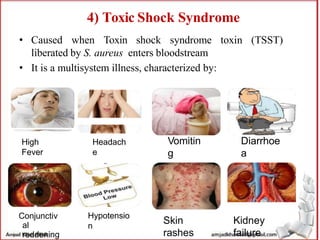
4) Toxic Shock Syndrome
• Caused when Toxin shock syndrome toxin (TSST)
liberated by S. aureus enters bloodstream
• It is a multisystem illness, characterized by:
Vomitin
g
Diarrhoe
a
Skin
rashes
Kidney
failure
High
Fever
Headach
e
Conjunctiv
al
reddening
Hypotensio
n
5) Staphylococcal Food Poisoning
• Caused when consuming food in which S. aureus has multiplied and
formed endotoxin
• The common food items responsible are - milk and milk products,
meat, fish and ice cream.
• Symptoms:
– Nausea
– Vomiting
– Severe abdominal cramp
– Diarrhoea
– Sweating
– Headache, etc.
Mode Of
Transmission
Person with
lesions
Airborne
droplets
Asymptomatic
carrier
Cross-
infection
Mode of
transmissio
n
Preventio
n
Wash your
hands
Avoid sharing
personal care items
Cooking and
storing food
properly
Keep
wounds
covered
Treatment and
Drugs
Antibioti
c
therapy
Wound
drainag
e
Removal
of dead
Laboratory Diagnosis
A. Haematological Investigation:
1. TLC (Total leukocyte count):
Normal:
In case of infection:
4000-10000 cells/mm³
> 10000 cells/mm³
2. DLC (Differential leukocyte count):
Normal neutrophil : 80%
In case of infection: > 80%
Laboratory Diagnosis (contd....)
B.Bacteriological
Investigation:
• Specimens:
– Pus: from wound or abscess
or burns]
– Nasal Swab: from
suspected carrier
– Food: to diagnose staphylococcal
intoxication
– Blood: to diagnose
endocarditis and bacteremia
– Sputum: to diagnose lower
respiratory tract infection
Laboratory Diagnosis (contd....)
• Culture and isolation:
– Specimens are cultured on BA plate and are
incubated @ 37 °C for 24 hours
– After incubation, BA plate is observed for
significant bacterial growth (> 2mm in
diameter)
– Then, Gram-staining is performed of the
isolated organisms
– Then, subcultured on NA plate for further
biochemical tests
• Tube coagulase test:
– i. Mix 0.5ml of human plasma with 0.1ml
of an overnight broth culture of S.aures
– ii. Incubate the mix in a water bath @ 37°C
for 3-6 hours
– Result: plasma clots and doesn’t flow if the
tube is inverted
THANK
YOU
21/03/2023

Staphylococcus

  • 1.
    STAPHYLOCOCCI Amjad Khan Afridi Lecturer, Departmentof Health & Biological Sciences Abasyn University Peshawar
  • 2.
    INTRODUCTION  Staphylococci aregram positive cocci,  Occur in grape like clusters, • Family: Micrococceae (consists of Gram positive cocci, arranged in tetrads, clusters) • Genus : Staphylococcus • Term “staphylococcus” derived from Greek : Staphyle = bunch of grapes and Kokkos = berry, meaning bacteria occurring in grape like clusters or berry.
  • 3.
    History • Robert Koch(1878)- first to see staphylococci in pus specimen • Louis Pasteur (1880)- first to cultivate in liquid medium • Sir Alexander Ongston (1881)- named the bacteria as
  • 4.
    A) Based oncoagulase production: 1. Coagulase positive: Eg- S. aureus 2. Coagulase negative: Eg- S. epidermidis S. saprophyticus B) Based on pathogenicity: 1. Common pathogen: Eg- S. aureus 2. Opportunistic pathogens: Eg- S. epidermidis S. saprophyticus 3. Non pathogen: Eg- S. homonis CLASSIFICATION:
  • 5.
    Biochemical Properties • Catalasepositive; oxidase negative • Ferment glucose, lactose, maltose, sucrose and mannitol, with production of acid but no gas • Mannitol fermentation carries diagnosis significance
  • 6.
    Staphylococcus aureus • Naturalhabitat:-Nostril and skin Morphology:- – Gram-positive, cocci, 0.5-1.5µm in diameter; occur characteristically in group, also singly and in pairs – Form irregular grapelike clusters – Non-motile, non- sporing and few strains are capsulated MORPHOLOGY:
  • 7.
    Culture • Aerobes andfacultative anaerobes • Opt. Temp. For growth= 37°C • Opt. pH for growth= 7.5 • On Nutrient agar, – Golden yellow and opaque colonies with smooth glistening surface, 1-2 mm in diameter (max. pigment production 22°C)
  • 8.
    Cultural Characteristics: i) Onnutrient agar- The colonies are large, circular, convex, smooth, shiny, and opaque. Most strains produce golden yellow pigments.
  • 9.
    CULTURE Media used :- i)Non selective media: Nutrient agar, Blood agar, MacConkey’s agar. ii) Selective media: Salt-milk agar, Ludlam’s medium, Baird Parker Agar
  • 10.
    Culture (contd...) • OnBlood agar – Golden yellow colonies, surrounded by a clear zone of hemolysis (β/beta- hemolysis),esp. When incubated in sheep or rabbit blood agar in atmosphere of 20% CO2 • On MacConkey agar – Smaller colonies than those on NA (0.1-0.5 mm) and are pink coloured due to lactose fermentation
  • 11.
    Culture (....contd) • OnMannitol Salt Agar, – S. aureus ferments mannitol and appear as yellow colonies – Mannitol Salt Agar (MSA) is a useful selective medium for recovering S. aureus from faecal specimens, when investigating food poisoning
  • 12.
    Biochemical Properties(....contd) • Indoletest= negative • MR test (Methyl Red) = positive • VP test (Voges-Proskauer) = positive • Urease test= positive • Hydrolyse gelatin • Reduces nitrate to nitrite • Phospahatase= positive • DNA-ase test= positive • Coagulase test= positive
  • 13.
    PATHOGENICITY: Source of infection: A)Exogenous: patients or carriers B) Endogenous: From colonized site Mode of transmission: A) Contact: Direct or indirect (through fomites) B) Inhalation of air borne droplets
  • 14.
     INFECTIONS: Mechanism ofpathogenesis: Cocci gain access to damaged skin, mucosal or tissue site Colonize by adhering to cells or extracellular matrix Evade the host defense mechanisms and multiply Cause tissue damage
  • 15.
    Clinical Syndromes 1. Cutaneousinfections – Folliculitis – Boils/furuncles – Carbuncle – Impetigo – Wound infections 2. Deep infections – Osteomyelitis – Periostitis – Endocarditis 3. Exfoliative diseases 4. Toxic Shock Syndrome 5. Staphylococcal food intoxication
  • 16.
  • 17.
    1) Cutaneous Infections •Folliculitis: It is inflammation of the hair follicles. • A small red bump or pimple develops at infection sites of hair follicle. •Sty: A sty is folliculitis affecting one or more hair follicles on the edge of the upper or lower eyelid.
  • 18.
    Cutaneous Infections(contd....) • Furuncle/boils:Furuncle is deep seated infection, originating from folliculitis,( if infection extends from follicle to neighbour tissue) • Causes redness, swelling, severe pain • Commonly found on the neck, armpit and groin regions • Carbuncle: Carbuncle is an aggregation of infected furuncles. Carbuncles may form large abscesses. • It is a large area of redness, swelling and pain, punctuated by several sites of drainage pus.
  • 19.
    Cutaneous Infections (contd....) •Impetigo: a very superficial skin infection common in children, usually produces blisters or sores on the face, neck, hands, and diaper area. • It is characterized by watery bristles, which become pustules and then honey coloured crust impetigo with vesicles, pustules, and sharply demarcated regions of honey-colored crusts.
  • 20.
    2) Deep Infections •Osteomyelitis: inflammation of bone • Bacteria can get to the bone – Via bloodstream – Following an injury Clinical features: pain, swelling, deformity, defective healing, in some case pus flow, Diagnosis: X-ray, MRI, bone aspirates
  • 21.
    Deep Infections (contd....) •Periostitis: inflammation of periosteum • Clinical features: fever, localised pain, leucocytosis • Diagnosis: needle aspiration of subperiosteal fluid
  • 22.
    Deep Infections (....contd) •Endocarditis: It is an inflammation of the inner layer of the heart, the endocardium • Endocarditis occurs when bacteria enter bloodstream, travel to heart, and lodge on abnormal heart valves or damaged heart tissue.
  • 23.
    3) Exfoliative Disease •(Exfoliate= scaling off tissues in layers) • Also known as ‘Staphylococcalskin scalded syndrome’ • Epidermal toxin produced by S.aureus at skin and is carried by bloodstream to epidermis , where it causes a split in a cellular layer i.e., this toxin separates outer layer of epidermis from underlying tissue
  • 24.
    4) Toxic ShockSyndrome • Caused when Toxin shock syndrome toxin (TSST) liberated by S. aureus enters bloodstream • It is a multisystem illness, characterized by: Vomitin g Diarrhoe a Skin rashes Kidney failure High Fever Headach e Conjunctiv al reddening Hypotensio n
  • 25.
    5) Staphylococcal FoodPoisoning • Caused when consuming food in which S. aureus has multiplied and formed endotoxin • The common food items responsible are - milk and milk products, meat, fish and ice cream. • Symptoms: – Nausea – Vomiting – Severe abdominal cramp – Diarrhoea – Sweating – Headache, etc.
  • 26.
  • 27.
    Preventio n Wash your hands Avoid sharing personalcare items Cooking and storing food properly Keep wounds covered
  • 28.
  • 29.
    Laboratory Diagnosis A. HaematologicalInvestigation: 1. TLC (Total leukocyte count): Normal: In case of infection: 4000-10000 cells/mm³ > 10000 cells/mm³ 2. DLC (Differential leukocyte count): Normal neutrophil : 80% In case of infection: > 80%
  • 30.
    Laboratory Diagnosis (contd....) B.Bacteriological Investigation: •Specimens: – Pus: from wound or abscess or burns] – Nasal Swab: from suspected carrier – Food: to diagnose staphylococcal intoxication – Blood: to diagnose endocarditis and bacteremia – Sputum: to diagnose lower respiratory tract infection
  • 31.
    Laboratory Diagnosis (contd....) •Culture and isolation: – Specimens are cultured on BA plate and are incubated @ 37 °C for 24 hours – After incubation, BA plate is observed for significant bacterial growth (> 2mm in diameter) – Then, Gram-staining is performed of the isolated organisms – Then, subcultured on NA plate for further biochemical tests • Tube coagulase test: – i. Mix 0.5ml of human plasma with 0.1ml of an overnight broth culture of S.aures – ii. Incubate the mix in a water bath @ 37°C for 3-6 hours – Result: plasma clots and doesn’t flow if the tube is inverted
  • 32.