Presented by: GURKIRAT SINGH
CONTENT
 Starting Of Induction Motor
 Starters
 Types Of Starter For 3-ph Induction Motors
 Starting Of Slip Ring Induction
Motor
 D.O.L.(Direct On Line) starter
 Star-delta Starter
 Auto Transformer Starter
 Difference Between DOL/Star Delta/
Autotransformer
Presented By:-Gurkirat Singh (Electrical Engineering)
Starting Of Induction Motor
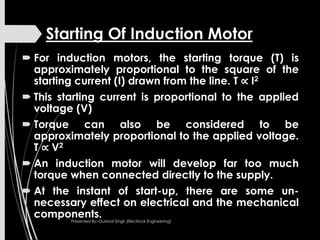
 For induction motors, the starting torque (T) is
approximately proportional to the square of the
starting current (I) drawn from the line. T ∝ I2
 This starting current is proportional to the applied
voltage (V)
 Torque can also be considered to be
approximately proportional to the applied voltage.
T ∝ V2
 An induction motor will develop far too much
torque when connected directly to the supply.
 At the instant of start-up, there are some un-
necessary effect on electrical and the mechanical
components.Presented By:-Gurkirat Singh (Electrical Engineering)
Un-Necessary Mechanical Effects
The sudden impact at start up on the load, followed
by the rapid acceleration to full speed causes
excessive wear on :-
 Belts and pulleys
 Gears and chains
 Couplings and bearings, etc.
Presented By:-Gurkirat Singh (Electrical Engineering)
Un-necessary Electrical Effects
 A heavy current surge on the electrical supply
which can be severe enough to cause voltage
dips and flickering lights.
 Burning of contacts due to high currents which
are many times the motor full-load current.
Presented By:-Gurkirat Singh (Electrical Engineering)
Problems Arises By These Effects
 Continuous maintenance.
 Greater chance of unscheduled shutdowns
 Oversized mechanical and electrical
components to cater for the power surge on
start up.
 Short component life.
Presented By:-Gurkirat Singh (Electrical Engineering)
Starter
 By Adjusting voltage during starting, the current
drawn by the motor and the
 Torque produced by the motor can be reduced
and controlled.
Function Of Starter
 Start and stop the motor.
 Limit inrush current where necessary.
 Permit automatic control when required
 Protect motor and other connected equipments
from over voltage, no voltage, under voltage,
single phasing etc.Presented By:-Gurkirat Singh (Electrical Engineering)
Starter Features
 Starting and stopping (electrical life)
 Remote ON/OFF control
 Motor overload protection
 Motor under voltage protection
 Rated by current (amperes) or power
(horsepower)
Presented By:-Gurkirat Singh (Electrical Engineering)
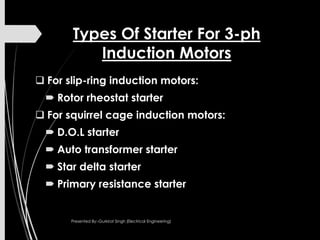
Types Of Starter For 3-ph
Induction Motors
 For slip-ring induction motors:
 Rotor rheostat starter
 For squirrel cage induction motors:
 D.O.L starter
 Auto transformer starter
 Star delta starter
 Primary resistance starter
Presented By:-Gurkirat Singh (Electrical Engineering)
Starting Of Slip Ring Induction
Motor
 In case of slip ring induction motors it is possible
to add external resistance in rotor phases as
wound rotor has 3-phase star connected
winding to limit the starting high current.
Presented By:-Gurkirat Singh (Electrical Engineering)
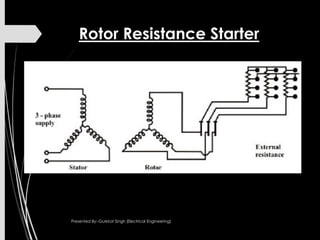
Rotor Resistance Starter
Presented By:-Gurkirat Singh (Electrical Engineering)
 In rotor resistance starter the three terminals of the
rotor winding are connected to a variable external
resistances through slip rings.
 Full supply voltage is applied across the stator.
Resistances are fully in the circuit at starting , so that
the starting current is reduced. The external variable
resistance connected in each phase of the rotor
circuit not only reduce the current at starting but
increases the starting torque also due to
improvement in power factor.
 The rotor circuit resistance is gradually cut out , as the
motor speeds up and during normal running
condition ,the rotor circuit resistance is completely
cut out and the slip rings are short circuited.Presented By:-Gurkirat Singh (Electrical Engineering)
D.O.L.(Direct On Line) starter
Presented By:-Gurkirat Singh (Electrical Engineering)
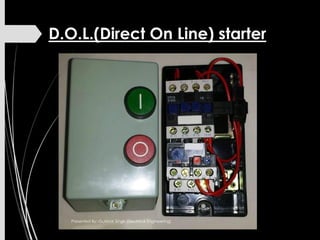
D.O.L.(Direct On Line) starter
 A Starter Which Connects A Motor Directly Across The Line
Is Called D.O.L. Starter.
 In This Method, The Motor Is Connected By Means Of A
Starter Across The Full Supply Voltage.
 It Is Very Simple, Inexpensive, Easy To Install And Maintain.
 It Consist - START Button
 OFF Button
 Electromagnetic Contactor
 Overload Relay
 Switching By This Starter Is Directly From Line Without Any
Provision To Control The Starting Current i.e. There Is No
Device To Reduce The Starting Current In This Starter.
Note: Only used for less than 5 KW squirrel cage induction
motor.
Presented By:-Gurkirat Singh (Electrical Engineering)
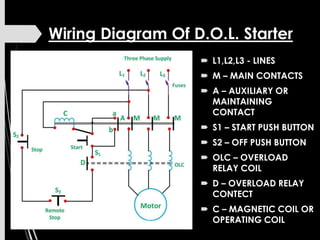
Wiring Diagram Of D.O.L. Starter
 L1,L2,L3 - LINES
 M – MAIN CONTACTS
 A – AUXILIARY OR
MAINTAINING
CONTACT
 S1 – START PUSH BUTTON
 S2 – OFF PUSH BUTTON
 OLC – OVERLOAD
RELAY COIL
 D – OVERLOAD RELAY
CONTECT
 C – MAGNETIC COIL OR
OPERATING COILPresented By:-Gurkirat Singh (Electrical Engineering)
Protection In This Type of Starter
 Under Voltage Protection
 Overload Protection
1) Under Voltage Protection
 When supply voltage is not sufficient or there is failure of
power supply , the coil C is de-energized and motor will
be disconnected.
2) Overload Protection
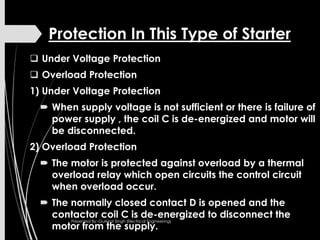
 The motor is protected against overload by a thermal
overload relay which open circuits the control circuit
when overload occur.
 The normally closed contact D is opened and the
contactor coil C is de-energized to disconnect the
motor from the supply.
Presented By:-Gurkirat Singh (Electrical Engineering)
Components OF D.O.L. Starter :
Overload Contactor
Presented By:-Gurkirat Singh (Electrical Engineering)
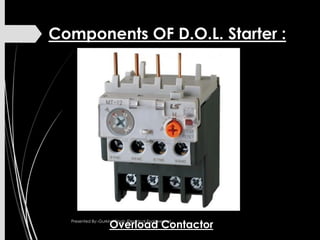
Magnetic ContactorPresented By:-Gurkirat Singh (Electrical Engineering)
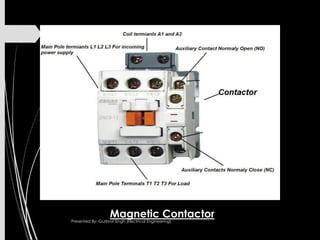
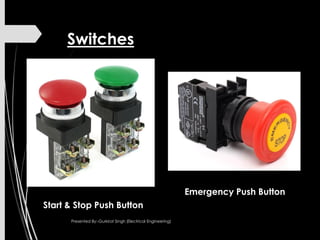
Switches
Start & Stop Push Button
Emergency Push Button
Presented By:-Gurkirat Singh (Electrical Engineering)
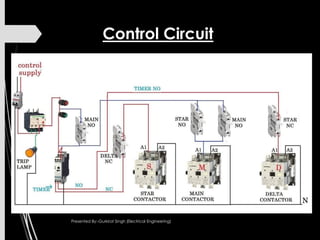
Star-Delta Starter
 This is very commonly used starter, compared to
the other types of the starters.
 Star-delta starter can be used, provided the
stator of the 3-O induction motor is designed for
delta connection during its normal operation.
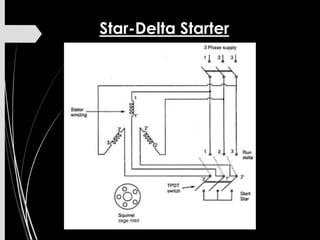
 At starting, the stator winding is connected in star,
therefore the applied voltage to each phase of
winding is 1/√3 of the rated voltage of the motor.
 When the motor has picked-up the speed(say 70
to 80% of its normal speed ) the phases of the
stator winding are connected in delta.
Presented By:-Gurkirat Singh (Electrical Engineering)
 Now full supply voltage is applied across the
stator windings.
 This method is cheap but limited to applications
where high starting torque is not necessary e.g.,
machine tools, pumps, motor-generator sets etc.
 The method is unsuitable for motors for voltage
exceeding 3000 V because of the excessive
number of stator turns needed for delta
connection.
 Such starters are employed for starting 3-phase
squirrel cage induction motors of rating between
4 and 20 k W.
Presented By:-Gurkirat Singh (Electrical Engineering)
Star-Delta Starter
Presented By:-Gurkirat Singh (Electrical Engineering)
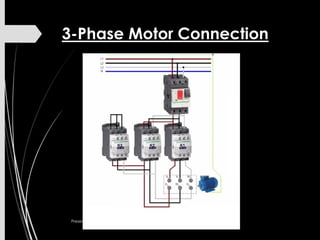
3-Phase Motor Connection
Presented By:-Gurkirat Singh (Electrical Engineering)
Control Circuit
Presented By:-Gurkirat Singh (Electrical Engineering)
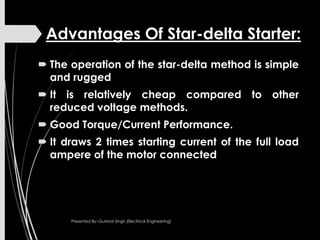
Advantages Of Star-delta Starter:
 The operation of the star-delta method is simple
and rugged
 It is relatively cheap compared to other
reduced voltage methods.
 Good Torque/Current Performance.
 It draws 2 times starting current of the full load
ampere of the motor connected
Presented By:-Gurkirat Singh (Electrical Engineering)
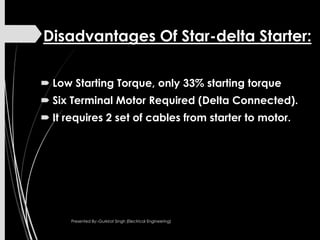
Disadvantages Of Star-delta Starter:
 Low Starting Torque, only 33% starting torque
 Six Terminal Motor Required (Delta Connected).
 It requires 2 set of cables from starter to motor.
Presented By:-Gurkirat Singh (Electrical Engineering)
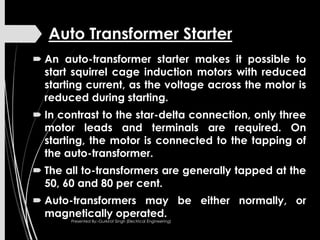
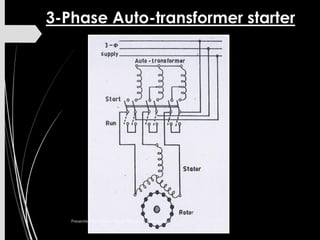
Auto Transformer Starter
 An auto-transformer starter makes it possible to
start squirrel cage induction motors with reduced
starting current, as the voltage across the motor is
reduced during starting.
 In contrast to the star-delta connection, only three
motor leads and terminals are required. On
starting, the motor is connected to the tapping of
the auto-transformer.
 The all to-transformers are generally tapped at the
50, 60 and 80 per cent.
 Auto-transformers may be either normally, or
magnetically operated.
Presented By:-Gurkirat Singh (Electrical Engineering)
3-Phase Auto-transformer starter
Presented By:-Gurkirat Singh (Electrical Engineering)
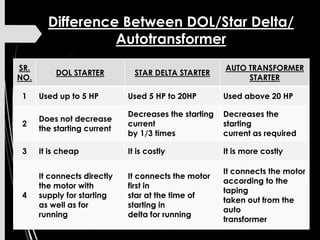
Difference Between DOL/Star Delta/
Autotransformer
SR.
NO.
DOL STARTER STAR DELTA STARTER
AUTO TRANSFORMER
STARTER
1 Used up to 5 HP Used 5 HP to 20HP Used above 20 HP
2
Does not decrease
the starting current
Decreases the starting
current
by 1/3 times
Decreases the
starting
current as required
3 It is cheap It is costly It is more costly
4
It connects directly
the motor with
supply for starting
as well as for
running
It connects the motor
first in
star at the time of
starting in
delta for running
It connects the motor
according to the
taping
taken out from the
auto
transformerPresented By:-Gurkirat Singh (Electrical Engineering)
Thank you……
Presented by: GURKIRAT SINGH
Presented By:-Gurkirat Singh (Electrical Engineering)

Starting method of induction motors

  • 1.
  • 2.
    CONTENT  Starting OfInduction Motor  Starters  Types Of Starter For 3-ph Induction Motors  Starting Of Slip Ring Induction Motor  D.O.L.(Direct On Line) starter  Star-delta Starter  Auto Transformer Starter  Difference Between DOL/Star Delta/ Autotransformer Presented By:-Gurkirat Singh (Electrical Engineering)
  • 3.
    Starting Of InductionMotor  For induction motors, the starting torque (T) is approximately proportional to the square of the starting current (I) drawn from the line. T ∝ I2  This starting current is proportional to the applied voltage (V)  Torque can also be considered to be approximately proportional to the applied voltage. T ∝ V2  An induction motor will develop far too much torque when connected directly to the supply.  At the instant of start-up, there are some un- necessary effect on electrical and the mechanical components.Presented By:-Gurkirat Singh (Electrical Engineering)
  • 4.
    Un-Necessary Mechanical Effects Thesudden impact at start up on the load, followed by the rapid acceleration to full speed causes excessive wear on :-  Belts and pulleys  Gears and chains  Couplings and bearings, etc. Presented By:-Gurkirat Singh (Electrical Engineering)
  • 5.
    Un-necessary Electrical Effects A heavy current surge on the electrical supply which can be severe enough to cause voltage dips and flickering lights.  Burning of contacts due to high currents which are many times the motor full-load current. Presented By:-Gurkirat Singh (Electrical Engineering)
  • 6.
    Problems Arises ByThese Effects  Continuous maintenance.  Greater chance of unscheduled shutdowns  Oversized mechanical and electrical components to cater for the power surge on start up.  Short component life. Presented By:-Gurkirat Singh (Electrical Engineering)
  • 7.
    Starter  By Adjustingvoltage during starting, the current drawn by the motor and the  Torque produced by the motor can be reduced and controlled. Function Of Starter  Start and stop the motor.  Limit inrush current where necessary.  Permit automatic control when required  Protect motor and other connected equipments from over voltage, no voltage, under voltage, single phasing etc.Presented By:-Gurkirat Singh (Electrical Engineering)
  • 8.
    Starter Features  Startingand stopping (electrical life)  Remote ON/OFF control  Motor overload protection  Motor under voltage protection  Rated by current (amperes) or power (horsepower) Presented By:-Gurkirat Singh (Electrical Engineering)
  • 9.
    Types Of StarterFor 3-ph Induction Motors  For slip-ring induction motors:  Rotor rheostat starter  For squirrel cage induction motors:  D.O.L starter  Auto transformer starter  Star delta starter  Primary resistance starter Presented By:-Gurkirat Singh (Electrical Engineering)
  • 10.
    Starting Of SlipRing Induction Motor  In case of slip ring induction motors it is possible to add external resistance in rotor phases as wound rotor has 3-phase star connected winding to limit the starting high current. Presented By:-Gurkirat Singh (Electrical Engineering)
  • 11.
    Rotor Resistance Starter PresentedBy:-Gurkirat Singh (Electrical Engineering)
  • 12.
     In rotorresistance starter the three terminals of the rotor winding are connected to a variable external resistances through slip rings.  Full supply voltage is applied across the stator. Resistances are fully in the circuit at starting , so that the starting current is reduced. The external variable resistance connected in each phase of the rotor circuit not only reduce the current at starting but increases the starting torque also due to improvement in power factor.  The rotor circuit resistance is gradually cut out , as the motor speeds up and during normal running condition ,the rotor circuit resistance is completely cut out and the slip rings are short circuited.Presented By:-Gurkirat Singh (Electrical Engineering)
  • 13.
    D.O.L.(Direct On Line)starter Presented By:-Gurkirat Singh (Electrical Engineering)
  • 14.
    D.O.L.(Direct On Line)starter  A Starter Which Connects A Motor Directly Across The Line Is Called D.O.L. Starter.  In This Method, The Motor Is Connected By Means Of A Starter Across The Full Supply Voltage.  It Is Very Simple, Inexpensive, Easy To Install And Maintain.  It Consist - START Button  OFF Button  Electromagnetic Contactor  Overload Relay  Switching By This Starter Is Directly From Line Without Any Provision To Control The Starting Current i.e. There Is No Device To Reduce The Starting Current In This Starter. Note: Only used for less than 5 KW squirrel cage induction motor. Presented By:-Gurkirat Singh (Electrical Engineering)
  • 15.
    Wiring Diagram OfD.O.L. Starter  L1,L2,L3 - LINES  M – MAIN CONTACTS  A – AUXILIARY OR MAINTAINING CONTACT  S1 – START PUSH BUTTON  S2 – OFF PUSH BUTTON  OLC – OVERLOAD RELAY COIL  D – OVERLOAD RELAY CONTECT  C – MAGNETIC COIL OR OPERATING COILPresented By:-Gurkirat Singh (Electrical Engineering)
  • 16.
    Protection In ThisType of Starter  Under Voltage Protection  Overload Protection 1) Under Voltage Protection  When supply voltage is not sufficient or there is failure of power supply , the coil C is de-energized and motor will be disconnected. 2) Overload Protection  The motor is protected against overload by a thermal overload relay which open circuits the control circuit when overload occur.  The normally closed contact D is opened and the contactor coil C is de-energized to disconnect the motor from the supply. Presented By:-Gurkirat Singh (Electrical Engineering)
  • 17.
    Components OF D.O.L.Starter : Overload Contactor Presented By:-Gurkirat Singh (Electrical Engineering)
  • 18.
    Magnetic ContactorPresented By:-GurkiratSingh (Electrical Engineering)
  • 19.
    Switches Start & StopPush Button Emergency Push Button Presented By:-Gurkirat Singh (Electrical Engineering)
  • 20.
    Star-Delta Starter  Thisis very commonly used starter, compared to the other types of the starters.  Star-delta starter can be used, provided the stator of the 3-O induction motor is designed for delta connection during its normal operation.  At starting, the stator winding is connected in star, therefore the applied voltage to each phase of winding is 1/√3 of the rated voltage of the motor.  When the motor has picked-up the speed(say 70 to 80% of its normal speed ) the phases of the stator winding are connected in delta. Presented By:-Gurkirat Singh (Electrical Engineering)
  • 21.
     Now fullsupply voltage is applied across the stator windings.  This method is cheap but limited to applications where high starting torque is not necessary e.g., machine tools, pumps, motor-generator sets etc.  The method is unsuitable for motors for voltage exceeding 3000 V because of the excessive number of stator turns needed for delta connection.  Such starters are employed for starting 3-phase squirrel cage induction motors of rating between 4 and 20 k W. Presented By:-Gurkirat Singh (Electrical Engineering)
  • 22.
    Star-Delta Starter Presented By:-GurkiratSingh (Electrical Engineering)
  • 23.
    3-Phase Motor Connection PresentedBy:-Gurkirat Singh (Electrical Engineering)
  • 24.
    Control Circuit Presented By:-GurkiratSingh (Electrical Engineering)
  • 25.
    Advantages Of Star-deltaStarter:  The operation of the star-delta method is simple and rugged  It is relatively cheap compared to other reduced voltage methods.  Good Torque/Current Performance.  It draws 2 times starting current of the full load ampere of the motor connected Presented By:-Gurkirat Singh (Electrical Engineering)
  • 26.
    Disadvantages Of Star-deltaStarter:  Low Starting Torque, only 33% starting torque  Six Terminal Motor Required (Delta Connected).  It requires 2 set of cables from starter to motor. Presented By:-Gurkirat Singh (Electrical Engineering)
  • 27.
    Auto Transformer Starter An auto-transformer starter makes it possible to start squirrel cage induction motors with reduced starting current, as the voltage across the motor is reduced during starting.  In contrast to the star-delta connection, only three motor leads and terminals are required. On starting, the motor is connected to the tapping of the auto-transformer.  The all to-transformers are generally tapped at the 50, 60 and 80 per cent.  Auto-transformers may be either normally, or magnetically operated. Presented By:-Gurkirat Singh (Electrical Engineering)
  • 28.
    3-Phase Auto-transformer starter PresentedBy:-Gurkirat Singh (Electrical Engineering)
  • 29.
    Difference Between DOL/StarDelta/ Autotransformer SR. NO. DOL STARTER STAR DELTA STARTER AUTO TRANSFORMER STARTER 1 Used up to 5 HP Used 5 HP to 20HP Used above 20 HP 2 Does not decrease the starting current Decreases the starting current by 1/3 times Decreases the starting current as required 3 It is cheap It is costly It is more costly 4 It connects directly the motor with supply for starting as well as for running It connects the motor first in star at the time of starting in delta for running It connects the motor according to the taping taken out from the auto transformerPresented By:-Gurkirat Singh (Electrical Engineering)
  • 30.
    Thank you…… Presented by:GURKIRAT SINGH Presented By:-Gurkirat Singh (Electrical Engineering)