UNIT I: STEPPER MOTOR
Constructional features – Types – Operating principles
Wednesday, October 26,
2022
Y.Mastanamma, EEE Department 1
 A stepper motor is an incremental motion machine, i.e.
its rotation is not continuous as in conventional
machines, but in steps.
 The motor rotates through a fixed angular step in
response to each input current pulse received by its
controller.
 A stepper motor is a “pulse-driven” motor that changes
the angular position of the rotor in “steps”.
 They can be controlled directly by computers,
microprocessors, and programmable controllers.
Wednesday, October 26,
2022
Y.Mastanamma, EEE Department 2
Stepper Motor
Stepper Motor
Wednesday, October 26,
2022
Y.Mastanamma, EEE Department 3
 The unique feature of a stepper motor is that its shaft
rotates in a series of discrete angular intervals or steps,
one step being taken each time a command pulse is
received.
 When a definite number of pulses are supplied, the shaft
moves through a definite known angle. This fact makes
the motor well suited for open-loop position control.
 Stepper motors develop torques ranging from 1μN-m
(e.g. in a wrist watch motor whose diameter is 3mm)
upto 40 N-m (e.g. in motors used in machine tools whose
diameter is 15mm).
Stepper Motor
Wednesday, October 26,
2022
Y.Mastanamma, EEE Department 4
 The power output ranges from 1 W to a maximum of
2500 W.
 The only moving part in a stepper motor is its rotor,
which has no windings, commutators or brushes.
 Typical types of stepper motors can rotate 1.8°, 2°,
2.5°, 5°, 7.5°, and 15° per input electrical pulse.
 The step angles are as small as 0.72° or as large as 90°.
Stepper Motor
Wednesday, October 26,
2022
Y.Mastanamma, EEE Department 5
 There are several features common to all stepper motors
that make them ideally suited for these types of
applications. They are as under:
1. High accuracy: Operate under open loop.
2. Reliability: Stepper motors are brushless.
3. Load independent: Stepper motors rotate at a set
speed under different load, provided the rated
torque is maintained.
4. Holding torque: For each and every step, the motor
holds its position without brakes.
Step Angle, β
Wednesday, October 26,
2022
Y.Mastanamma, EEE Department 6
 The angle through which the motor shaft rotates for
each command pulse is called the step angle, β.
 Smaller the step angle, greater the number of steps per
revolution and higher the resolution or accuracy of
positioning obtained.
 The value of step angle (β) can be expressed either in
terms of the rotor (Nr) and stator (Ns) poles (teeth) or in
terms of the number of stator phases (m) and the
number of rotor teeth.
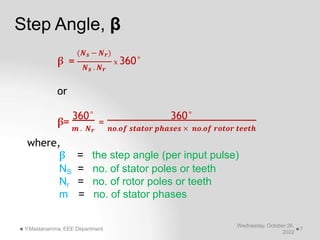
𝑵𝒔 . 𝑵𝒓
Wednesday, October 26,
2022
Y.Mastanamma, EEE Department 7
(𝑵𝒔 − 𝑵𝒓)
β = x 360°
or
360°
𝒎 . 𝑵𝒓
=
360°
𝒏𝒐.𝒐𝒇 𝒔𝒕𝒂𝒕𝒐𝒓 𝒑𝒉𝒂𝒔𝒆𝒔 × 𝒏𝒐.𝒐𝒇 𝒓𝒐𝒕𝒐𝒓 𝒕𝒆𝒆𝒕𝒉
β=
where,
β = the step angle (per input pulse)
NS = no. of stator poles or teeth
Nr = no. of rotor poles or teeth
m = no. of stator phases
Step Angle, β
Resolution
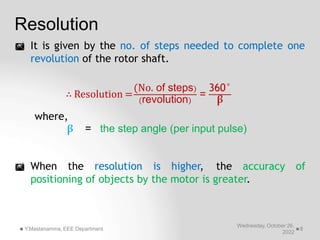
 It is given by the no. of steps needed to complete one
revolution of the rotor shaft.
∴ Resolution = =
(No. of steps) 360°
Wednesday, October 26,
2022
Y.Mastanamma, EEE Department 8
(revolution) β
where,
β = the step angle (per input pulse)
 When the resolution is higher, the accuracy of
positioning of objects by the motor is greater.
Total rotor angle, θ
Wednesday, October 26,
2022
Y.Mastanamma, EEE Department 9
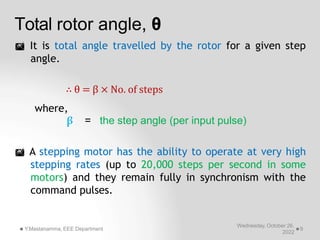
 It is total angle travelled by the rotor for a given step
angle.
∴ θ = β × No. of steps
where,
β = the step angle (per input pulse)
 A stepping motor has the ability to operate at very high
stepping rates (up to 20,000 steps per second in some
motors) and they remain fully in synchronism with the
command pulses.
Slewing
Wednesday, October 26,
2022
Y.Mastanamma, EEE Department 10
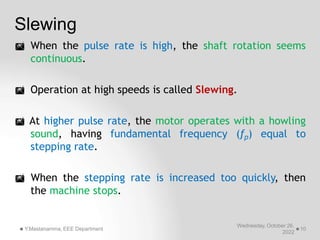
 When the pulse rate is high, the shaft rotation seems
continuous.
 Operation at high speeds is called Slewing.
 At higher pulse rate, the motor operates with a howling
sound, having fundamental frequency (fp) equal to
stepping rate.
 When the stepping rate is increased too quickly, then
the machine stops.
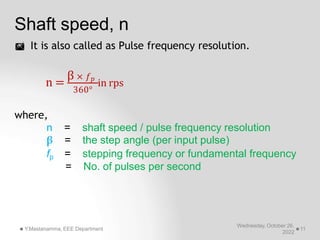
Shaft speed, n
 It is also called as Pulse frequency resolution.
360°
Wednesday, October 26,
2022
Y.Mastanamma, EEE Department 11
n =
β × 𝑓𝑝
in rps
where,
n = shaft speed / pulse frequency resolution
β = the step angle (per input pulse)
fp = stepping frequency or fundamental frequency
= No. of pulses per second
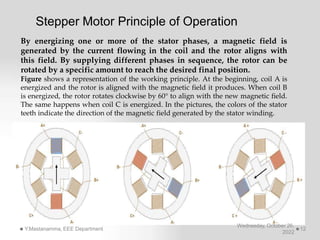
By energizing one or more of the stator phases, a magnetic field is
generated by the current flowing in the coil and the rotor aligns with
this field. By supplying different phases in sequence, the rotor can be
rotated by a specific amount to reach the desired final position.
Figure shows a representation of the working principle. At the beginning, coil A is
energized and the rotor is aligned with the magnetic field it produces. When coil B
is energized, the rotor rotates clockwise by 60° to align with the new magnetic field.
The same happens when coil C is energized. In the pictures, the colors of the stator
teeth indicate the direction of the magnetic field generated by the stator winding.
Stepper Motor Principle of Operation
Wednesday, October 26,
2022
Y.Mastanamma, EEE Department 12
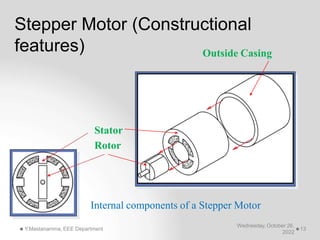
Stepper Motor (Constructional
features) Outside Casing
Stator
Rotor
Internal components of a Stepper Motor
Wednesday, October 26,
2022
Y.Mastanamma, EEE Department 13
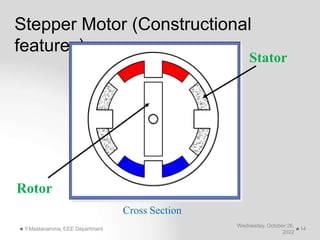
Stepper Motor (Constructional
features)
Stator
Rotor
Cross Section
Wednesday, October 26,
2022
Y.Mastanamma, EEE Department 14
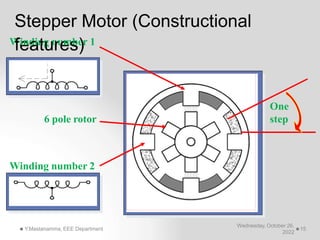
Stepper Motor (Constructional
W
fe
ind
a
in
tg
un
ru
e
m
s
be
)r 1
Winding number 2
One
step
6 pole rotor
Wednesday, October 26,
2022
Y.Mastanamma, EEE Department 15
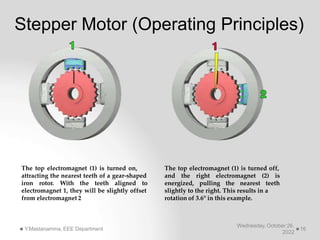
Stepper Motor (Operating Principles)
The top electromagnet (1) is turned on,
attracting the nearest teeth of a gear-shaped
iron rotor. With the teeth aligned to
electromagnet 1, they will be slightly offset
from electromagnet 2
The top electromagnet (1) is turned off,
Wednesday, October 26,
2022
Y.Mastanamma, EEE Department 16
and the right electromagnet (2) is
energized, pulling the nearest teeth
slightly to the right. This results in a
rotation of 3.6° in this example.
Stepper Motor (Operating Principles)
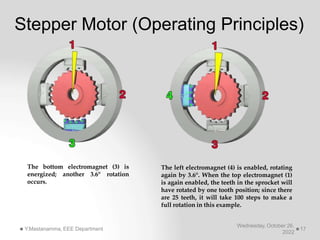
The bottom electromagnet (3) is
energized; another 3.6° rotation
occurs.
The left electromagnet (4) is enabled, rotating
again by 3.6°. When the top electromagnet (1)
is again enabled, the teeth in the sprocket will
have rotated by one tooth position; since there
are 25 teeth, it will take 100 steps to make a
full rotation in this example.
Wednesday, October 26,
2022
Y.Mastanamma, EEE Department 17
Wednesday, October 26,
2022
Y.Mastanamma, EEE Department 18
Wednesday, October 26,
2022
Y.Mastanamma, EEE Department 19
Wednesday, October 26,
2022
Y.Mastanamma, EEE Department 20
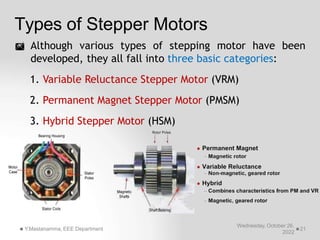
Types of Stepper Motors
 Although various types of stepping motor have been
developed, they all fall into three basic categories:
1. Variable Reluctance Stepper Motor (VRM)
2. Permanent Magnet Stepper Motor (PMSM)
3. Hybrid Stepper Motor (HSM)
Wednesday, October 26,
2022
Y.Mastanamma, EEE Department 21
Permanent Magnet Stepper.
Wednesday, October 26,
2022
Y.Mastanamma, EEE Department 22
constructed with permanent magnets, which interact with
PM steppers have rotors that are
the
electromagnets of the stator to create rotation and torque.
PM steppers usually have comparatively low power requirements
and can produce more torque per unit of input power.
Variable Reluctance Stepper. VR stepper rotors are not built with
permanent magnets. Rather, they are constructed with plain iron
and resemble a gear, with protrusions or “teeth” around the
circumference of the rotor. The teeth lead to VR steppers that have
a very high degree of angular resolution; however, this accuracy
usually comes at the expense of torque.
Hybrid Stepper. HS rotors use the best features of both PM and VR
steppers. The rotor in an HS motor has a permanent magnet core,
while the circumference is built from plain iron and has teeth. A
hybrid stepper motor, therefore, has both high angular
resolution and high torque.
The operating modes
Wednesday, October 26,
2022
Y.Mastanamma, EEE Department 23
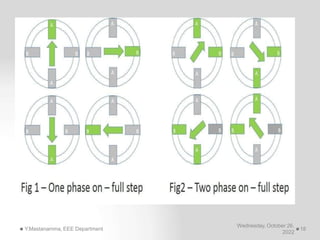
Full Step Mode. For each 360° rotation of the motor shaft, the rotor proceeds
through 200 distinct steps, each exactly 1.8°. During full step operation, one phase
on the stator is always energized. This provides maximum torque, but angular
resolution is limited by the number of teeth on the rotor.
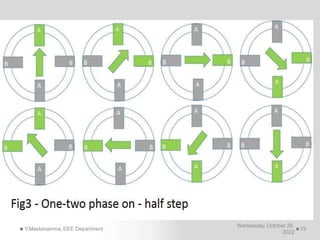
Half Step Mode. For each 360° rotation of the motor shaft, the rotor proceeds
through 400 distinct steps, each exactly 0.9°. During half step operation, there is
an alternation between having one or two phases on the stator energized. This
provides twice the level of angular resolution for increased positioning accuracy
but comes at the expense of torque.
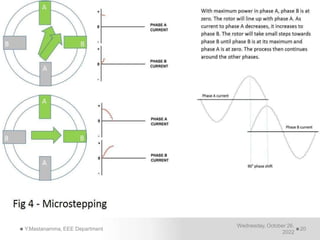
Micro Step Mode. For each 360° rotation of the motor shaft, the rotor proceeds
through 51,200 distinct steps, each exactly 0.007°. During micro-step operation,
phases on the stator can be either energized, de-energized or partially energized.
This mode is used in applications where highly accurate positioning is needed,
although torque rating can be reduced by as much as 30%.
VARIABLE RELUCTANCE
STEPPER MOTOR
Constructional features – Principle of operation – Variable
reluctance motor – Single and multi stack configurations –
Torque equations – Modes of excitation–Applications.
Wednesday, October 26,
2022
Y.Mastanamma, EEE Department 24
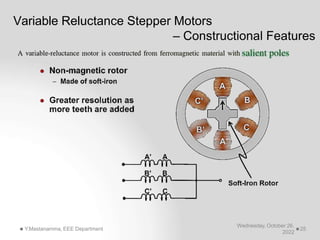
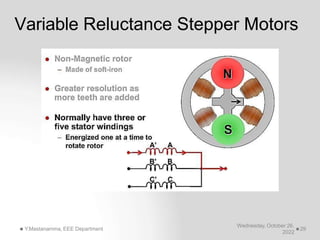
Variable Reluctance Stepper Motors
– Constructional Features
Wednesday, October 26,
2022
Y.Mastanamma, EEE Department 25
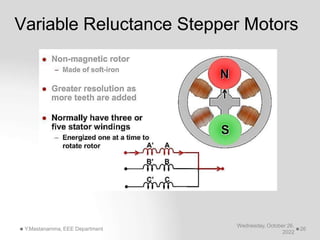
Variable Reluctance Stepper Motors
Wednesday, October 26,
2022
Y.Mastanamma, EEE Department 26
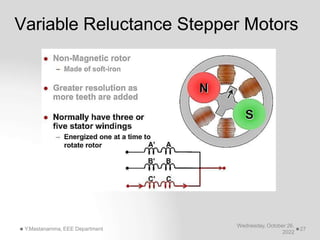
Variable Reluctance Stepper Motors
Wednesday, October 26,
2022
Y.Mastanamma, EEE Department 27
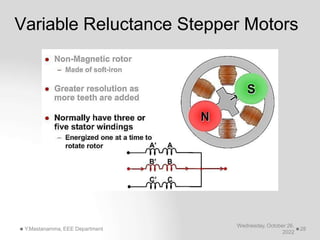
Variable Reluctance Stepper Motors
Wednesday, October 26,
2022
Y.Mastanamma, EEE Department 28
Variable Reluctance Stepper Motors
Wednesday, October 26,
2022
Y.Mastanamma, EEE Department 29
Variable Reluctance Stepper Motors
Wednesday, October 26,
2022
Y.Mastanamma, EEE Department 30
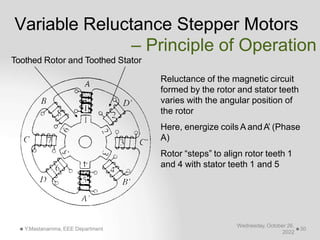
– Principle of Operation
Toothed Rotor and Toothed Stator
Reluctance of the magnetic circuit
formed by the rotor and stator teeth
varies with the angular position of
the rotor
Here, energize coils A andA’ (Phase
A)
Rotor “steps” to align rotor teeth 1
and 4 with stator teeth 1 and 5
 Nr
 
Ns
360
Variable Reluctance Stepper Motors
– Principle of Operation
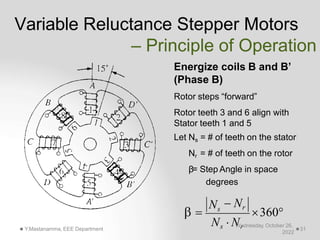
Energize coils B and B’
(Phase B)
Rotor steps “forward”
Rotor teeth 3 and 6 align with
Stator teeth 1 and 5
Let Ns = # of teeth on the stator
Nr = # of teeth on the rotor
β= Step Angle in space
degrees
Ns  N
Wr
ednesday, October 26,
2022
Y.Mastanamma, EEE Department 31
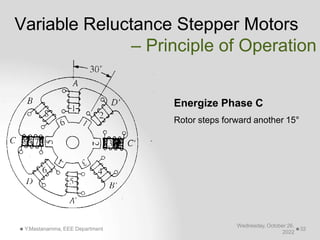
Energize Phase C
Rotor steps forward another 15°
Wednesday, October 26,
2022
Y.Mastanamma, EEE Department 32
Variable Reluctance Stepper Motors
– Principle of Operation
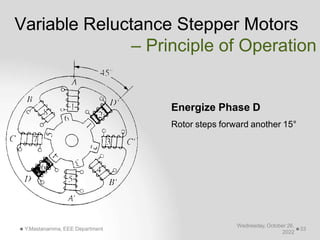
Energize Phase D
Rotor steps forward another 15°
Wednesday, October 26,
2022
Y.Mastanamma, EEE Department 33
Variable Reluctance Stepper Motors
– Principle of Operation
Variable Reluctance Stepper Motors
Wednesday, October 26,
2022
Y.Mastanamma, EEE Department 34
– Principle of Operation
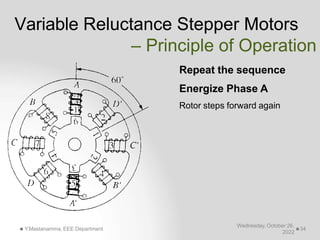
Repeat the sequence
Energize Phase A
Rotor steps forward again
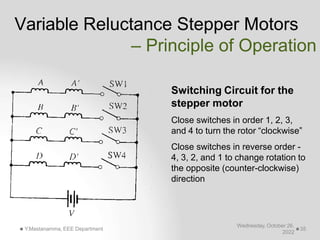
Switching Circuit for the
stepper motor
Close switches in order 1, 2, 3,
and 4 to turn the rotor “clockwise”
Close switches in reverse order -
4, 3, 2, and 1 to change rotation to
the opposite (counter-clockwise)
direction
Wednesday, October 26,
2022
Y.Mastanamma, EEE Department 35
Variable Reluctance Stepper Motors
– Principle of Operation
Variable Reluctance Stepper Motors
Wednesday, October 26,
2022
Y.Mastanamma, EEE Department 36
– Modes of Excitation
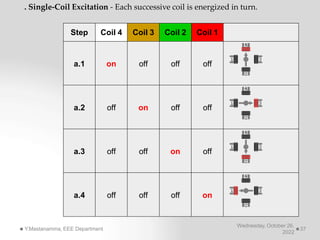
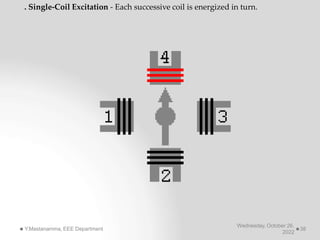
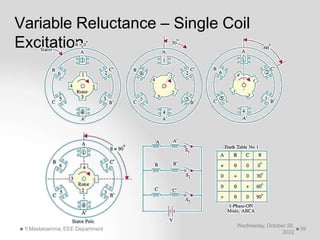
. Single-Coil Excitation - Each successive coil is energized in turn.
Step Coil 4 Coil 3 Coil 2 Coil 1
a.1 on off off off
a.2 off on off off
a.3 off off on off
a.4 off off off on
Wednesday, October 26,
2022
Y.Mastanamma, EEE Department 37
. Single-Coil Excitation - Each successive coil is energized in turn.
Wednesday, October 26,
2022
Y.Mastanamma, EEE Department 38
Variable Reluctance – Single Coil
Excitation
Wednesday, October 26,
2022
Y.Mastanamma, EEE Department 39
Variable Reluctance Stepper Motors
Wednesday, October 26,
2022
Y.Mastanamma, EEE Department 40
– Modes of Excitation
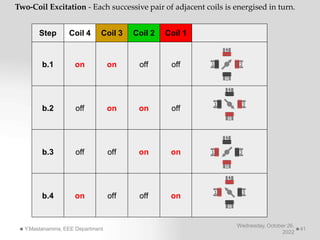
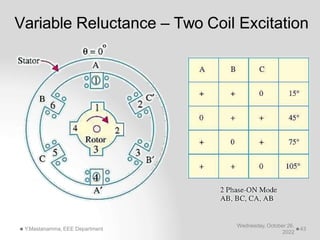
Two-Coil Excitation - Each successive pair of adjacent coils is energised in turn.
Step Coil 4 Coil 3 Coil 2 Coil 1
b.1 on on off off
b.2 off on on off
b.3 off off on on
b.4 on off off on
Wednesday, October 26,
2022
Y.Mastanamma, EEE Department 41
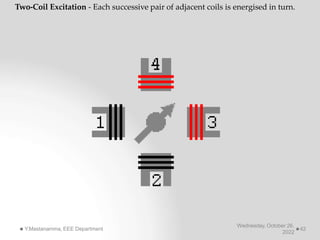
Two-Coil Excitation - Each successive pair of adjacent coils is energised in turn.
Wednesday, October 26,
2022
Y.Mastanamma, EEE Department 42
Variable Reluctance – Two Coil Excitation
Wednesday, October 26,
2022
Y.Mastanamma, EEE Department 43
Variable Reluctance Stepper Motors
Wednesday, October 26,
2022
Y.Mastanamma, EEE Department 44
– Modes of Excitation
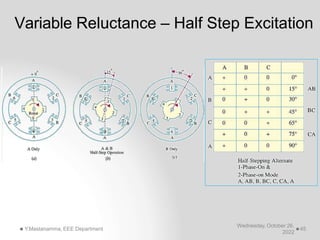
Variable Reluctance – Half Step Excitation
Wednesday, October 26,
2022
Y.Mastanamma, EEE Department 45
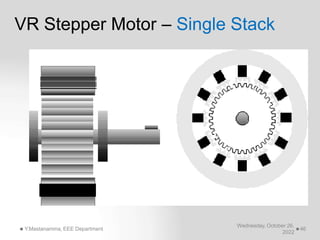
VR Stepper Motor – Single Stack
Wednesday, October 26,
2022
Y.Mastanamma, EEE Department 46
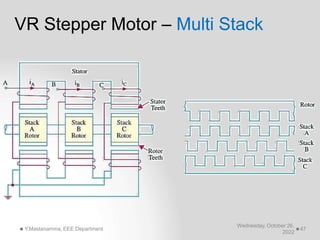
VR Stepper Motor – Multi Stack
Wednesday, October 26,
2022
Y.Mastanamma, EEE Department 47
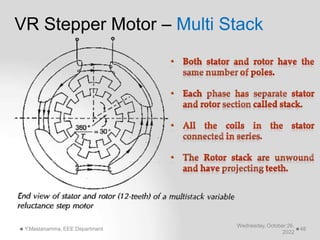
VR Stepper Motor – Multi Stack
Wednesday, October 26,
2022
Y.Mastanamma, EEE Department 48
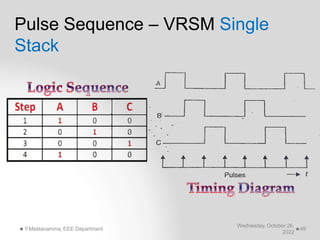
Pulse Sequence – VRSM Single
Stack
Wednesday, October 26,
2022
Y.Mastanamma, EEE Department 49
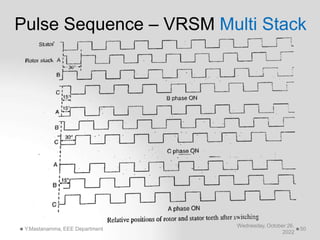
Pulse Sequence – VRSM Multi Stack
Wednesday, October 26,
2022
Y.Mastanamma, EEE Department 50
VR Stepper Motor – Torque Equation
Wednesday, October 26,
2022
Y.Mastanamma, EEE Department 51
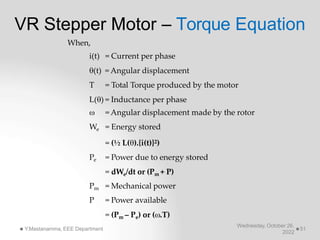
When,
i(t) = Current per phase
(t) = Angular displacement
T = Total Torque produced by the motor
L() = Inductance per phase
 = Angular displacement made by the rotor
We = Energy stored
= (½ L().{i(t)}2)
Pe = Power due to energy stored
= dWe/dt or (Pm + P)
Pm = Mechanical power
P = Power available
= (Pm – Pe) or (.T)
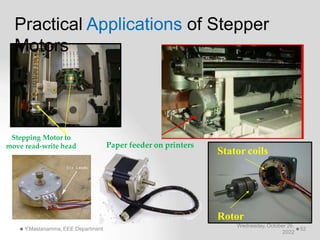
Paper feeder on printers
Stator coils
Rotor
Stepping Motor to
move read-write head
Practical Applications of Stepper
Motors
Wednesday, October 26,
2022
Y.Mastanamma, EEE Department 52
Control circuits for stepping motor-open loop controller for a
2-phase stepping motor
Wednesday, October 26,
2022
Y.Mastanamma, EEE Department 53
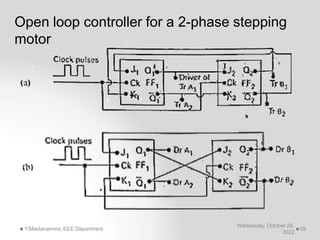
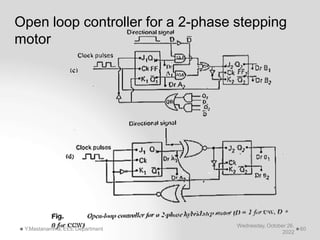
 The control and drive circuits form an important part of the
overall stepping motor drive.
 A large variety of control circuits are possible depending on
whether the motor is operating in open loop or closed loop, and
whether it is a 2-Phase or 3-Phase motor.
 In open loop control, the rotor position is not sensed to find out
whether the motor has actually executed a step or not for the
given command.
 Nevertheless, open-loop control is quite satisfactory for many
applications, provided the motor is able to develop enough
torque to position the load against external and frictional
torques and the time interval between the input pulses is
sufficiently large.
Wednesday, October 26,
2022
Y.Mastanamma, EEE Department 54
Control circuits for stepping motor
Wednesday, October 26,
2022
Y.Mastanamma, EEE Department 55
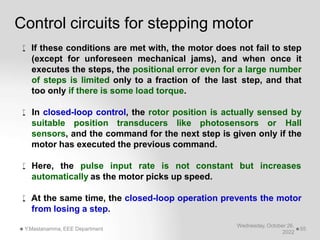
 If these conditions are met with, the motor does not fail to step
(except for unforeseen mechanical jams), and when once it
executes the steps, the positional error even for a large number
of steps is limited only to a fraction of the last step, and that
too only if there is some load torque.
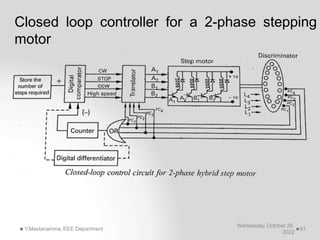
 In closed-loop control, the rotor position is actually sensed by
suitable position transducers like photosensors or Hall
sensors, and the command for the next step is given only if the
motor has executed the previous command.
 Here, the pulse input rate is not constant but increases
automatically as the motor picks up speed.
 At the same time, the closed-loop operation prevents the motor
from losing a step.
Control circuits for stepping motor
Wednesday, October 26,
2022
Y.Mastanamma, EEE Department 56
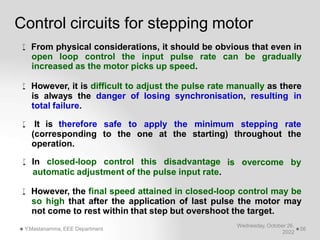
 From physical considerations, it should be obvious that even in
open loop control the input pulse rate can be gradually
increased as the motor picks up speed.
 However, it is difficult to adjust the pulse rate manually as there
is always the danger of losing synchronisation, resulting in
total failure.
safe to apply
to the one at
the minimum stepping rate
the starting) throughout the
 It is therefore
(corresponding
operation.
is overcome by
 In closed-loop control this disadvantage
automatic adjustment of the pulse input rate.
 However, the final speed attained in closed-loop control may be
so high that after the application of last pulse the motor may
not come to rest within that step but overshoot the target.
Control circuits for stepping motor
Wednesday, October 26,
2022
Y.Mastanamma, EEE Department 57
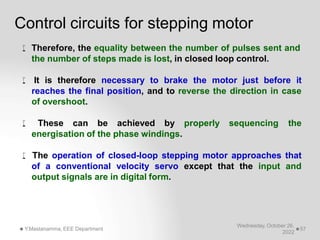
 Therefore, the equality between the number of pulses sent and
the number of steps made is lost, in closed loop control.
 It is therefore necessary to brake the motor just before it
reaches the final position, and to reverse the direction in case
of overshoot.
 These can be achieved by properly sequencing the
energisation of the phase windings.
 The operation of closed-loop stepping motor approaches that
of a conventional velocity servo except that the input and
output signals are in digital form.
Open loop controller for a 2-phase stepping
motor
Wednesday, October 26,
2022
Y.Mastanamma, EEE Department 58
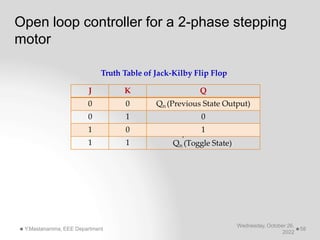
J K Q
0 0 Qn (Previous State Output)
0 1 0
1 0 1
1 1
’
Qn (Toggle State)
Truth Table of Jack-Kilby Flip Flop
Open loop controller for a 2-phase stepping
motor
Wednesday, October 26,
2022
Y.Mastanamma, EEE Department 59
Open loop controller for a 2-phase stepping
motor
Wednesday, October 26,
2022
Y.Mastanamma, EEE Department 60
Closed loop controller for a 2-phase stepping
motor
Wednesday, October 26,
2022
Y.Mastanamma, EEE Department 61

unit1semsteppermotor ppt.pptx

  • 1.
    UNIT I: STEPPERMOTOR Constructional features – Types – Operating principles Wednesday, October 26, 2022 Y.Mastanamma, EEE Department 1
  • 2.
     A steppermotor is an incremental motion machine, i.e. its rotation is not continuous as in conventional machines, but in steps.  The motor rotates through a fixed angular step in response to each input current pulse received by its controller.  A stepper motor is a “pulse-driven” motor that changes the angular position of the rotor in “steps”.  They can be controlled directly by computers, microprocessors, and programmable controllers. Wednesday, October 26, 2022 Y.Mastanamma, EEE Department 2 Stepper Motor
  • 3.
    Stepper Motor Wednesday, October26, 2022 Y.Mastanamma, EEE Department 3  The unique feature of a stepper motor is that its shaft rotates in a series of discrete angular intervals or steps, one step being taken each time a command pulse is received.  When a definite number of pulses are supplied, the shaft moves through a definite known angle. This fact makes the motor well suited for open-loop position control.  Stepper motors develop torques ranging from 1μN-m (e.g. in a wrist watch motor whose diameter is 3mm) upto 40 N-m (e.g. in motors used in machine tools whose diameter is 15mm).
  • 4.
    Stepper Motor Wednesday, October26, 2022 Y.Mastanamma, EEE Department 4  The power output ranges from 1 W to a maximum of 2500 W.  The only moving part in a stepper motor is its rotor, which has no windings, commutators or brushes.  Typical types of stepper motors can rotate 1.8°, 2°, 2.5°, 5°, 7.5°, and 15° per input electrical pulse.  The step angles are as small as 0.72° or as large as 90°.
  • 5.
    Stepper Motor Wednesday, October26, 2022 Y.Mastanamma, EEE Department 5  There are several features common to all stepper motors that make them ideally suited for these types of applications. They are as under: 1. High accuracy: Operate under open loop. 2. Reliability: Stepper motors are brushless. 3. Load independent: Stepper motors rotate at a set speed under different load, provided the rated torque is maintained. 4. Holding torque: For each and every step, the motor holds its position without brakes.
  • 6.
    Step Angle, β Wednesday,October 26, 2022 Y.Mastanamma, EEE Department 6  The angle through which the motor shaft rotates for each command pulse is called the step angle, β.  Smaller the step angle, greater the number of steps per revolution and higher the resolution or accuracy of positioning obtained.  The value of step angle (β) can be expressed either in terms of the rotor (Nr) and stator (Ns) poles (teeth) or in terms of the number of stator phases (m) and the number of rotor teeth.
  • 7.
    𝑵𝒔 . 𝑵𝒓 Wednesday,October 26, 2022 Y.Mastanamma, EEE Department 7 (𝑵𝒔 − 𝑵𝒓) β = x 360° or 360° 𝒎 . 𝑵𝒓 = 360° 𝒏𝒐.𝒐𝒇 𝒔𝒕𝒂𝒕𝒐𝒓 𝒑𝒉𝒂𝒔𝒆𝒔 × 𝒏𝒐.𝒐𝒇 𝒓𝒐𝒕𝒐𝒓 𝒕𝒆𝒆𝒕𝒉 β= where, β = the step angle (per input pulse) NS = no. of stator poles or teeth Nr = no. of rotor poles or teeth m = no. of stator phases Step Angle, β
  • 8.
    Resolution  It isgiven by the no. of steps needed to complete one revolution of the rotor shaft. ∴ Resolution = = (No. of steps) 360° Wednesday, October 26, 2022 Y.Mastanamma, EEE Department 8 (revolution) β where, β = the step angle (per input pulse)  When the resolution is higher, the accuracy of positioning of objects by the motor is greater.
  • 9.
    Total rotor angle,θ Wednesday, October 26, 2022 Y.Mastanamma, EEE Department 9  It is total angle travelled by the rotor for a given step angle. ∴ θ = β × No. of steps where, β = the step angle (per input pulse)  A stepping motor has the ability to operate at very high stepping rates (up to 20,000 steps per second in some motors) and they remain fully in synchronism with the command pulses.
  • 10.
    Slewing Wednesday, October 26, 2022 Y.Mastanamma,EEE Department 10  When the pulse rate is high, the shaft rotation seems continuous.  Operation at high speeds is called Slewing.  At higher pulse rate, the motor operates with a howling sound, having fundamental frequency (fp) equal to stepping rate.  When the stepping rate is increased too quickly, then the machine stops.
  • 11.
    Shaft speed, n It is also called as Pulse frequency resolution. 360° Wednesday, October 26, 2022 Y.Mastanamma, EEE Department 11 n = β × 𝑓𝑝 in rps where, n = shaft speed / pulse frequency resolution β = the step angle (per input pulse) fp = stepping frequency or fundamental frequency = No. of pulses per second
  • 12.
    By energizing oneor more of the stator phases, a magnetic field is generated by the current flowing in the coil and the rotor aligns with this field. By supplying different phases in sequence, the rotor can be rotated by a specific amount to reach the desired final position. Figure shows a representation of the working principle. At the beginning, coil A is energized and the rotor is aligned with the magnetic field it produces. When coil B is energized, the rotor rotates clockwise by 60° to align with the new magnetic field. The same happens when coil C is energized. In the pictures, the colors of the stator teeth indicate the direction of the magnetic field generated by the stator winding. Stepper Motor Principle of Operation Wednesday, October 26, 2022 Y.Mastanamma, EEE Department 12
  • 13.
    Stepper Motor (Constructional features)Outside Casing Stator Rotor Internal components of a Stepper Motor Wednesday, October 26, 2022 Y.Mastanamma, EEE Department 13
  • 14.
    Stepper Motor (Constructional features) Stator Rotor CrossSection Wednesday, October 26, 2022 Y.Mastanamma, EEE Department 14
  • 15.
    Stepper Motor (Constructional W fe ind a in tg un ru e m s be )r1 Winding number 2 One step 6 pole rotor Wednesday, October 26, 2022 Y.Mastanamma, EEE Department 15
  • 16.
    Stepper Motor (OperatingPrinciples) The top electromagnet (1) is turned on, attracting the nearest teeth of a gear-shaped iron rotor. With the teeth aligned to electromagnet 1, they will be slightly offset from electromagnet 2 The top electromagnet (1) is turned off, Wednesday, October 26, 2022 Y.Mastanamma, EEE Department 16 and the right electromagnet (2) is energized, pulling the nearest teeth slightly to the right. This results in a rotation of 3.6° in this example.
  • 17.
    Stepper Motor (OperatingPrinciples) The bottom electromagnet (3) is energized; another 3.6° rotation occurs. The left electromagnet (4) is enabled, rotating again by 3.6°. When the top electromagnet (1) is again enabled, the teeth in the sprocket will have rotated by one tooth position; since there are 25 teeth, it will take 100 steps to make a full rotation in this example. Wednesday, October 26, 2022 Y.Mastanamma, EEE Department 17
  • 18.
  • 19.
  • 20.
  • 21.
    Types of StepperMotors  Although various types of stepping motor have been developed, they all fall into three basic categories: 1. Variable Reluctance Stepper Motor (VRM) 2. Permanent Magnet Stepper Motor (PMSM) 3. Hybrid Stepper Motor (HSM) Wednesday, October 26, 2022 Y.Mastanamma, EEE Department 21
  • 22.
    Permanent Magnet Stepper. Wednesday,October 26, 2022 Y.Mastanamma, EEE Department 22 constructed with permanent magnets, which interact with PM steppers have rotors that are the electromagnets of the stator to create rotation and torque. PM steppers usually have comparatively low power requirements and can produce more torque per unit of input power. Variable Reluctance Stepper. VR stepper rotors are not built with permanent magnets. Rather, they are constructed with plain iron and resemble a gear, with protrusions or “teeth” around the circumference of the rotor. The teeth lead to VR steppers that have a very high degree of angular resolution; however, this accuracy usually comes at the expense of torque. Hybrid Stepper. HS rotors use the best features of both PM and VR steppers. The rotor in an HS motor has a permanent magnet core, while the circumference is built from plain iron and has teeth. A hybrid stepper motor, therefore, has both high angular resolution and high torque.
  • 23.
    The operating modes Wednesday,October 26, 2022 Y.Mastanamma, EEE Department 23 Full Step Mode. For each 360° rotation of the motor shaft, the rotor proceeds through 200 distinct steps, each exactly 1.8°. During full step operation, one phase on the stator is always energized. This provides maximum torque, but angular resolution is limited by the number of teeth on the rotor. Half Step Mode. For each 360° rotation of the motor shaft, the rotor proceeds through 400 distinct steps, each exactly 0.9°. During half step operation, there is an alternation between having one or two phases on the stator energized. This provides twice the level of angular resolution for increased positioning accuracy but comes at the expense of torque. Micro Step Mode. For each 360° rotation of the motor shaft, the rotor proceeds through 51,200 distinct steps, each exactly 0.007°. During micro-step operation, phases on the stator can be either energized, de-energized or partially energized. This mode is used in applications where highly accurate positioning is needed, although torque rating can be reduced by as much as 30%.
  • 24.
    VARIABLE RELUCTANCE STEPPER MOTOR Constructionalfeatures – Principle of operation – Variable reluctance motor – Single and multi stack configurations – Torque equations – Modes of excitation–Applications. Wednesday, October 26, 2022 Y.Mastanamma, EEE Department 24
  • 25.
    Variable Reluctance StepperMotors – Constructional Features Wednesday, October 26, 2022 Y.Mastanamma, EEE Department 25
  • 26.
    Variable Reluctance StepperMotors Wednesday, October 26, 2022 Y.Mastanamma, EEE Department 26
  • 27.
    Variable Reluctance StepperMotors Wednesday, October 26, 2022 Y.Mastanamma, EEE Department 27
  • 28.
    Variable Reluctance StepperMotors Wednesday, October 26, 2022 Y.Mastanamma, EEE Department 28
  • 29.
    Variable Reluctance StepperMotors Wednesday, October 26, 2022 Y.Mastanamma, EEE Department 29
  • 30.
    Variable Reluctance StepperMotors Wednesday, October 26, 2022 Y.Mastanamma, EEE Department 30 – Principle of Operation Toothed Rotor and Toothed Stator Reluctance of the magnetic circuit formed by the rotor and stator teeth varies with the angular position of the rotor Here, energize coils A andA’ (Phase A) Rotor “steps” to align rotor teeth 1 and 4 with stator teeth 1 and 5
  • 31.
     Nr   Ns 360 VariableReluctance Stepper Motors – Principle of Operation Energize coils B and B’ (Phase B) Rotor steps “forward” Rotor teeth 3 and 6 align with Stator teeth 1 and 5 Let Ns = # of teeth on the stator Nr = # of teeth on the rotor β= Step Angle in space degrees Ns  N Wr ednesday, October 26, 2022 Y.Mastanamma, EEE Department 31
  • 32.
    Energize Phase C Rotorsteps forward another 15° Wednesday, October 26, 2022 Y.Mastanamma, EEE Department 32 Variable Reluctance Stepper Motors – Principle of Operation
  • 33.
    Energize Phase D Rotorsteps forward another 15° Wednesday, October 26, 2022 Y.Mastanamma, EEE Department 33 Variable Reluctance Stepper Motors – Principle of Operation
  • 34.
    Variable Reluctance StepperMotors Wednesday, October 26, 2022 Y.Mastanamma, EEE Department 34 – Principle of Operation Repeat the sequence Energize Phase A Rotor steps forward again
  • 35.
    Switching Circuit forthe stepper motor Close switches in order 1, 2, 3, and 4 to turn the rotor “clockwise” Close switches in reverse order - 4, 3, 2, and 1 to change rotation to the opposite (counter-clockwise) direction Wednesday, October 26, 2022 Y.Mastanamma, EEE Department 35 Variable Reluctance Stepper Motors – Principle of Operation
  • 36.
    Variable Reluctance StepperMotors Wednesday, October 26, 2022 Y.Mastanamma, EEE Department 36 – Modes of Excitation
  • 37.
    . Single-Coil Excitation- Each successive coil is energized in turn. Step Coil 4 Coil 3 Coil 2 Coil 1 a.1 on off off off a.2 off on off off a.3 off off on off a.4 off off off on Wednesday, October 26, 2022 Y.Mastanamma, EEE Department 37
  • 38.
    . Single-Coil Excitation- Each successive coil is energized in turn. Wednesday, October 26, 2022 Y.Mastanamma, EEE Department 38
  • 39.
    Variable Reluctance –Single Coil Excitation Wednesday, October 26, 2022 Y.Mastanamma, EEE Department 39
  • 40.
    Variable Reluctance StepperMotors Wednesday, October 26, 2022 Y.Mastanamma, EEE Department 40 – Modes of Excitation
  • 41.
    Two-Coil Excitation -Each successive pair of adjacent coils is energised in turn. Step Coil 4 Coil 3 Coil 2 Coil 1 b.1 on on off off b.2 off on on off b.3 off off on on b.4 on off off on Wednesday, October 26, 2022 Y.Mastanamma, EEE Department 41
  • 42.
    Two-Coil Excitation -Each successive pair of adjacent coils is energised in turn. Wednesday, October 26, 2022 Y.Mastanamma, EEE Department 42
  • 43.
    Variable Reluctance –Two Coil Excitation Wednesday, October 26, 2022 Y.Mastanamma, EEE Department 43
  • 44.
    Variable Reluctance StepperMotors Wednesday, October 26, 2022 Y.Mastanamma, EEE Department 44 – Modes of Excitation
  • 45.
    Variable Reluctance –Half Step Excitation Wednesday, October 26, 2022 Y.Mastanamma, EEE Department 45
  • 46.
    VR Stepper Motor– Single Stack Wednesday, October 26, 2022 Y.Mastanamma, EEE Department 46
  • 47.
    VR Stepper Motor– Multi Stack Wednesday, October 26, 2022 Y.Mastanamma, EEE Department 47
  • 48.
    VR Stepper Motor– Multi Stack Wednesday, October 26, 2022 Y.Mastanamma, EEE Department 48
  • 49.
    Pulse Sequence –VRSM Single Stack Wednesday, October 26, 2022 Y.Mastanamma, EEE Department 49
  • 50.
    Pulse Sequence –VRSM Multi Stack Wednesday, October 26, 2022 Y.Mastanamma, EEE Department 50
  • 51.
    VR Stepper Motor– Torque Equation Wednesday, October 26, 2022 Y.Mastanamma, EEE Department 51 When, i(t) = Current per phase (t) = Angular displacement T = Total Torque produced by the motor L() = Inductance per phase  = Angular displacement made by the rotor We = Energy stored = (½ L().{i(t)}2) Pe = Power due to energy stored = dWe/dt or (Pm + P) Pm = Mechanical power P = Power available = (Pm – Pe) or (.T)
  • 52.
    Paper feeder onprinters Stator coils Rotor Stepping Motor to move read-write head Practical Applications of Stepper Motors Wednesday, October 26, 2022 Y.Mastanamma, EEE Department 52
  • 53.
    Control circuits forstepping motor-open loop controller for a 2-phase stepping motor Wednesday, October 26, 2022 Y.Mastanamma, EEE Department 53
  • 54.
     The controland drive circuits form an important part of the overall stepping motor drive.  A large variety of control circuits are possible depending on whether the motor is operating in open loop or closed loop, and whether it is a 2-Phase or 3-Phase motor.  In open loop control, the rotor position is not sensed to find out whether the motor has actually executed a step or not for the given command.  Nevertheless, open-loop control is quite satisfactory for many applications, provided the motor is able to develop enough torque to position the load against external and frictional torques and the time interval between the input pulses is sufficiently large. Wednesday, October 26, 2022 Y.Mastanamma, EEE Department 54 Control circuits for stepping motor
  • 55.
    Control circuits forstepping motor Wednesday, October 26, 2022 Y.Mastanamma, EEE Department 55  If these conditions are met with, the motor does not fail to step (except for unforeseen mechanical jams), and when once it executes the steps, the positional error even for a large number of steps is limited only to a fraction of the last step, and that too only if there is some load torque.  In closed-loop control, the rotor position is actually sensed by suitable position transducers like photosensors or Hall sensors, and the command for the next step is given only if the motor has executed the previous command.  Here, the pulse input rate is not constant but increases automatically as the motor picks up speed.  At the same time, the closed-loop operation prevents the motor from losing a step.
  • 56.
    Control circuits forstepping motor Wednesday, October 26, 2022 Y.Mastanamma, EEE Department 56  From physical considerations, it should be obvious that even in open loop control the input pulse rate can be gradually increased as the motor picks up speed.  However, it is difficult to adjust the pulse rate manually as there is always the danger of losing synchronisation, resulting in total failure. safe to apply to the one at the minimum stepping rate the starting) throughout the  It is therefore (corresponding operation. is overcome by  In closed-loop control this disadvantage automatic adjustment of the pulse input rate.  However, the final speed attained in closed-loop control may be so high that after the application of last pulse the motor may not come to rest within that step but overshoot the target.
  • 57.
    Control circuits forstepping motor Wednesday, October 26, 2022 Y.Mastanamma, EEE Department 57  Therefore, the equality between the number of pulses sent and the number of steps made is lost, in closed loop control.  It is therefore necessary to brake the motor just before it reaches the final position, and to reverse the direction in case of overshoot.  These can be achieved by properly sequencing the energisation of the phase windings.  The operation of closed-loop stepping motor approaches that of a conventional velocity servo except that the input and output signals are in digital form.
  • 58.
    Open loop controllerfor a 2-phase stepping motor Wednesday, October 26, 2022 Y.Mastanamma, EEE Department 58 J K Q 0 0 Qn (Previous State Output) 0 1 0 1 0 1 1 1 ’ Qn (Toggle State) Truth Table of Jack-Kilby Flip Flop
  • 59.
    Open loop controllerfor a 2-phase stepping motor Wednesday, October 26, 2022 Y.Mastanamma, EEE Department 59
  • 60.
    Open loop controllerfor a 2-phase stepping motor Wednesday, October 26, 2022 Y.Mastanamma, EEE Department 60
  • 61.
    Closed loop controllerfor a 2-phase stepping motor Wednesday, October 26, 2022 Y.Mastanamma, EEE Department 61