Directorate of Technical
Education,
Tamilnadu.
Thanthai Periyar Government
Institute of Technology,
Vellore–632002
Department of ECE
Speed control of 3 phase
induction motor
Unit 4
Presented by
M.P.Sasirekha
Speed control methods of induction
motor
• By changing the applied voltage
• By changing the applied frequency
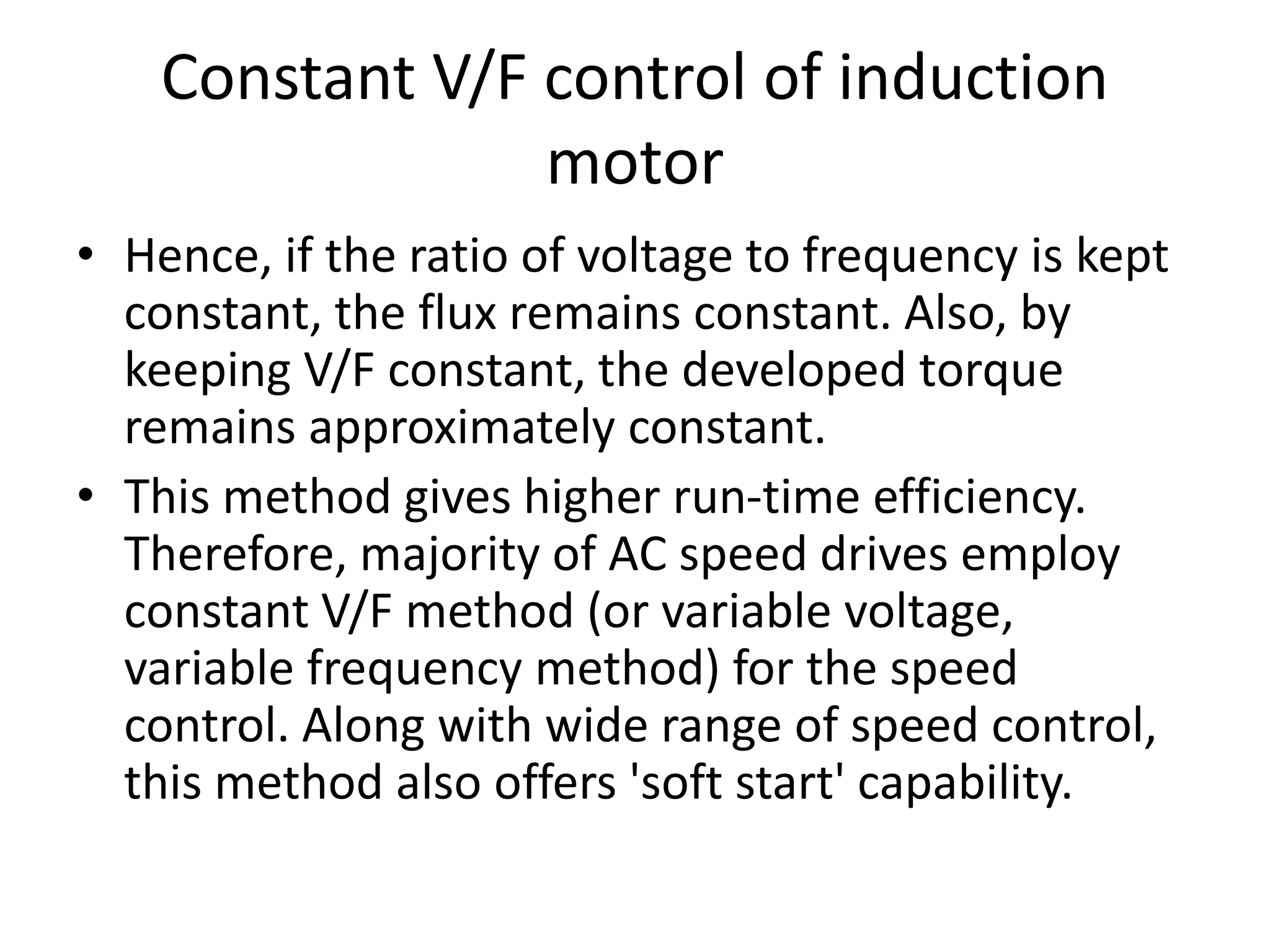
• Constant V/F control of induction motor
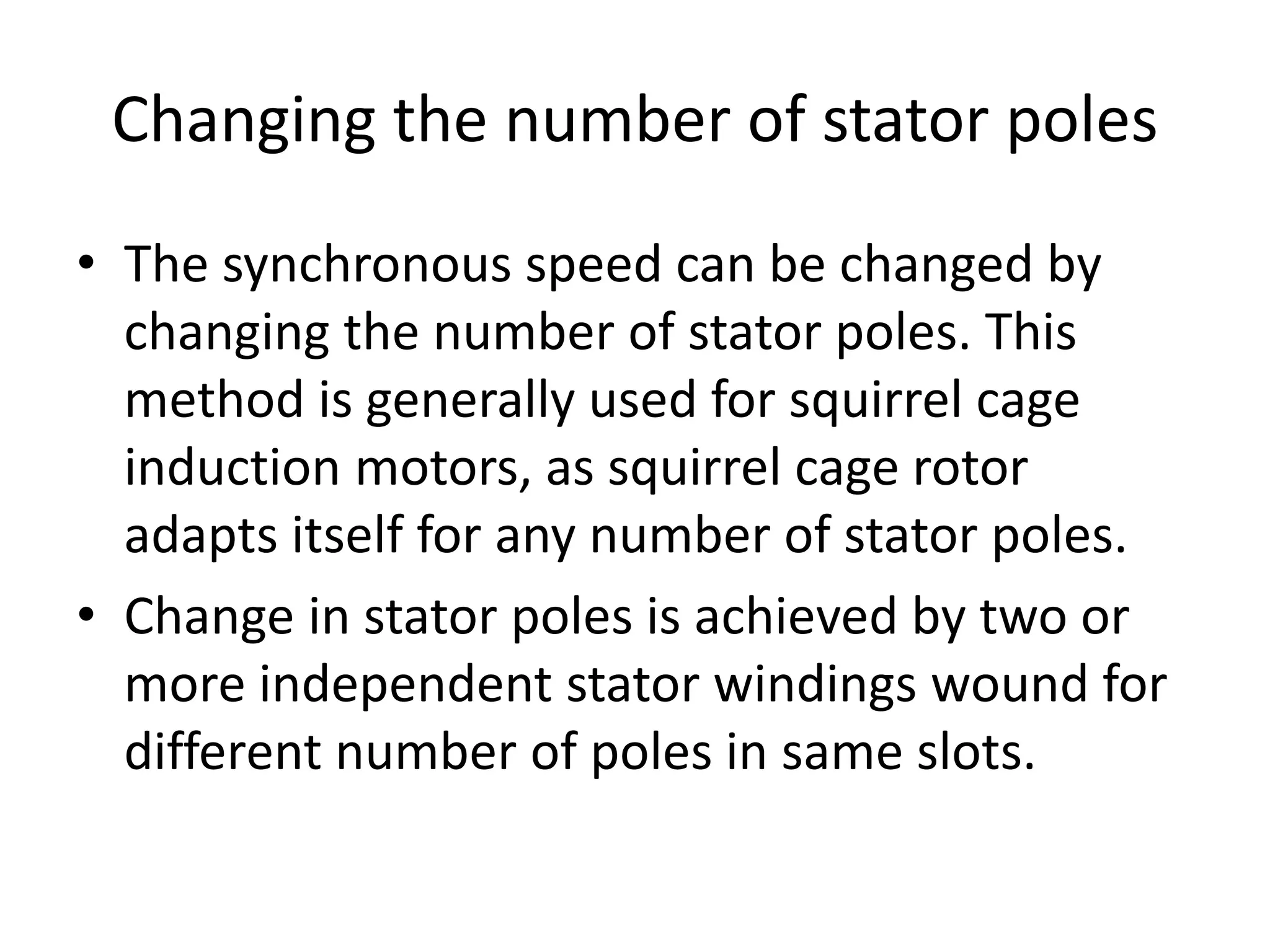
• Changing the number of stator poles
By changing the applied voltage
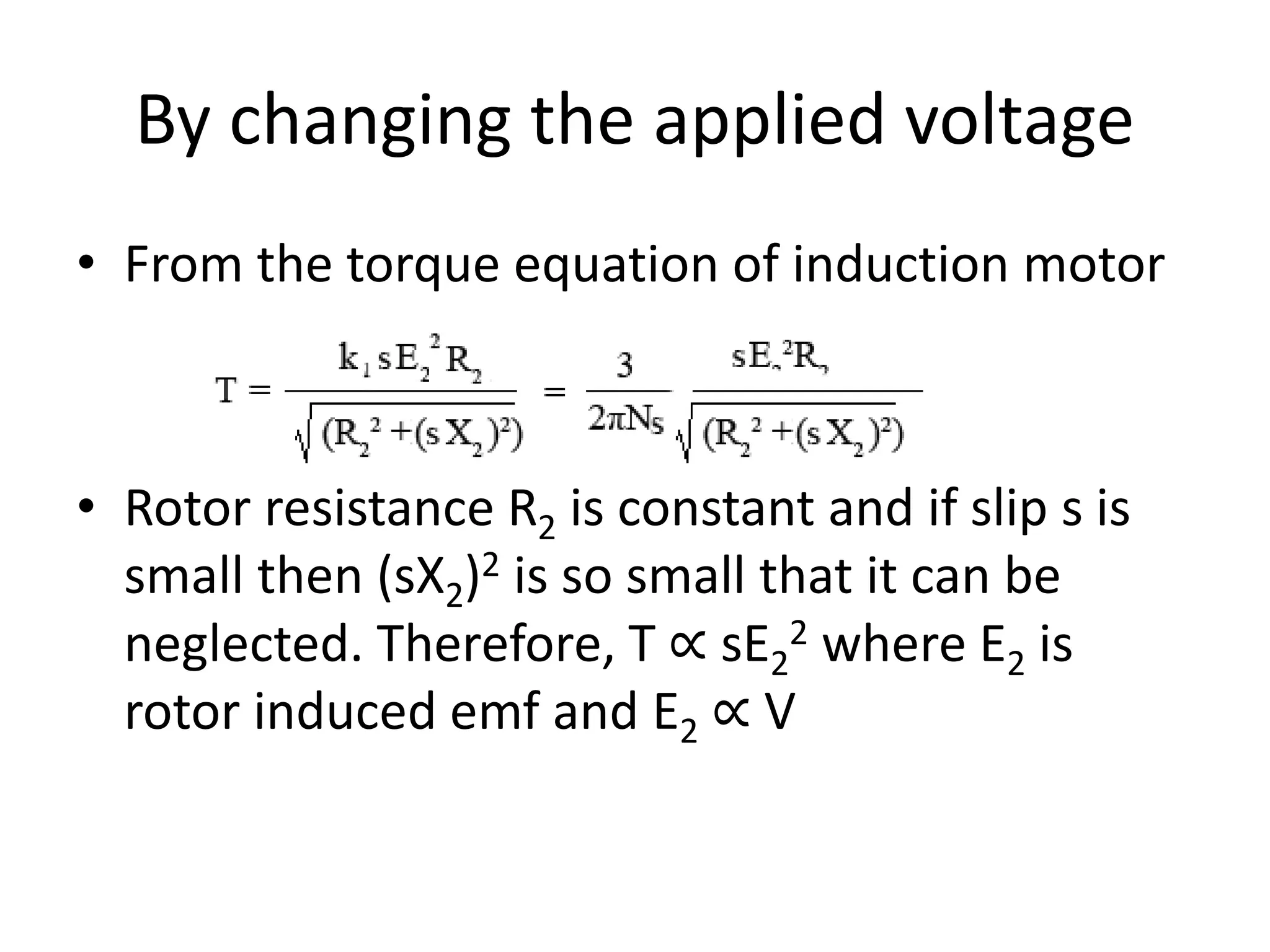
• From the torque equation of induction motor
• Rotor resistance R2 is constant and if slip s is
small then (sX2)2 is so small that it can be
neglected. Therefore, T ∝ sE2
2 where E2 is
rotor induced emf and E2 ∝ V
By changing the applied voltage
• Thus, T ∝ sV2, which means, if supplied voltage is
decreased, the developed torque decreases. Hence, for
providing the same load torque, the slip increases with
decrease in voltage, and consequently, the speed
decreases. This method is the easiest and cheapest,
still rarely used, because
large change in supply voltage is required for relatively
small change in speed.
• large change in supply voltage will result in a large
change in flux density, hence, this will disturb the
magnetic conditions of the motor.
By changing the applied frequency
• Synchronous speed of the rotating magnetic
field of an induction motor is given by,
• where, f = frequency of the supply and P =
number of stator poles.
Hence, the synchronous speed changes with
change in supply frequency. Actual speed of
an induction motor is given as N = Ns (1 - s).
By changing the applied frequency
• However, this method is not widely used. It may
be used where, the induction motor is supplied
by a dedicated generator (so that frequency can
be easily varied by changing the speed of prime
mover).
• Also, at lower frequency, the motor current may
become too high due to decreased reactance.
And if the frequency is increased beyond the
rated value, the maximum torque developed falls
while the speed rises.
Constant V/F control of induction
motor
• This is the most popular method for controlling the
speed of an induction motor. As in frequency control
method, if the supply frequency is reduced keeping the
rated supply voltage, the air gap flux will tend to
saturate.
• This will cause excessive stator current and distortion
of the stator flux wave. Therefore, the stator voltage
should also be reduced in proportional to the
frequency so as to maintain the air-gap flux constant.
The magnitude of the stator flux is proportional to the
ratio of the stator voltage and the frequency.
Constant V/F control of induction
motor
• Hence, if the ratio of voltage to frequency is kept
constant, the flux remains constant. Also, by
keeping V/F constant, the developed torque
remains approximately constant.
• This method gives higher run-time efficiency.
Therefore, majority of AC speed drives employ
constant V/F method (or variable voltage,
variable frequency method) for the speed
control. Along with wide range of speed control,
this method also offers 'soft start' capability.
Changing the number of stator poles
• The synchronous speed can be changed by
changing the number of stator poles. This
method is generally used for squirrel cage
induction motors, as squirrel cage rotor
adapts itself for any number of stator poles.
• Change in stator poles is achieved by two or
more independent stator windings wound for
different number of poles in same slots.
Changing the number of stator poles
• For example, a stator is wound with two
3phase windings, one for 4 poles and other for
6 poles.
for supply frequency of 50 Hz
i) synchronous speed when 4 pole winding is
connected, Ns = 120*50/4 = 1500 RPM
ii) synchronous speed when 6 pole winding is
connected, Ns = 120*50/6 = 1000 RPM
Reference
• https://www.quora.com/How-can-I-control-
the-speed-of-3-phase-induction-motor
• https://www.electricaleasy.com/2014/02/spe
ed-control-methods-of-induction-motor.html
Thank you

Speed control of 3 phase induction motor

  • 1.
    Directorate of Technical Education, Tamilnadu. ThanthaiPeriyar Government Institute of Technology, Vellore–632002 Department of ECE
  • 2.
    Speed control of3 phase induction motor Unit 4 Presented by M.P.Sasirekha
  • 3.
    Speed control methodsof induction motor • By changing the applied voltage • By changing the applied frequency • Constant V/F control of induction motor • Changing the number of stator poles
  • 4.
    By changing theapplied voltage • From the torque equation of induction motor • Rotor resistance R2 is constant and if slip s is small then (sX2)2 is so small that it can be neglected. Therefore, T ∝ sE2 2 where E2 is rotor induced emf and E2 ∝ V
  • 5.
    By changing theapplied voltage • Thus, T ∝ sV2, which means, if supplied voltage is decreased, the developed torque decreases. Hence, for providing the same load torque, the slip increases with decrease in voltage, and consequently, the speed decreases. This method is the easiest and cheapest, still rarely used, because large change in supply voltage is required for relatively small change in speed. • large change in supply voltage will result in a large change in flux density, hence, this will disturb the magnetic conditions of the motor.
  • 6.
    By changing theapplied frequency • Synchronous speed of the rotating magnetic field of an induction motor is given by, • where, f = frequency of the supply and P = number of stator poles. Hence, the synchronous speed changes with change in supply frequency. Actual speed of an induction motor is given as N = Ns (1 - s).
  • 7.
    By changing theapplied frequency • However, this method is not widely used. It may be used where, the induction motor is supplied by a dedicated generator (so that frequency can be easily varied by changing the speed of prime mover). • Also, at lower frequency, the motor current may become too high due to decreased reactance. And if the frequency is increased beyond the rated value, the maximum torque developed falls while the speed rises.
  • 8.
    Constant V/F controlof induction motor • This is the most popular method for controlling the speed of an induction motor. As in frequency control method, if the supply frequency is reduced keeping the rated supply voltage, the air gap flux will tend to saturate. • This will cause excessive stator current and distortion of the stator flux wave. Therefore, the stator voltage should also be reduced in proportional to the frequency so as to maintain the air-gap flux constant. The magnitude of the stator flux is proportional to the ratio of the stator voltage and the frequency.
  • 9.
    Constant V/F controlof induction motor • Hence, if the ratio of voltage to frequency is kept constant, the flux remains constant. Also, by keeping V/F constant, the developed torque remains approximately constant. • This method gives higher run-time efficiency. Therefore, majority of AC speed drives employ constant V/F method (or variable voltage, variable frequency method) for the speed control. Along with wide range of speed control, this method also offers 'soft start' capability.
  • 10.
    Changing the numberof stator poles • The synchronous speed can be changed by changing the number of stator poles. This method is generally used for squirrel cage induction motors, as squirrel cage rotor adapts itself for any number of stator poles. • Change in stator poles is achieved by two or more independent stator windings wound for different number of poles in same slots.
  • 11.
    Changing the numberof stator poles • For example, a stator is wound with two 3phase windings, one for 4 poles and other for 6 poles. for supply frequency of 50 Hz i) synchronous speed when 4 pole winding is connected, Ns = 120*50/4 = 1500 RPM ii) synchronous speed when 6 pole winding is connected, Ns = 120*50/6 = 1000 RPM
  • 12.
  • 13.