1
04 March 2021 Prepared by M.Srinivasan 2
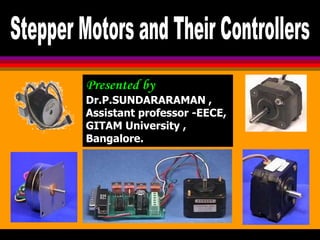
Presented by
Dr.P.SUNDARARAMAN ,
Assistant professor -EECE,
GITAM University ,
Bangalore.
04 March 2021 Prepared by M.Srinivasan 3
CONTENTS
● Introduction
● How Stepper Motors Work
● Types of Stepper Motors
● Construction
● Design Considerations
● Torque Prediction
● Characteristics
● Drive Circuits
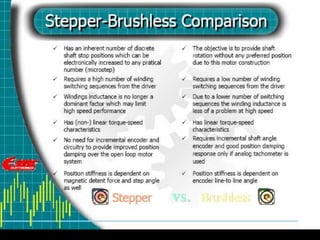
● Comparison
● Applications
04 March 2021 Prepared by M.Srinivasan 4
INTRODUCTION
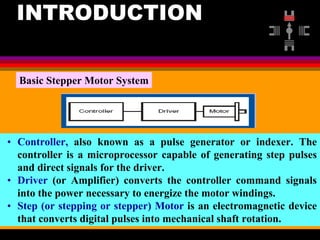
Basic Stepper Motor System
• Controller, also known as a pulse generator or indexer. The
controller is a microprocessor capable of generating step pulses
and direct signals for the driver.
• Driver (or Amplifier) converts the controller command signals
into the power necessary to energize the motor windings.
• Step (or stepping or stepper) Motor is an electromagnetic device
that converts digital pulses into mechanical shaft rotation.
04 March 2021 Prepared by M.Srinivasan 5
ABOUT STEP MOTOR…
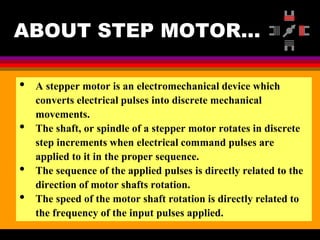
• A stepper motor is an electromechanical device which
converts electrical pulses into discrete mechanical
movements.
• The shaft, or spindle of a stepper motor rotates in discrete
step increments when electrical command pulses are
applied to it in the proper sequence.
• The sequence of the applied pulses is directly related to the
direction of motor shafts rotation.
• The speed of the motor shaft rotation is directly related to
the frequency of the input pulses applied.
04 March 2021 Prepared by M.Srinivasan 6
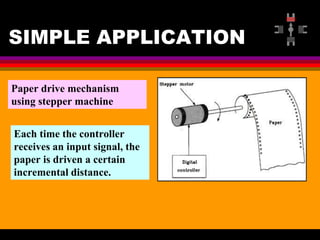
SIMPLE APPLICATION
Each time the controller
receives an input signal, the
paper is driven a certain
incremental distance.
Paper drive mechanism
using stepper machine
04 March 2021 Prepared by M.Srinivasan 7
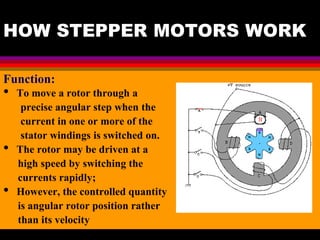
HOW STEPPER MOTORS WORK
Function:
• To move a rotor through a
precise angular step when the
current in one or more of the
stator windings is switched on.
• The rotor may be driven at a
high speed by switching the
currents rapidly;
• However, the controlled quantity
is angular rotor position rather
than its velocity
04 March 2021 Prepared by M.Srinivasan 8
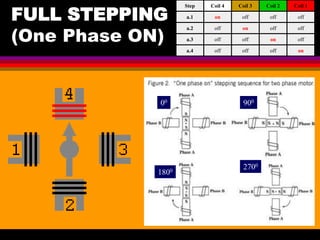
FULL STEPPING
(One Phase ON)
00 900
1800
2700
on
off
off
off
a.4
off
on
off
off
a.3
off
off
on
off
a.2
off
off
off
on
a.1
Coil 1
Coil 2
Coil 3
Coil 4
Step
04 March 2021 Prepared by M.Srinivasan 9
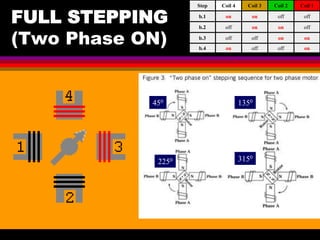
FULL STEPPING
(Two Phase ON)
450 1350
2250 3150
on
off
off
on
b.4
on
on
off
off
b.3
off
on
on
off
b.2
off
off
on
on
b.1
Coil 1
Coil 2
Coil 3
Coil 4
Step
04 March 2021 Prepared by M.Srinivasan 10
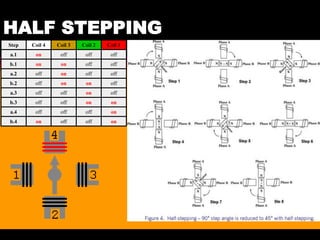
HALF STEPPING
on
off
off
on
b.4
on
off
off
off
a.4
on
on
off
off
b.3
off
on
off
off
a.3
off
on
on
off
b.2
off
off
on
off
a.2
off
off
on
on
b.1
off
off
off
on
a.1
Coil 1
Coil 2
Coil 3
Coil 4
Step
04 March 2021 Prepared by M.Srinivasan 11
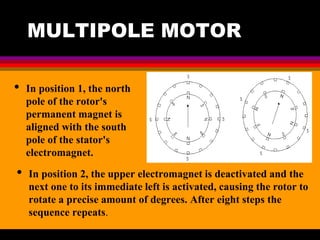
MULTIPOLE MOTOR
• In position 1, the north
pole of the rotor's
permanent magnet is
aligned with the south
pole of the stator's
electromagnet.
• In position 2, the upper electromagnet is deactivated and the
next one to its immediate left is activated, causing the rotor to
rotate a precise amount of degrees. After eight steps the
sequence repeats.
04 March 2021 Prepared by M.Srinivasan 12
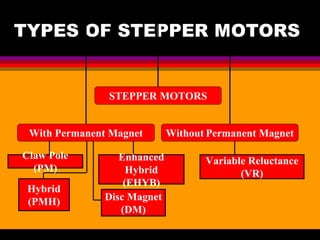
TYPES OF STEPPER MOTORS
STEPPER MOTORS
With Permanent Magnet Without Permanent Magnet
Claw Pole
(PM)
Hybrid
(PMH)
Enhanced
Hybrid
(EHYB)
Disc Magnet
(DM)
Variable Reluctance
(VR)
04 March 2021 Prepared by M.Srinivasan 13
VARIABLE RELUCTANCE
(VR) STEPPER MOTOR
● The variable-reluctance (VR) stepper motor differs from the
PM stepper in that it has no permanent-magnet rotor and no
residual torque to hold the rotor at one position when turned
off.
● When the stator coils are energized, the rotor teeth will align
with the energized stator poles.
● This type of motor operates on the principle of minimizing
the reluctance along the path of the applied magnetic field.
● By alternating the windings that are energized in the stator,
the stator field changes, and the rotor is moved to a new
position.
04 March 2021 Prepared by M.Srinivasan 14
VR STEPPER MOTOR (Cont..)
Construction
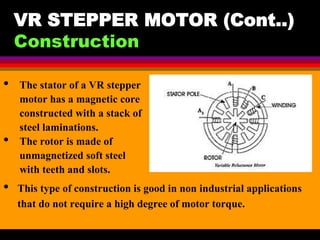
• This type of construction is good in non industrial applications
that do not require a high degree of motor torque.
• The stator of a VR stepper
motor has a magnetic core
constructed with a stack of
steel laminations.
• The rotor is made of
unmagnetized soft steel
with teeth and slots.
04 March 2021 Prepared by M.Srinivasan 15
VR STEPPER MOTOR (Cont..)
Principle of Operation
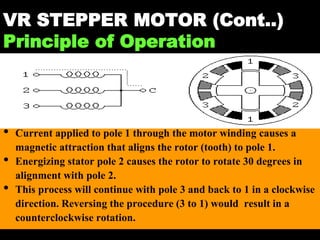
• Current applied to pole 1 through the motor winding causes a
magnetic attraction that aligns the rotor (tooth) to pole 1.
• Energizing stator pole 2 causes the rotor to rotate 30 degrees in
alignment with pole 2.
• This process will continue with pole 3 and back to 1 in a clockwise
direction. Reversing the procedure (3 to 1) would result in a
counterclockwise rotation.
04 March 2021 Prepared by M.Srinivasan 16
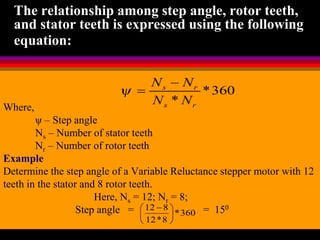
The relationship among step angle, rotor teeth,
and stator teeth is expressed using the following
equation:
Where,
ψ – Step angle
Ns – Number of stator teeth
Nr – Number of rotor teeth
Example
Determine the step angle of a Variable Reluctance stepper motor with 12
teeth in the stator and 8 rotor teeth.
Here, Ns = 12; Nr = 8;
Step angle = = 150
MULTISTACK STEPPER MOTOR
●The VR stepper motors mentioned up to this point are all single-
stack motors. That is, all the phases are arranged in a single stack,
or plane.
●The disadvantage of this design for a stepper motor is that the
steps are generally quite large (above 15°).
●Multi-stack stepper motors can produce smaller step sizes because
the motor is divided along its axial length into magnetically
isolated sections, or stacks.
●Each of these sections is excited by a separate winding, or phase.
●In this type of motor, each stack corresponds to a phase, and the
stator and rotor have the same tooth pitch.
04 March 2021 Prepared by M.Srinivasan 18
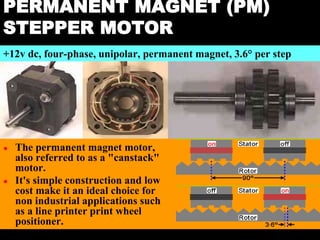
PERMANENT MAGNET (PM)
STEPPER MOTOR
● The permanent magnet motor,
also referred to as a "canstack"
motor.
● It's simple construction and low
cost make it an ideal choice for
non industrial applications such
as a line printer print wheel
positioner.
+12v dc, four-phase, unipolar, permanent magnet, 3.6° per step
04 March 2021 Prepared by M.Srinivasan 19
PM STEPPER MOTOR (Cont..)
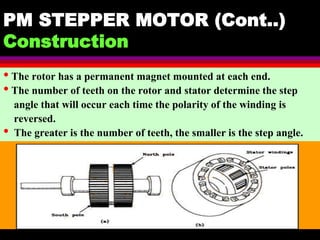
Construction
• The rotor has a permanent magnet mounted at each end.
• The number of teeth on the rotor and stator determine the step
angle that will occur each time the polarity of the winding is
reversed.
• The greater is the number of teeth, the smaller is the step angle.
20
PM STEPPER MOTOR (Cont..)
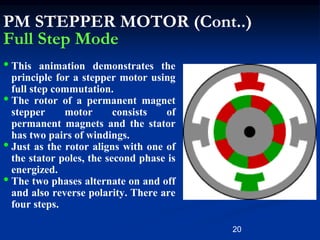
Full Step Mode
• This animation demonstrates the
principle for a stepper motor using
full step commutation.
• The rotor of a permanent magnet
stepper motor consists of
permanent magnets and the stator
has two pairs of windings.
• Just as the rotor aligns with one of
the stator poles, the second phase is
energized.
• The two phases alternate on and off
and also reverse polarity. There are
four steps.
21
PM STEPPER MOTOR (Cont..)
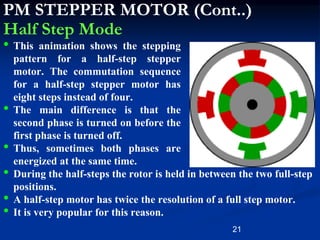
Half Step Mode
• This animation shows the stepping
pattern for a half-step stepper
motor. The commutation sequence
for a half-step stepper motor has
eight steps instead of four.
• The main difference is that the
second phase is turned on before the
first phase is turned off.
• Thus, sometimes both phases are
energized at the same time.
• During the half-steps the rotor is held in between the two full-step
positions.
• A half-step motor has twice the resolution of a full step motor.
• It is very popular for this reason.
04 March 2021 Prepared by M.Srinivasan 22
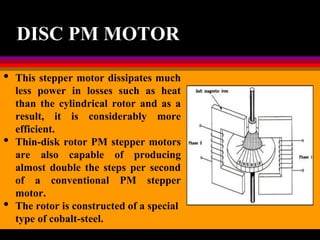
DISC PM MOTOR
• This stepper motor dissipates much
less power in losses such as heat
than the cylindrical rotor and as a
result, it is considerably more
efficient.
• Thin-disk rotor PM stepper motors
are also capable of producing
almost double the steps per second
of a conventional PM stepper
motor.
• The rotor is constructed of a special
type of cobalt-steel.
23
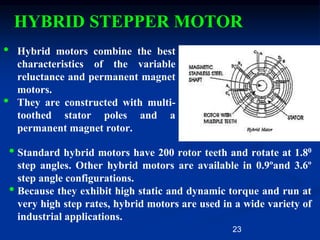
HYBRID STEPPER MOTOR
• Hybrid motors combine the best
characteristics of the variable
reluctance and permanent magnet
motors.
• They are constructed with multi-
toothed stator poles and a
permanent magnet rotor.
• Standard hybrid motors have 200 rotor teeth and rotate at 1.80
step angles. Other hybrid motors are available in 0.9ºand 3.6º
step angle configurations.
• Because they exhibit high static and dynamic torque and run at
very high step rates, hybrid motors are used in a wide variety of
industrial applications.
04 March 2021 Prepared by M.Srinivasan 24
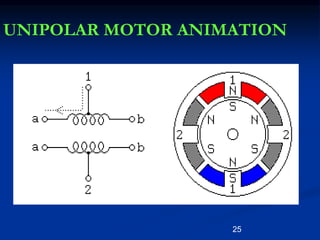
MOTOR WINDINGS
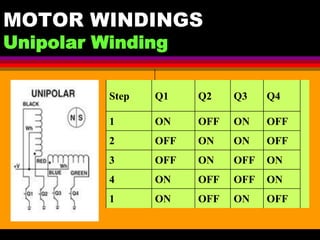
Unipolar Winding
Figure 2.12
Step Q1 Q2 Q3 Q4
1 ON OFF ON OFF
2 OFF ON ON OFF
3 OFF ON OFF ON
4 ON OFF OFF ON
1 ON OFF ON OFF
25
UNIPOLAR MOTOR ANIMATION
04 March 2021 Prepared by M.Srinivasan 26
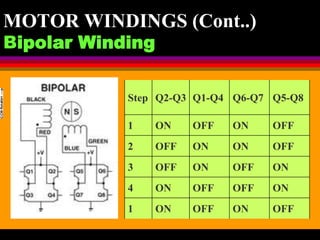
MOTOR WINDINGS (Cont..)
Bipolar Winding
Step Q2-Q3 Q1-Q4 Q6-Q7 Q5-Q8
1 ON OFF ON OFF
2 OFF ON ON OFF
3 OFF ON OFF ON
4 ON OFF OFF ON
1 ON OFF ON OFF
04 March 2021 27
Prepared by M.Srinivasan
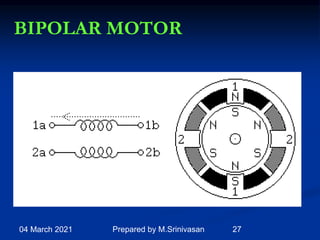
BIPOLAR MOTOR
04 March 2021 Prepared by M.Srinivasan 28
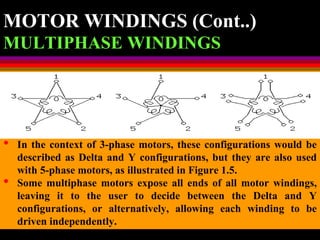
MOTOR WINDINGS (Cont..)
MULTIPHASE WINDINGS
• In the context of 3-phase motors, these configurations would be
described as Delta and Y configurations, but they are also used
with 5-phase motors, as illustrated in Figure 1.5.
• Some multiphase motors expose all ends of all motor windings,
leaving it to the user to decide between the Delta and Y
configurations, or alternatively, allowing each winding to be
driven independently.
04 March 2021 Prepared by M.Srinivasan 29
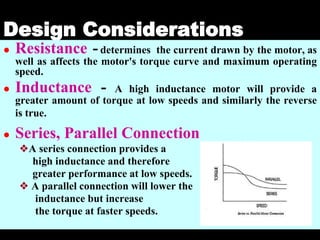
Design Considerations
● Resistance -determines the current drawn by the motor, as
well as affects the motor's torque curve and maximum operating
speed.
● Inductance - A high inductance motor will provide a
greater amount of torque at low speeds and similarly the reverse
is true.
● Series, Parallel Connection
❖A series connection provides a
high inductance and therefore
greater performance at low speeds.
❖ A parallel connection will lower the
inductance but increase
the torque at faster speeds.
04 March 2021 Prepared by M.Srinivasan 30
Design Considerations (Cont..)
•Driver Voltage - The higher the output voltage from the
driver, the higher the level of torque vs. speed. Generally, the
driver output voltage should be rated higher than the motor
voltage rating.
•Motor Stiffness - By design, stepping motors tend to run
stiff. Reducing the current flow to the motor by a small percentage
will smooth the rotation. Likewise, increasing the motor current
will increase the stiffness but will also provide more torque.
•Motor Heat -Step motors are designed to run hot (50º-90º
C). However, too much current may cause excessive heating and
damage to the motor insulation and windings.
04 March 2021 Prepared by M.Srinivasan 31
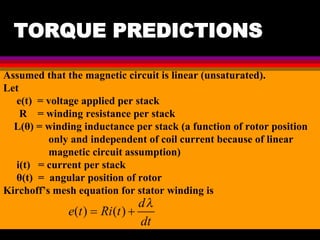
TORQUE PREDICTIONS
Assumed that the magnetic circuit is linear (unsaturated).
Let
e(t) = voltage applied per stack
R = winding resistance per stack
L(θ) = winding inductance per stack (a function of rotor position
only and independent of coil current because of linear
magnetic circuit assumption)
i(t) = current per stack
θ(t) = angular position of rotor
Kirchoff’s mesh equation for stator winding is
04 March 2021 Prepared by M.Srinivasan 32
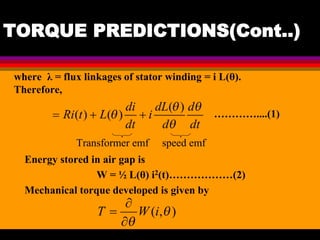
TORQUE PREDICTIONS(Cont..)
where λ = flux linkages of stator winding = i L(θ).
Therefore,
…………....(1)
Transformer emf speed emf
Energy stored in air gap is
W = ½ L(θ) i2(t)………………(2)
Mechanical torque developed is given by
04 March 2021 Prepared by M.Srinivasan 33
TORQUE PREDICTIONS(Cont..)
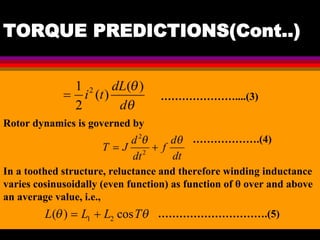
…………………....(3)
……………….(4)
Rotor dynamics is governed by
In a toothed structure, reluctance and therefore winding inductance
varies cosinusoidally (even function) as function of θ over and above
an average value, i.e.,
………………………….(5)
04 March 2021 Prepared by M.Srinivasan 34
TORQUE PREDICTIONS(Cont..)
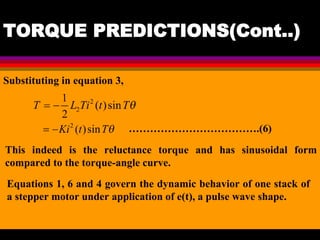
Substituting in equation 3,
……………………………….(6)
This indeed is the reluctance torque and has sinusoidal form
compared to the torque-angle curve.
Equations 1, 6 and 4 govern the dynamic behavior of one stack of
a stepper motor under application of e(t), a pulse wave shape.
04 March 2021 Prepared by M.Srinivasan 35
STEPPER MOTOR
CHARACTERISTICS
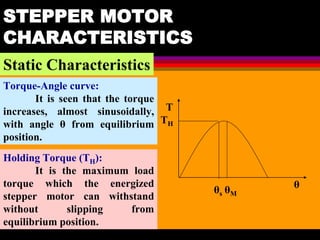
Static Characteristics
Torque-Angle curve:
It is seen that the torque
increases, almost sinusoidally,
with angle θ from equilibrium
position.
T
TH
θ
θM
θs
Holding Torque (TH):
It is the maximum load
torque which the energized
stepper motor can withstand
without slipping from
equilibrium position.
04 March 2021 Prepared by M.Srinivasan 36
STATIC CHARACTERISTICS
(Cont..)
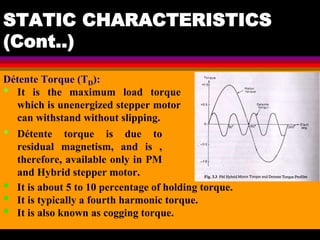
Détente Torque (TD):
• It is the maximum load torque
which is unenergized stepper motor
can withstand without slipping.
• Détente torque is due to
residual magnetism, and is ,
therefore, available only in PM
and Hybrid stepper motor.
• It is about 5 to 10 percentage of holding torque.
• It is typically a fourth harmonic torque.
• It is also known as cogging torque.
04 March 2021 Prepared by M.Srinivasan 37
STATIC CHARACTERISTICS
(Cont..)
Torque – Current Curve T
TH
TD
IRated I
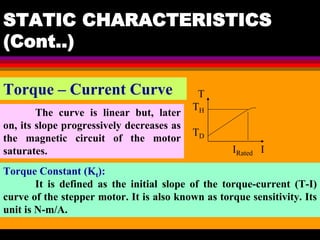
Torque Constant (Kt):
It is defined as the initial slope of the torque-current (T-I)
curve of the stepper motor. It is also known as torque sensitivity. Its
unit is N-m/A.
The curve is linear but, later
on, its slope progressively decreases as
the magnetic circuit of the motor
saturates.
04 March 2021 Prepared by M.Srinivasan 38
DYNAMIC CHARACTERISTICS
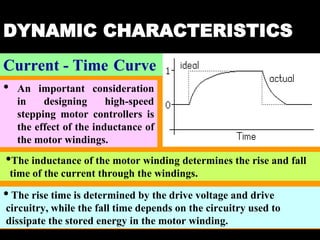
Current - Time Curve
• An important consideration
in designing high-speed
stepping motor controllers is
the effect of the inductance of
the motor windings.
•The inductance of the motor winding determines the rise and fall
time of the current through the windings.
•The rise time is determined by the drive voltage and drive
circuitry, while the fall time depends on the circuitry used to
dissipate the stored energy in the motor winding.
04 March 2021 Prepared by M.Srinivasan 39
DYNAMIC CHARS. (Cont..)
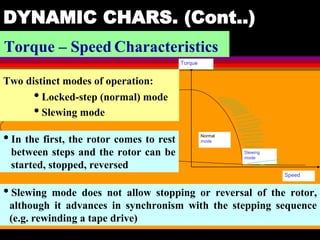
Torque – Speed Characteristics
Torque
Speed
Slewing
mode
Normal
mode
Two distinct modes of operation:
• Locked-step (normal) mode
• Slewing mode
•In the first, the rotor comes to rest
between steps and the rotor can be
started, stopped, reversed
•Slewing mode does not allow stopping or reversal of the rotor,
although it advances in synchronism with the stepping sequence
(e.g. rewinding a tape drive)
04 March 2021 Prepared by M.Srinivasan 40
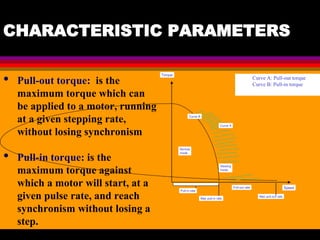
CHARACTERISTIC PARAMETERS
Curve A: Pull-out torque
Curve B: Pull-in torque
Torque
Speed
Slewing
mode
Normal
mode
Curve A
Curve B
Pull-in rate
Pull-out rate
Max pull-out rate
Max pull-in rate
• Pull-out torque: is the
maximum torque which can
be applied to a motor, running
at a given stepping rate,
without losing synchronism
• Pull-in torque: is the
maximum torque against
which a motor will start, at a
given pulse rate, and reach
synchronism without losing a
step.
04 March 2021 Prepared by M.Srinivasan 41
CHARACTERISTIC PARAMETERS
(Cont..)
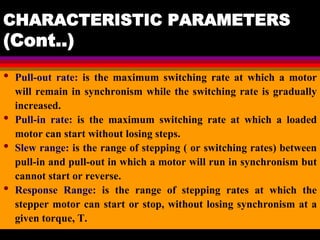
• Pull-out rate: is the maximum switching rate at which a motor
will remain in synchronism while the switching rate is gradually
increased.
• Pull-in rate: is the maximum switching rate at which a loaded
motor can start without losing steps.
• Slew range: is the range of stepping ( or switching rates) between
pull-in and pull-out in which a motor will run in synchronism but
cannot start or reverse.
• Response Range: is the range of stepping rates at which the
stepper motor can start or stop, without losing synchronism at a
given torque, T.
04 March 2021 Prepared by M.Srinivasan 42
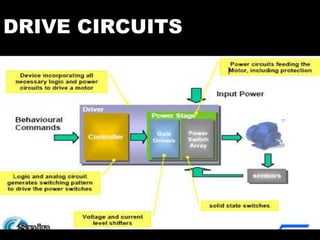
DRIVE CIRCUITS
43
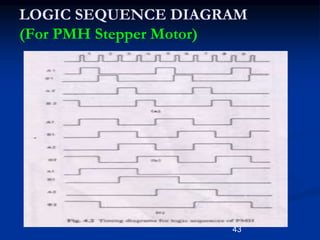
LOGIC SEQUENCE DIAGRAM
(For PMH Stepper Motor)
44
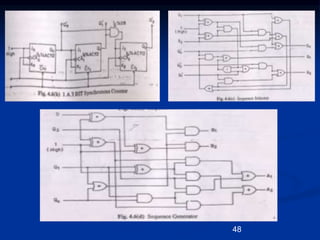
LOGIC SEQUENCE GENERATOR
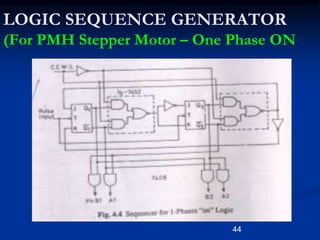
(For PMH Stepper Motor – One Phase ON
45
LOGIC SEQUENCE GENERATOR
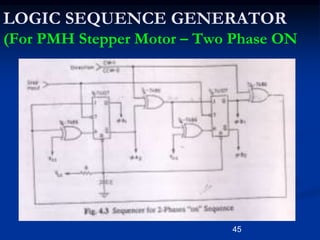
(For PMH Stepper Motor – Two Phase ON
46
LOGIC SEQUENCE GENERATOR
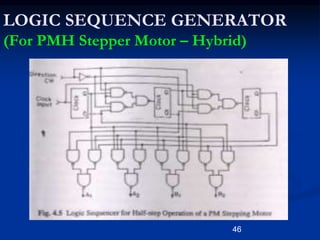
(For PMH Stepper Motor – Hybrid)
47
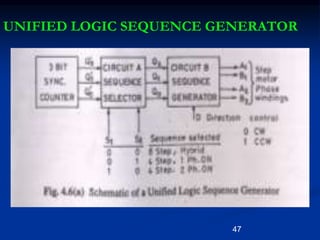
UNIFIED LOGIC SEQUENCE GENERATOR
48
49
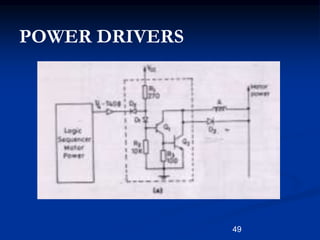
POWER DRIVERS
50
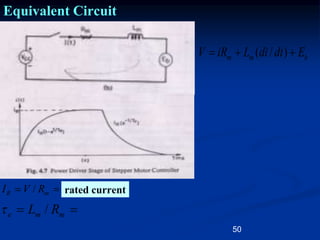
Equivalent Circuit
rated current
51
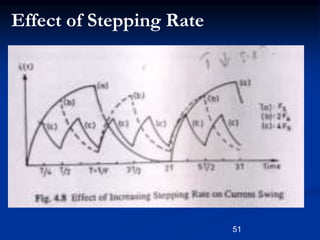
Effect of Stepping Rate
52
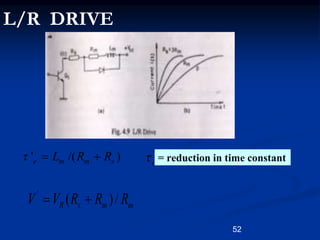
L/R DRIVE
= reduction in time constant
53
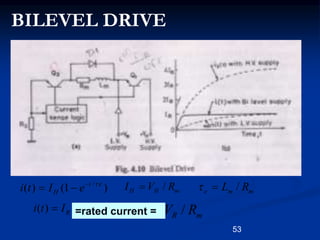
BILEVEL DRIVE
=rated current =
54
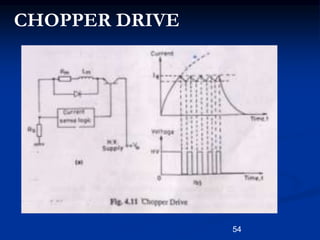
CHOPPER DRIVE
55
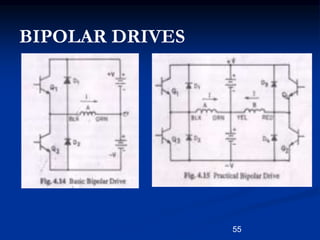
BIPOLAR DRIVES
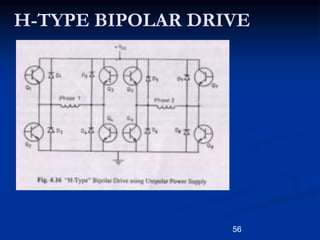
56
H-TYPE BIPOLAR DRIVE
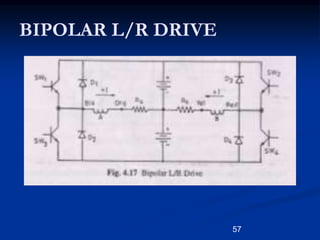
57
BIPOLAR L/R DRIVE
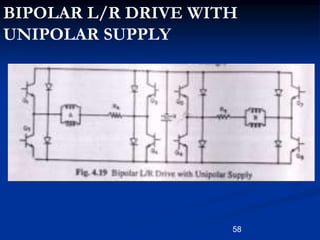
58
BIPOLAR L/R DRIVE WITH
UNIPOLAR SUPPLY
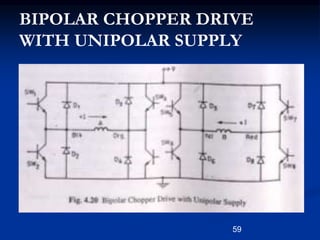
59
BIPOLAR CHOPPER DRIVE
WITH UNIPOLAR SUPPLY
04 March 2021 Prepared by M.Srinivasan 60
STEPPER MOTOR ADVANTAGES
• Low cost
• Ruggedness
• Simplicity in construction
• High reliability since there is no contact brushes in the motor
• No maintenance
• Wide acceptance
• No feedback components are needed
• They work in just about any environment
• Inherently more failsafe than servo motors.
• Excellent response to starting/ stopping/reversing.
• It is possible to achieve very low speed synchronous rotation
with a load that is directly coupled to the shaft.
04 March 2021 Prepared by M.Srinivasan 61
STEPPER MOTOR DISADVANTAGES
• Resonances can occur if not properly controlled.
• Not easy to operate at extremely high speeds.
• Rough performance at low speed unless a micro-step drive is
used
• Liability to undetected position loss as a result of operating
open-loop
• They consume current regardless of load conditions and
therefore tend to run hot
• Losses at speed are relatively high and can cause excessive
heating, and they are frequently noisy (especially at high
speeds).
Many of these drawbacks can be overcome by the use of
a closed-loop control scheme.
04 March 2021 Prepared by M.Srinivasan 62
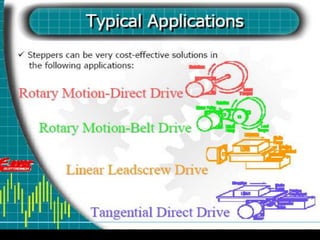
Stepper Motors Applications
63
When to find the stepper motors ?
●A stepper motor can be a good choice whenever controlled
movement is required.
●They can be used to advantage in applications where you
need to control rotation angle, speed, position and
synchronism.
Where to find the stepper motors ?
• Printers
• Plotters
• High end office equipment
• Hard disk drives
• Medical equipment
• Fax machines
• Automotive
• Machine tools
• Process control systems
• programmable controllers
and many more.
04 March 2021 Prepared by M.Srinivasan 64
04 March 2021 Prepared by M.Srinivasan 65
04 March 2021 Prepared by M.Srinivasan 66
04 March 2021 Prepared by M.Srinivasan 67
04 March 2021 Prepared by M.Srinivasan 68

Stepper Motor .pptx

  • 1.
  • 2.
    04 March 2021Prepared by M.Srinivasan 2 Presented by Dr.P.SUNDARARAMAN , Assistant professor -EECE, GITAM University , Bangalore.
  • 3.
    04 March 2021Prepared by M.Srinivasan 3 CONTENTS ● Introduction ● How Stepper Motors Work ● Types of Stepper Motors ● Construction ● Design Considerations ● Torque Prediction ● Characteristics ● Drive Circuits ● Comparison ● Applications
  • 4.
    04 March 2021Prepared by M.Srinivasan 4 INTRODUCTION Basic Stepper Motor System • Controller, also known as a pulse generator or indexer. The controller is a microprocessor capable of generating step pulses and direct signals for the driver. • Driver (or Amplifier) converts the controller command signals into the power necessary to energize the motor windings. • Step (or stepping or stepper) Motor is an electromagnetic device that converts digital pulses into mechanical shaft rotation.
  • 5.
    04 March 2021Prepared by M.Srinivasan 5 ABOUT STEP MOTOR… • A stepper motor is an electromechanical device which converts electrical pulses into discrete mechanical movements. • The shaft, or spindle of a stepper motor rotates in discrete step increments when electrical command pulses are applied to it in the proper sequence. • The sequence of the applied pulses is directly related to the direction of motor shafts rotation. • The speed of the motor shaft rotation is directly related to the frequency of the input pulses applied.
  • 6.
    04 March 2021Prepared by M.Srinivasan 6 SIMPLE APPLICATION Each time the controller receives an input signal, the paper is driven a certain incremental distance. Paper drive mechanism using stepper machine
  • 7.
    04 March 2021Prepared by M.Srinivasan 7 HOW STEPPER MOTORS WORK Function: • To move a rotor through a precise angular step when the current in one or more of the stator windings is switched on. • The rotor may be driven at a high speed by switching the currents rapidly; • However, the controlled quantity is angular rotor position rather than its velocity
  • 8.
    04 March 2021Prepared by M.Srinivasan 8 FULL STEPPING (One Phase ON) 00 900 1800 2700 on off off off a.4 off on off off a.3 off off on off a.2 off off off on a.1 Coil 1 Coil 2 Coil 3 Coil 4 Step
  • 9.
    04 March 2021Prepared by M.Srinivasan 9 FULL STEPPING (Two Phase ON) 450 1350 2250 3150 on off off on b.4 on on off off b.3 off on on off b.2 off off on on b.1 Coil 1 Coil 2 Coil 3 Coil 4 Step
  • 10.
    04 March 2021Prepared by M.Srinivasan 10 HALF STEPPING on off off on b.4 on off off off a.4 on on off off b.3 off on off off a.3 off on on off b.2 off off on off a.2 off off on on b.1 off off off on a.1 Coil 1 Coil 2 Coil 3 Coil 4 Step
  • 11.
    04 March 2021Prepared by M.Srinivasan 11 MULTIPOLE MOTOR • In position 1, the north pole of the rotor's permanent magnet is aligned with the south pole of the stator's electromagnet. • In position 2, the upper electromagnet is deactivated and the next one to its immediate left is activated, causing the rotor to rotate a precise amount of degrees. After eight steps the sequence repeats.
  • 12.
    04 March 2021Prepared by M.Srinivasan 12 TYPES OF STEPPER MOTORS STEPPER MOTORS With Permanent Magnet Without Permanent Magnet Claw Pole (PM) Hybrid (PMH) Enhanced Hybrid (EHYB) Disc Magnet (DM) Variable Reluctance (VR)
  • 13.
    04 March 2021Prepared by M.Srinivasan 13 VARIABLE RELUCTANCE (VR) STEPPER MOTOR ● The variable-reluctance (VR) stepper motor differs from the PM stepper in that it has no permanent-magnet rotor and no residual torque to hold the rotor at one position when turned off. ● When the stator coils are energized, the rotor teeth will align with the energized stator poles. ● This type of motor operates on the principle of minimizing the reluctance along the path of the applied magnetic field. ● By alternating the windings that are energized in the stator, the stator field changes, and the rotor is moved to a new position.
  • 14.
    04 March 2021Prepared by M.Srinivasan 14 VR STEPPER MOTOR (Cont..) Construction • This type of construction is good in non industrial applications that do not require a high degree of motor torque. • The stator of a VR stepper motor has a magnetic core constructed with a stack of steel laminations. • The rotor is made of unmagnetized soft steel with teeth and slots.
  • 15.
    04 March 2021Prepared by M.Srinivasan 15 VR STEPPER MOTOR (Cont..) Principle of Operation • Current applied to pole 1 through the motor winding causes a magnetic attraction that aligns the rotor (tooth) to pole 1. • Energizing stator pole 2 causes the rotor to rotate 30 degrees in alignment with pole 2. • This process will continue with pole 3 and back to 1 in a clockwise direction. Reversing the procedure (3 to 1) would result in a counterclockwise rotation.
  • 16.
    04 March 2021Prepared by M.Srinivasan 16 The relationship among step angle, rotor teeth, and stator teeth is expressed using the following equation: Where, ψ – Step angle Ns – Number of stator teeth Nr – Number of rotor teeth Example Determine the step angle of a Variable Reluctance stepper motor with 12 teeth in the stator and 8 rotor teeth. Here, Ns = 12; Nr = 8; Step angle = = 150
  • 17.
    MULTISTACK STEPPER MOTOR ●TheVR stepper motors mentioned up to this point are all single- stack motors. That is, all the phases are arranged in a single stack, or plane. ●The disadvantage of this design for a stepper motor is that the steps are generally quite large (above 15°). ●Multi-stack stepper motors can produce smaller step sizes because the motor is divided along its axial length into magnetically isolated sections, or stacks. ●Each of these sections is excited by a separate winding, or phase. ●In this type of motor, each stack corresponds to a phase, and the stator and rotor have the same tooth pitch.
  • 18.
    04 March 2021Prepared by M.Srinivasan 18 PERMANENT MAGNET (PM) STEPPER MOTOR ● The permanent magnet motor, also referred to as a "canstack" motor. ● It's simple construction and low cost make it an ideal choice for non industrial applications such as a line printer print wheel positioner. +12v dc, four-phase, unipolar, permanent magnet, 3.6° per step
  • 19.
    04 March 2021Prepared by M.Srinivasan 19 PM STEPPER MOTOR (Cont..) Construction • The rotor has a permanent magnet mounted at each end. • The number of teeth on the rotor and stator determine the step angle that will occur each time the polarity of the winding is reversed. • The greater is the number of teeth, the smaller is the step angle.
  • 20.
    20 PM STEPPER MOTOR(Cont..) Full Step Mode • This animation demonstrates the principle for a stepper motor using full step commutation. • The rotor of a permanent magnet stepper motor consists of permanent magnets and the stator has two pairs of windings. • Just as the rotor aligns with one of the stator poles, the second phase is energized. • The two phases alternate on and off and also reverse polarity. There are four steps.
  • 21.
    21 PM STEPPER MOTOR(Cont..) Half Step Mode • This animation shows the stepping pattern for a half-step stepper motor. The commutation sequence for a half-step stepper motor has eight steps instead of four. • The main difference is that the second phase is turned on before the first phase is turned off. • Thus, sometimes both phases are energized at the same time. • During the half-steps the rotor is held in between the two full-step positions. • A half-step motor has twice the resolution of a full step motor. • It is very popular for this reason.
  • 22.
    04 March 2021Prepared by M.Srinivasan 22 DISC PM MOTOR • This stepper motor dissipates much less power in losses such as heat than the cylindrical rotor and as a result, it is considerably more efficient. • Thin-disk rotor PM stepper motors are also capable of producing almost double the steps per second of a conventional PM stepper motor. • The rotor is constructed of a special type of cobalt-steel.
  • 23.
    23 HYBRID STEPPER MOTOR •Hybrid motors combine the best characteristics of the variable reluctance and permanent magnet motors. • They are constructed with multi- toothed stator poles and a permanent magnet rotor. • Standard hybrid motors have 200 rotor teeth and rotate at 1.80 step angles. Other hybrid motors are available in 0.9ºand 3.6º step angle configurations. • Because they exhibit high static and dynamic torque and run at very high step rates, hybrid motors are used in a wide variety of industrial applications.
  • 24.
    04 March 2021Prepared by M.Srinivasan 24 MOTOR WINDINGS Unipolar Winding Figure 2.12 Step Q1 Q2 Q3 Q4 1 ON OFF ON OFF 2 OFF ON ON OFF 3 OFF ON OFF ON 4 ON OFF OFF ON 1 ON OFF ON OFF
  • 25.
  • 26.
    04 March 2021Prepared by M.Srinivasan 26 MOTOR WINDINGS (Cont..) Bipolar Winding Step Q2-Q3 Q1-Q4 Q6-Q7 Q5-Q8 1 ON OFF ON OFF 2 OFF ON ON OFF 3 OFF ON OFF ON 4 ON OFF OFF ON 1 ON OFF ON OFF
  • 27.
    04 March 202127 Prepared by M.Srinivasan BIPOLAR MOTOR
  • 28.
    04 March 2021Prepared by M.Srinivasan 28 MOTOR WINDINGS (Cont..) MULTIPHASE WINDINGS • In the context of 3-phase motors, these configurations would be described as Delta and Y configurations, but they are also used with 5-phase motors, as illustrated in Figure 1.5. • Some multiphase motors expose all ends of all motor windings, leaving it to the user to decide between the Delta and Y configurations, or alternatively, allowing each winding to be driven independently.
  • 29.
    04 March 2021Prepared by M.Srinivasan 29 Design Considerations ● Resistance -determines the current drawn by the motor, as well as affects the motor's torque curve and maximum operating speed. ● Inductance - A high inductance motor will provide a greater amount of torque at low speeds and similarly the reverse is true. ● Series, Parallel Connection ❖A series connection provides a high inductance and therefore greater performance at low speeds. ❖ A parallel connection will lower the inductance but increase the torque at faster speeds.
  • 30.
    04 March 2021Prepared by M.Srinivasan 30 Design Considerations (Cont..) •Driver Voltage - The higher the output voltage from the driver, the higher the level of torque vs. speed. Generally, the driver output voltage should be rated higher than the motor voltage rating. •Motor Stiffness - By design, stepping motors tend to run stiff. Reducing the current flow to the motor by a small percentage will smooth the rotation. Likewise, increasing the motor current will increase the stiffness but will also provide more torque. •Motor Heat -Step motors are designed to run hot (50º-90º C). However, too much current may cause excessive heating and damage to the motor insulation and windings.
  • 31.
    04 March 2021Prepared by M.Srinivasan 31 TORQUE PREDICTIONS Assumed that the magnetic circuit is linear (unsaturated). Let e(t) = voltage applied per stack R = winding resistance per stack L(θ) = winding inductance per stack (a function of rotor position only and independent of coil current because of linear magnetic circuit assumption) i(t) = current per stack θ(t) = angular position of rotor Kirchoff’s mesh equation for stator winding is
  • 32.
    04 March 2021Prepared by M.Srinivasan 32 TORQUE PREDICTIONS(Cont..) where λ = flux linkages of stator winding = i L(θ). Therefore, …………....(1) Transformer emf speed emf Energy stored in air gap is W = ½ L(θ) i2(t)………………(2) Mechanical torque developed is given by
  • 33.
    04 March 2021Prepared by M.Srinivasan 33 TORQUE PREDICTIONS(Cont..) …………………....(3) ……………….(4) Rotor dynamics is governed by In a toothed structure, reluctance and therefore winding inductance varies cosinusoidally (even function) as function of θ over and above an average value, i.e., ………………………….(5)
  • 34.
    04 March 2021Prepared by M.Srinivasan 34 TORQUE PREDICTIONS(Cont..) Substituting in equation 3, ……………………………….(6) This indeed is the reluctance torque and has sinusoidal form compared to the torque-angle curve. Equations 1, 6 and 4 govern the dynamic behavior of one stack of a stepper motor under application of e(t), a pulse wave shape.
  • 35.
    04 March 2021Prepared by M.Srinivasan 35 STEPPER MOTOR CHARACTERISTICS Static Characteristics Torque-Angle curve: It is seen that the torque increases, almost sinusoidally, with angle θ from equilibrium position. T TH θ θM θs Holding Torque (TH): It is the maximum load torque which the energized stepper motor can withstand without slipping from equilibrium position.
  • 36.
    04 March 2021Prepared by M.Srinivasan 36 STATIC CHARACTERISTICS (Cont..) Détente Torque (TD): • It is the maximum load torque which is unenergized stepper motor can withstand without slipping. • Détente torque is due to residual magnetism, and is , therefore, available only in PM and Hybrid stepper motor. • It is about 5 to 10 percentage of holding torque. • It is typically a fourth harmonic torque. • It is also known as cogging torque.
  • 37.
    04 March 2021Prepared by M.Srinivasan 37 STATIC CHARACTERISTICS (Cont..) Torque – Current Curve T TH TD IRated I Torque Constant (Kt): It is defined as the initial slope of the torque-current (T-I) curve of the stepper motor. It is also known as torque sensitivity. Its unit is N-m/A. The curve is linear but, later on, its slope progressively decreases as the magnetic circuit of the motor saturates.
  • 38.
    04 March 2021Prepared by M.Srinivasan 38 DYNAMIC CHARACTERISTICS Current - Time Curve • An important consideration in designing high-speed stepping motor controllers is the effect of the inductance of the motor windings. •The inductance of the motor winding determines the rise and fall time of the current through the windings. •The rise time is determined by the drive voltage and drive circuitry, while the fall time depends on the circuitry used to dissipate the stored energy in the motor winding.
  • 39.
    04 March 2021Prepared by M.Srinivasan 39 DYNAMIC CHARS. (Cont..) Torque – Speed Characteristics Torque Speed Slewing mode Normal mode Two distinct modes of operation: • Locked-step (normal) mode • Slewing mode •In the first, the rotor comes to rest between steps and the rotor can be started, stopped, reversed •Slewing mode does not allow stopping or reversal of the rotor, although it advances in synchronism with the stepping sequence (e.g. rewinding a tape drive)
  • 40.
    04 March 2021Prepared by M.Srinivasan 40 CHARACTERISTIC PARAMETERS Curve A: Pull-out torque Curve B: Pull-in torque Torque Speed Slewing mode Normal mode Curve A Curve B Pull-in rate Pull-out rate Max pull-out rate Max pull-in rate • Pull-out torque: is the maximum torque which can be applied to a motor, running at a given stepping rate, without losing synchronism • Pull-in torque: is the maximum torque against which a motor will start, at a given pulse rate, and reach synchronism without losing a step.
  • 41.
    04 March 2021Prepared by M.Srinivasan 41 CHARACTERISTIC PARAMETERS (Cont..) • Pull-out rate: is the maximum switching rate at which a motor will remain in synchronism while the switching rate is gradually increased. • Pull-in rate: is the maximum switching rate at which a loaded motor can start without losing steps. • Slew range: is the range of stepping ( or switching rates) between pull-in and pull-out in which a motor will run in synchronism but cannot start or reverse. • Response Range: is the range of stepping rates at which the stepper motor can start or stop, without losing synchronism at a given torque, T.
  • 42.
    04 March 2021Prepared by M.Srinivasan 42 DRIVE CIRCUITS
  • 43.
  • 44.
    44 LOGIC SEQUENCE GENERATOR (ForPMH Stepper Motor – One Phase ON
  • 45.
    45 LOGIC SEQUENCE GENERATOR (ForPMH Stepper Motor – Two Phase ON
  • 46.
    46 LOGIC SEQUENCE GENERATOR (ForPMH Stepper Motor – Hybrid)
  • 47.
  • 48.
  • 49.
  • 50.
  • 51.
  • 52.
    52 L/R DRIVE = reductionin time constant
  • 53.
  • 54.
  • 55.
  • 56.
  • 57.
  • 58.
    58 BIPOLAR L/R DRIVEWITH UNIPOLAR SUPPLY
  • 59.
  • 60.
    04 March 2021Prepared by M.Srinivasan 60 STEPPER MOTOR ADVANTAGES • Low cost • Ruggedness • Simplicity in construction • High reliability since there is no contact brushes in the motor • No maintenance • Wide acceptance • No feedback components are needed • They work in just about any environment • Inherently more failsafe than servo motors. • Excellent response to starting/ stopping/reversing. • It is possible to achieve very low speed synchronous rotation with a load that is directly coupled to the shaft.
  • 61.
    04 March 2021Prepared by M.Srinivasan 61 STEPPER MOTOR DISADVANTAGES • Resonances can occur if not properly controlled. • Not easy to operate at extremely high speeds. • Rough performance at low speed unless a micro-step drive is used • Liability to undetected position loss as a result of operating open-loop • They consume current regardless of load conditions and therefore tend to run hot • Losses at speed are relatively high and can cause excessive heating, and they are frequently noisy (especially at high speeds). Many of these drawbacks can be overcome by the use of a closed-loop control scheme.
  • 62.
    04 March 2021Prepared by M.Srinivasan 62 Stepper Motors Applications
  • 63.
    63 When to findthe stepper motors ? ●A stepper motor can be a good choice whenever controlled movement is required. ●They can be used to advantage in applications where you need to control rotation angle, speed, position and synchronism. Where to find the stepper motors ? • Printers • Plotters • High end office equipment • Hard disk drives • Medical equipment • Fax machines • Automotive • Machine tools • Process control systems • programmable controllers and many more.
  • 64.
    04 March 2021Prepared by M.Srinivasan 64
  • 65.
    04 March 2021Prepared by M.Srinivasan 65
  • 66.
    04 March 2021Prepared by M.Srinivasan 66
  • 67.
    04 March 2021Prepared by M.Srinivasan 67
  • 68.
    04 March 2021Prepared by M.Srinivasan 68