A SEMINAR
on
STEPPER MOTORS
Submitted in partial fulfillment of the requirements for the award of the degree in
BACHELOR OF TECHNOLOGY
IN
ELECTRICAL AND ELECTRONICS ENGINEERING
By
V.SUMANTH(12BF5A0212)
Under the esteemed guidance of
Mr.B.HEMANTH KUMAR M.Tech,
Assistant Professor
DEPARTMENT OF ELECTRICAL AND ELECTRONICS ENGINEERING
SRI VENKATESWARA COLLEGE OF ENGINEERING
Karakambadi road, Tirupati-517507, A.P
(Affiliated to J.N.T.U, Anantapur)
(2012 – 2015)
CONTENT:
 INTRODUCTION
 PRINCIPLE OF STEPPER MOTOR
 TYPES OF STEPPER MOTOR
 STEPPER MOTOR PARAMETERS
 STEPPING MODES
 MECHANICAL PARAMETERS, LOAD, FRICTION, INERTIA
 CHARACTERISTICS
 SINGLE STEP RESPONSE AND RESONANCES
 ADVANTAGES
 DISADVANTAGES
 APPLICATIONS
 CONCLUSION
INTRODUCTION:
 An electric motor is a machine that converts electrical energy into
mechanical energy for obtaining useful work.
 A stepper motor is a brushless DC motor whose rotor rotates in a discrete
angular increments when its stator is energised in a programmed manner
 The first stepper motor is invented by walker i.e., salient pole variable
reluctance stepper motor.
 As far as application of stepper motors are concerned McCelland
described application of the stepper motor in British warships.
 The modern stepper motor was first described by Thomas and Fleischauer in
1957
 The permanent magnet hybrid stepper motor was invented by Feirtag and
Donahoo of General Electric Co. (GEC) in 1952.
PRINCIPLE OF STEPPER MOTOR
 A stepper motor is an electromechanical device which converts electrical
pulses into discrete mechanical movements.
 The shaft or spindle of a stepper motor rotates in discrete step increments
when electrical command pulses are applied to it in the proper sequence.
 The motors rotation has several direct relationships to these applied input
pulses.
 The sequence of the applied pulses is directly related to the direction of
motor shafts rotation.
 The speed of the motor shafts rotation is directly to the frequency of the
input pulses.
TYPES OF STEPPER MOTOR:
 As far as construction is concerned, stepper motors may be divided into
two major groups.
 Without permanent magnet and with permanent magnet
WITHOUT PERMANENT MAGNET
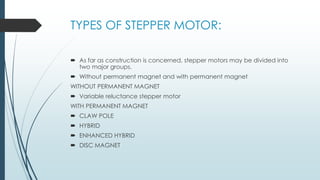
 Variable reluctance stepper motor
WITH PERMANENT MAGNET
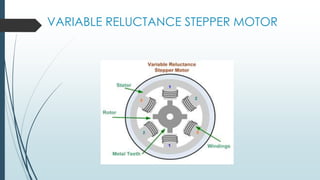
 CLAW POLE
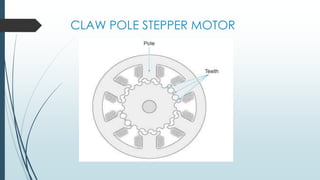
 HYBRID
 ENHANCED HYBRID
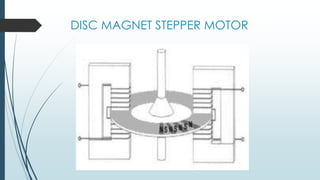
 DISC MAGNET
VARIABLE RELUCTANCE STEPPER MOTOR
CLAW POLE STEPPER MOTOR
HYBRID STEPPER MOTOR
DISC MAGNET STEPPER MOTOR
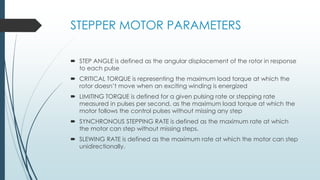
STEPPER MOTOR PARAMETERS
 STEP ANGLE is defined as the angular displacement of the rotor in response
to each pulse
 CRITICAL TORQUE is representing the maximum load torque at which the
rotor doesn’t move when an exciting winding is energized
 LIMITING TORQUE is defined for a given pulsing rate or stepping rate
measured in pulses per second, as the maximum load torque at which the
motor follows the control pulses without missing any step
 SYNCHRONOUS STEPPING RATE is defined as the maximum rate at which
the motor can step without missing steps.
 SLEWING RATE is defined as the maximum rate at which the motor can step
unidirectionally.
STEPPING MODES
 Full step operation
 2 phase ON operation
 Half step operation
 Micro stepping operation
MECHANICAL PARAMETERS, LOAD,
FRICTION, INERTIA
 The performance of a stepper motor system ( driver and motor) I s also
highly dependent on the mechanical parameters of the load.
 The load is defined as what the motor drives. it is typically frictional, inertial
or a combination of the two
 A minimum torque level is required throughout the step in over to
overcome this friction
 Increasing a frictional load lowers the increases the positional error. The
converse is true if the frictional load is lowered.
 Inertia is the resistance to changes in speed. A high inertial load requires
same would apply for braking.
 The rotor oscillations of a stepper motor will vary with the amount of friction
and inertia load.
CHARACTERISTICS
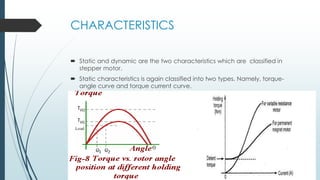
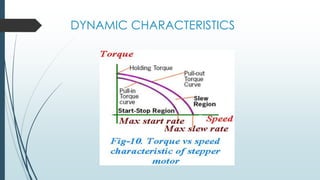
 Static and dynamic are the two characteristics which are classified in
stepper motor.
 Static characteristics is again classified into two types. Namely, torque-
angle curve and torque current curve.
DYNAMIC CHARACTERISTICS
SINGLE STEP RESPONSE AND RESONANCE
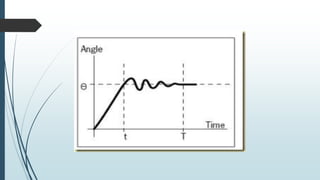
 When one step pulse is applied to a stepper motor the rotor behaves in a
manner as defined by the below curve.
 The step time ‘t’ is the time it takes the motor shaft to rotate one step angle
once the first step pulse is applied.
 Step time is highly dependent on the ratio of torque to inertia (load) as well
as the type of driver used.
 Since the torque is a function of the displacement it follows that the
acceleration will be.
 The settling time T is the time it takes these osccillations or ringing to cease.
ADVANTAGES
 Excellent response to starting/stopping/reversing.
 Very reliable since there are no contact brushes in the motor.
 Less costly to control.
 It is possible to achieve very low speed synchronous rotation with a load
that is directly coupled to the shaft.
 Precise positioning and repeatability of movement since good stepper
motors have an accuracy of 3-5 % of a step and this error is non cumulative
from one step to the next.
DISADVANTAGES
 Resonance can occur if not properly controlled.
 Not easy to operate at extremely
APPLICATIONS
 Stepper motors are used in a wide variety of applications in industry,
including computer peripherals, business machines, motion control, and
robotics, which are included in process control and machine tool
applications. A complete list of applications is shown below
 COMPUTER PERIPHERALS- floppy disc, printer, tape reader, plotter etc.,
 BUSSINESS MACHINES- copy reader, copy machine, banking systems, type
writer, card sorter.
 PROCESS CONTROL- carburettor adjusting, valve control, conveyor, in
process gaging, assembly lines, silicon processing, ic bonding, laser
trimming, liquid gasket dispensing, mail handling systems.
 MACHINE TOOLS- Milling Machines, Drilling Machines, Grinding Machines,
Electron Beam Welder, Laser Cutting, Lathes, Sewing.
CONCLUSION
THANK YOU
ANY QUERIES

stepper motor

  • 1.
    A SEMINAR on STEPPER MOTORS Submittedin partial fulfillment of the requirements for the award of the degree in BACHELOR OF TECHNOLOGY IN ELECTRICAL AND ELECTRONICS ENGINEERING By V.SUMANTH(12BF5A0212) Under the esteemed guidance of Mr.B.HEMANTH KUMAR M.Tech, Assistant Professor DEPARTMENT OF ELECTRICAL AND ELECTRONICS ENGINEERING SRI VENKATESWARA COLLEGE OF ENGINEERING Karakambadi road, Tirupati-517507, A.P (Affiliated to J.N.T.U, Anantapur) (2012 – 2015)
  • 2.
    CONTENT:  INTRODUCTION  PRINCIPLEOF STEPPER MOTOR  TYPES OF STEPPER MOTOR  STEPPER MOTOR PARAMETERS  STEPPING MODES  MECHANICAL PARAMETERS, LOAD, FRICTION, INERTIA  CHARACTERISTICS  SINGLE STEP RESPONSE AND RESONANCES  ADVANTAGES  DISADVANTAGES  APPLICATIONS  CONCLUSION
  • 3.
    INTRODUCTION:  An electricmotor is a machine that converts electrical energy into mechanical energy for obtaining useful work.  A stepper motor is a brushless DC motor whose rotor rotates in a discrete angular increments when its stator is energised in a programmed manner  The first stepper motor is invented by walker i.e., salient pole variable reluctance stepper motor.  As far as application of stepper motors are concerned McCelland described application of the stepper motor in British warships.  The modern stepper motor was first described by Thomas and Fleischauer in 1957  The permanent magnet hybrid stepper motor was invented by Feirtag and Donahoo of General Electric Co. (GEC) in 1952.
  • 4.
    PRINCIPLE OF STEPPERMOTOR  A stepper motor is an electromechanical device which converts electrical pulses into discrete mechanical movements.  The shaft or spindle of a stepper motor rotates in discrete step increments when electrical command pulses are applied to it in the proper sequence.  The motors rotation has several direct relationships to these applied input pulses.  The sequence of the applied pulses is directly related to the direction of motor shafts rotation.  The speed of the motor shafts rotation is directly to the frequency of the input pulses.
  • 5.
    TYPES OF STEPPERMOTOR:  As far as construction is concerned, stepper motors may be divided into two major groups.  Without permanent magnet and with permanent magnet WITHOUT PERMANENT MAGNET  Variable reluctance stepper motor WITH PERMANENT MAGNET  CLAW POLE  HYBRID  ENHANCED HYBRID  DISC MAGNET
  • 6.
  • 7.
  • 8.
  • 9.
  • 10.
    STEPPER MOTOR PARAMETERS STEP ANGLE is defined as the angular displacement of the rotor in response to each pulse  CRITICAL TORQUE is representing the maximum load torque at which the rotor doesn’t move when an exciting winding is energized  LIMITING TORQUE is defined for a given pulsing rate or stepping rate measured in pulses per second, as the maximum load torque at which the motor follows the control pulses without missing any step  SYNCHRONOUS STEPPING RATE is defined as the maximum rate at which the motor can step without missing steps.  SLEWING RATE is defined as the maximum rate at which the motor can step unidirectionally.
  • 11.
    STEPPING MODES  Fullstep operation  2 phase ON operation  Half step operation  Micro stepping operation
  • 12.
    MECHANICAL PARAMETERS, LOAD, FRICTION,INERTIA  The performance of a stepper motor system ( driver and motor) I s also highly dependent on the mechanical parameters of the load.  The load is defined as what the motor drives. it is typically frictional, inertial or a combination of the two  A minimum torque level is required throughout the step in over to overcome this friction  Increasing a frictional load lowers the increases the positional error. The converse is true if the frictional load is lowered.  Inertia is the resistance to changes in speed. A high inertial load requires same would apply for braking.  The rotor oscillations of a stepper motor will vary with the amount of friction and inertia load.
  • 13.
    CHARACTERISTICS  Static anddynamic are the two characteristics which are classified in stepper motor.  Static characteristics is again classified into two types. Namely, torque- angle curve and torque current curve.
  • 14.
  • 15.
    SINGLE STEP RESPONSEAND RESONANCE  When one step pulse is applied to a stepper motor the rotor behaves in a manner as defined by the below curve.  The step time ‘t’ is the time it takes the motor shaft to rotate one step angle once the first step pulse is applied.  Step time is highly dependent on the ratio of torque to inertia (load) as well as the type of driver used.  Since the torque is a function of the displacement it follows that the acceleration will be.  The settling time T is the time it takes these osccillations or ringing to cease.
  • 17.
    ADVANTAGES  Excellent responseto starting/stopping/reversing.  Very reliable since there are no contact brushes in the motor.  Less costly to control.  It is possible to achieve very low speed synchronous rotation with a load that is directly coupled to the shaft.  Precise positioning and repeatability of movement since good stepper motors have an accuracy of 3-5 % of a step and this error is non cumulative from one step to the next.
  • 18.
    DISADVANTAGES  Resonance canoccur if not properly controlled.  Not easy to operate at extremely
  • 19.
    APPLICATIONS  Stepper motorsare used in a wide variety of applications in industry, including computer peripherals, business machines, motion control, and robotics, which are included in process control and machine tool applications. A complete list of applications is shown below  COMPUTER PERIPHERALS- floppy disc, printer, tape reader, plotter etc.,  BUSSINESS MACHINES- copy reader, copy machine, banking systems, type writer, card sorter.  PROCESS CONTROL- carburettor adjusting, valve control, conveyor, in process gaging, assembly lines, silicon processing, ic bonding, laser trimming, liquid gasket dispensing, mail handling systems.  MACHINE TOOLS- Milling Machines, Drilling Machines, Grinding Machines, Electron Beam Welder, Laser Cutting, Lathes, Sewing.
  • 20.
  • 21.
  • 22.