Motor Fundamental
Motor Fundamental Motor Outline Stepper Motor Servo Motor Agenda
Motor Outline DC Motor/Synchronous Motor / Induction Motor
Motor Fundamental Stepper Motor Agenda Advantage Disadvantage Type of Stepper Motors Theory of Operation Switching Sequence Linear Stepper Motors Application
Stepper Motor Low Cost Excellent  Torque Holding Low Maintenance(Brushless) Very Rugged (Any Environment) No Tuning Required Advantage
Stepper Motor Rough Performance at Low Speed Consume Current Regardless of Load Limited Sizes Available Noisy Torque Decreases with speed Stall or Lose Position Running without a Control Loop Disadvantage
Stepper Motor Type of Stepper Motors Permanent Magnet Variable Reluctance Hybrid
Stepper Motor Brushless Relative Low Torque Teeth Offset Thin-Disk Rotor (Stator Offset?) Permanent Magnet
No Permanent Magnet Numbers of Steps : (Ns - Nr)/(Ns*Nr)   Ns: number of teeth in stator core   Nr: number of teeth in rotor core  Single Stack / Multi Stack Stepper Motor Variable-Reluctance Stepper Motor
Consist of two pieces of  soft iron, round PM Bifilar Stepper Motor Hybrid
Stepper Motor Unipolar Bipolar Free Wheeling Drive
Stepper Motor Theory of Operation
Stepper Motor Full Step Switching Sequence
Stepper Motor Half Step Switching Sequence
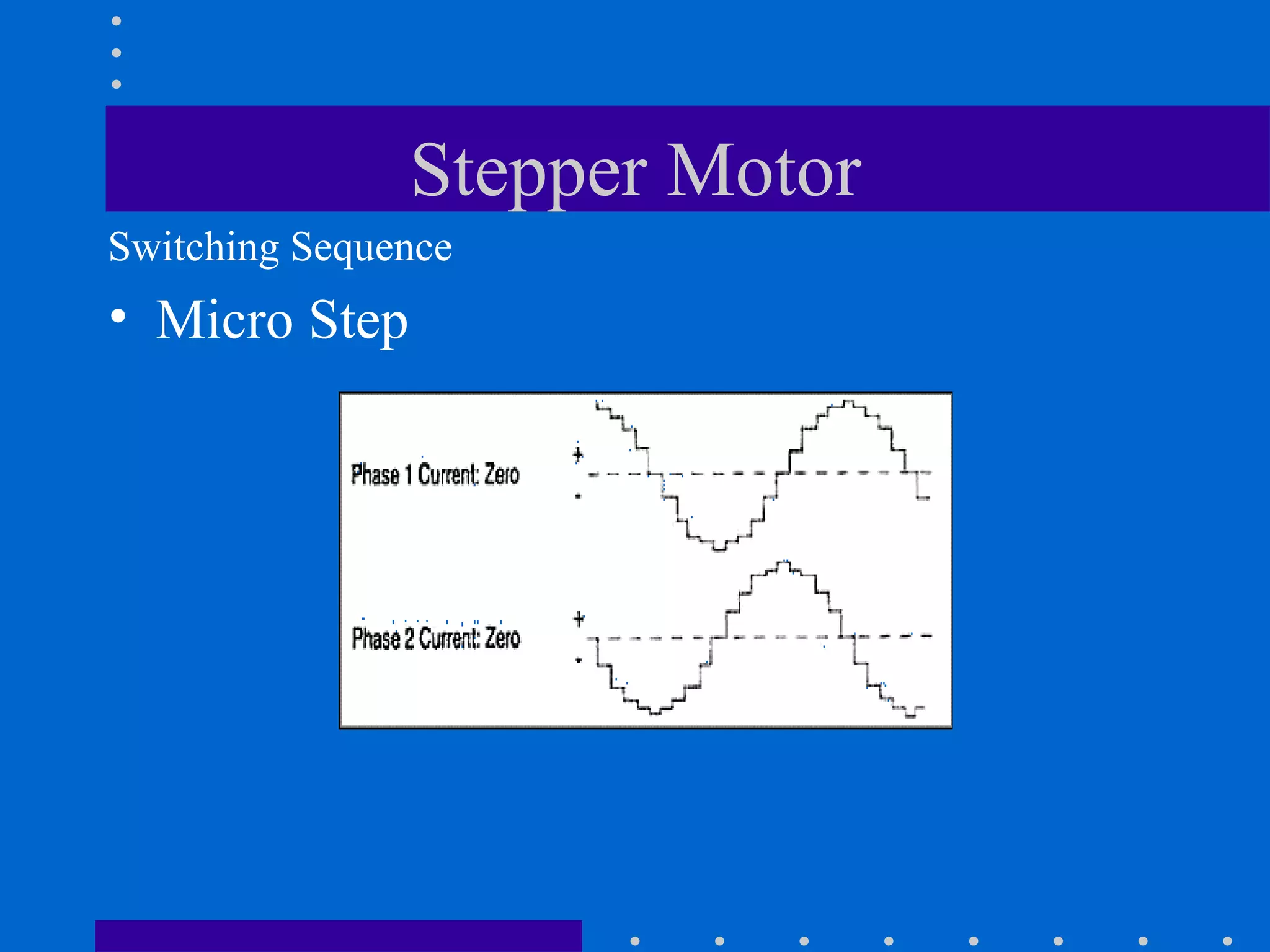
Stepper Motor Micro Step Switching Sequence
Linear Stepper Motors
Stepper Motor Coil Wind Transport Wafer Printer Wafer Slicing Application
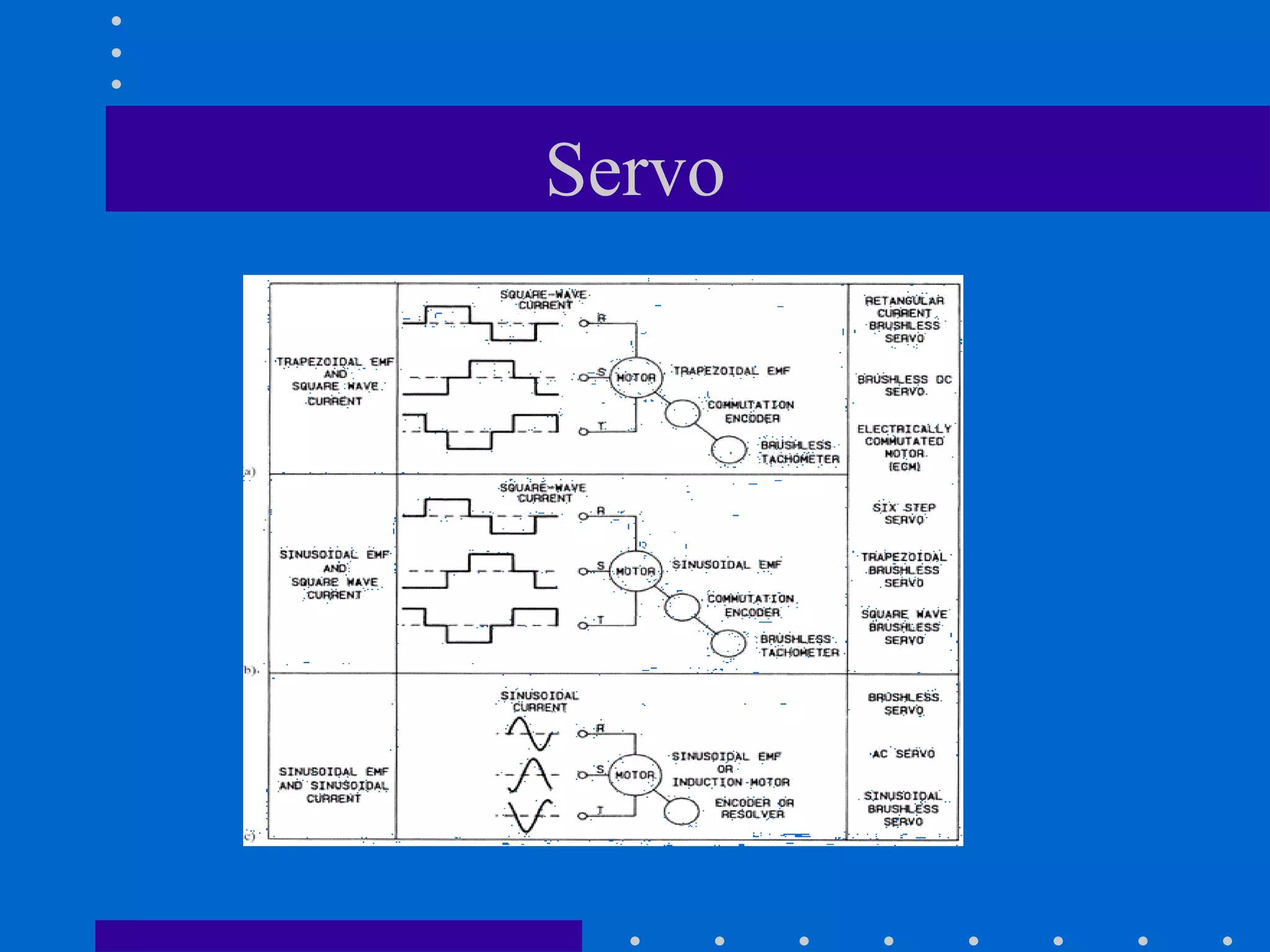
Servo With  Feedback SCR / Transistor Issue Cooling Fan
Servo
Servo

Motor Fundamental