Introduction To Electrical
Machines
Dr. Sameer Khader
Chapter 10
Single Phase Induction Motors
“S_Ph_lecture_10_1”
Intended Learning outcomes from this Chapter:
1. Studying the construction of Induction Machines (IM)
2. Classification of Induction machines ( M & G).
3. Understanding the concept of revolving field .
4. Studying the concept of Motor equivalent circuit
5. Studying the energy flow and mechanical performance.
6. Speed control of IM.
7. Starting of IM and testing of these motors.
Chapter 10: Induction Motors
10.1Single Phase Induction Motor
• The single-phase induction machine is the most
frequently used motor for refrigerators,
washing machines, clocks, drills, compressors,
pumps, and so forth.
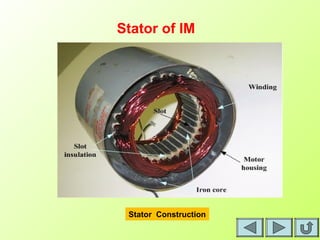
• The single-phase motor stator has a laminated
iron core with two windings arranged
perpendicularly.
• One is the main and the other is the auxiliary
winding or starting winding
Stator Construction
Stator of IM
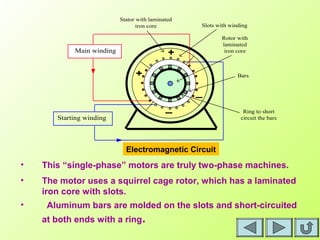
• This “single-phase” motors are truly two-phase machines.
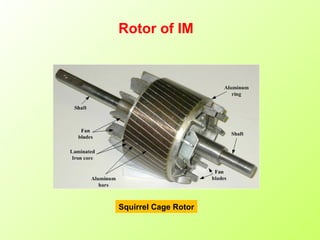
• The motor uses a squirrel cage rotor, which has a laminated
iron core with slots.
• Aluminum bars are molded on the slots and short-circuited
at both ends with a ring.
Stator with laminated
iron core Slots with winding
Bars
Ring to short
circuit the barsStarting winding
+
_
Main winding
Rotor with
laminated
iron core
+
_
Electromagnetic Circuit
Squirrel Cage Rotor
Rotor of IM
• The single-phase induction motor operation
can be described by two methods:
– Double revolving field theory; and
– Cross-field theory.
• Double revolving theory is perhaps the
easier of the two explanations to understand
• Learn the double revolving theory only
Principle Operating
Double Revolving Field Theory
• A single-phase ac current supplies the main
winding that produces a pulsating magnetic field.
• Mathematically, the pulsating field could be divided
into two fields, which are rotating in opposite
directions.
• The interaction between the fields and the current
induced in the rotor bars generates opposing
torque.
• Under these conditions, the net result torque will
be zero, which means that with only the main field
energized the motor will not start. In other words,
the pulsating field cannot produce starting torque,
and the motor remains in stall status.
• However, if an external torque moves the motor in any
direction, the motor will begin to rotate in that direction.
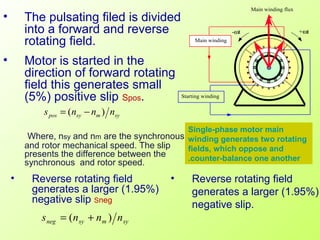
• The pulsating filed is divided
into a forward and reverse
rotating field.
• Motor is started in the
direction of forward rotating
field this generates small
(5%) positive slip Spos.
Where, nsy and nm are the synchronous
and rotor mechanical speed. The slip
presents the difference between the
synchronous and rotor speed.
Starting winding
Main winding
+ωt-ωt
Main winding flux
Single-phase motor main
winding generates two rotating
fields, which oppose and
counter-balance one another.
symsypos nnns )( −=
symsyneg nnns )( +=
• Reverse rotating field
generates a larger (1.95%)
negative slip Sneg
• Reverse rotating field
generates a larger (1.95%)
negative slip.
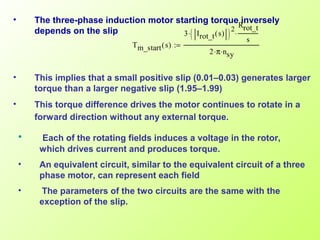
• The three-phase induction motor starting torque inversely
depends on the slip
• This implies that a small positive slip (0.01–0.03) generates larger
torque than a larger negative slip (1.95–1.99)
• This torque difference drives the motor continues to rotate in a
forward direction without any external torque.
Tm_start s( )
3 Irot_t s( )( )2
⋅
Rrot_t
s
⋅
2 π⋅ nsy⋅
:=
• Each of the rotating fields induces a voltage in the rotor,
which drives current and produces torque.
• An equivalent circuit, similar to the equivalent circuit of a three
phase motor, can represent each field
• The parameters of the two circuits are the same with the
exception of the slip.
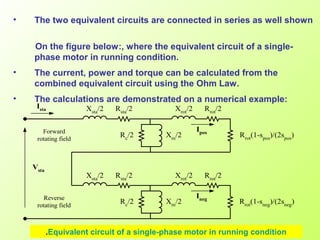
• The two equivalent circuits are connected in series as well shown
On the figure below:, where the equivalent circuit of a single-
phase motor in running condition.
• The current, power and torque can be calculated from the
combined equivalent circuit using the Ohm Law.
• The calculations are demonstrated on a numerical example:
Forward
rotating field
Xsta
/2
Vsta
Ista
Rrot
(1-spos
)/(2spos
)
Rsta
/2
Rc
/2 Xm
/2
Xrot
/2 Rrot
/2
Reverse
rotating field
Xsta
/2
Rrot
(1-sneg
)/(2sneg
)
Rsta
/2
Rc
/2 Xm
/2
Xrot
/2 Rrot
/2
Ipos
Ineg
Equivalent circuit of a single-phase motor in running condition.
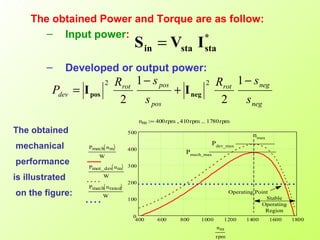
The obtained Power and Torque are as follow:
– Input power:
– Developed or output power:
*
stastain IVS =
neg
negrot
pos
posrot
dev
s
sR
s
sR
P
−
+
−
=
1
2
1
2
22
negpos II
The obtained
mechanical
performance
is illustrated
on the figure:
nm 400rpm 410rpm, 1780rpm..:=
400 600 800 1000 1200 1400 1600 1800
0
100
200
300
400
500
Pmech nm( )
W
Pmot_dev nm( )
W
Pmech nrated( )
W
nm
rpm
Pdev_max
nmax
Operating Point
Pmech_max
Stable
Operating
Region
To be continued
(See the next file: Single-phase_IM_Lecture_10_2
from chapter 10)

Single phase im-lecture_10_1

  • 1.
    Introduction To Electrical Machines Dr.Sameer Khader Chapter 10 Single Phase Induction Motors “S_Ph_lecture_10_1”
  • 2.
    Intended Learning outcomesfrom this Chapter: 1. Studying the construction of Induction Machines (IM) 2. Classification of Induction machines ( M & G). 3. Understanding the concept of revolving field . 4. Studying the concept of Motor equivalent circuit 5. Studying the energy flow and mechanical performance. 6. Speed control of IM. 7. Starting of IM and testing of these motors. Chapter 10: Induction Motors
  • 3.
    10.1Single Phase InductionMotor • The single-phase induction machine is the most frequently used motor for refrigerators, washing machines, clocks, drills, compressors, pumps, and so forth. • The single-phase motor stator has a laminated iron core with two windings arranged perpendicularly. • One is the main and the other is the auxiliary winding or starting winding
  • 4.
  • 5.
    • This “single-phase”motors are truly two-phase machines. • The motor uses a squirrel cage rotor, which has a laminated iron core with slots. • Aluminum bars are molded on the slots and short-circuited at both ends with a ring. Stator with laminated iron core Slots with winding Bars Ring to short circuit the barsStarting winding + _ Main winding Rotor with laminated iron core + _ Electromagnetic Circuit
  • 6.
  • 7.
    • The single-phaseinduction motor operation can be described by two methods: – Double revolving field theory; and – Cross-field theory. • Double revolving theory is perhaps the easier of the two explanations to understand • Learn the double revolving theory only Principle Operating
  • 8.
    Double Revolving FieldTheory • A single-phase ac current supplies the main winding that produces a pulsating magnetic field. • Mathematically, the pulsating field could be divided into two fields, which are rotating in opposite directions. • The interaction between the fields and the current induced in the rotor bars generates opposing torque. • Under these conditions, the net result torque will be zero, which means that with only the main field energized the motor will not start. In other words, the pulsating field cannot produce starting torque, and the motor remains in stall status. • However, if an external torque moves the motor in any direction, the motor will begin to rotate in that direction.
  • 9.
    • The pulsatingfiled is divided into a forward and reverse rotating field. • Motor is started in the direction of forward rotating field this generates small (5%) positive slip Spos. Where, nsy and nm are the synchronous and rotor mechanical speed. The slip presents the difference between the synchronous and rotor speed. Starting winding Main winding +ωt-ωt Main winding flux Single-phase motor main winding generates two rotating fields, which oppose and counter-balance one another. symsypos nnns )( −= symsyneg nnns )( += • Reverse rotating field generates a larger (1.95%) negative slip Sneg • Reverse rotating field generates a larger (1.95%) negative slip.
  • 10.
    • The three-phaseinduction motor starting torque inversely depends on the slip • This implies that a small positive slip (0.01–0.03) generates larger torque than a larger negative slip (1.95–1.99) • This torque difference drives the motor continues to rotate in a forward direction without any external torque. Tm_start s( ) 3 Irot_t s( )( )2 ⋅ Rrot_t s ⋅ 2 π⋅ nsy⋅ := • Each of the rotating fields induces a voltage in the rotor, which drives current and produces torque. • An equivalent circuit, similar to the equivalent circuit of a three phase motor, can represent each field • The parameters of the two circuits are the same with the exception of the slip.
  • 11.
    • The twoequivalent circuits are connected in series as well shown On the figure below:, where the equivalent circuit of a single- phase motor in running condition. • The current, power and torque can be calculated from the combined equivalent circuit using the Ohm Law. • The calculations are demonstrated on a numerical example: Forward rotating field Xsta /2 Vsta Ista Rrot (1-spos )/(2spos ) Rsta /2 Rc /2 Xm /2 Xrot /2 Rrot /2 Reverse rotating field Xsta /2 Rrot (1-sneg )/(2sneg ) Rsta /2 Rc /2 Xm /2 Xrot /2 Rrot /2 Ipos Ineg Equivalent circuit of a single-phase motor in running condition.
  • 12.
    The obtained Powerand Torque are as follow: – Input power: – Developed or output power: * stastain IVS = neg negrot pos posrot dev s sR s sR P − + − = 1 2 1 2 22 negpos II The obtained mechanical performance is illustrated on the figure: nm 400rpm 410rpm, 1780rpm..:= 400 600 800 1000 1200 1400 1600 1800 0 100 200 300 400 500 Pmech nm( ) W Pmot_dev nm( ) W Pmech nrated( ) W nm rpm Pdev_max nmax Operating Point Pmech_max Stable Operating Region
  • 13.
    To be continued (Seethe next file: Single-phase_IM_Lecture_10_2 from chapter 10)