
A 
SEMINAR ON 
“STEPPER MOTOR” 
BACHELOR OF TECHNOLOGY 
IN 
ELECTRICAL & ELECTRONICS ENGINEERING 
SUBMITTED 
BY 
PANKAJ CHAUDHARY 
R.N. - 24823 
UNDER THE SUPERVISION OF 
ARUNESH DUTT 
ASST. PROFESSOR 
DEPARTMENT OF ELECTRICAL & ELECTRONICS ENGINEERING 
SANJAY GANDHI INSTITUTE OF ENGINEERING & TECHNOLOGY 
NEHRU GRAM BHARATI UNIVERSITY, ALLAHABAD
CONTENTS 
 WHAT ’S A STEPPER MOTOR? 
 TYPES OF STEPPER MOT 
* PERMANENT MAGNET 
* VARIABLE RELUCTANCE 
* HYBRID 
 IDENTIFYING WIRES 
 FULL STEPPER MOTOR 
 HALF STEPPER MOTOR 
 STEPPER MOTOR EXAMPLE 
 APPLICATIONS 
….SGIET….
What’s a Stepper Motor? 
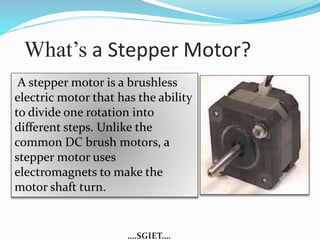
A stepper motor is a brushless 
electric motor that has the ability 
to divide one rotation into 
different steps. Unlike the 
common DC brush motors, a 
stepper motor uses 
electromagnets to make the 
motor shaft turn. 
….SGIET….
Stepper Motors 
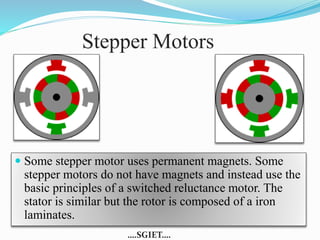
 Some stepper motor uses permanent magnets. Some 
stepper motors do not have magnets and instead use the 
basic principles of a switched reluctance motor. The 
stator is similar but the rotor is composed of a iron 
laminates. 
….SGIET….
DC STEPPER MOTORS 
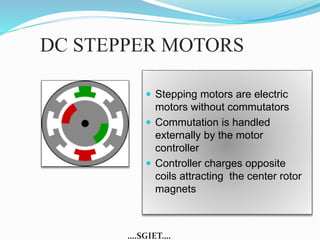
 Stepping motors are electric 
motors without commutators 
 Commutation is handled 
externally by the motor 
controller 
 Controller charges opposite 
coils attracting the center rotor 
magnets 
….SGIET….
DC STEPPER MOTORS 
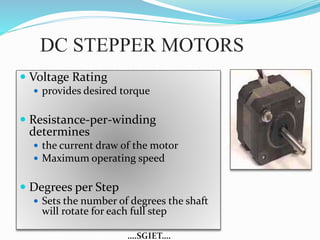
 Voltage Rating 
 provides desired torque 
 Resistance-per-winding 
determines 
 the current draw of the motor 
 Maximum operating speed 
 Degrees per Step 
 Sets the number of degrees the shaft 
will rotate for each full step 
….SGIET….
Types of Stepper Motors 
 Permanent Magnet 
 Variable Reluctance 
 Hybrid 
….SGIET….
Permanent Magnet Motors 
Permanent magnet motors use a permanent magnet (PM) in 
the rotor and operate on the attraction or repulsion 
between the rotor PM and the stator electromagnets 
….SGIET….
Variable Reluctance Motors 
Variable reluctance (VR) motors have a plain iron 
rotor and operate based on the principle that 
minimum reluctance occurs with minimum gap, 
hence the rotor points are attracted toward the 
stator magnet poles. 
….SGIET….
Hybrid Motors 
Hybrid stepper motors are named because they use a 
combination of PM and VR techniques to achieve 
maximum power in a small package size. 
….SGIET….
IDENTIFYING WIRES 
 Check make and model to see if wire colour code is 
available. 
 Observe the wires to see if you can identify groups of 3 
wires. 
 Measure resistance between wires . 
 Wire with lowest resistance is power wire. 
….SGIET….
Full Stepper Motor 
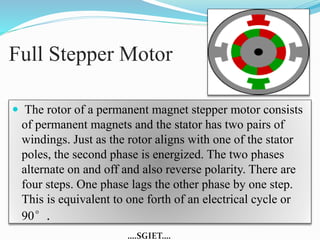
 The rotor of a permanent magnet stepper motor consists 
of permanent magnets and the stator has two pairs of 
windings. Just as the rotor aligns with one of the stator 
poles, the second phase is energized. The two phases 
alternate on and off and also reverse polarity. There are 
four steps. One phase lags the other phase by one step. 
This is equivalent to one forth of an electrical cycle or 
90°. 
….SGIET….
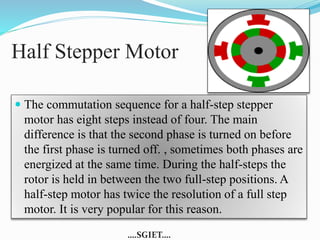
Half Stepper Motor 
 The commutation sequence for a half-step stepper 
motor has eight steps instead of four. The main 
difference is that the second phase is turned on before 
the first phase is turned off. , sometimes both phases are 
energized at the same time. During the half-steps the 
rotor is held in between the two full-step positions. A 
half-step motor has twice the resolution of a full step 
motor. It is very popular for this reason. 
….SGIET….
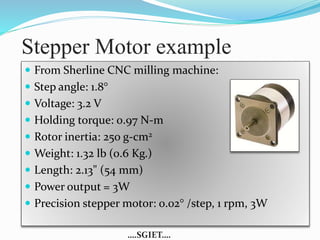
Stepper Motor example 
 From Sherline CNC milling machine: 
 Step angle: 1.8° 
 Voltage: 3.2 V 
 Holding torque: 0.97 N-m 
 Rotor inertia: 250 g-cm2 
 Weight: 1.32 lb (0.6 Kg.) 
 Length: 2.13" (54 mm) 
 Power output = 3W 
 Precision stepper motor: 0.02° /step, 1 rpm, 3W 
….SGIET….
Applications 
These are examples of OSM's (optimal stepper 
motor) Stepper Motor Application, Stepper motors 
are used in a wide variety of applications in industry, 
including computer peripherals, business machines, 
motion control, and robotics etc. 
….SGIET….
THANK YOU 
….SGIET….

Stepper motor by pankaj chaudhary

  • 1.
    A SEMINAR ON “STEPPER MOTOR” BACHELOR OF TECHNOLOGY IN ELECTRICAL & ELECTRONICS ENGINEERING SUBMITTED BY PANKAJ CHAUDHARY R.N. - 24823 UNDER THE SUPERVISION OF ARUNESH DUTT ASST. PROFESSOR DEPARTMENT OF ELECTRICAL & ELECTRONICS ENGINEERING SANJAY GANDHI INSTITUTE OF ENGINEERING & TECHNOLOGY NEHRU GRAM BHARATI UNIVERSITY, ALLAHABAD
  • 2.
    CONTENTS  WHAT’S A STEPPER MOTOR?  TYPES OF STEPPER MOT * PERMANENT MAGNET * VARIABLE RELUCTANCE * HYBRID  IDENTIFYING WIRES  FULL STEPPER MOTOR  HALF STEPPER MOTOR  STEPPER MOTOR EXAMPLE  APPLICATIONS ….SGIET….
  • 3.
    What’s a StepperMotor? A stepper motor is a brushless electric motor that has the ability to divide one rotation into different steps. Unlike the common DC brush motors, a stepper motor uses electromagnets to make the motor shaft turn. ….SGIET….
  • 4.
    Stepper Motors Some stepper motor uses permanent magnets. Some stepper motors do not have magnets and instead use the basic principles of a switched reluctance motor. The stator is similar but the rotor is composed of a iron laminates. ….SGIET….
  • 5.
    DC STEPPER MOTORS  Stepping motors are electric motors without commutators  Commutation is handled externally by the motor controller  Controller charges opposite coils attracting the center rotor magnets ….SGIET….
  • 6.
    DC STEPPER MOTORS  Voltage Rating  provides desired torque  Resistance-per-winding determines  the current draw of the motor  Maximum operating speed  Degrees per Step  Sets the number of degrees the shaft will rotate for each full step ….SGIET….
  • 7.
    Types of StepperMotors  Permanent Magnet  Variable Reluctance  Hybrid ….SGIET….
  • 8.
    Permanent Magnet Motors Permanent magnet motors use a permanent magnet (PM) in the rotor and operate on the attraction or repulsion between the rotor PM and the stator electromagnets ….SGIET….
  • 9.
    Variable Reluctance Motors Variable reluctance (VR) motors have a plain iron rotor and operate based on the principle that minimum reluctance occurs with minimum gap, hence the rotor points are attracted toward the stator magnet poles. ….SGIET….
  • 10.
    Hybrid Motors Hybridstepper motors are named because they use a combination of PM and VR techniques to achieve maximum power in a small package size. ….SGIET….
  • 11.
    IDENTIFYING WIRES Check make and model to see if wire colour code is available.  Observe the wires to see if you can identify groups of 3 wires.  Measure resistance between wires .  Wire with lowest resistance is power wire. ….SGIET….
  • 12.
    Full Stepper Motor  The rotor of a permanent magnet stepper motor consists of permanent magnets and the stator has two pairs of windings. Just as the rotor aligns with one of the stator poles, the second phase is energized. The two phases alternate on and off and also reverse polarity. There are four steps. One phase lags the other phase by one step. This is equivalent to one forth of an electrical cycle or 90°. ….SGIET….
  • 13.
    Half Stepper Motor  The commutation sequence for a half-step stepper motor has eight steps instead of four. The main difference is that the second phase is turned on before the first phase is turned off. , sometimes both phases are energized at the same time. During the half-steps the rotor is held in between the two full-step positions. A half-step motor has twice the resolution of a full step motor. It is very popular for this reason. ….SGIET….
  • 14.
    Stepper Motor example  From Sherline CNC milling machine:  Step angle: 1.8°  Voltage: 3.2 V  Holding torque: 0.97 N-m  Rotor inertia: 250 g-cm2  Weight: 1.32 lb (0.6 Kg.)  Length: 2.13" (54 mm)  Power output = 3W  Precision stepper motor: 0.02° /step, 1 rpm, 3W ….SGIET….
  • 15.
    Applications These areexamples of OSM's (optimal stepper motor) Stepper Motor Application, Stepper motors are used in a wide variety of applications in industry, including computer peripherals, business machines, motion control, and robotics etc. ….SGIET….
  • 16.