ICE 3015: CONTROL SYSTEM
COMPONENTS
Class 2: Servomotors – Basics &
Working
Dr. S. Meenatchisundaram
Email: meenasundar@gmail.com
Control System Components (ICE 3015)
Dr. S.Meenatchisundaram, MIT, Manipal, Aug – Nov 2018
Components:
• Consists of three basic components
— a controlled device (motor and driver circuit)
— a output sensor
— a feedback system.
• Controlled by a feedback signal instead of variable input signal.
• Reference signal (input or command signal) is compared with
sensor signal, and a third signal (error) produced.
• This third signal (error) acts as an input signal of controlled device.
• Primary task of a servomechanism is
to maintain the output of a system at the desired value in
the presence of disturbances.
Control System Components (ICE 3015)
Dr. S.Meenatchisundaram, MIT, Manipal, Aug – Nov 2018
Servomotors:
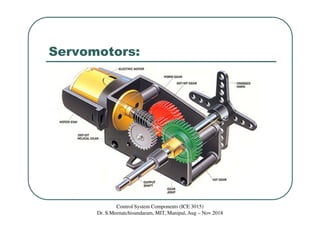
• Servomotors are special electromechanical devices that produce
precise degrees of rotation.
• A servomotor is a DC or AC or brushless DC motor combined
with a position sensing device.
• Servomotors are also called control motors as they are involved
in controlling a mechanical system.
• If the motor as controlled device, associated with
servomechanism is DC motor, then it is commonly known DC
Servo Motor.
• Servomotor is a special type of motor which is automatically
operated up to certain limit for a given command with help of
error-sensing feedback to correct the performance.
Control System Components (ICE 3015)
Dr. S.Meenatchisundaram, MIT, Manipal, Aug – Nov 2018
Servomotors:
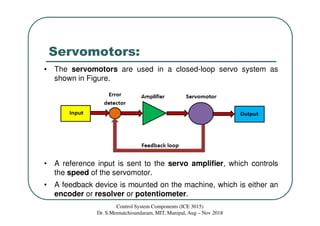
• The servomotors are used in a closed-loop servo system as
shown in Figure.
• A reference input is sent to the servo amplifier, which controls
the speed of the servomotor.
• A feedback device is mounted on the machine, which is either an
encoder or resolver or potentiometer.
Control System Components (ICE 3015)
Dr. S.Meenatchisundaram, MIT, Manipal, Aug – Nov 2018
Servomotors:
• This device changes mechanical motion into electrical signals
and is used as a feedback.
• This feedback is sent to the error detector, which compares the
actual operation with that of the reference input.
• If there is an error, that error is fed directly to the amplifier, which
will be used to make necessary corrections in control action.
• In many servo systems, both velocity and position are
monitored.
• Servomotors provide accurate speed, torque, and have ability of
direction control.
Control System Components (ICE 3015)
Dr. S.Meenatchisundaram, MIT, Manipal, Aug – Nov 2018
Servomotors:
Control System Components (ICE 3015)
Dr. S.Meenatchisundaram, MIT, Manipal, Aug – Nov 2018
Servo Motor Control:
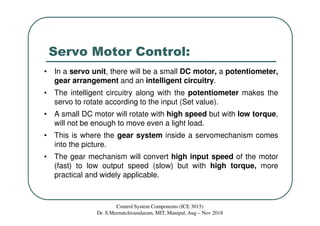
• In a servo unit, there will be a small DC motor, a potentiometer,
gear arrangement and an intelligent circuitry.
• The intelligent circuitry along with the potentiometer makes the
servo to rotate according to the input (Set value).
• A small DC motor will rotate with high speed but with low torque,
will not be enough to move even a light load.
• This is where the gear system inside a servomechanism comes
into the picture.
• The gear mechanism will convert high input speed of the motor
(fast) to low output speed (slow) but with high torque, more
practical and widely applicable.
Control System Components (ICE 3015)
Dr. S.Meenatchisundaram, MIT, Manipal, Aug – Nov 2018
Servo Motor Control:
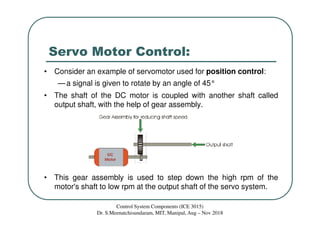
• Consider an example of servomotor used for position control:
—a signal is given to rotate by an angle of 45°
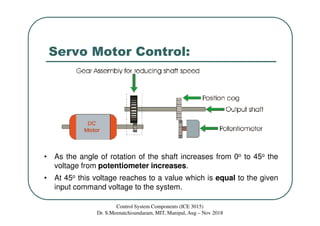
• The shaft of the DC motor is coupled with another shaft called
output shaft, with the help of gear assembly.
• This gear assembly is used to step down the high rpm of the
motor's shaft to low rpm at the output shaft of the servo system.
Control System Components (ICE 3015)
Dr. S.Meenatchisundaram, MIT, Manipal, Aug – Nov 2018
Servo Motor Control:
• The voltage adjusting knob of a potentiometer is so arranged with
the output shaft by means of another gear assembly.
• During rotation of the shaft, the knob also rotates and creates an
varying electrical potential according to the potentiometer.
• This signal i.e. electrical potential is increased with angular
movement of potentiometer knob along with the system shaft from
0°to 45°.
• This electrical potential or voltage is taken to the error detector
feedback amplifier along with the input reference commends i.e.
input signal voltage.
Control System Components (ICE 3015)
Dr. S.Meenatchisundaram, MIT, Manipal, Aug – Nov 2018
Servo Motor Control:
• As the angle of rotation of the shaft increases from 0o to 45o the
voltage from potentiometer increases.
• At 45o this voltage reaches to a value which is equal to the given
input command voltage to the system.
Control System Components (ICE 3015)
Dr. S.Meenatchisundaram, MIT, Manipal, Aug – Nov 2018
Servo Motor Control:
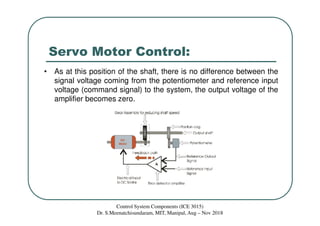
• As at this position of the shaft, there is no difference between the
signal voltage coming from the potentiometer and reference input
voltage (command signal) to the system, the output voltage of the
amplifier becomes zero.
Control System Components (ICE 3015)
Dr. S.Meenatchisundaram, MIT, Manipal, Aug – Nov 2018
Servo Motor Control:
• As per the picture given above the output electrical voltage signal
of the amplifier, acts as input voltage of the DC motor.
• Hence, the motor will stop rotating after the shaft rotates by 45o.
• The motor will be at this rest position until another command is
given to the system for further movement of the shaft in the
desired direction.
• NB: Although in practical servo motor control system,
instead of using simple potentiometer, digital or analog
position sensor encoders are used.
Control System Components (ICE 3015)
Dr. S.Meenatchisundaram, MIT, Manipal, Aug – Nov 2018
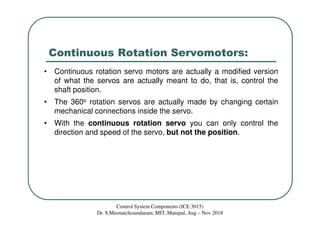
Continuous Rotation Servomotors:
• Continuous rotation servo motors are actually a modified version
of what the servos are actually meant to do, that is, control the
shaft position.
• The 360o rotation servos are actually made by changing certain
mechanical connections inside the servo.
• With the continuous rotation servo you can only control the
direction and speed of the servo, but not the position.
Control System Components (ICE 3015)
Dr. S.Meenatchisundaram, MIT, Manipal, Aug – Nov 2018
Feedback sensor:
Control System Components (ICE 3015)
Dr. S.Meenatchisundaram, MIT, Manipal, Aug – Nov 2018
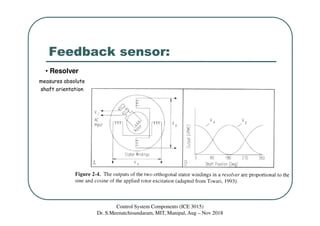
• Resolver
measures absolute
shaft orientation
Feedback sensor:
Control System Components (ICE 3015)
Dr. S.Meenatchisundaram, MIT, Manipal, Aug – Nov 2018
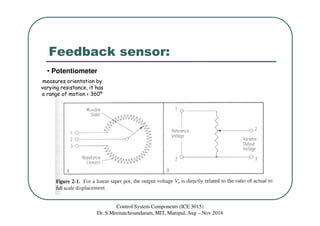
• Potentiometer
measures orientation by
varying resistance, it has
a range of motion < 360º
Feedback sensor:
Control System Components (ICE 3015)
Dr. S.Meenatchisundaram, MIT, Manipal, Aug – Nov 2018
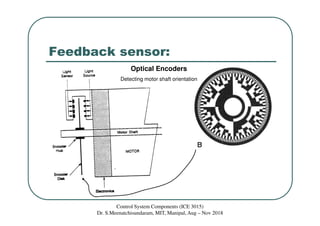
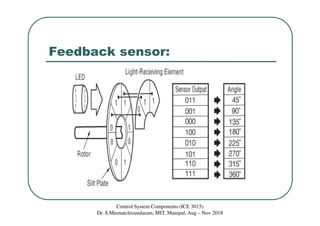
Optical Encoders
Detecting motor shaft orientation
Feedback sensor:
Control System Components (ICE 3015)
Dr. S.Meenatchisundaram, MIT, Manipal, Aug – Nov 2018
Summary:
• The shaft of the servo is connected to a potentiometer.
• The circuitry inside the servo, to which the potentiometer is
connected, knows the position of the servo.
• The current position will be compared with the desired position
continuously with the help of an Error Detection Amplifier.
• If a mismatch is found, then an error signal is provided at the
output of the error amplifier and the shaft will rotate to go the exact
location required.
• Once the desired location is reached, it stops and waits.
• Feedback sensor can be resolver or encoder or a potentiometer.
Control System Components (ICE 3015)
Dr. S.Meenatchisundaram, MIT, Manipal, Aug – Nov 2018
References:
• http://nptel.ac.in/courses/112103174/module4/lec2/2.html
• http://www.globalspec.com/reference/10801/179909/chapter-3-ac-
and-dc-motors-servomotors-general-principles-of-operation
• https://www.electrical4u.com/dc-servo-motors-theory-and-working-
principle/
Control System Components (ICE 3015)
Dr. S.Meenatchisundaram, MIT, Manipal, Aug – Nov 2018

Lecture 2 Servomotors - Basics & Working

  • 1.
    ICE 3015: CONTROLSYSTEM COMPONENTS Class 2: Servomotors – Basics & Working Dr. S. Meenatchisundaram Email: meenasundar@gmail.com Control System Components (ICE 3015) Dr. S.Meenatchisundaram, MIT, Manipal, Aug – Nov 2018
  • 2.
    Components: • Consists ofthree basic components — a controlled device (motor and driver circuit) — a output sensor — a feedback system. • Controlled by a feedback signal instead of variable input signal. • Reference signal (input or command signal) is compared with sensor signal, and a third signal (error) produced. • This third signal (error) acts as an input signal of controlled device. • Primary task of a servomechanism is to maintain the output of a system at the desired value in the presence of disturbances. Control System Components (ICE 3015) Dr. S.Meenatchisundaram, MIT, Manipal, Aug – Nov 2018
  • 3.
    Servomotors: • Servomotors arespecial electromechanical devices that produce precise degrees of rotation. • A servomotor is a DC or AC or brushless DC motor combined with a position sensing device. • Servomotors are also called control motors as they are involved in controlling a mechanical system. • If the motor as controlled device, associated with servomechanism is DC motor, then it is commonly known DC Servo Motor. • Servomotor is a special type of motor which is automatically operated up to certain limit for a given command with help of error-sensing feedback to correct the performance. Control System Components (ICE 3015) Dr. S.Meenatchisundaram, MIT, Manipal, Aug – Nov 2018
  • 4.
    Servomotors: • The servomotorsare used in a closed-loop servo system as shown in Figure. • A reference input is sent to the servo amplifier, which controls the speed of the servomotor. • A feedback device is mounted on the machine, which is either an encoder or resolver or potentiometer. Control System Components (ICE 3015) Dr. S.Meenatchisundaram, MIT, Manipal, Aug – Nov 2018
  • 5.
    Servomotors: • This devicechanges mechanical motion into electrical signals and is used as a feedback. • This feedback is sent to the error detector, which compares the actual operation with that of the reference input. • If there is an error, that error is fed directly to the amplifier, which will be used to make necessary corrections in control action. • In many servo systems, both velocity and position are monitored. • Servomotors provide accurate speed, torque, and have ability of direction control. Control System Components (ICE 3015) Dr. S.Meenatchisundaram, MIT, Manipal, Aug – Nov 2018
  • 6.
    Servomotors: Control System Components(ICE 3015) Dr. S.Meenatchisundaram, MIT, Manipal, Aug – Nov 2018
  • 7.
    Servo Motor Control: •In a servo unit, there will be a small DC motor, a potentiometer, gear arrangement and an intelligent circuitry. • The intelligent circuitry along with the potentiometer makes the servo to rotate according to the input (Set value). • A small DC motor will rotate with high speed but with low torque, will not be enough to move even a light load. • This is where the gear system inside a servomechanism comes into the picture. • The gear mechanism will convert high input speed of the motor (fast) to low output speed (slow) but with high torque, more practical and widely applicable. Control System Components (ICE 3015) Dr. S.Meenatchisundaram, MIT, Manipal, Aug – Nov 2018
  • 8.
    Servo Motor Control: •Consider an example of servomotor used for position control: —a signal is given to rotate by an angle of 45° • The shaft of the DC motor is coupled with another shaft called output shaft, with the help of gear assembly. • This gear assembly is used to step down the high rpm of the motor's shaft to low rpm at the output shaft of the servo system. Control System Components (ICE 3015) Dr. S.Meenatchisundaram, MIT, Manipal, Aug – Nov 2018
  • 9.
    Servo Motor Control: •The voltage adjusting knob of a potentiometer is so arranged with the output shaft by means of another gear assembly. • During rotation of the shaft, the knob also rotates and creates an varying electrical potential according to the potentiometer. • This signal i.e. electrical potential is increased with angular movement of potentiometer knob along with the system shaft from 0°to 45°. • This electrical potential or voltage is taken to the error detector feedback amplifier along with the input reference commends i.e. input signal voltage. Control System Components (ICE 3015) Dr. S.Meenatchisundaram, MIT, Manipal, Aug – Nov 2018
  • 10.
    Servo Motor Control: •As the angle of rotation of the shaft increases from 0o to 45o the voltage from potentiometer increases. • At 45o this voltage reaches to a value which is equal to the given input command voltage to the system. Control System Components (ICE 3015) Dr. S.Meenatchisundaram, MIT, Manipal, Aug – Nov 2018
  • 11.
    Servo Motor Control: •As at this position of the shaft, there is no difference between the signal voltage coming from the potentiometer and reference input voltage (command signal) to the system, the output voltage of the amplifier becomes zero. Control System Components (ICE 3015) Dr. S.Meenatchisundaram, MIT, Manipal, Aug – Nov 2018
  • 12.
    Servo Motor Control: •As per the picture given above the output electrical voltage signal of the amplifier, acts as input voltage of the DC motor. • Hence, the motor will stop rotating after the shaft rotates by 45o. • The motor will be at this rest position until another command is given to the system for further movement of the shaft in the desired direction. • NB: Although in practical servo motor control system, instead of using simple potentiometer, digital or analog position sensor encoders are used. Control System Components (ICE 3015) Dr. S.Meenatchisundaram, MIT, Manipal, Aug – Nov 2018
  • 13.
    Continuous Rotation Servomotors: •Continuous rotation servo motors are actually a modified version of what the servos are actually meant to do, that is, control the shaft position. • The 360o rotation servos are actually made by changing certain mechanical connections inside the servo. • With the continuous rotation servo you can only control the direction and speed of the servo, but not the position. Control System Components (ICE 3015) Dr. S.Meenatchisundaram, MIT, Manipal, Aug – Nov 2018
  • 14.
    Feedback sensor: Control SystemComponents (ICE 3015) Dr. S.Meenatchisundaram, MIT, Manipal, Aug – Nov 2018 • Resolver measures absolute shaft orientation
  • 15.
    Feedback sensor: Control SystemComponents (ICE 3015) Dr. S.Meenatchisundaram, MIT, Manipal, Aug – Nov 2018 • Potentiometer measures orientation by varying resistance, it has a range of motion < 360º
  • 16.
    Feedback sensor: Control SystemComponents (ICE 3015) Dr. S.Meenatchisundaram, MIT, Manipal, Aug – Nov 2018 Optical Encoders Detecting motor shaft orientation
  • 17.
    Feedback sensor: Control SystemComponents (ICE 3015) Dr. S.Meenatchisundaram, MIT, Manipal, Aug – Nov 2018
  • 18.
    Summary: • The shaftof the servo is connected to a potentiometer. • The circuitry inside the servo, to which the potentiometer is connected, knows the position of the servo. • The current position will be compared with the desired position continuously with the help of an Error Detection Amplifier. • If a mismatch is found, then an error signal is provided at the output of the error amplifier and the shaft will rotate to go the exact location required. • Once the desired location is reached, it stops and waits. • Feedback sensor can be resolver or encoder or a potentiometer. Control System Components (ICE 3015) Dr. S.Meenatchisundaram, MIT, Manipal, Aug – Nov 2018
  • 19.
    References: • http://nptel.ac.in/courses/112103174/module4/lec2/2.html • http://www.globalspec.com/reference/10801/179909/chapter-3-ac- and-dc-motors-servomotors-general-principles-of-operation •https://www.electrical4u.com/dc-servo-motors-theory-and-working- principle/ Control System Components (ICE 3015) Dr. S.Meenatchisundaram, MIT, Manipal, Aug – Nov 2018