WELCOME
STEPPER MOTOR
                 By
       LALKISHORE PRASD
Electrical & Electronics Department
Introduction

Capable of motion in precise increments
converts electronic pulses into
 proportionate mechanical movement
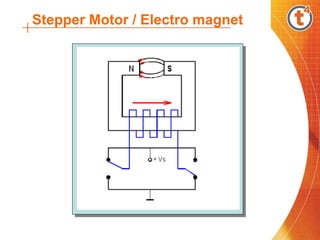
Stepper Motor / Electro magnet
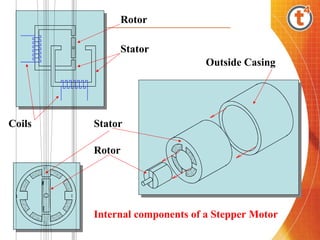
Rotor

                        Stator
                                       Outside Casing


Coils           Stator

                Rotor
        1


        N

 2          2


        S
                Internal components of a Stepper Motor
        1
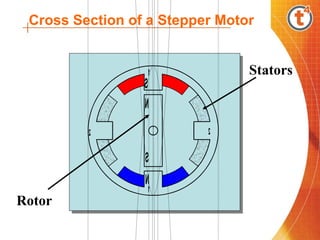
Cross Section of a Stepper Motor


                 1              Stators
                 S
                 N

         2                2


                 S
                 N
                 1
Rotor
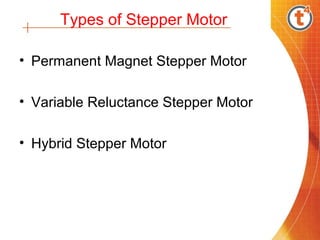
Types of Stepper Motor

• Permanent Magnet Stepper Motor

• Variable Reluctance Stepper Motor

• Hybrid Stepper Motor
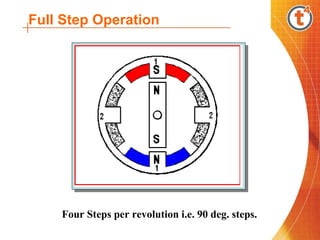
Full Step Operation


    Four Steps per revolution i.e. 90 deg. steps.
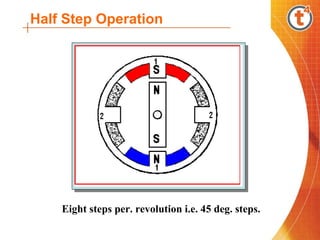
Half Step Operation


    Eight steps per. revolution i.e. 45 deg. steps.
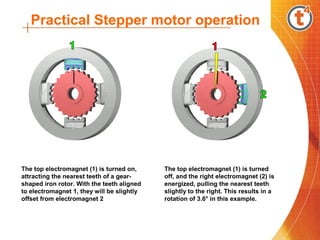
Practical Stepper motor operation


The top electromagnet (1) is turned on,     The top electromagnet (1) is turned
attracting the nearest teeth of a gear-     off, and the right electromagnet (2) is
shaped iron rotor. With the teeth aligned   energized, pulling the nearest teeth
to electromagnet 1, they will be slightly   slightly to the right. This results in a
offset from electromagnet 2                 rotation of 3.6° in this example.
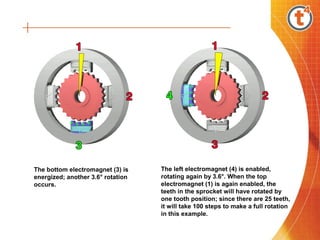
The bottom electromagnet (3) is    The left electromagnet (4) is enabled,
energized; another 3.6° rotation   rotating again by 3.6°. When the top
occurs.                            electromagnet (1) is again enabled, the
                                   teeth in the sprocket will have rotated by
                                   one tooth position; since there are 25 teeth,
                                   it will take 100 steps to make a full rotation
                                   in this example.
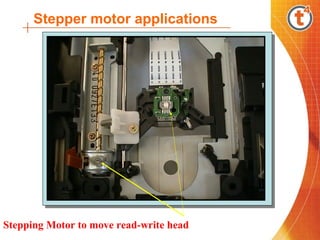
Stepper motor applications


Stepping Motor to move read-write head
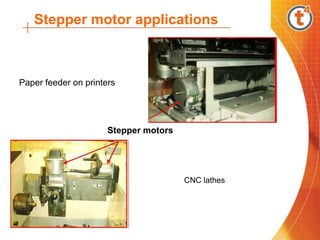
Stepper motor applications


Paper feeder on printers


                      Stepper motors


                                       CNC lathes
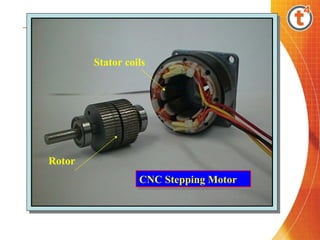
Stator coils


Rotor
                  CNC Stepping Motor
                  CNC Stepping Motor
Advantages / Disadvantages
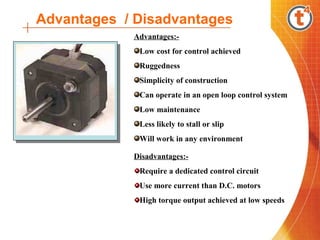
            Advantages:-
             Low cost for control achieved
             Ruggedness
             Simplicity of construction
             Can operate in an open loop control system
             Low maintenance
             Less likely to stall or slip
             Will work in any environment

            Disadvantages:-
             Require a dedicated control circuit
             Use more current than D.C. motors
             High torque output achieved at low speeds
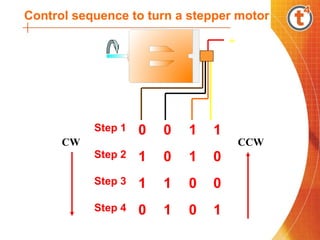
Control sequence to turn a stepper motor
                                    +


           Step 1   0   0   1   1
      CW                                CCW
           Step 2   1   0   1   0
           Step 3   1   1   0   0
           Step 4   0   1   0   1
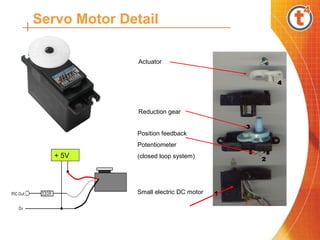
Servo Motor Detail

               Actuator


               Reduction gear


               Position feedback
               Potentiometer
   + 5V        (closed loop system)


               Small electric DC motor

Stepper motor site

  • 1.
  • 2.
    STEPPER MOTOR By LALKISHORE PRASD Electrical & Electronics Department
  • 3.
    Introduction Capable of motionin precise increments converts electronic pulses into proportionate mechanical movement
  • 4.
    Stepper Motor /Electro magnet
  • 5.
    Rotor Stator Outside Casing Coils Stator Rotor 1 N 2 2 S Internal components of a Stepper Motor 1
  • 6.
    Cross Section ofa Stepper Motor 1 Stators S N 2 2 S N 1 Rotor
  • 8.
    Types of StepperMotor • Permanent Magnet Stepper Motor • Variable Reluctance Stepper Motor • Hybrid Stepper Motor
  • 9.
    Full Step Operation Four Steps per revolution i.e. 90 deg. steps.
  • 10.
    Half Step Operation Eight steps per. revolution i.e. 45 deg. steps.
  • 11.
    Practical Stepper motoroperation The top electromagnet (1) is turned on, The top electromagnet (1) is turned attracting the nearest teeth of a gear- off, and the right electromagnet (2) is shaped iron rotor. With the teeth aligned energized, pulling the nearest teeth to electromagnet 1, they will be slightly slightly to the right. This results in a offset from electromagnet 2 rotation of 3.6° in this example.
  • 12.
    The bottom electromagnet(3) is The left electromagnet (4) is enabled, energized; another 3.6° rotation rotating again by 3.6°. When the top occurs. electromagnet (1) is again enabled, the teeth in the sprocket will have rotated by one tooth position; since there are 25 teeth, it will take 100 steps to make a full rotation in this example.
  • 13.
    Stepper motor applications SteppingMotor to move read-write head
  • 14.
    Stepper motor applications Paperfeeder on printers Stepper motors CNC lathes
  • 15.
    Stator coils Rotor CNC Stepping Motor CNC Stepping Motor
  • 16.
    Advantages / Disadvantages Advantages:- Low cost for control achieved Ruggedness Simplicity of construction Can operate in an open loop control system Low maintenance Less likely to stall or slip Will work in any environment Disadvantages:- Require a dedicated control circuit Use more current than D.C. motors High torque output achieved at low speeds
  • 17.
    Control sequence toturn a stepper motor + Step 1 0 0 1 1 CW CCW Step 2 1 0 1 0 Step 3 1 1 0 0 Step 4 0 1 0 1
  • 18.
    Servo Motor Detail Actuator Reduction gear Position feedback Potentiometer + 5V (closed loop system) Small electric DC motor