Servomotor
Presented by
Mr. C.S.Satheesh, M.E.,
Assistant Professor, Department of EEE,
Muthayammal Engineering College (Autonomous),
Namakkal (Dt), Rasipuram – 637408.
MUTHAYAMMAL ENGINEERING COLLEGE
(An Autonomous Institution)
(Approved by AICTE, New Delhi, Accredited by NAAC, NBA & Affiliated to Anna University),
Rasipuram - 637 408, Namakkal Dist., Tamil Nadu, India.
Servo motor
 Servo Motor are also called Control motors.
 They are used in feedback control systems as output actuators and
does not use for continuous energy conversion.
 A servomotor is a rotary actuator or linear actuator that allows for
precise control of angular or linear position, velocity and
acceleration.
 The principle of the Servomotor is similar to that of the other
electromagnetic motor, but the construction and the operation are
different.
 The rotor inertia of the motors is low and have a high speed of
response.
 The rotor of the Motor has the long length and smaller diameter.
They operate at very low speed and sometimes even at the zero
speed.
 The power rating of the servo motor may vary from the fraction of
watts to few hundreds of watts.
 The rotor of servo motor have low inertia strength, and therefore
they have a high speed of inertia.
Applications of the Servo Motor
 They are used in Radar system and process
controller.
 Servomotors are used in computers and robotics.
 They are also used in machine tools.
 Tracking and guidance systems.
Classification of Servo Motor
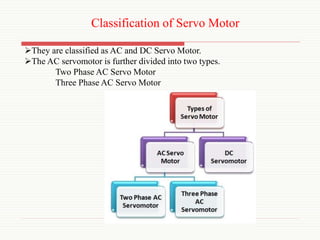
They are classified as AC and DC Servo Motor.
The AC servomotor is further divided into two types.
Two Phase AC Servo Motor
Three Phase AC Servo Motor
DC Servo Motor
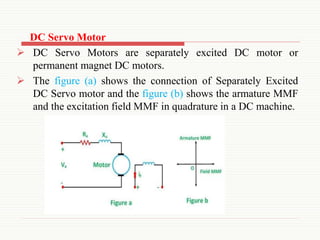
 DC Servo Motors are separately excited DC motor or
permanent magnet DC motors.
 The figure (a) shows the connection of Separately Excited
DC Servo motor and the figure (b) shows the armature MMF
and the excitation field MMF in quadrature in a DC machine.
 This provides a fast torque response because torque and flux are
decoupled. Therefore, a small change in the armature voltage or current
brings a significant shift in the position or speed of the rotor. Most of the
high power servo motors are mainly DC.
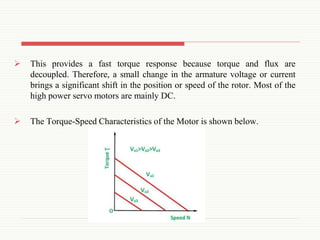
 The Torque-Speed Characteristics of the Motor is shown below.
 As from the above characteristics, it is seen that the slope is
negative. Thus, a negative slope provides viscous damping for the
servo drive system.
AC Servo Motor
 The AC Servo Motors are divided into two types 2 and 3 Phase AC
servomotor. Most of the AC servomotor are of the two-phase
squirrel cage induction motor type.
 They are used for low power applications. The three phase squirrel
cage induction motor is now utilized for the applications where
high power system is required
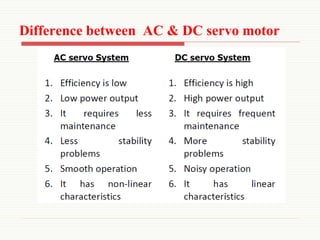
Difference between AC & DC servo motor
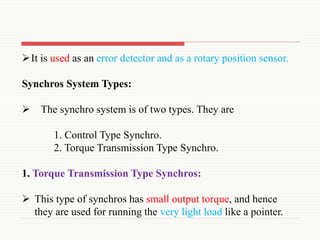
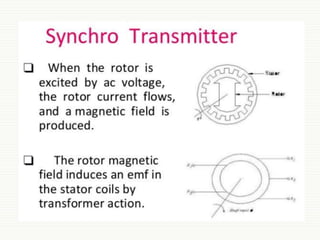
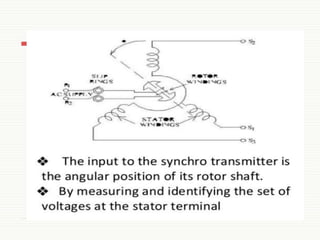
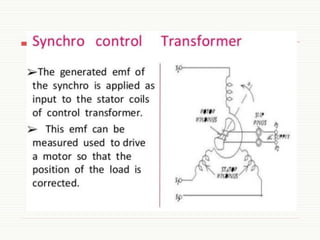
It is used as an error detector and as a rotary position sensor.
Synchros System Types:
 The synchro system is of two types. They are
1. Control Type Synchro.
2. Torque Transmission Type Synchro.
1. Torque Transmission Type Synchros:
 This type of synchros has small output torque, and hence
they are used for running the very light load like a pointer.
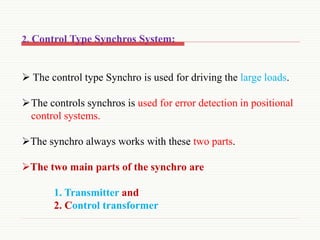
2. Control Type Synchros System:
 The control type Synchro is used for driving the large loads.
The controls synchros is used for error detection in positional
control systems.
The synchro always works with these two parts.
The two main parts of the synchro are
1. Transmitter and
2. Control transformer
Advantages of using a Synchro
Synchro's have a low failure rate.
Synchros and resolvers have a very long life expectancy
as they are inductive devices.
As soon as transmission is engaged, the Synchro will align
to the correct positioning and therefore is self-
synchronising.
No mechanical stops.
References :
 A.Nagoorkani, Control Systems,
RBA Publications.
17
Thank You
18

Servomotor

  • 1.
    Servomotor Presented by Mr. C.S.Satheesh,M.E., Assistant Professor, Department of EEE, Muthayammal Engineering College (Autonomous), Namakkal (Dt), Rasipuram – 637408. MUTHAYAMMAL ENGINEERING COLLEGE (An Autonomous Institution) (Approved by AICTE, New Delhi, Accredited by NAAC, NBA & Affiliated to Anna University), Rasipuram - 637 408, Namakkal Dist., Tamil Nadu, India.
  • 2.
    Servo motor  ServoMotor are also called Control motors.  They are used in feedback control systems as output actuators and does not use for continuous energy conversion.  A servomotor is a rotary actuator or linear actuator that allows for precise control of angular or linear position, velocity and acceleration.  The principle of the Servomotor is similar to that of the other electromagnetic motor, but the construction and the operation are different.
  • 3.
     The rotorinertia of the motors is low and have a high speed of response.  The rotor of the Motor has the long length and smaller diameter. They operate at very low speed and sometimes even at the zero speed.  The power rating of the servo motor may vary from the fraction of watts to few hundreds of watts.  The rotor of servo motor have low inertia strength, and therefore they have a high speed of inertia.
  • 4.
    Applications of theServo Motor  They are used in Radar system and process controller.  Servomotors are used in computers and robotics.  They are also used in machine tools.  Tracking and guidance systems.
  • 5.
    Classification of ServoMotor They are classified as AC and DC Servo Motor. The AC servomotor is further divided into two types. Two Phase AC Servo Motor Three Phase AC Servo Motor
  • 6.
    DC Servo Motor DC Servo Motors are separately excited DC motor or permanent magnet DC motors.  The figure (a) shows the connection of Separately Excited DC Servo motor and the figure (b) shows the armature MMF and the excitation field MMF in quadrature in a DC machine.
  • 7.
     This providesa fast torque response because torque and flux are decoupled. Therefore, a small change in the armature voltage or current brings a significant shift in the position or speed of the rotor. Most of the high power servo motors are mainly DC.  The Torque-Speed Characteristics of the Motor is shown below.
  • 8.
     As fromthe above characteristics, it is seen that the slope is negative. Thus, a negative slope provides viscous damping for the servo drive system. AC Servo Motor  The AC Servo Motors are divided into two types 2 and 3 Phase AC servomotor. Most of the AC servomotor are of the two-phase squirrel cage induction motor type.  They are used for low power applications. The three phase squirrel cage induction motor is now utilized for the applications where high power system is required
  • 9.
    Difference between AC& DC servo motor
  • 11.
    It is usedas an error detector and as a rotary position sensor. Synchros System Types:  The synchro system is of two types. They are 1. Control Type Synchro. 2. Torque Transmission Type Synchro. 1. Torque Transmission Type Synchros:  This type of synchros has small output torque, and hence they are used for running the very light load like a pointer.
  • 12.
    2. Control TypeSynchros System:  The control type Synchro is used for driving the large loads. The controls synchros is used for error detection in positional control systems. The synchro always works with these two parts. The two main parts of the synchro are 1. Transmitter and 2. Control transformer
  • 16.
    Advantages of usinga Synchro Synchro's have a low failure rate. Synchros and resolvers have a very long life expectancy as they are inductive devices. As soon as transmission is engaged, the Synchro will align to the correct positioning and therefore is self- synchronising. No mechanical stops.
  • 17.
    References :  A.Nagoorkani,Control Systems, RBA Publications. 17
  • 18.