Relays
 A relay is an electrically operated switch
 All electrical relays have one thing in common--they
control things where it is inconvenient or impossible
for a person to flip a switch. For example, electrical
relays are used to turn on the motor to open an
automatic garage door, as well as to turn on a furnace.
Relay vs H bridge
 A "double pole double throw" relay can generally
achieve the same electrical functionality as an H-
bridge, but an H-bridge would be preferable where a
smaller physical size is needed, high speed switching,
low driving voltage, or where the wearing out of
mechanical parts is undesirable.
H Bridge
 It is an electronic circuit which enables a voltage to be
applied across a load in either direction.
 It allows a circuit full control over a standard electric
DC motor. That is, with an H-bridge, a
microcontroller, logic chip, or remote control can
electronically command the motor to go forward,
reverse, brake, and coast.
 H-bridges are available as integrated circuits, or can be
built from discrete components.
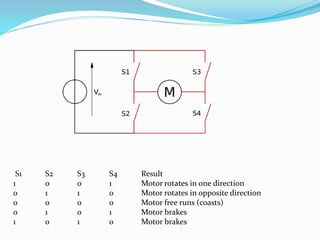
 The term "H-bridge" is derived from the typical
graphical representation of such a circuit, which is
built with four switches, either solid-state (eg, L293/
L298) or mechanical (eg, relays).
S1 S2 S3 S4 Result
1 0 0 1 Motor rotates in one direction
0 1 1 0 Motor rotates in opposite direction
0 0 0 0 Motor free runs (coasts)
0 1 0 1 Motor brakes
1 0 1 0 Motor brakes
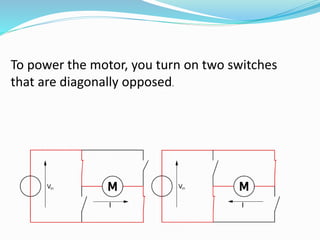
To power the motor, you turn on two switches
that are diagonally opposed.
Need
 The current provided by the MCU is of the order of
5mA and that required by a motor is ~500mA. Hence,
motor can’t be controlled directly by MCU and we
need an interface between the MCU and the motor.
 A Motor Driver IC like L293D or L298 is used for this
purpose which has two H-bridge drivers. Hence, each
IC can drive two motors
 Note that a motor driver does not amplify the current;
it only acts as a switch (An H bridge is nothing but 4
switches).
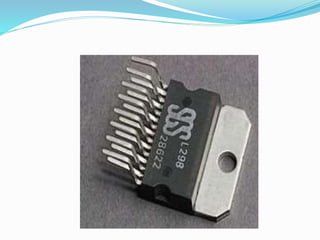
L293 vs L298
 L293 is quadruple half-H driver while L298 is dual full-H
driver, i.e, in L293 all four input- output lines are
independent while in L298, a half H driver cannot be used
independently, only full H driver has to be used.
 Output current per channel = 1A for L293 and 2A for L298.
Hence, heat sink is provided in L298.
 Protective Diodes against back EMF are provided internally
in L293D but must be provided externally in L298.
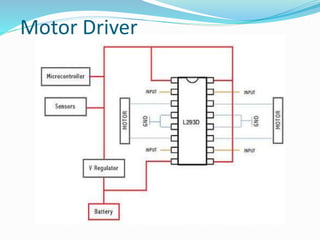
Motor Driver
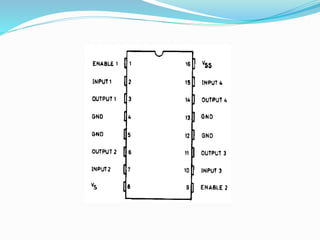
 Drivers are enabled in pairs, with drivers 1 and 2 being
enabled by the Enable pin. When an enable input is high
(logic 1 or +5V), the associated drivers are enabled and their
outputs are active and in phase with their inputs.
 When the enable pin is low, the output is neither high nor
low (disconnected), irrespective of the input.
 Direction of the motor is controlled by asserting one of the
inputs to motor to be high (logic 1) and the other to be low
(logic 0).
 To move the motor in opposite direction just interchange
the logic applied to the two inputs of the motors.
 Asserting both inputs to logic high or logic low will
stop the motor.
 Difference between L293NE and L293D: Output
current per channel = 1A for L293 and 600mA for
L293D.
 Vs is used to power the motors while Vss powers the
L293NE.
Speed Control:
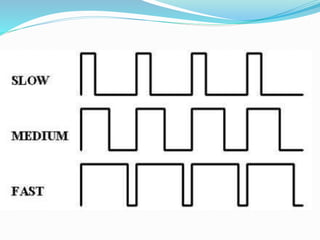
 To control motor speed we can use pulse width
modulation (PWM), applied to the enable pins of L293
driver.
 PWM is the scheme in which the duty cycle of a square
wave output from the microcontroller is varied to
provide a varying average DC output.
 What actually happens by applying a PWM pulse is
that the motor is switched ON and OFF at a given
frequency. In this way, the motor reacts to the time
average of the power supply
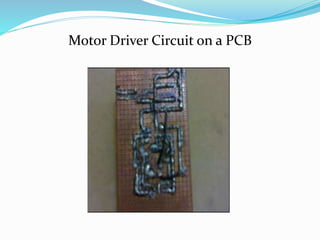
Motor Driver Circuit on a PCB

Motor driver

  • 2.
    Relays  A relayis an electrically operated switch  All electrical relays have one thing in common--they control things where it is inconvenient or impossible for a person to flip a switch. For example, electrical relays are used to turn on the motor to open an automatic garage door, as well as to turn on a furnace.
  • 3.
    Relay vs Hbridge  A "double pole double throw" relay can generally achieve the same electrical functionality as an H- bridge, but an H-bridge would be preferable where a smaller physical size is needed, high speed switching, low driving voltage, or where the wearing out of mechanical parts is undesirable.
  • 4.
    H Bridge  Itis an electronic circuit which enables a voltage to be applied across a load in either direction.  It allows a circuit full control over a standard electric DC motor. That is, with an H-bridge, a microcontroller, logic chip, or remote control can electronically command the motor to go forward, reverse, brake, and coast.
  • 5.
     H-bridges areavailable as integrated circuits, or can be built from discrete components.  The term "H-bridge" is derived from the typical graphical representation of such a circuit, which is built with four switches, either solid-state (eg, L293/ L298) or mechanical (eg, relays).
  • 6.
    S1 S2 S3S4 Result 1 0 0 1 Motor rotates in one direction 0 1 1 0 Motor rotates in opposite direction 0 0 0 0 Motor free runs (coasts) 0 1 0 1 Motor brakes 1 0 1 0 Motor brakes
  • 7.
    To power themotor, you turn on two switches that are diagonally opposed.
  • 8.
    Need  The currentprovided by the MCU is of the order of 5mA and that required by a motor is ~500mA. Hence, motor can’t be controlled directly by MCU and we need an interface between the MCU and the motor.  A Motor Driver IC like L293D or L298 is used for this purpose which has two H-bridge drivers. Hence, each IC can drive two motors
  • 9.
     Note thata motor driver does not amplify the current; it only acts as a switch (An H bridge is nothing but 4 switches).
  • 11.
    L293 vs L298 L293 is quadruple half-H driver while L298 is dual full-H driver, i.e, in L293 all four input- output lines are independent while in L298, a half H driver cannot be used independently, only full H driver has to be used.  Output current per channel = 1A for L293 and 2A for L298. Hence, heat sink is provided in L298.  Protective Diodes against back EMF are provided internally in L293D but must be provided externally in L298.
  • 12.
  • 14.
     Drivers areenabled in pairs, with drivers 1 and 2 being enabled by the Enable pin. When an enable input is high (logic 1 or +5V), the associated drivers are enabled and their outputs are active and in phase with their inputs.  When the enable pin is low, the output is neither high nor low (disconnected), irrespective of the input.  Direction of the motor is controlled by asserting one of the inputs to motor to be high (logic 1) and the other to be low (logic 0).  To move the motor in opposite direction just interchange the logic applied to the two inputs of the motors.
  • 15.
     Asserting bothinputs to logic high or logic low will stop the motor.  Difference between L293NE and L293D: Output current per channel = 1A for L293 and 600mA for L293D.  Vs is used to power the motors while Vss powers the L293NE.
  • 16.
    Speed Control:  Tocontrol motor speed we can use pulse width modulation (PWM), applied to the enable pins of L293 driver.  PWM is the scheme in which the duty cycle of a square wave output from the microcontroller is varied to provide a varying average DC output.
  • 17.
     What actuallyhappens by applying a PWM pulse is that the motor is switched ON and OFF at a given frequency. In this way, the motor reacts to the time average of the power supply
  • 20.