SERVO MOTORS
PREPARED BY:
MERAJ AKHTAR
JAHANGIRABAD INSTITUTE OF
TECHNOLOGY,BARABANKI
•A Servo is a small device that has an output shaft.
• This shaft can be positioned to specific angular positions
by sending the servo a coded signal.
• As long as the coded signal exists on the input line, the
servo will maintain the angular position of the shaft.
• As the coded signal changes, the angular position of the
shaft changes.
Definition
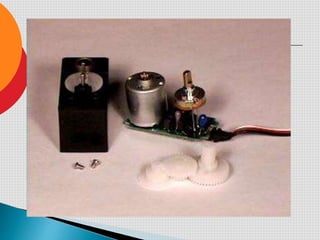
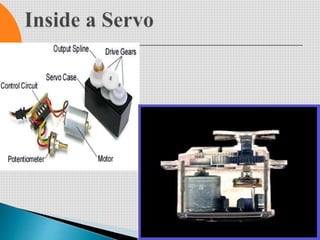
Servo motors and are constructed out of basic DC
motors, by adding:
• some gear reduction
• a position sensor for the motor shaft
• an electronic circuit that controls the motor's
operation
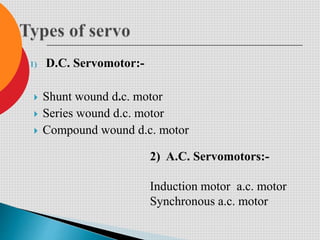
1) D.C. Servomotor:-
 Shunt wound d.c. motor
 Series wound d.c. motor
 Compound wound d.c. motor
2) A.C. Servomotors:-
Induction motor a.c. motor
Synchronous a.c. motor
 DC servo motors are controlled by DC command
signals applied directly to coils
 The magnetic fields that are formed interact with
permanent magnets and cause the rotating member to
turn
 One type of PM uses a wound armature and brushes
like a conventional DC motor, but uses magnets as
pole pieces
 Another type uses wound field coils and a permanent
magnet rotor
 Controlled by AC command signals applied to the
coils
 AC Brushless Servo Motor
◦ Operates on the same principle as single-phase induction
motor
AC Servomotors
•It is a two phase a.c. induction motor. There are two
winding, one fixed or reference winding is supplied
with a fixed voltage and frequency from a constant
voltage source. Second winding is called control
winding, with variable supply voltage of same
frequency.
•The stator has two distributed windings displaced 90
electrical degree apart.
•One winding is the reference phase and is connected
to a constant voltage source.
•The other winding is the control phase and is
supplied with a variable voltage of the same
frequency as the reference phase but is phase-
displaced by 90 electrical degree.
 The two major advantages of using a SERVO
MOTOR in sewing machines and other machines in
the sewing operation are that, one can always control
the speed of the motor and that they are completely
silent when the pedal is not engaged.
 The other advantages include:
 They consume up to 90% less energy than
clutch motors.
 1/3 times lighter than clutch motors
 Reverse motor rotation with the flick of a
switch
 Adjusted speed remains the same no matter
how hard the pedal is pressed.
 Position control
• Speed control

Unit 2 servo motor

  • 1.
    SERVO MOTORS PREPARED BY: MERAJAKHTAR JAHANGIRABAD INSTITUTE OF TECHNOLOGY,BARABANKI
  • 2.
    •A Servo isa small device that has an output shaft. • This shaft can be positioned to specific angular positions by sending the servo a coded signal. • As long as the coded signal exists on the input line, the servo will maintain the angular position of the shaft. • As the coded signal changes, the angular position of the shaft changes. Definition
  • 4.
    Servo motors andare constructed out of basic DC motors, by adding: • some gear reduction • a position sensor for the motor shaft • an electronic circuit that controls the motor's operation
  • 6.
    1) D.C. Servomotor:- Shunt wound d.c. motor  Series wound d.c. motor  Compound wound d.c. motor 2) A.C. Servomotors:- Induction motor a.c. motor Synchronous a.c. motor
  • 7.
     DC servomotors are controlled by DC command signals applied directly to coils  The magnetic fields that are formed interact with permanent magnets and cause the rotating member to turn  One type of PM uses a wound armature and brushes like a conventional DC motor, but uses magnets as pole pieces  Another type uses wound field coils and a permanent magnet rotor
  • 8.
     Controlled byAC command signals applied to the coils  AC Brushless Servo Motor ◦ Operates on the same principle as single-phase induction motor
  • 9.
    AC Servomotors •It isa two phase a.c. induction motor. There are two winding, one fixed or reference winding is supplied with a fixed voltage and frequency from a constant voltage source. Second winding is called control winding, with variable supply voltage of same frequency. •The stator has two distributed windings displaced 90 electrical degree apart.
  • 10.
    •One winding isthe reference phase and is connected to a constant voltage source. •The other winding is the control phase and is supplied with a variable voltage of the same frequency as the reference phase but is phase- displaced by 90 electrical degree.
  • 11.
     The twomajor advantages of using a SERVO MOTOR in sewing machines and other machines in the sewing operation are that, one can always control the speed of the motor and that they are completely silent when the pedal is not engaged.
  • 12.
     The otheradvantages include:  They consume up to 90% less energy than clutch motors.  1/3 times lighter than clutch motors  Reverse motor rotation with the flick of a switch  Adjusted speed remains the same no matter how hard the pedal is pressed.
  • 13.