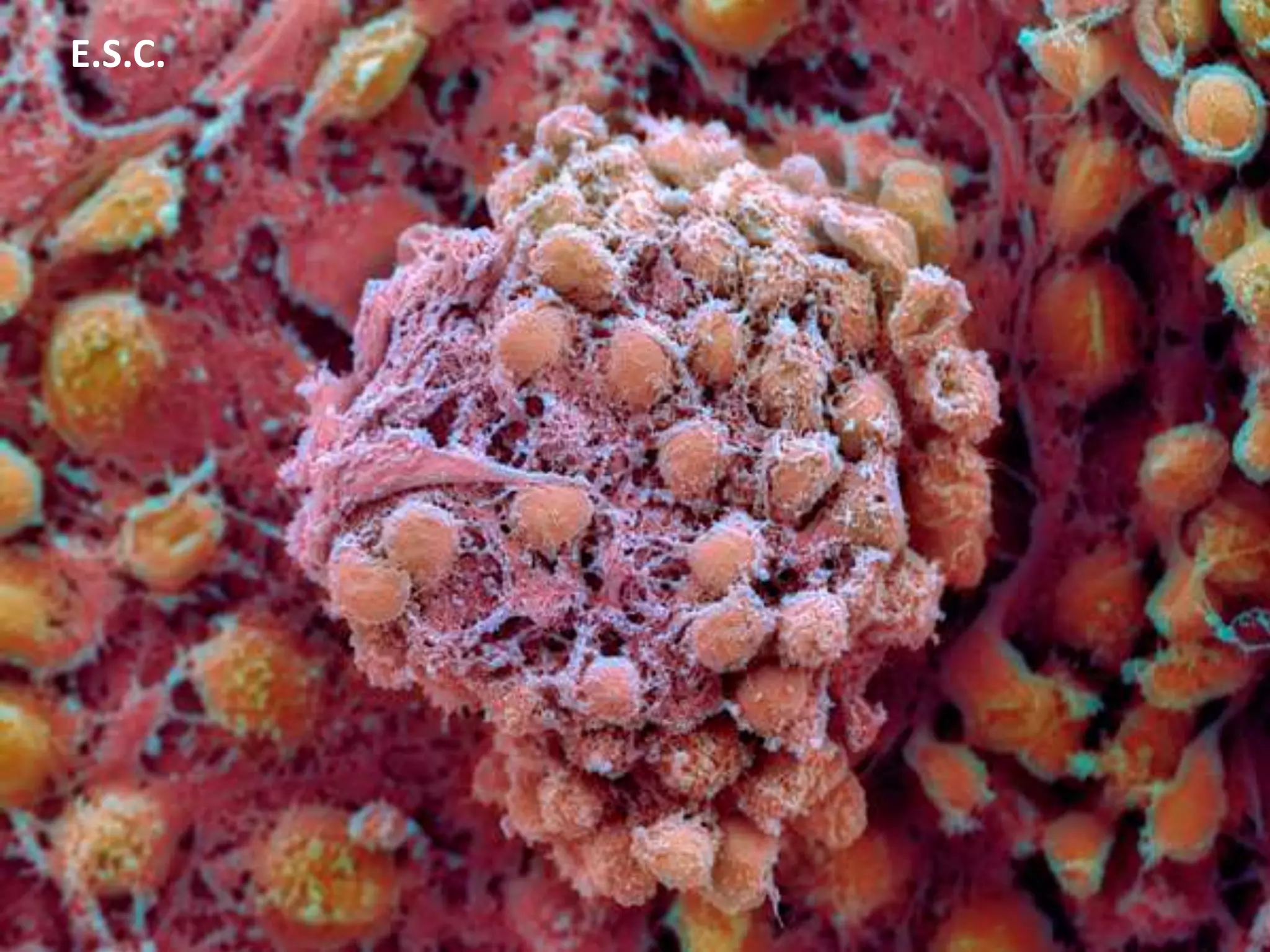
E.S.C.
Stem Cells
The Therapeutic Potential
Ahmad A. Al-Qudah
Supervisor
Prof. Laila F. Nimri
Stem Cells
Something Old, Something New, Something Borrowed
- Stem Cells Definition .
- Stem Cells Classifications ( Source , Potency ) .
- Induced Stem Cells .
- Stem Cells Operations :
- Stem Cells Transplantation .
- Stem Cells Transfusion .
- Differences .
- Stem Cells Testing and Cross matching .
- Stem Cells Treatment .
- Abstract .
- Stem Cell Technologies Bright Future .
- Bibliography .
Stem Cells Definition
- Cells that has the ability to continuously divide and differentiate
(develop) into various other kind(s) of cells & tissues . Found in
all multicellular organisms .
- Characteristics of Stem Cells :
- Self-renewal : ability to go through numerous cycles of cell division .
- Potency : the capacity to differentiate into specialized cell types .
- Repair : return function to damaged cells in the living organisms .
Stem Cells Classifications
( Source , Potency )
- Potency : A measure of how many types of specialized cell a stem
cell can make .
- Based on Potency , Stem cells can be classified into the
following :
1 – Totipotent : can develop into a new individual.
2 – Pluripotent : can form any cell types .
3 – Multipotent : Can make multiple types of specialized cells.
- Based on Source , Stem cells can be classified into this
tow major Types :
1- Embryonic Stem Cells . ( Totipotent )
2- Adult Stem Cell .
- Hematopoietic stem Cells .
- Mesenchymal stem cells .
- Neural stem cells .
- Intestinal stem cells .
- Endothelial stem cells .
Stem Cells Classifications
( Source , Potency )
- Stem Cell : A
- Progenitor Cell : B
- differentiated cell : C
Adult stem cells:
Haematopoietic stem cells (HSCs)
HSC
committed progenitors
neutrophil
NK cell
erythrocytes
dendritic cell
plateletsmegakaryocyte
macrophage
eosinophil
basophil
B cell
T cell
specialized cells
Adult stem cells:
Neural stem cells (NSCs)
NSC
committed progenitors specialized cells
Neurons
Interneurons
Oligodendrocytes
Type 2 Astrocytes
Type 1 Astrocytes
Adult stem cells:
Mesenchymal stem cells (MSCs)
MSC
committed progenitors
Bone (osteoblasts)
Cartilage (chondrocytes)
Fat (adipocytes)
specialized cells
Induced Stem Cells
- Stem cells artificially derived from some other cell types , by
epigenetic reprogramming.
- In accordance to the developmental potentiality , ISC’s
subdivides into :
- Induced Totipotent
- Induced progenitor stem cells ( iPSC )
- Induced neural stem cells ( iNSC )
Stem Cells Operations
- Transplantation :
- Term used when we replace organ with complete new organ from the
donor . ( ex. Kidney , Heart Transplantation ) .
- Stem Cells Transplantation .
Stem Cells Operations
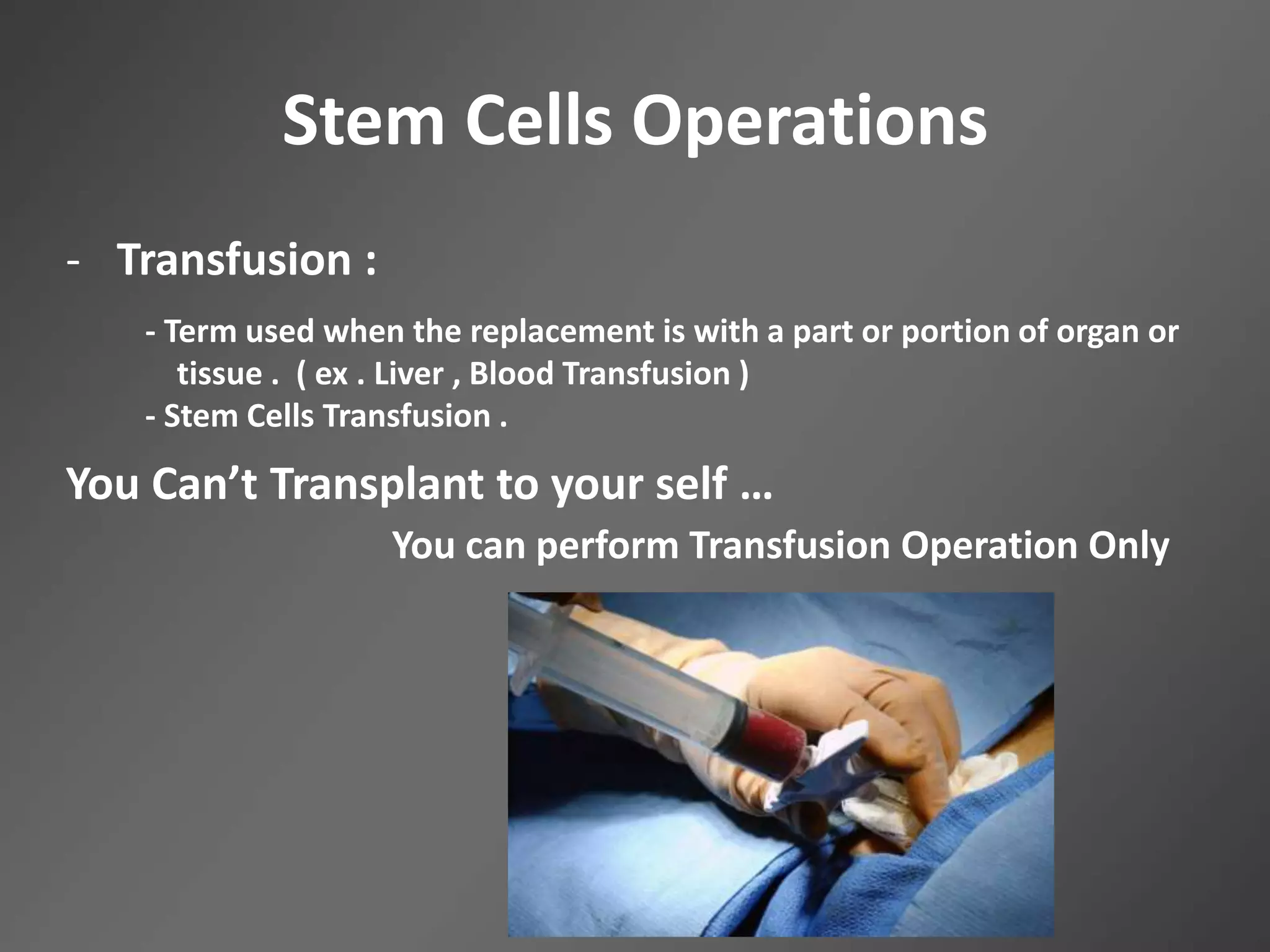
- Transfusion :
- Term used when the replacement is with a part or portion of organ or
tissue . ( ex . Liver , Blood Transfusion )
- Stem Cells Transfusion .
You Can’t Transplant to your self …
You can perform Transfusion Operation Only
Stem Cells Testing and Cross matching
- Preimplantation HLA testing :
 The (healthy) donor and the (patient) recipient , must have
a tissue (HLA) type that matches each other .
 Perfect match is preferred , to avoid any type of rejection .
(HLA-identical)
 When matching is good or less , the recipient will take
immunosuppressive medications.
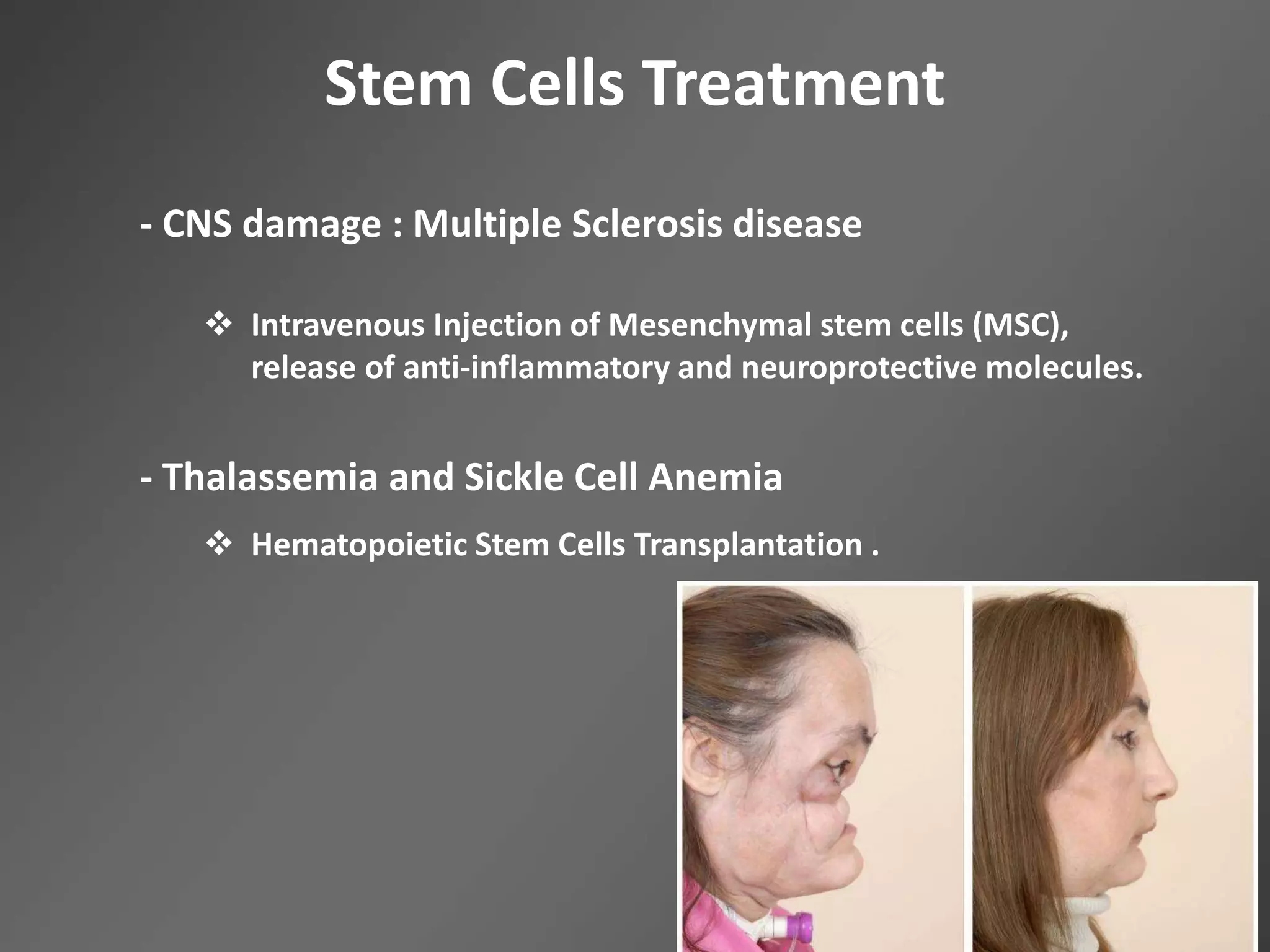
Stem Cells Treatment
Potential treatments :
- Brain damage : Alzheimer's disease
 Use of Stem Cells for Neuroreplacement , producing neural cells in
the brain using both Neural and Mesenchymal stem cell
Transplantation .
- Spinal cord injury :
 Korean researchers , transplanted Multipotent adult stem cells
from umbilical cord blood to a patient suffering from a spinal cord
injury. she walk on her own.
- CNS damage : Multiple Sclerosis disease
Stem Cells Treatment
 Intravenous Injection of Mesenchymal stem cells (MSC),
release of anti-inflammatory and neuroprotective molecules.
- Thalassemia and Sickle Cell Anemia
 Hematopoietic Stem Cells Transplantation .
Abstract
In recent years, there has been an explosion of interest in stem
cells, not just within the scientific and medical communities but
also among politicians, religious groups and ethicists.
There is still much to be learned about Stem Cells . There is
a growing realization of the importance of environmental
factors in regulating stem cell behavior and this is being
explored by imaging stem cells in vivo and recreating artificial
niches in vitro.
New therapies, based on stem cell transplantation, are
emerging research areas, as is drug discovery based on patient-
specific pluripotent cells and cancer stem cells.
What makes stem cell research so exciting is its tremendous
potentials to benefit human health and the opportunities for
interdisciplinary research that it presents.
Stem Cell Technologies Bright Future
Stem Cells Therapy in cancer
Bibliography
• Mesenchymal stem cells as treatment for MS
Uccelli A, Laroni A, Freedman MS.
• The therapeutic potential of stem cells
Fiona M. Watt* and Ryan R. Driskell
PMCID: PMC2842697
• How to approach Alzheimer's disease therapy using stem cell technologies.
Sugaya K, Merchant S.
J Alzheimers Dis. 2008 Oct;15(2):241-54.
• Hematopoietic Stem Cell Transplantation in Thalassemia and Sickle Cell Anemia
Guido Lucarelli, Antonella Isgrò, Pietro Sodani, and Javid Gaziev
• Genetic modification of stem cells for cardiac, diabetic, and hemophilia
transplantation therapies.
Phillips MI, Tang Y.
• Preimplantation HLA testing.
Verlinsky Y, Rechitsky S, Sharapova T, Morris R, Taranissi M, Kuliev A.
Stem cells

Stem cells

  • 1.
  • 2.
    Stem Cells The TherapeuticPotential Ahmad A. Al-Qudah Supervisor Prof. Laila F. Nimri
  • 3.
    Stem Cells Something Old,Something New, Something Borrowed - Stem Cells Definition . - Stem Cells Classifications ( Source , Potency ) . - Induced Stem Cells . - Stem Cells Operations : - Stem Cells Transplantation . - Stem Cells Transfusion . - Differences . - Stem Cells Testing and Cross matching . - Stem Cells Treatment . - Abstract . - Stem Cell Technologies Bright Future . - Bibliography .
  • 4.
    Stem Cells Definition -Cells that has the ability to continuously divide and differentiate (develop) into various other kind(s) of cells & tissues . Found in all multicellular organisms . - Characteristics of Stem Cells : - Self-renewal : ability to go through numerous cycles of cell division . - Potency : the capacity to differentiate into specialized cell types . - Repair : return function to damaged cells in the living organisms .
  • 5.
    Stem Cells Classifications (Source , Potency ) - Potency : A measure of how many types of specialized cell a stem cell can make . - Based on Potency , Stem cells can be classified into the following : 1 – Totipotent : can develop into a new individual. 2 – Pluripotent : can form any cell types . 3 – Multipotent : Can make multiple types of specialized cells.
  • 6.
    - Based onSource , Stem cells can be classified into this tow major Types : 1- Embryonic Stem Cells . ( Totipotent ) 2- Adult Stem Cell . - Hematopoietic stem Cells . - Mesenchymal stem cells . - Neural stem cells . - Intestinal stem cells . - Endothelial stem cells . Stem Cells Classifications ( Source , Potency ) - Stem Cell : A - Progenitor Cell : B - differentiated cell : C
  • 8.
    Adult stem cells: Haematopoieticstem cells (HSCs) HSC committed progenitors neutrophil NK cell erythrocytes dendritic cell plateletsmegakaryocyte macrophage eosinophil basophil B cell T cell specialized cells
  • 9.
    Adult stem cells: Neuralstem cells (NSCs) NSC committed progenitors specialized cells Neurons Interneurons Oligodendrocytes Type 2 Astrocytes Type 1 Astrocytes
  • 10.
    Adult stem cells: Mesenchymalstem cells (MSCs) MSC committed progenitors Bone (osteoblasts) Cartilage (chondrocytes) Fat (adipocytes) specialized cells
  • 11.
    Induced Stem Cells -Stem cells artificially derived from some other cell types , by epigenetic reprogramming. - In accordance to the developmental potentiality , ISC’s subdivides into : - Induced Totipotent - Induced progenitor stem cells ( iPSC ) - Induced neural stem cells ( iNSC )
  • 12.
    Stem Cells Operations -Transplantation : - Term used when we replace organ with complete new organ from the donor . ( ex. Kidney , Heart Transplantation ) . - Stem Cells Transplantation .
  • 13.
    Stem Cells Operations -Transfusion : - Term used when the replacement is with a part or portion of organ or tissue . ( ex . Liver , Blood Transfusion ) - Stem Cells Transfusion . You Can’t Transplant to your self … You can perform Transfusion Operation Only
  • 14.
    Stem Cells Testingand Cross matching - Preimplantation HLA testing :  The (healthy) donor and the (patient) recipient , must have a tissue (HLA) type that matches each other .  Perfect match is preferred , to avoid any type of rejection . (HLA-identical)  When matching is good or less , the recipient will take immunosuppressive medications.
  • 15.
    Stem Cells Treatment Potentialtreatments : - Brain damage : Alzheimer's disease  Use of Stem Cells for Neuroreplacement , producing neural cells in the brain using both Neural and Mesenchymal stem cell Transplantation . - Spinal cord injury :  Korean researchers , transplanted Multipotent adult stem cells from umbilical cord blood to a patient suffering from a spinal cord injury. she walk on her own.
  • 16.
    - CNS damage: Multiple Sclerosis disease Stem Cells Treatment  Intravenous Injection of Mesenchymal stem cells (MSC), release of anti-inflammatory and neuroprotective molecules. - Thalassemia and Sickle Cell Anemia  Hematopoietic Stem Cells Transplantation .
  • 17.
    Abstract In recent years,there has been an explosion of interest in stem cells, not just within the scientific and medical communities but also among politicians, religious groups and ethicists. There is still much to be learned about Stem Cells . There is a growing realization of the importance of environmental factors in regulating stem cell behavior and this is being explored by imaging stem cells in vivo and recreating artificial niches in vitro. New therapies, based on stem cell transplantation, are emerging research areas, as is drug discovery based on patient- specific pluripotent cells and cancer stem cells. What makes stem cell research so exciting is its tremendous potentials to benefit human health and the opportunities for interdisciplinary research that it presents.
  • 18.
    Stem Cell TechnologiesBright Future Stem Cells Therapy in cancer
  • 19.
    Bibliography • Mesenchymal stemcells as treatment for MS Uccelli A, Laroni A, Freedman MS. • The therapeutic potential of stem cells Fiona M. Watt* and Ryan R. Driskell PMCID: PMC2842697 • How to approach Alzheimer's disease therapy using stem cell technologies. Sugaya K, Merchant S. J Alzheimers Dis. 2008 Oct;15(2):241-54. • Hematopoietic Stem Cell Transplantation in Thalassemia and Sickle Cell Anemia Guido Lucarelli, Antonella Isgrò, Pietro Sodani, and Javid Gaziev • Genetic modification of stem cells for cardiac, diabetic, and hemophilia transplantation therapies. Phillips MI, Tang Y. • Preimplantation HLA testing. Verlinsky Y, Rechitsky S, Sharapova T, Morris R, Taranissi M, Kuliev A.

Editor's Notes

  • #9 Tissue stem cells: Haematopoietic stem cells (HSCs) HSCs = blood stem cells HSCs are isolated from the bone marrow. They give rise to committed progenitors, which then give rise to all specialized blood cell types.
  • #10 Tissue stem cells: Neural stem cells (NSCs) NSCs are isolated from specific areas of the brain. They give rise to committed progenitors, which then give rise to all specialized brain cell types.
  • #11 Tissue stem cells: Mesenchymal stem cells (MSCs) MSCs are isolated from the bone marrow. They give rise to committed progenitors, which then give rise to all specialized mesenchymal cell types (bone, cartilage, fat).