Ahmad A. Al-Qudah
LM755 - ADVANCED DIAGNOSTIC IMMUNOHEMATOLOGY AND BLOOD BANKING
Cross transfusion and Compatibility
- Pretransfusion Testing .
- Pretransfusion testing elements :
- ABO & Rh
- Antibody Screening
- Cross Matching
- Antibody Identification .
- Special Techniques in Ab Identification :
- Elution
- Hemagglutination inhibition
- Titration
Pretransfusion Testing
History
- After Landsteiner described the ABO .
- Crossmatch :
- Major Crossmatch : Recipient Serum + Donor RBCs.
- Minor Crossmatch : Recipient RBCs + Donor Plasma (not required by AABB)
- RT ( IS Phase ) IgM , then Rh (IgG) and detection at various
Temperatures with or without enhancements .
Pretransfusion Testing
- To select blood components that will not cause harm to the
recipient and will have acceptable survival when transfused.
- ABO compatibility , Rh compatibility , clinically significant
Antibody Screening and Identification .
Indirect Antiglobulin Test Phases
- Immediate Spin ( IS ) Phase at Room Temperature .
Detection of ABO incompatibility and Cold Antibody (M,N, Lea+b,P1)
- 37° with Enhancement media (LISS)
Allows IgG and other complement to bind to RBCs .
- Anti Human Globulin Phase ( AHG )
Detection of IgG or complements binds to RBCs
- Check Cells : Approve the Results
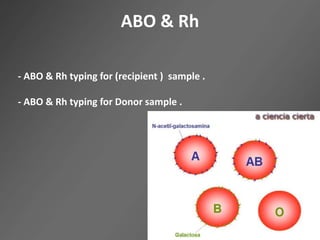
ABO & Rh
- ABO & Rh typing for (recipient ) sample .
- ABO & Rh typing for Donor sample .
Antibody Screening
- Autoantibody : is an antibody manufactured by the immune
system that is directed against one or more of the individual's
own cells, Causes Many autoimmune disease.
Antibody Screening
- Alloantibody : is an immune response to foreign antigen,
Formed from previous transfusion or pregnancy.
- Antibody Screening test performed to detect auto-antibodies
/allo-antibodies using DAT (Direct Anti-human Globulin Test)
Antibody Screening
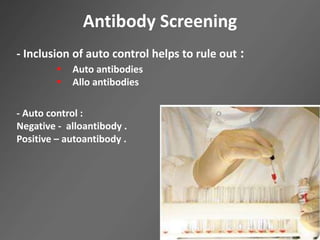
- Inclusion of auto control helps to rule out :
 Auto antibodies
 Allo antibodies
- Auto control :
Negative - alloantibody .
Positive – autoantibody .
Antibody Screening
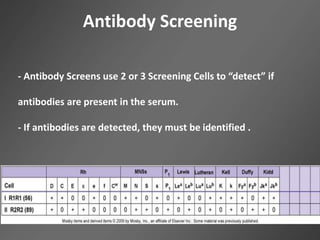
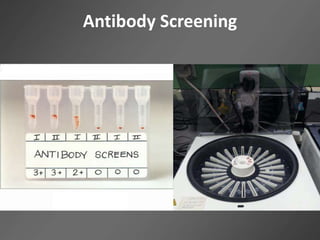
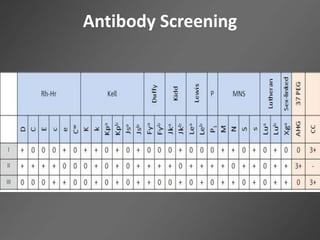
- Antibody Screens use 2 or 3 Screening Cells to “detect” if
antibodies are present in the serum.
- If antibodies are detected, they must be identified .
Antibody Screening
Antibody Screening
Cross Matching
- Cross match is done to ensure there are no clinically significant
Abs in patient blood ( Serum ) against donor RBCs and so prevent
hemolytic reaction during or after transfusion .
Cross Matching
- Major cross-match test, consisting of mixing the patient’s
serum with donor RBCs.
- Minor cross-match test, consisting of mixing the donor’s
plasma with patient’s RBCs.
- Minor cross-match test has been completely eliminated in
most blood banks according to AABB SOPs since 1960.
Cross Matching
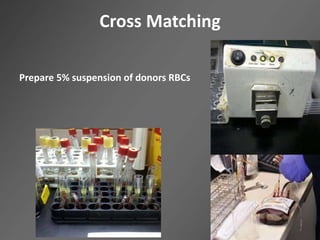
Prepare 5% suspension of donors RBCs
Cross Matching
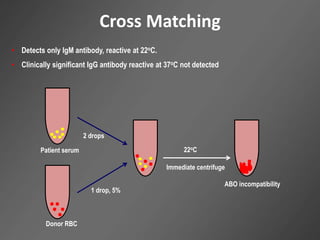
Patient serum
2 drops
Donor RBC
1 drop, 5%
Immediate centrifuge
ABO incompatibility
22oC
• Detects only IgM antibody, reactive at 22oC.
• Clinically significant IgG antibody reactive at 37oC not detected
Cross Matching
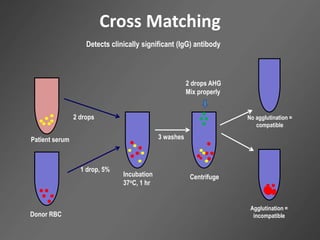
Patient serum
2 drops
Incubation
37oC, 1 hr
Donor RBC
1 drop, 5%
3 washes
Centrifuge
2 drops AHG
Mix properly
No agglutination =
compatible
Detects clinically significant (IgG) antibody
Agglutination =
incompatible
Antibody Identification
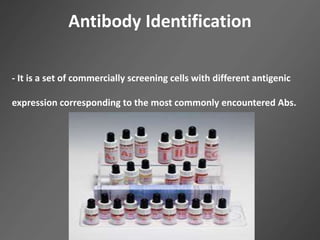
- It is a set of commercially screening cells with different antigenic
expression corresponding to the most commonly encountered Abs.
Antibody Identification
- Screening Cells and Panel Cells are the same with minor differences:
- Screening cells
- Antibody detection
- Sets of 2 or 3 vials
- Panel cells
- Antibody identification
- At least 10 vials per set.
- Panel test is just an extended version of an antibody screen
Antibody Identification
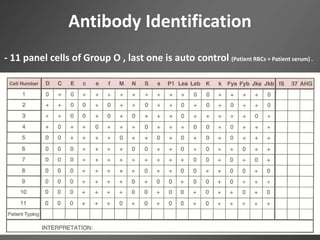
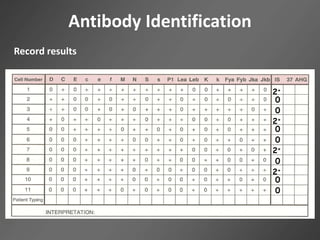
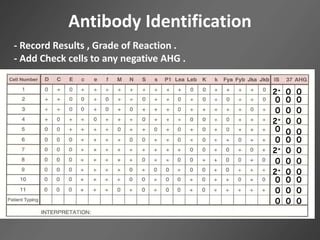
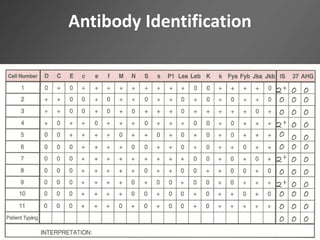
- 11 panel cells of Group O , last one is auto control (Patient RBCs + Patient serum) .
Antibody Identification
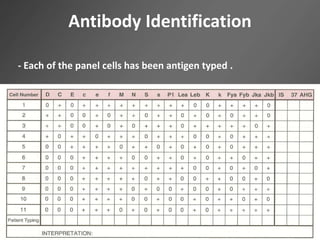
- Each of the panel cells has been antigen typed .
Antibody Identification
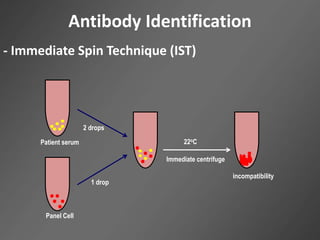
- Immediate Spin Technique (IST)
Patient serum
2 drops
Panel Cell
1 drop
Immediate centrifuge
incompatibility
22oC
Antibody Identification
2+
0
0
2+
0
0
2+
0
0
2+
0
Record results
Antibody Identification
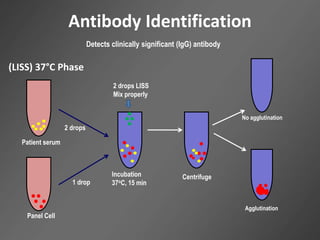
Incubation
37oC, 15 min
Centrifuge
2 drops LISS
Mix properly
Agglutination
No agglutination
Detects clinically significant (IgG) antibody
(LISS) 37°C Phase
Patient serum
2 drops
Panel Cell
1 drop
Antibody Identification
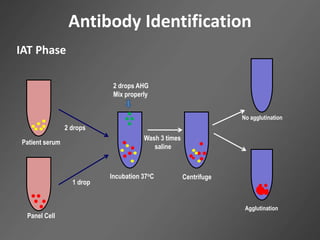
IAT Phase
Incubation 37oC Centrifuge
2 drops AHG
Mix properly
Agglutination
No agglutination
Patient serum
2 drops
Panel Cell
1 drop
Wash 3 times
saline
Antibody Identification
2+
0
0
2+
0
0
2+
0
0
2+
0
0
0
0
0
0
0
0
0
0
0
0
0
0
0
0
0
0
0
0
0
0
0
0 0 0
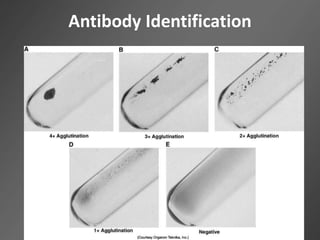
- Record Results , Grade of Reaction .
- Add Check cells to any negative AHG .
Antibody Identification
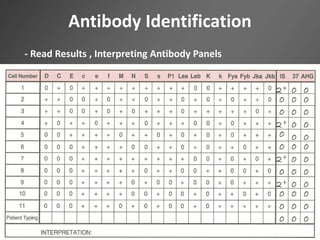
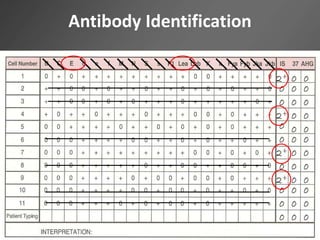
- Read Results , Interpreting Antibody Panels
Antibody Identification
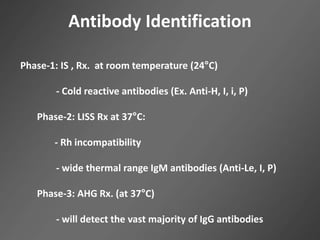
Phase-1: IS , Rx. at room temperature (24°C)
- Cold reactive antibodies (Ex. Anti-H, I, i, P)
Phase-2: LISS Rx at 37°C:
- Rh incompatibility
- wide thermal range IgM antibodies (Anti-Le, I, P)
Phase-3: AHG Rx. (at 37°C)
- will detect the vast majority of IgG antibodies
Antibody Identification
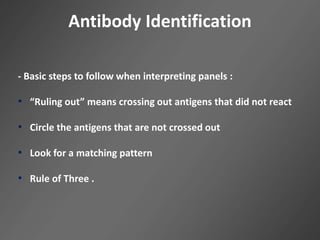
- Basic steps to follow when interpreting panels :
• “Ruling out” means crossing out antigens that did not react
• Circle the antigens that are not crossed out
• Look for a matching pattern
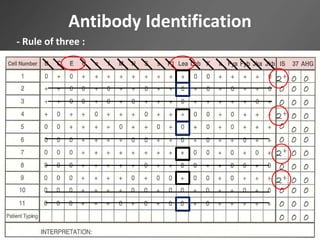
• Rule of Three .
Antibody Identification
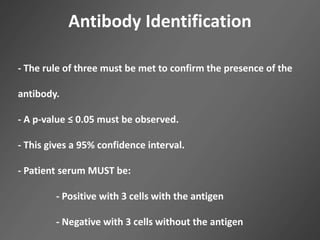
- The rule of three must be met to confirm the presence of the
antibody.
- A p-value ≤ 0.05 must be observed.
- This gives a 95% confidence interval.
- Patient serum MUST be:
- Positive with 3 cells with the antigen
- Negative with 3 cells without the antigen
Antibody Identification
- Rule of three :
Antibody Identification
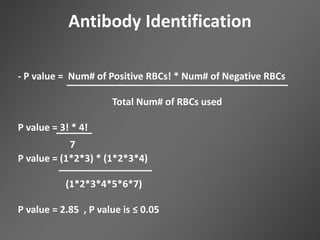
- P value = Num# of Positive RBCs! * Num# of Negative RBCs
Total Num# of RBCs used
P value = 3! * 4!
P value = (1*2*3) * (1*2*3*4)
(1*2*3*4*5*6*7)
P value = 2.85 , P value is ≤ 0.05
7
Special Techniques in Ab Identification
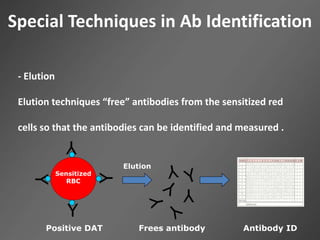
- Elution
Elution techniques “free” antibodies from the sensitized red
cells so that the antibodies can be identified and measured .
Y
Y
Y
Y
Sensitized
RBC
Positive DAT
Elution
Y
Frees antibody Antibody ID
Special Techniques in Ab Identification
- Elution
• Acid elution (glycine acid)
- Most common
- Lowers pH, causing antibody to dissociate
• Organic solvents (ether, chloroform)
- Dissolve bilipid layer of RBC
• Heat (conformational change)
• Freeze-Thaw (lyses cells)
Special Techniques in Ab Identification
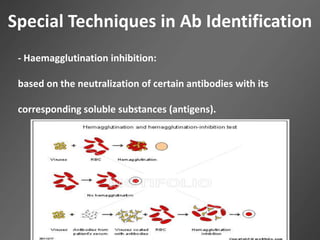
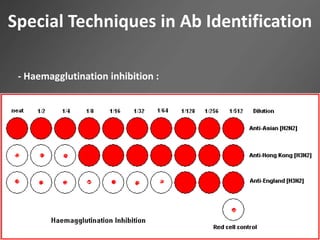
- Haemagglutination inhibition:
based on the neutralization of certain antibodies with its
corresponding soluble substances (antigens).
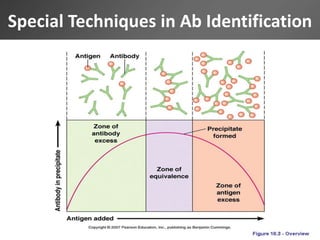
Special Techniques in Ab Identification
- Haemagglutination inhibition :
Special Techniques in Ab Identification
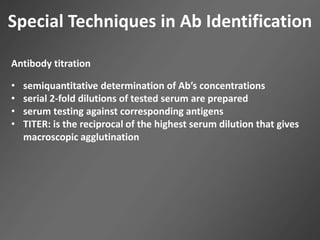
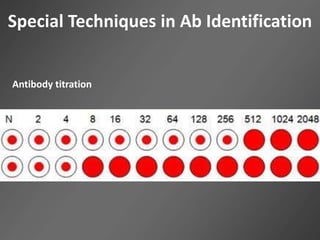
Antibody titration
• semiquantitative determination of Ab’s concentrations
• serial 2-fold dilutions of tested serum are prepared
• serum testing against corresponding antigens
• TITER: is the reciprocal of the highest serum dilution that gives
macroscopic agglutination
Special Techniques in Ab Identification
Antibody titration
Cross transfusion and compatibility

Cross transfusion and compatibility

  • 2.
    Ahmad A. Al-Qudah LM755- ADVANCED DIAGNOSTIC IMMUNOHEMATOLOGY AND BLOOD BANKING Cross transfusion and Compatibility
  • 3.
    Cross transfusion andCompatibility - Pretransfusion Testing . - Pretransfusion testing elements : - ABO & Rh - Antibody Screening - Cross Matching - Antibody Identification . - Special Techniques in Ab Identification : - Elution - Hemagglutination inhibition - Titration
  • 4.
    Pretransfusion Testing History - AfterLandsteiner described the ABO . - Crossmatch : - Major Crossmatch : Recipient Serum + Donor RBCs. - Minor Crossmatch : Recipient RBCs + Donor Plasma (not required by AABB) - RT ( IS Phase ) IgM , then Rh (IgG) and detection at various Temperatures with or without enhancements .
  • 5.
    Pretransfusion Testing - Toselect blood components that will not cause harm to the recipient and will have acceptable survival when transfused. - ABO compatibility , Rh compatibility , clinically significant Antibody Screening and Identification .
  • 6.
    Indirect Antiglobulin TestPhases - Immediate Spin ( IS ) Phase at Room Temperature . Detection of ABO incompatibility and Cold Antibody (M,N, Lea+b,P1) - 37° with Enhancement media (LISS) Allows IgG and other complement to bind to RBCs . - Anti Human Globulin Phase ( AHG ) Detection of IgG or complements binds to RBCs - Check Cells : Approve the Results
  • 7.
    ABO & Rh -ABO & Rh typing for (recipient ) sample . - ABO & Rh typing for Donor sample .
  • 8.
    Antibody Screening - Autoantibody: is an antibody manufactured by the immune system that is directed against one or more of the individual's own cells, Causes Many autoimmune disease.
  • 9.
    Antibody Screening - Alloantibody: is an immune response to foreign antigen, Formed from previous transfusion or pregnancy. - Antibody Screening test performed to detect auto-antibodies /allo-antibodies using DAT (Direct Anti-human Globulin Test)
  • 10.
    Antibody Screening - Inclusionof auto control helps to rule out :  Auto antibodies  Allo antibodies - Auto control : Negative - alloantibody . Positive – autoantibody .
  • 11.
    Antibody Screening - AntibodyScreens use 2 or 3 Screening Cells to “detect” if antibodies are present in the serum. - If antibodies are detected, they must be identified .
  • 12.
  • 13.
  • 14.
    Cross Matching - Crossmatch is done to ensure there are no clinically significant Abs in patient blood ( Serum ) against donor RBCs and so prevent hemolytic reaction during or after transfusion .
  • 15.
    Cross Matching - Majorcross-match test, consisting of mixing the patient’s serum with donor RBCs. - Minor cross-match test, consisting of mixing the donor’s plasma with patient’s RBCs. - Minor cross-match test has been completely eliminated in most blood banks according to AABB SOPs since 1960.
  • 16.
    Cross Matching Prepare 5%suspension of donors RBCs
  • 17.
    Cross Matching Patient serum 2drops Donor RBC 1 drop, 5% Immediate centrifuge ABO incompatibility 22oC • Detects only IgM antibody, reactive at 22oC. • Clinically significant IgG antibody reactive at 37oC not detected
  • 18.
    Cross Matching Patient serum 2drops Incubation 37oC, 1 hr Donor RBC 1 drop, 5% 3 washes Centrifuge 2 drops AHG Mix properly No agglutination = compatible Detects clinically significant (IgG) antibody Agglutination = incompatible
  • 19.
    Antibody Identification - Itis a set of commercially screening cells with different antigenic expression corresponding to the most commonly encountered Abs.
  • 20.
    Antibody Identification - ScreeningCells and Panel Cells are the same with minor differences: - Screening cells - Antibody detection - Sets of 2 or 3 vials - Panel cells - Antibody identification - At least 10 vials per set. - Panel test is just an extended version of an antibody screen
  • 21.
    Antibody Identification - 11panel cells of Group O , last one is auto control (Patient RBCs + Patient serum) .
  • 22.
    Antibody Identification - Eachof the panel cells has been antigen typed .
  • 23.
    Antibody Identification - ImmediateSpin Technique (IST) Patient serum 2 drops Panel Cell 1 drop Immediate centrifuge incompatibility 22oC
  • 24.
  • 25.
    Antibody Identification Incubation 37oC, 15min Centrifuge 2 drops LISS Mix properly Agglutination No agglutination Detects clinically significant (IgG) antibody (LISS) 37°C Phase Patient serum 2 drops Panel Cell 1 drop
  • 26.
  • 27.
    Antibody Identification IAT Phase Incubation37oC Centrifuge 2 drops AHG Mix properly Agglutination No agglutination Patient serum 2 drops Panel Cell 1 drop Wash 3 times saline
  • 28.
    Antibody Identification 2+ 0 0 2+ 0 0 2+ 0 0 2+ 0 0 0 0 0 0 0 0 0 0 0 0 0 0 0 0 0 0 0 0 0 0 0 0 00 - Record Results , Grade of Reaction . - Add Check cells to any negative AHG .
  • 29.
    Antibody Identification - ReadResults , Interpreting Antibody Panels
  • 30.
    Antibody Identification Phase-1: IS, Rx. at room temperature (24°C) - Cold reactive antibodies (Ex. Anti-H, I, i, P) Phase-2: LISS Rx at 37°C: - Rh incompatibility - wide thermal range IgM antibodies (Anti-Le, I, P) Phase-3: AHG Rx. (at 37°C) - will detect the vast majority of IgG antibodies
  • 31.
    Antibody Identification - Basicsteps to follow when interpreting panels : • “Ruling out” means crossing out antigens that did not react • Circle the antigens that are not crossed out • Look for a matching pattern • Rule of Three .
  • 32.
  • 33.
  • 34.
    Antibody Identification - Therule of three must be met to confirm the presence of the antibody. - A p-value ≤ 0.05 must be observed. - This gives a 95% confidence interval. - Patient serum MUST be: - Positive with 3 cells with the antigen - Negative with 3 cells without the antigen
  • 35.
  • 36.
    Antibody Identification - Pvalue = Num# of Positive RBCs! * Num# of Negative RBCs Total Num# of RBCs used P value = 3! * 4! P value = (1*2*3) * (1*2*3*4) (1*2*3*4*5*6*7) P value = 2.85 , P value is ≤ 0.05 7
  • 37.
    Special Techniques inAb Identification - Elution Elution techniques “free” antibodies from the sensitized red cells so that the antibodies can be identified and measured . Y Y Y Y Sensitized RBC Positive DAT Elution Y Frees antibody Antibody ID
  • 38.
    Special Techniques inAb Identification - Elution • Acid elution (glycine acid) - Most common - Lowers pH, causing antibody to dissociate • Organic solvents (ether, chloroform) - Dissolve bilipid layer of RBC • Heat (conformational change) • Freeze-Thaw (lyses cells)
  • 39.
    Special Techniques inAb Identification - Haemagglutination inhibition: based on the neutralization of certain antibodies with its corresponding soluble substances (antigens).
  • 40.
    Special Techniques inAb Identification - Haemagglutination inhibition :
  • 41.
    Special Techniques inAb Identification
  • 42.
    Special Techniques inAb Identification Antibody titration • semiquantitative determination of Ab’s concentrations • serial 2-fold dilutions of tested serum are prepared • serum testing against corresponding antigens • TITER: is the reciprocal of the highest serum dilution that gives macroscopic agglutination
  • 43.
    Special Techniques inAb Identification Antibody titration