
HARIS SADDIQUE
M.PHIL SCHOLAR
DEPTT: OF BIOTECHNOLOGY
UNIVERSITY OF MALAKAND
KPK,PAKISTAN
STEM CELL ON HISTORY PAGES
1950/51
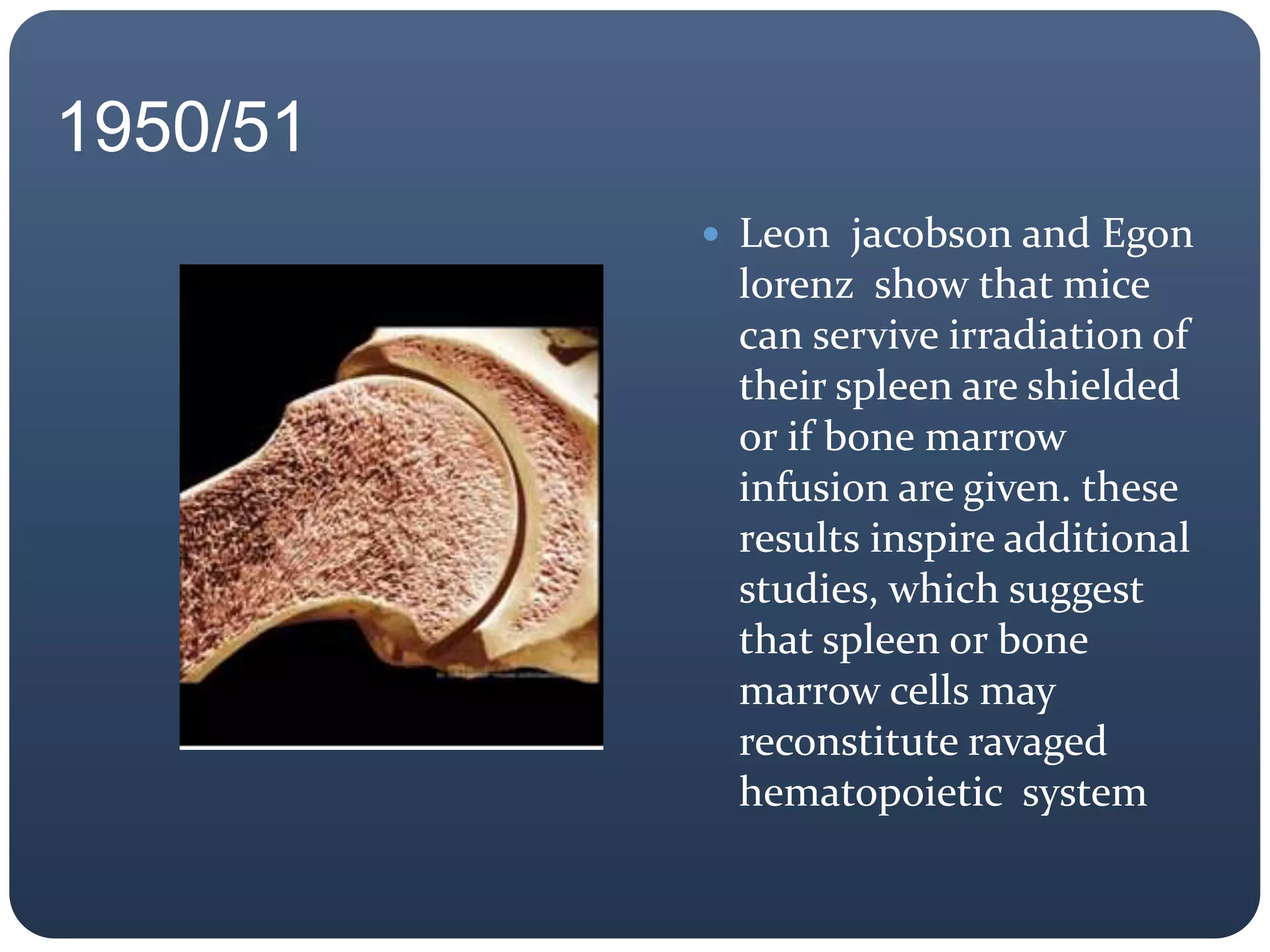
 Leon jacobson and Egon
lorenz show that mice
can servive irradiation of
their spleen are shielded
or if bone marrow
infusion are given. these
results inspire additional
studies, which suggest
that spleen or bone
marrow cells may
reconstitute ravaged
hematopoietic system
1957
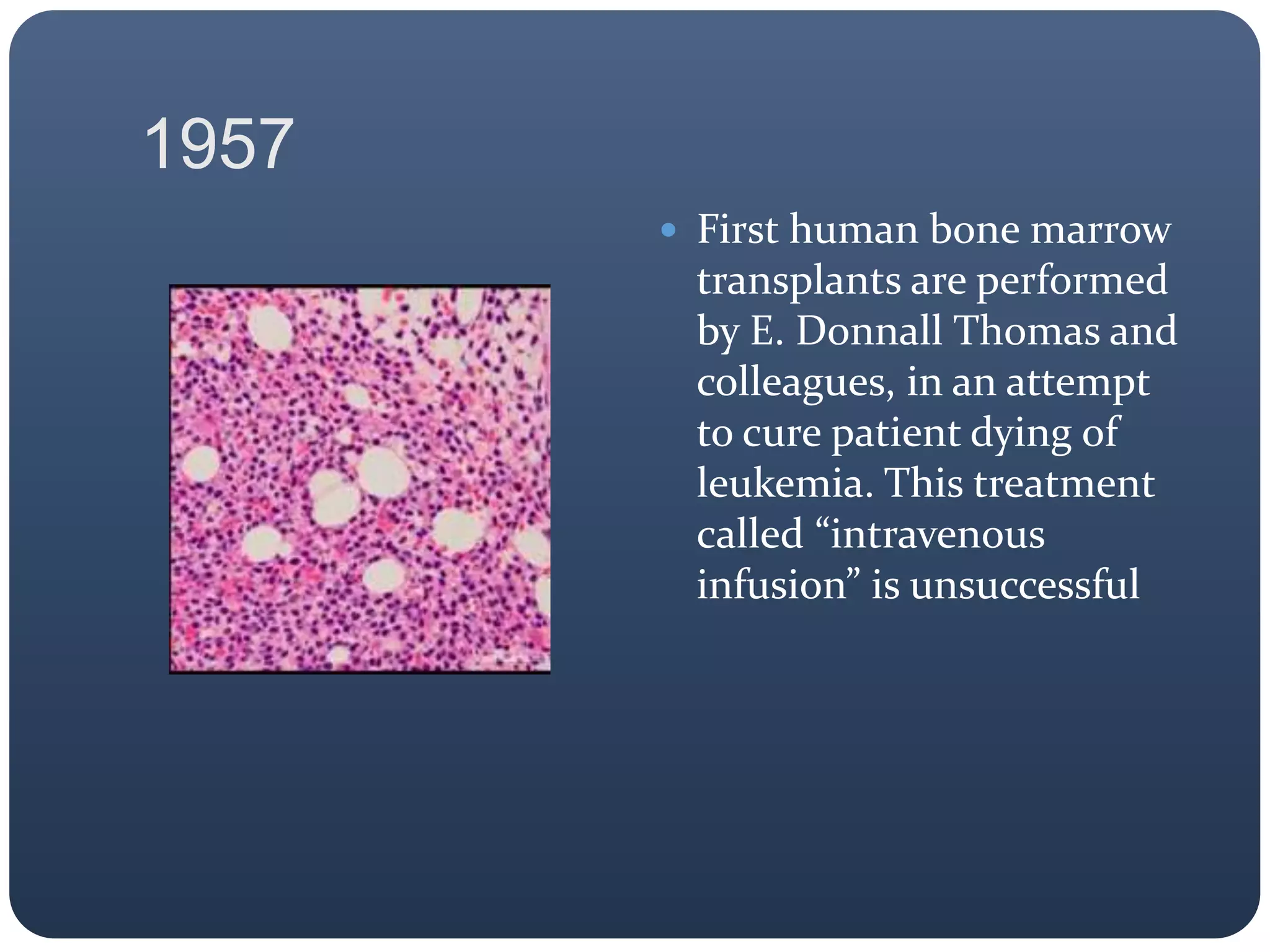
 First human bone marrow
transplants are performed
by E. Donnall Thomas and
colleagues, in an attempt
to cure patient dying of
leukemia. This treatment
called “intravenous
infusion” is unsuccessful
1959
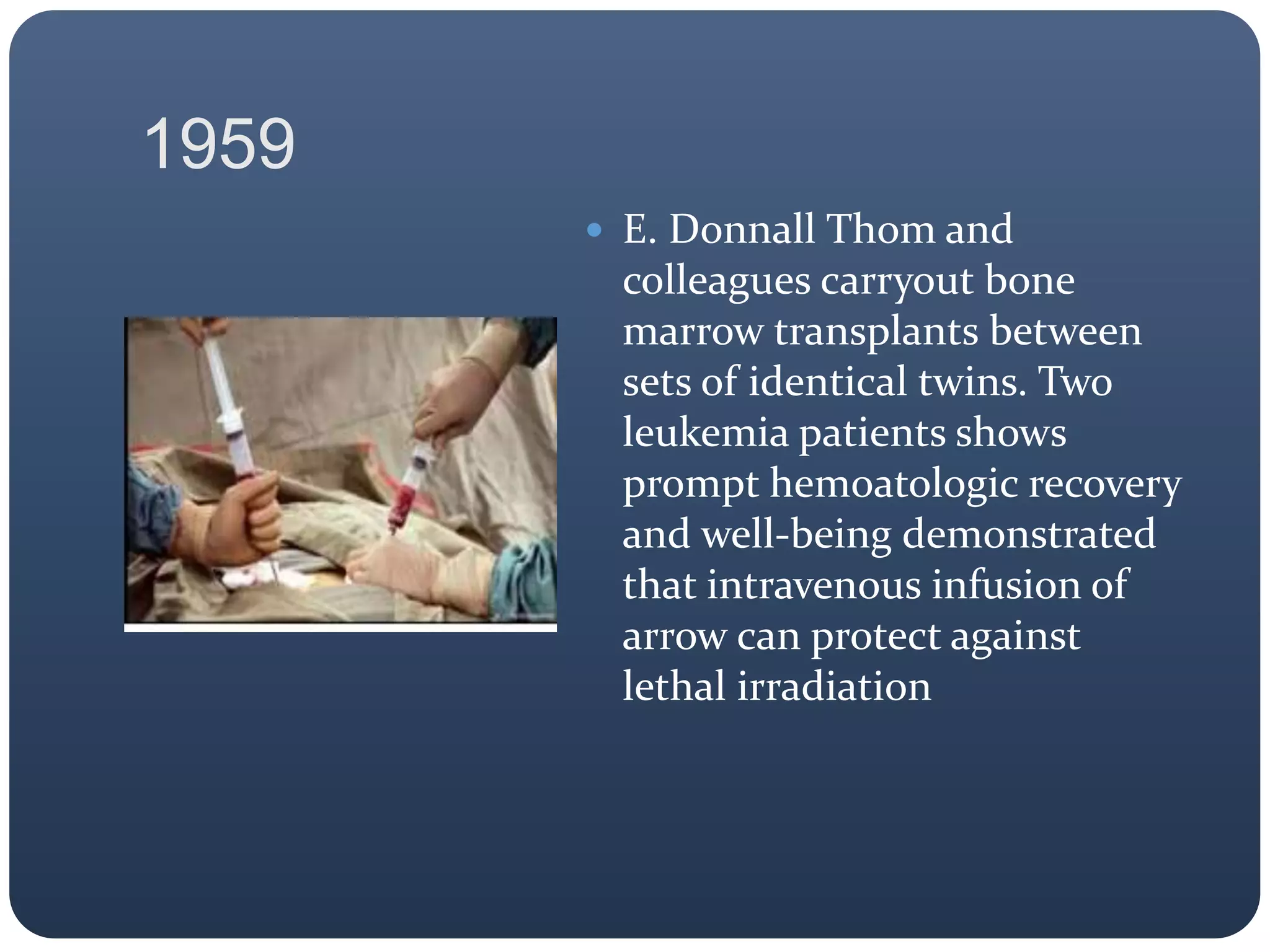
 E. Donnall Thom and
colleagues carryout bone
marrow transplants between
sets of identical twins. Two
leukemia patients shows
prompt hemoatologic recovery
and well-being demonstrated
that intravenous infusion of
arrow can protect against
lethal irradiation
1960/61
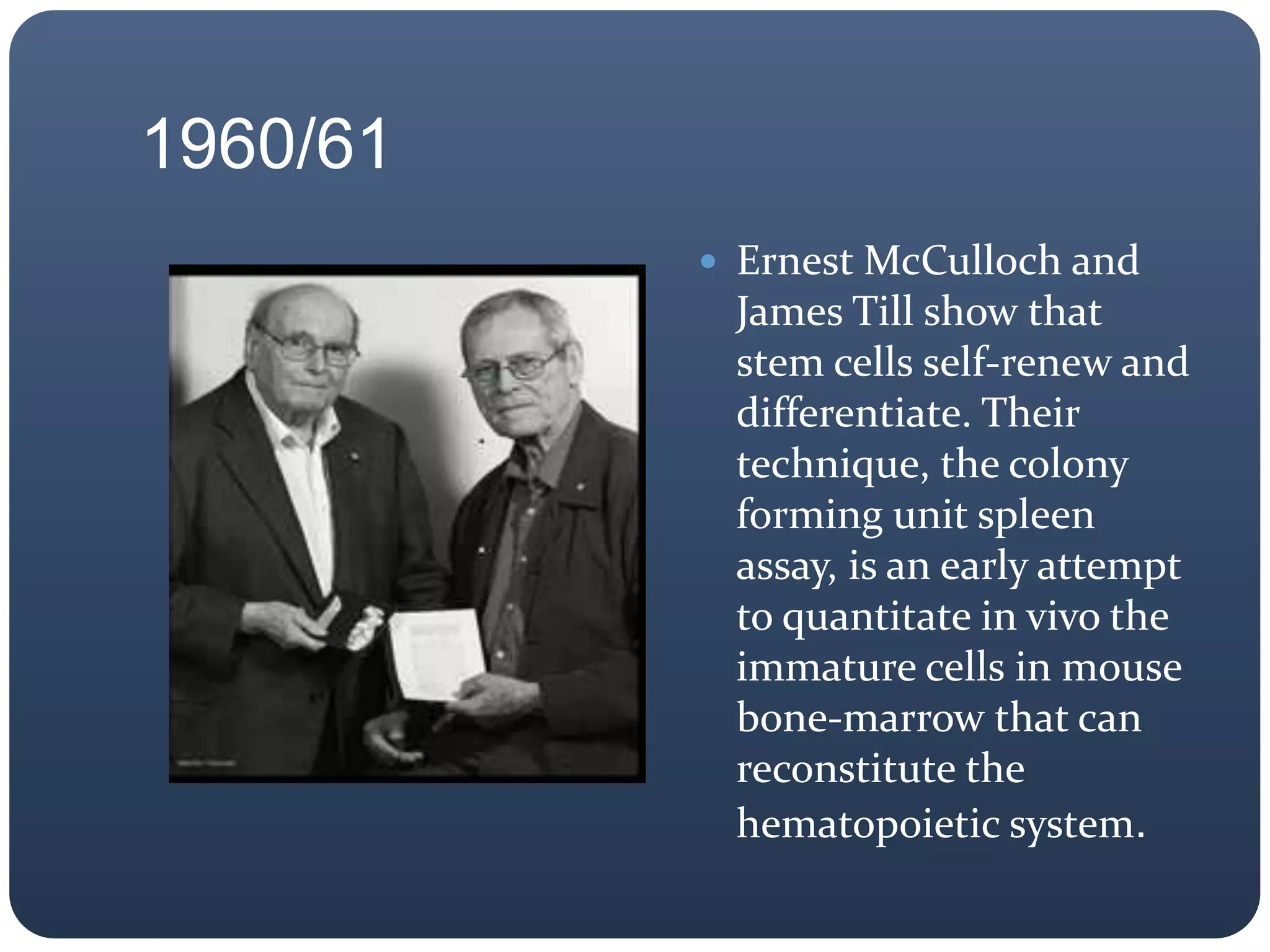
 Ernest McCulloch and
James Till show that
stem cells self-renew and
differentiate. Their
technique, the colony
forming unit spleen
assay, is an early attempt
to quantitate in vivo the
immature cells in mouse
bone-marrow that can
reconstitute the
hematopoietic system.
1962
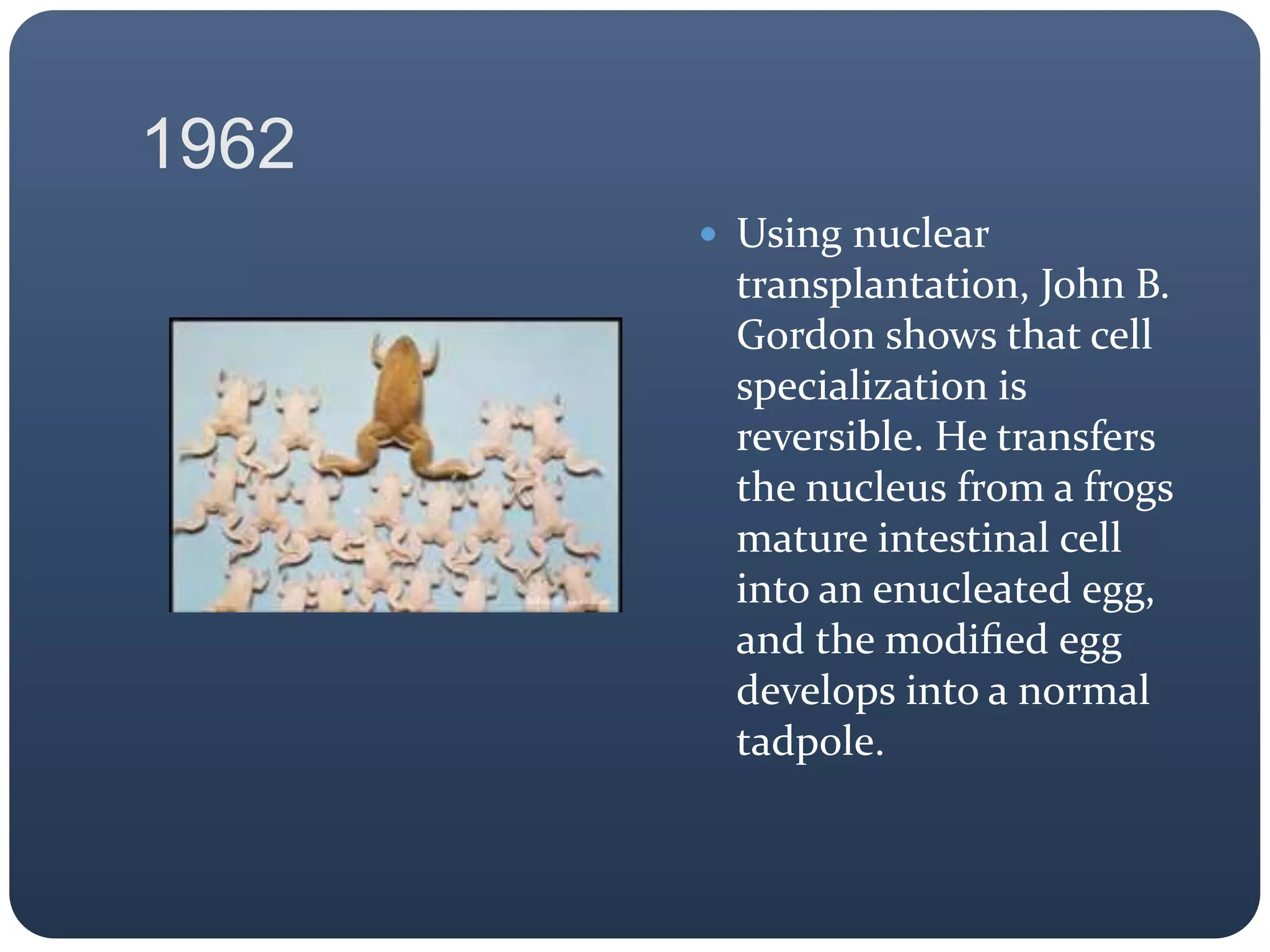
 Using nuclear
transplantation, John B.
Gordon shows that cell
specialization is
reversible. He transfers
the nucleus from a frogs
mature intestinal cell
into an enucleated egg,
and the modified egg
develops into a normal
tadpole.
1965/66
 An in vitro assay is
developed for the
identification and
quantitation of
hematopoietic
protogenitor cells—the
immature cells that arise
directly from
hematopoietic stem cells.
Two teams-Bradley and
Metcalf, and Pluznik and
Sachs—develop the assay
independently.
1968/69
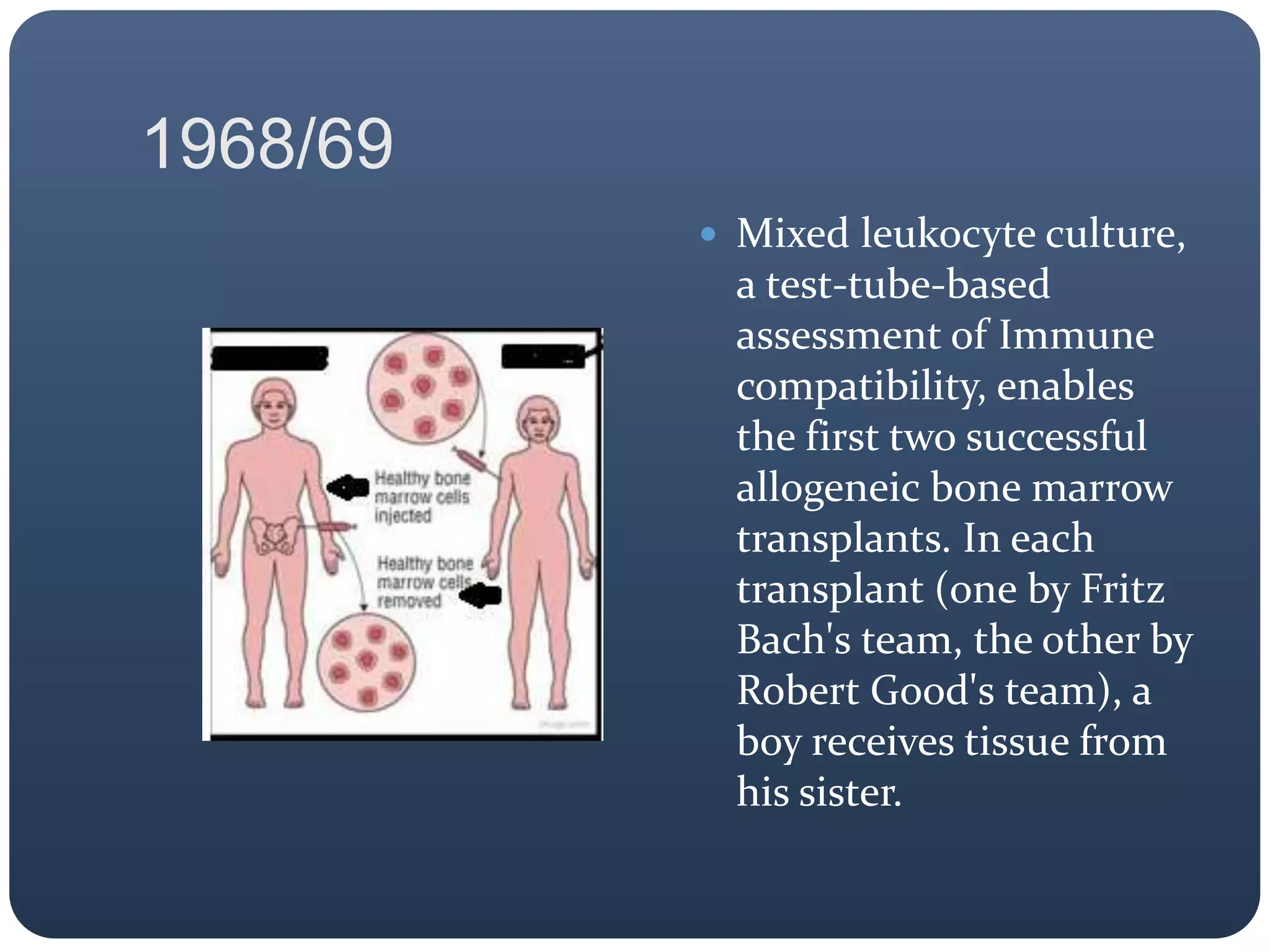
 Mixed leukocyte culture,
a test-tube-based
assessment of Immune
compatibility, enables
the first two successful
allogeneic bone marrow
transplants. In each
transplant (one by Fritz
Bach's team, the other by
Robert Good's team), a
boy receives tissue from
his sister.
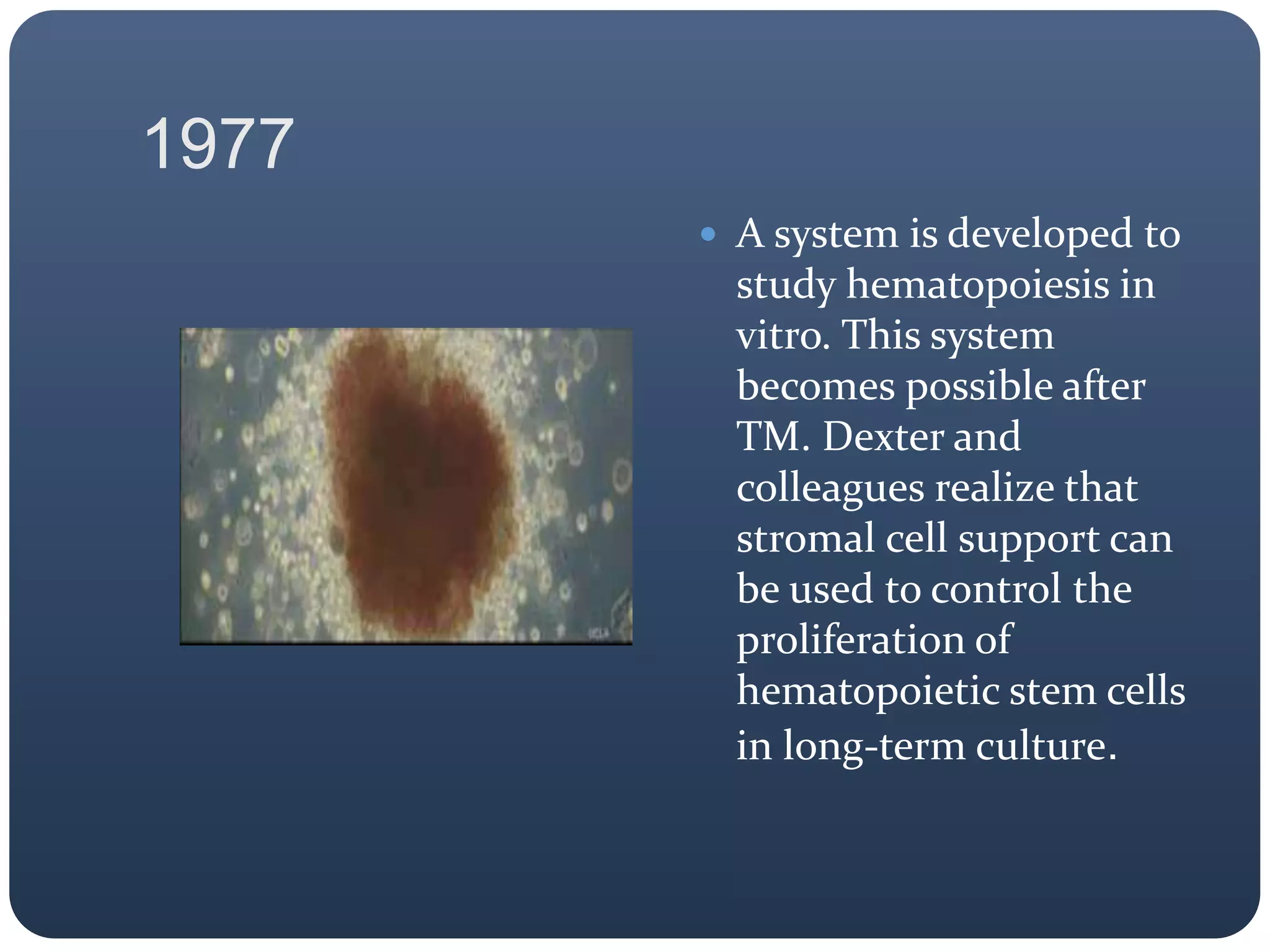
1977
 A system is developed to
study hematopoiesis in
vitro. This system
becomes possible after
TM. Dexter and
colleagues realize that
stromal cell support can
be used to control the
proliferation of
hematopoietic stem cells
in long-term culture.
1979/81
 Another transplant
modality, peripheral
blood stem cell
transplantation, enters
clinical use. Attempts by
UCLA (1979) and the
NIH (1980) fail, possibly
because transfusions
contain too few
protogenitor cells. But
'Johns Hopkins (1981)
provides first evidence of
hemotopoietic
reconstitution.
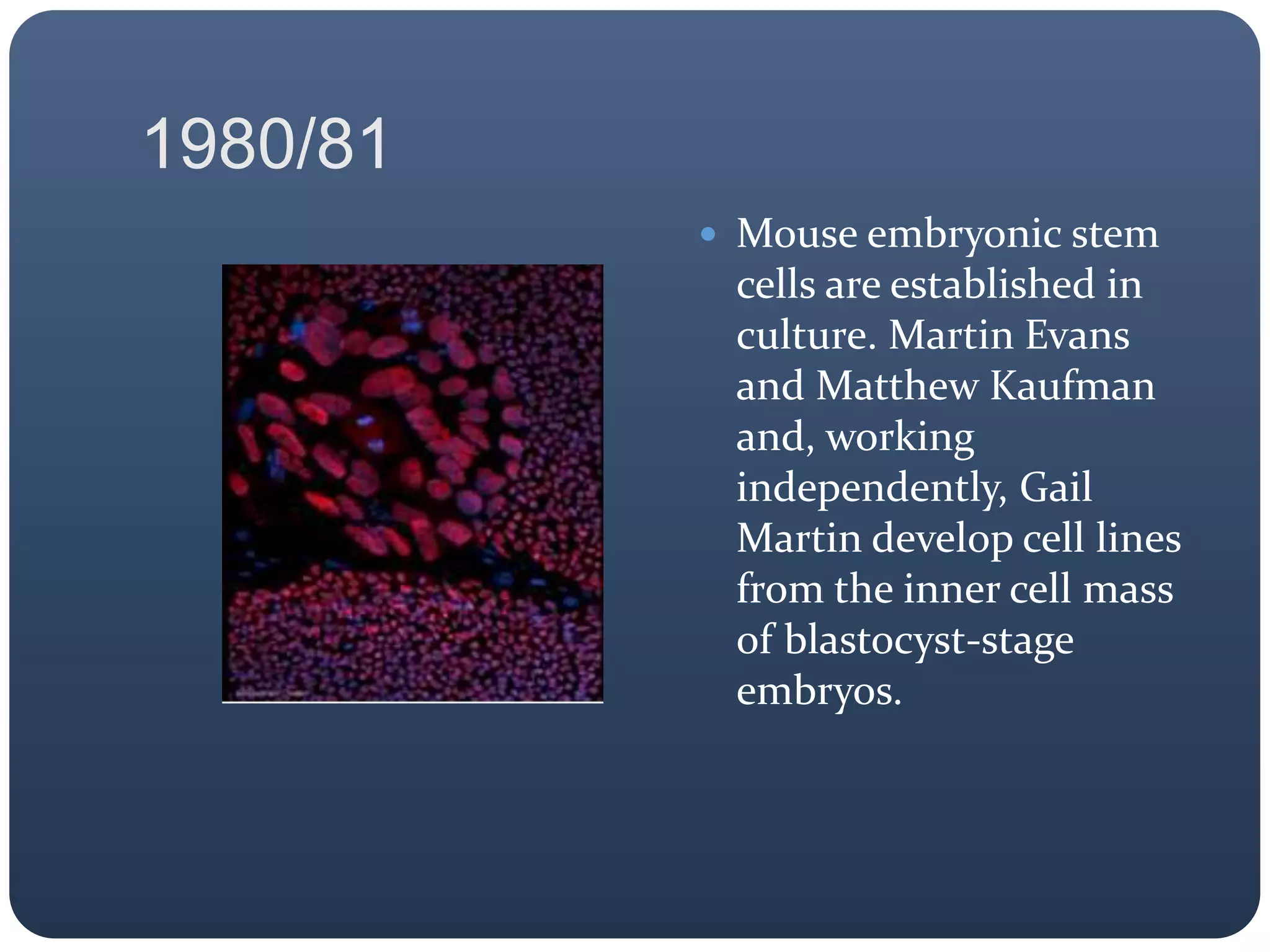
1980/81
 Mouse embryonic stem
cells are established in
culture. Martin Evans
and Matthew Kaufman
and, working
independently, Gail
Martin develop cell lines
from the inner cell mass
of blastocyst-stage
embryos.
1984
 Hematopoietic stem
cells from mice are
isolated from other bone
marrow cells. To
accomplish the task, J.
Visser and colleagues
utilize flow cytometry.
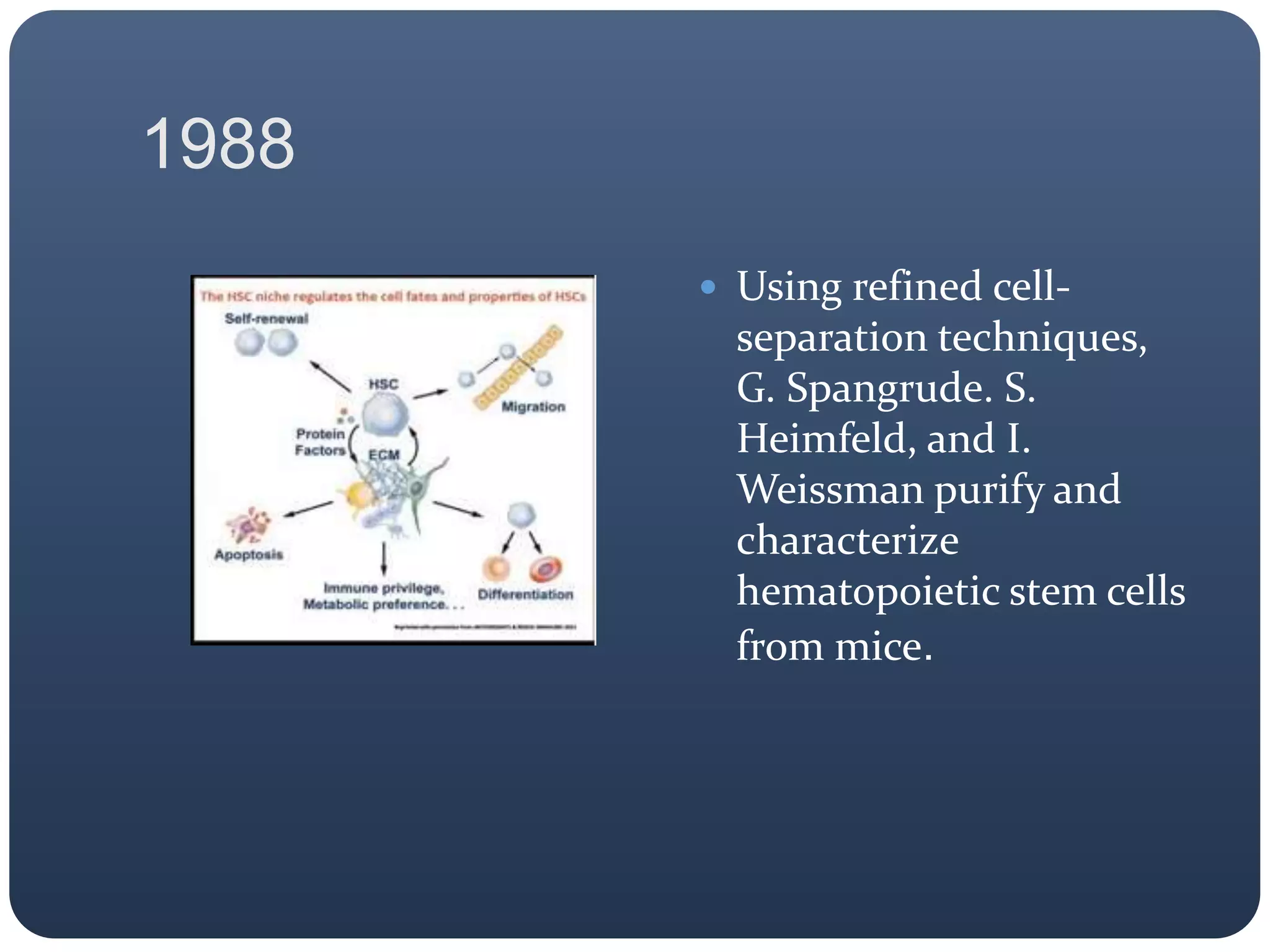
1988
 Using refined cell-
separation techniques,
G. Spangrude. S.
Heimfeld, and I.
Weissman purify and
characterize
hematopoietic stem cells
from mice.
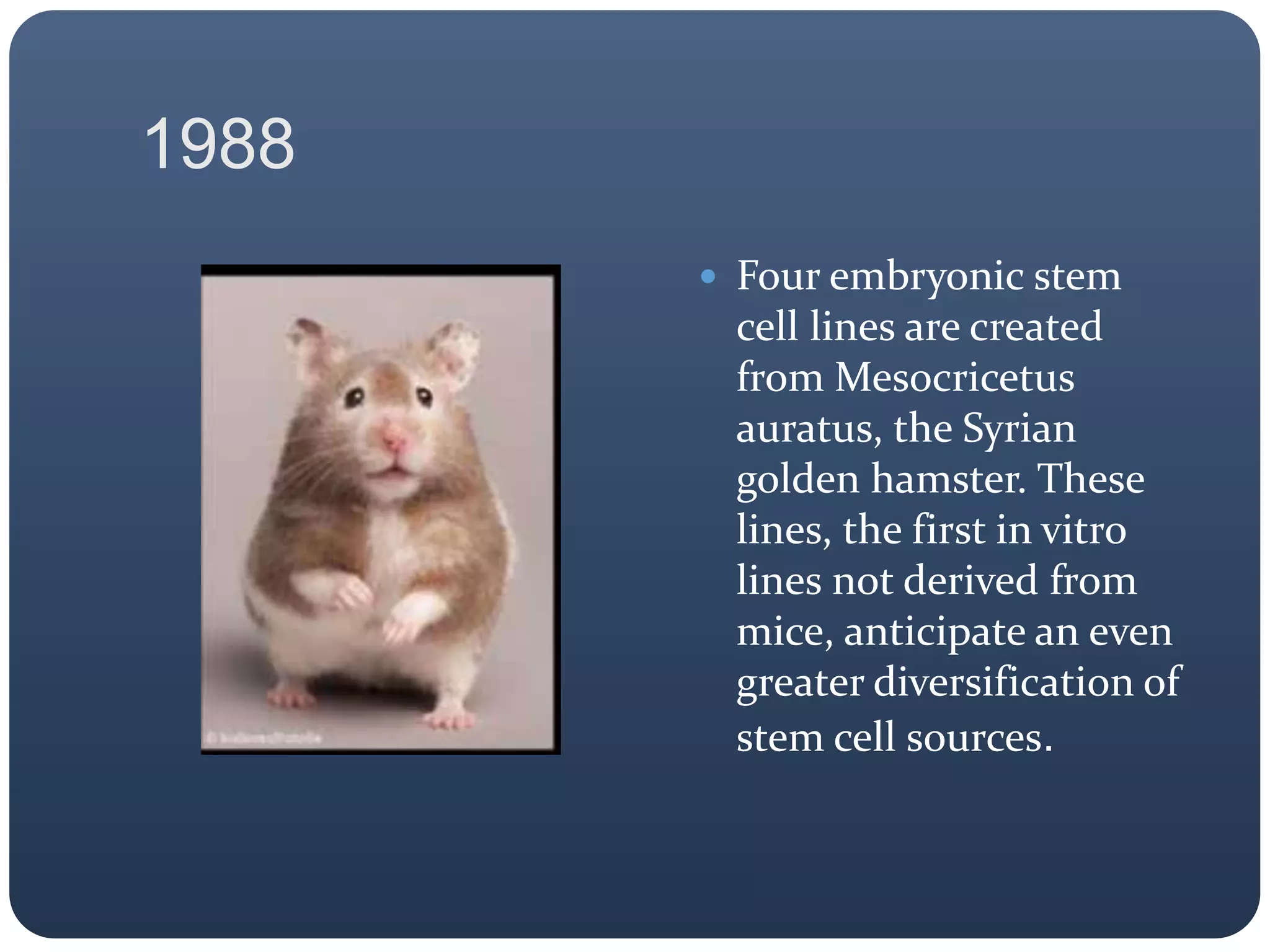
1988
 Four embryonic stem
cell lines are created
from Mesocricetus
auratus, the Syrian
golden hamster. These
lines, the first in vitro
lines not derived from
mice, anticipate an even
greater diversification of
stem cell sources.
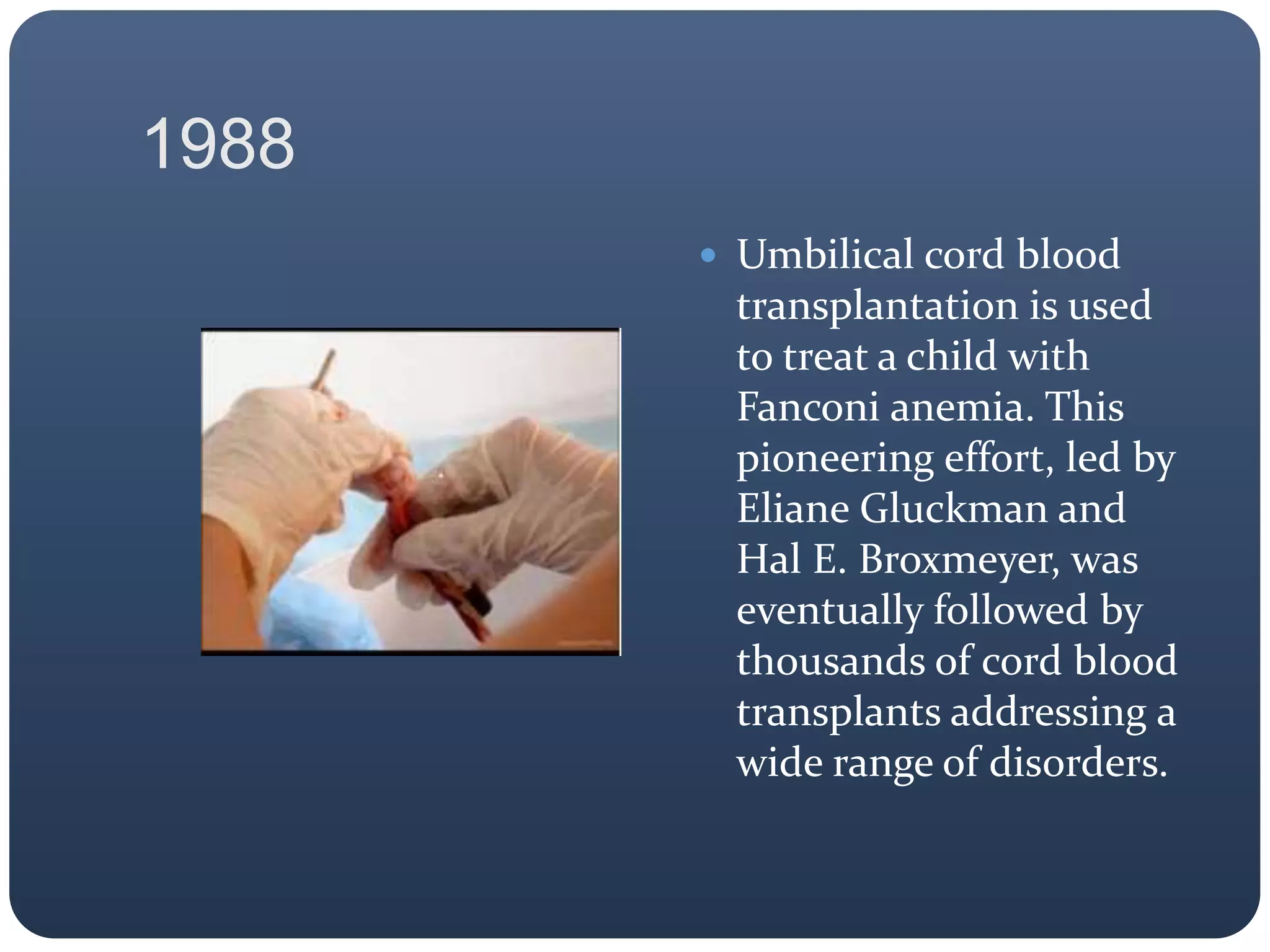
1988
 Umbilical cord blood
transplantation is used
to treat a child with
Fanconi anemia. This
pioneering effort, led by
Eliane Gluckman and
Hal E. Broxmeyer, was
eventually followed by
thousands of cord blood
transplants addressing a
wide range of disorders.
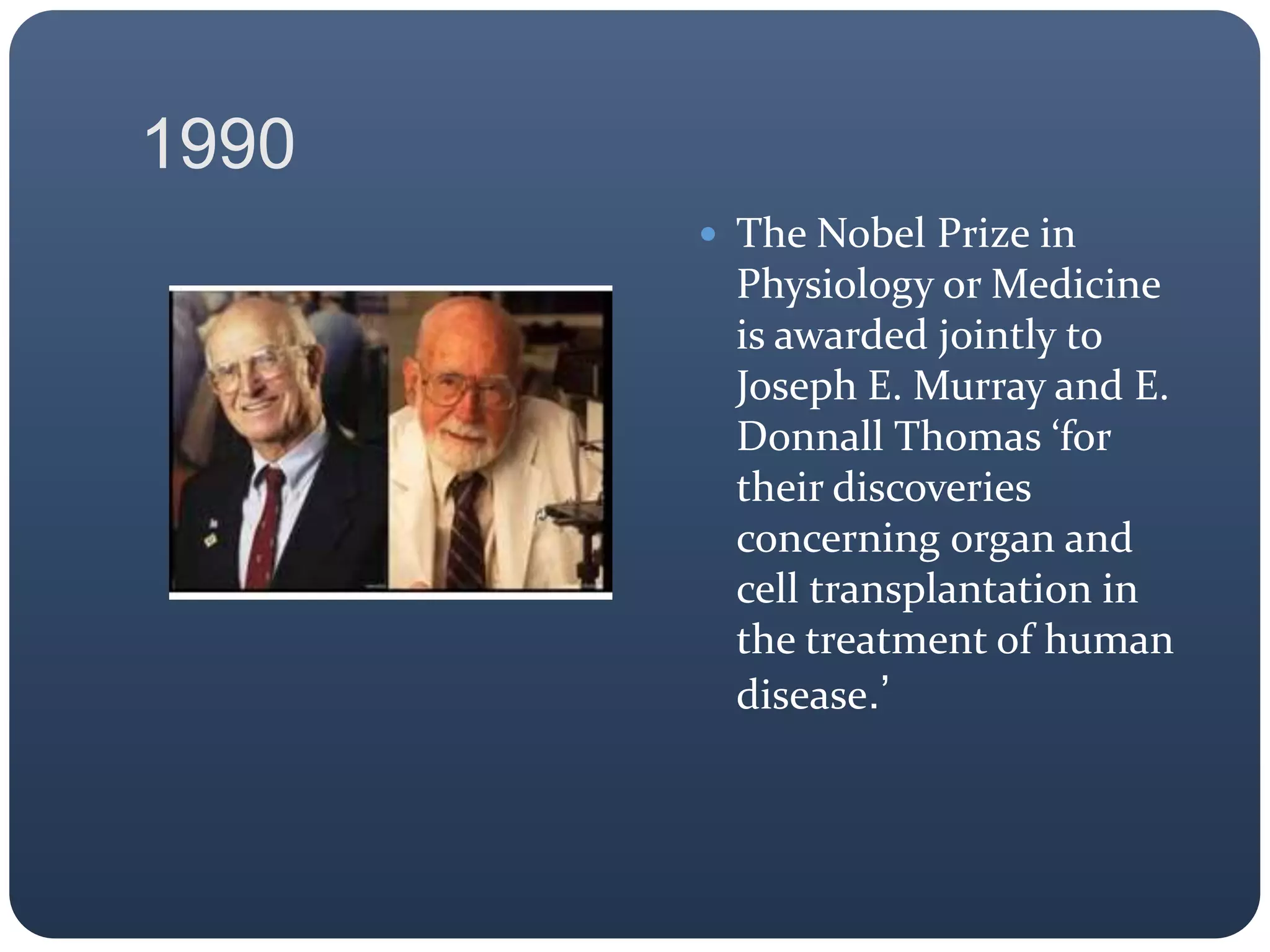
1990
 The Nobel Prize in
Physiology or Medicine
is awarded jointly to
Joseph E. Murray and E.
Donnall Thomas ‘for
their discoveries
concerning organ and
cell transplantation in
the treatment of human
disease.’
1995
 Embryonic stem cells are
derived from non human
primates for the first
time by J.A. Thomson
and colleagues. This
result, from rhesus
monkeys and
marmosets, raises
expectations that such
cells could be derived
from humans.
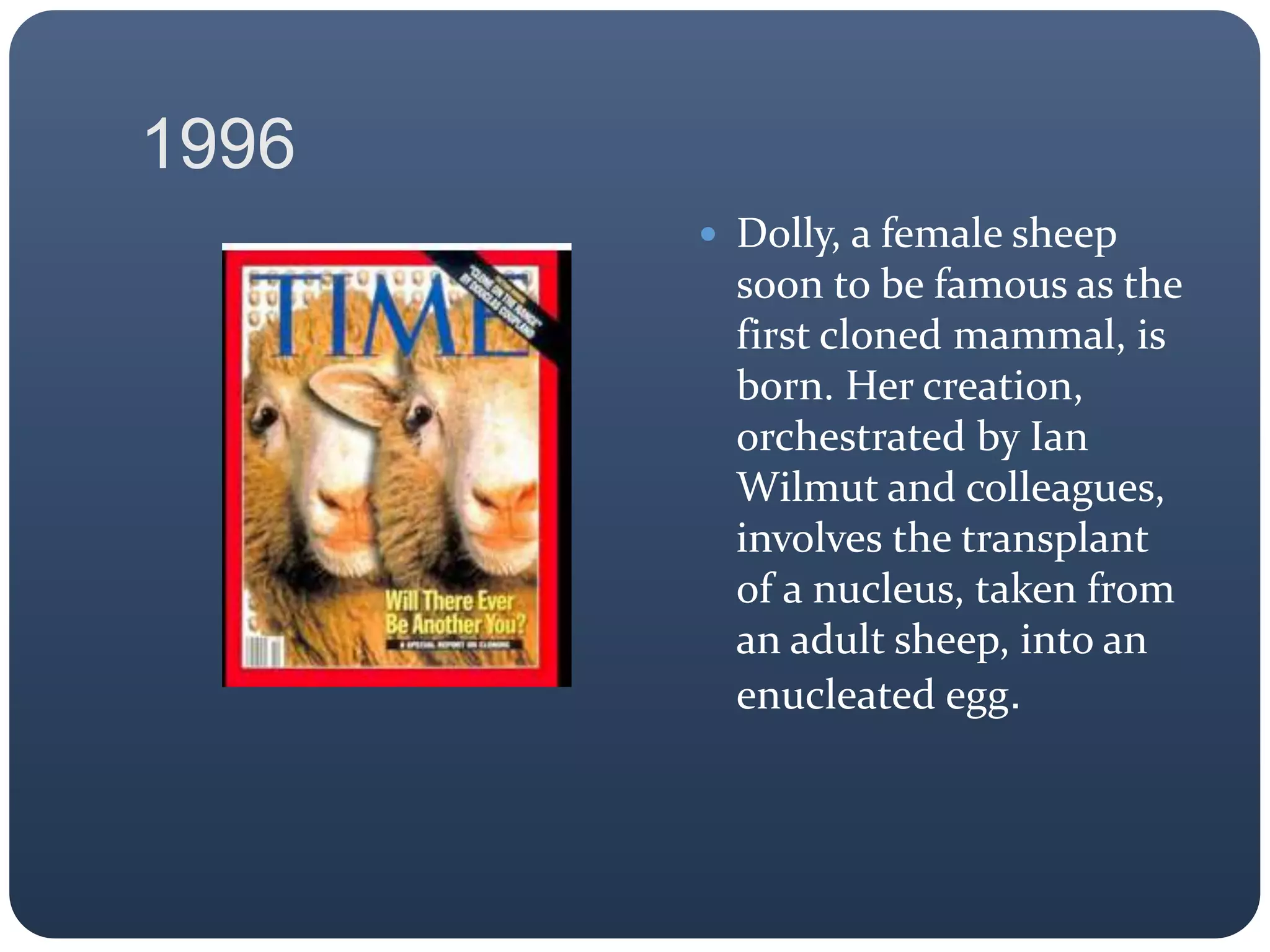
1996
 Dolly, a female sheep
soon to be famous as the
first cloned mammal, is
born. Her creation,
orchestrated by Ian
Wilmut and colleagues,
involves the transplant
of a nucleus, taken from
an adult sheep, into an
enucleated egg.
1998
 The isolation of human
embryonic stem cells is
reported by J.A.
Thomson and
colleagues. Despite their
enormous potential for
research and treatment,
human stem cell raise
controversy because
their derivation requires
the destruction of
human embryos.
2000
 The NIH publishes
guidelines for research
using human pluripotent
stem cells. The
guidelines are intended
to help ensure that ‘NIH-
funded research in this
area is conducted in an
ethical and legal
manner."
2001
 The United Kingdom
becomes the first
country to pass a law
governing the use of
human embryos for stem
cell research.
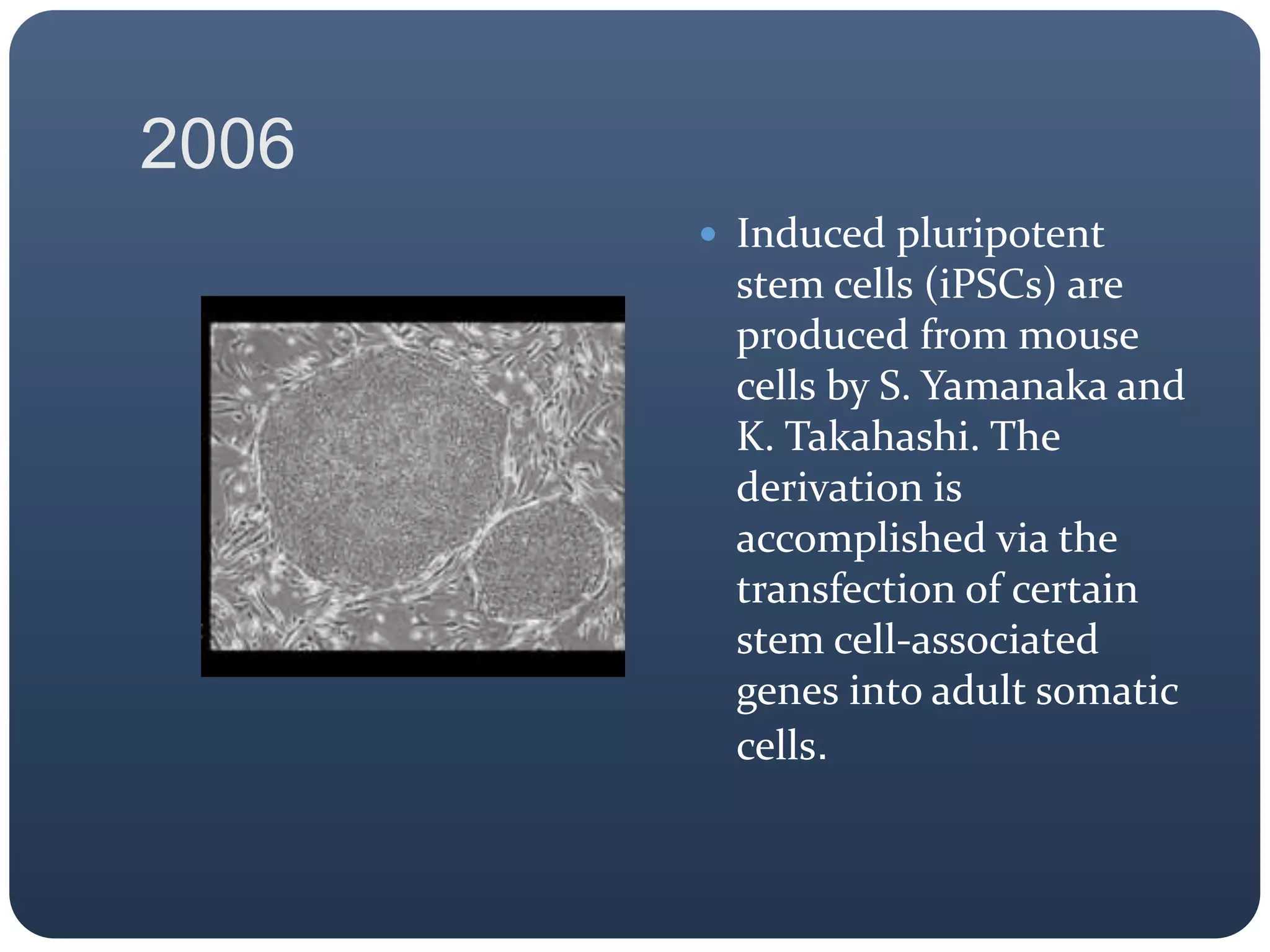
2006
 Induced pluripotent
stem cells (iPSCs) are
produced from mouse
cells by S. Yamanaka and
K. Takahashi. The
derivation is
accomplished via the
transfection of certain
stem cell-associated
genes into adult somatic
cells.
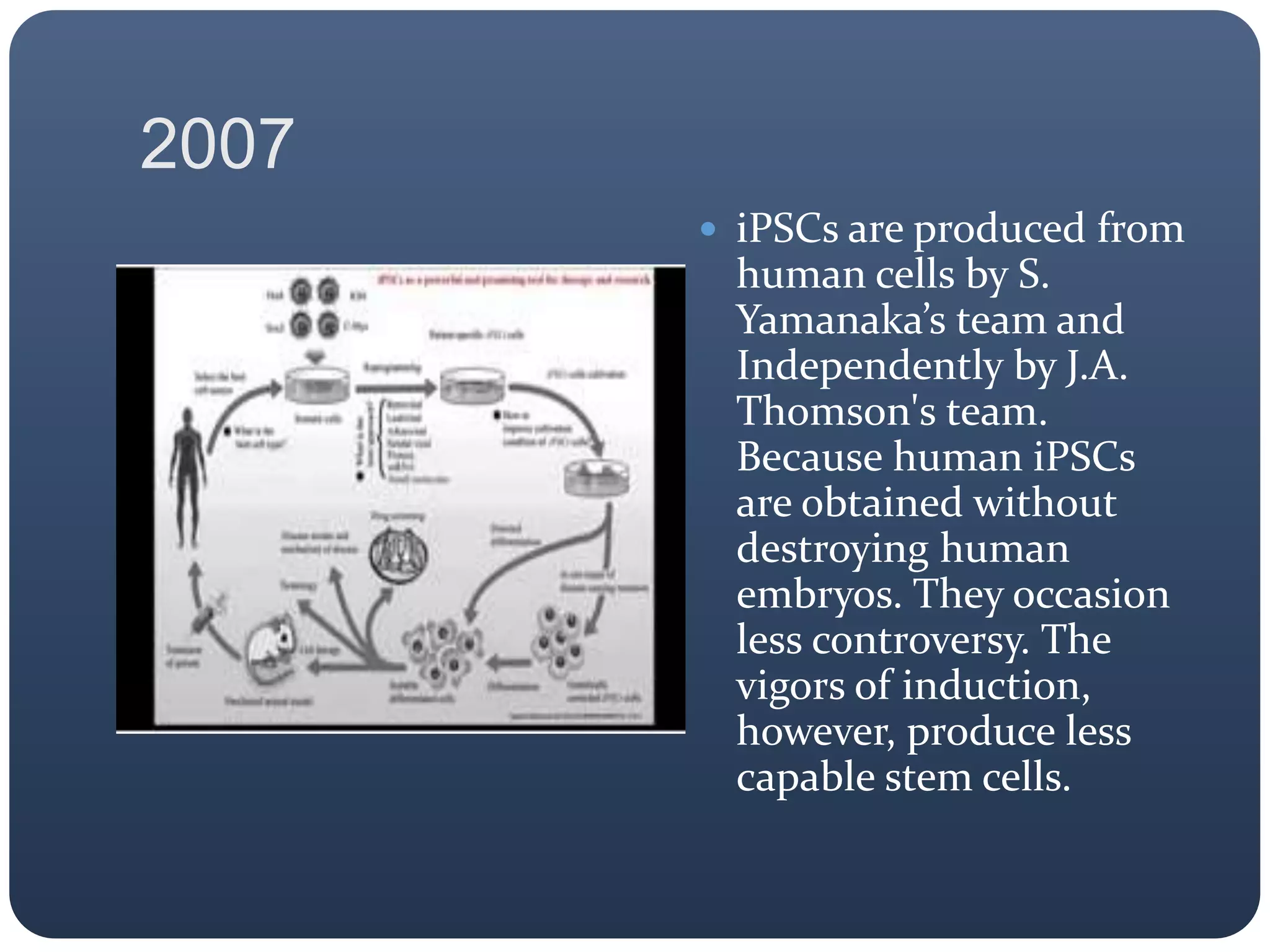
2007
 iPSCs are produced from
human cells by S.
Yamanaka’s team and
Independently by J.A.
Thomson's team.
Because human iPSCs
are obtained without
destroying human
embryos. They occasion
less controversy. The
vigors of induction,
however, produce less
capable stem cells.
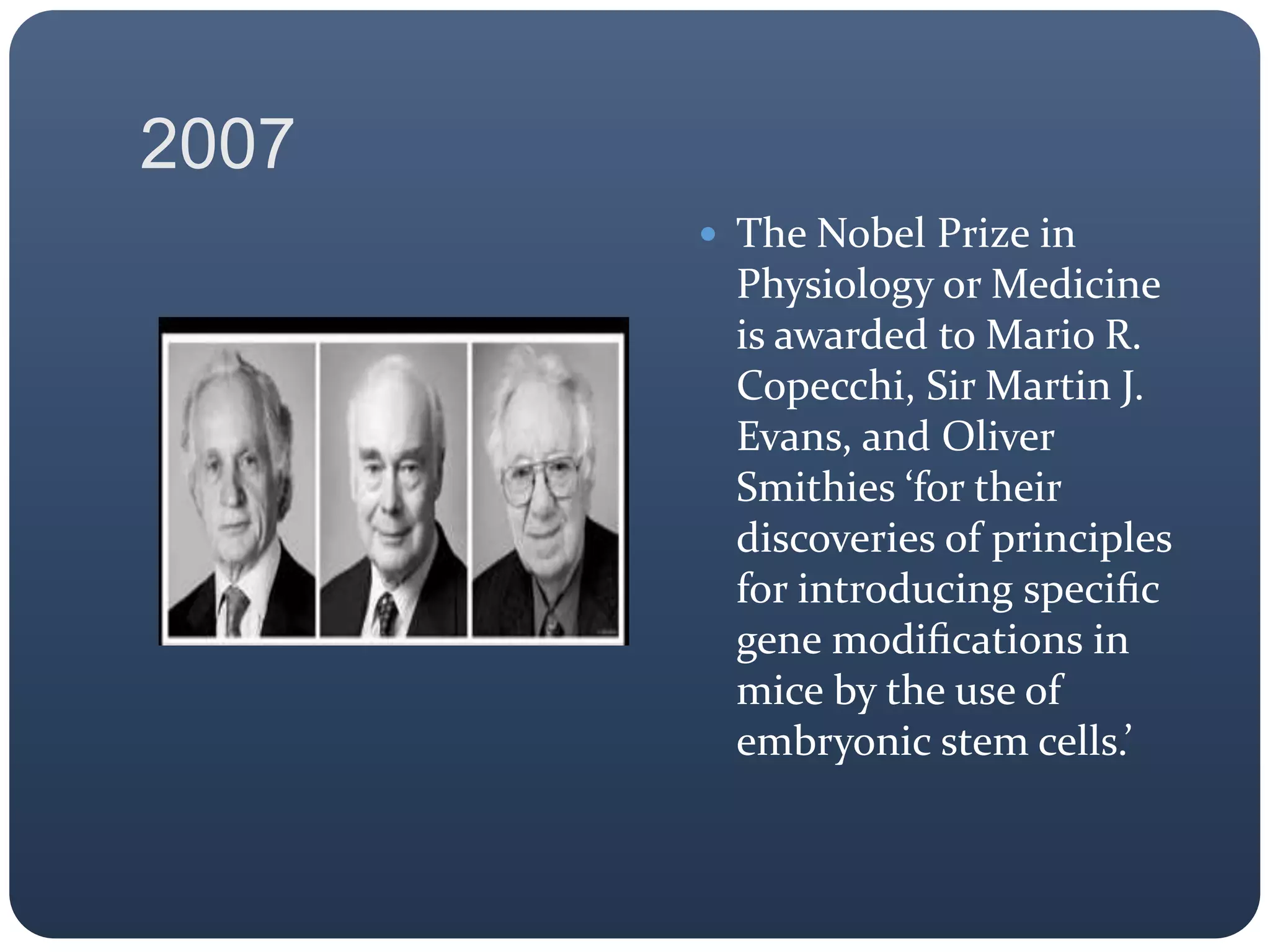
2007
 The Nobel Prize in
Physiology or Medicine
is awarded to Mario R.
Copecchi, Sir Martin J.
Evans, and Oliver
Smithies ‘for their
discoveries of principles
for introducing specific
gene modifications in
mice by the use of
embryonic stem cells.’
2010
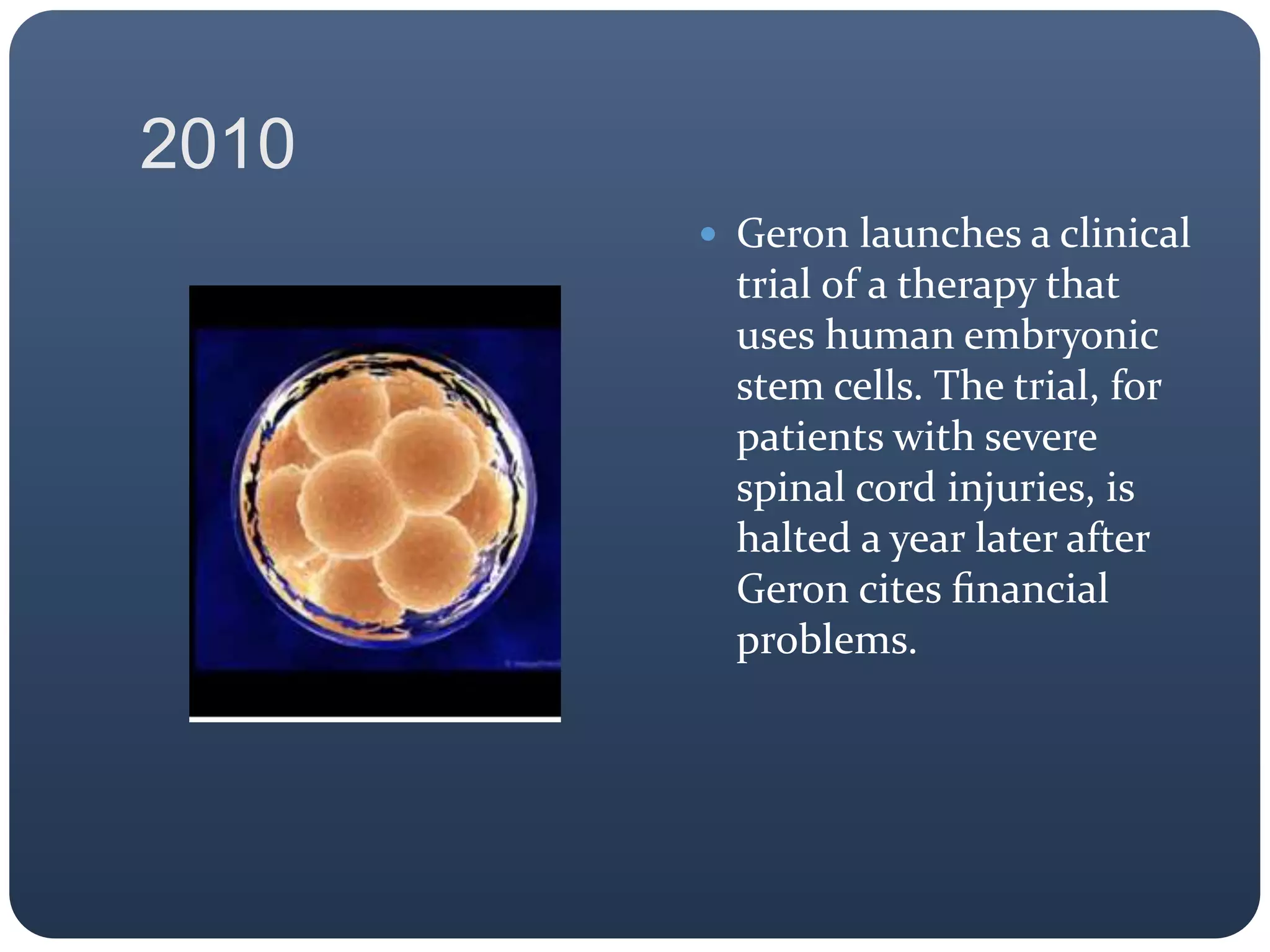
 Geron launches a clinical
trial of a therapy that
uses human embryonic
stem cells. The trial, for
patients with severe
spinal cord injuries, is
halted a year later after
Geron cites financial
problems.
2010
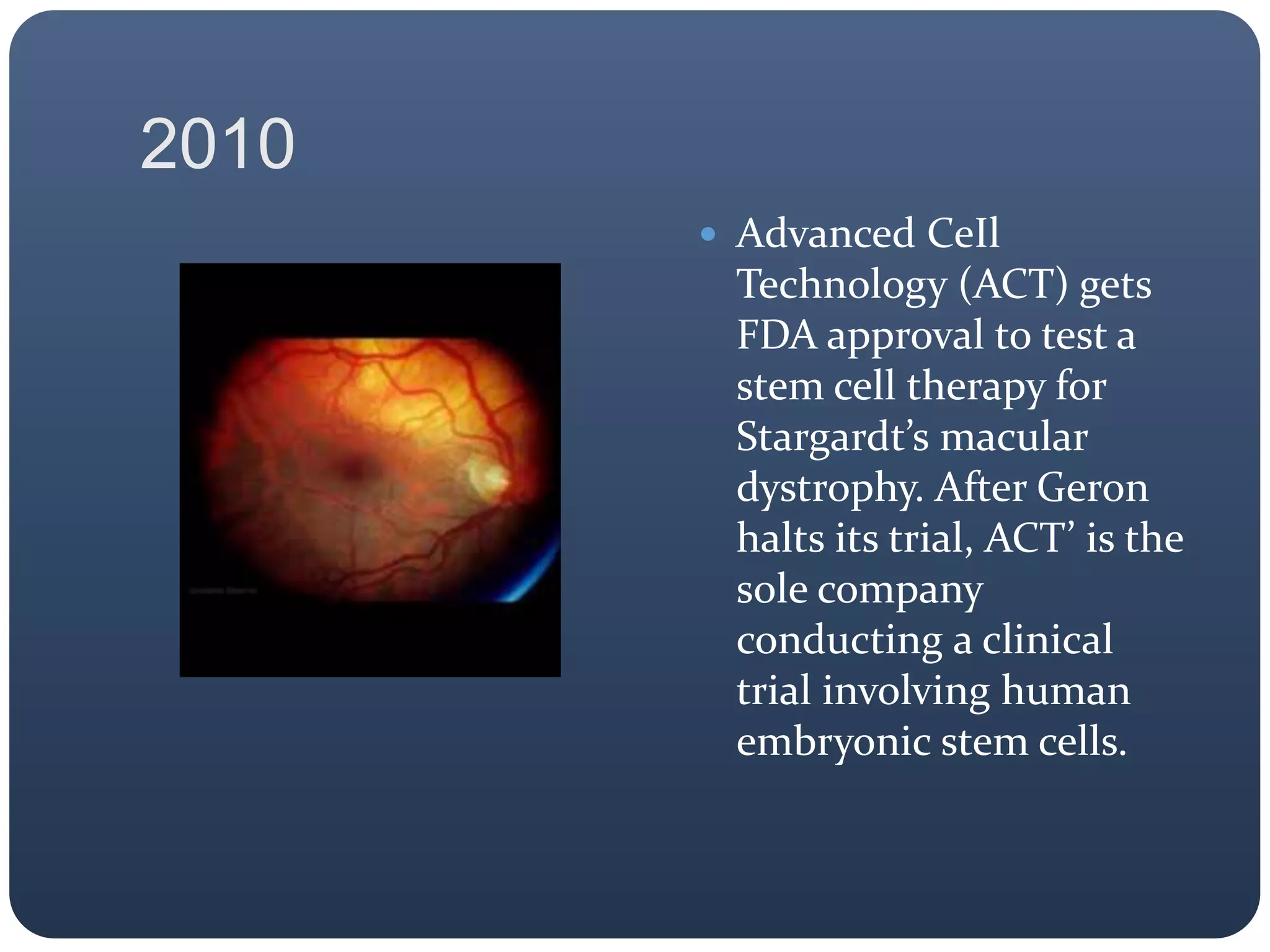
 Advanced CeIl
Technology (ACT) gets
FDA approval to test a
stem cell therapy for
Stargardt’s macular
dystrophy. After Geron
halts its trial, ACT’ is the
sole company
conducting a clinical
trial involving human
embryonic stem cells.
2011
 A federal judge dismisses
a lawsuit challenging the
NIH’s policy for funding
human embryonic stem
cell research. The
plaintiffs, adult stem cell
researchers had argued
that the NIH’s policy
promoted embryo
destruction.
2012
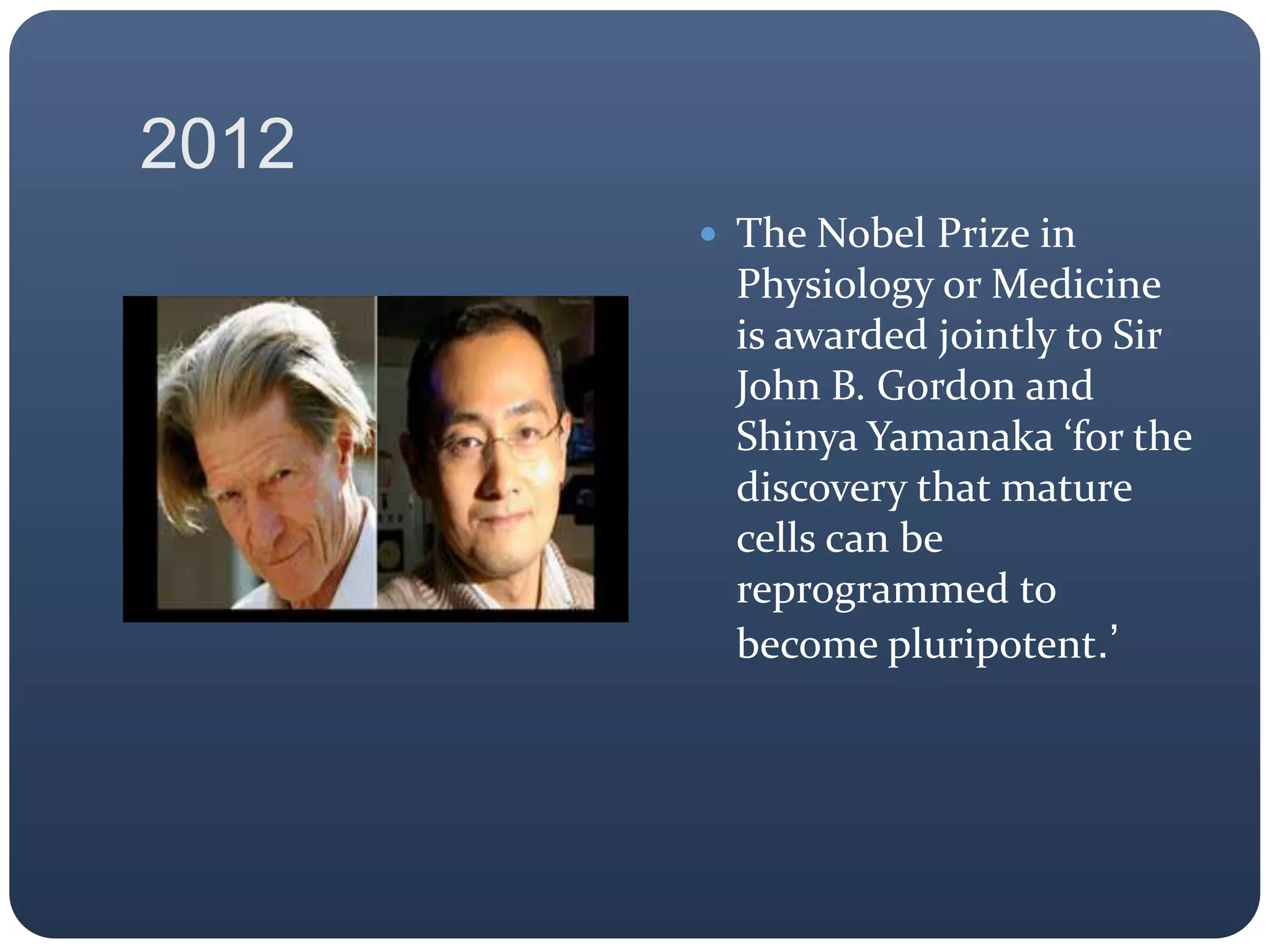
 The Nobel Prize in
Physiology or Medicine
is awarded jointly to Sir
John B. Gordon and
Shinya Yamanaka ‘for the
discovery that mature
cells can be
reprogrammed to
become pluripotent.’
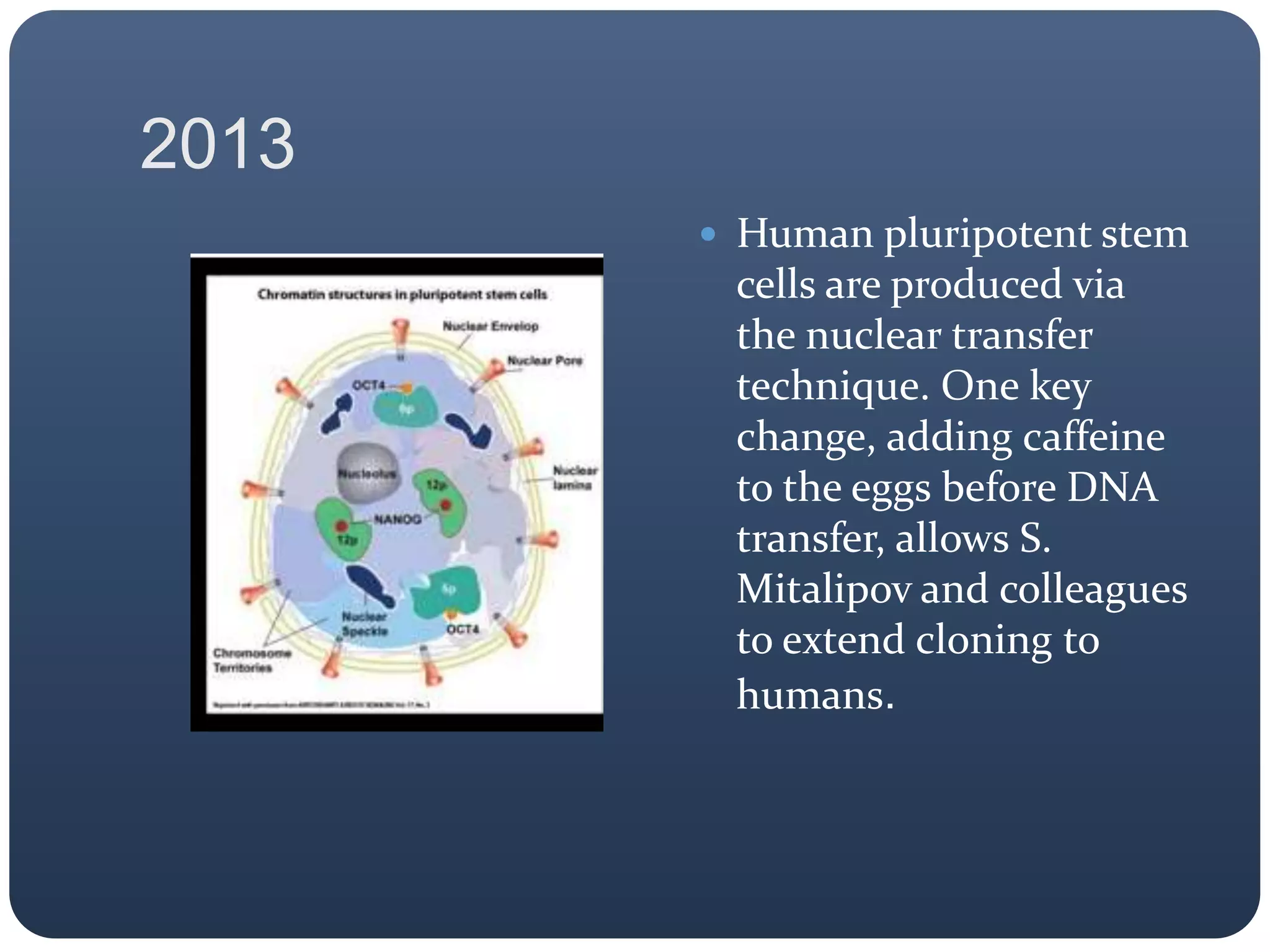
2013
 Human pluripotent stem
cells are produced via
the nuclear transfer
technique. One key
change, adding caffeine
to the eggs before DNA
transfer, allows S.
Mitalipov and colleagues
to extend cloning to
humans.
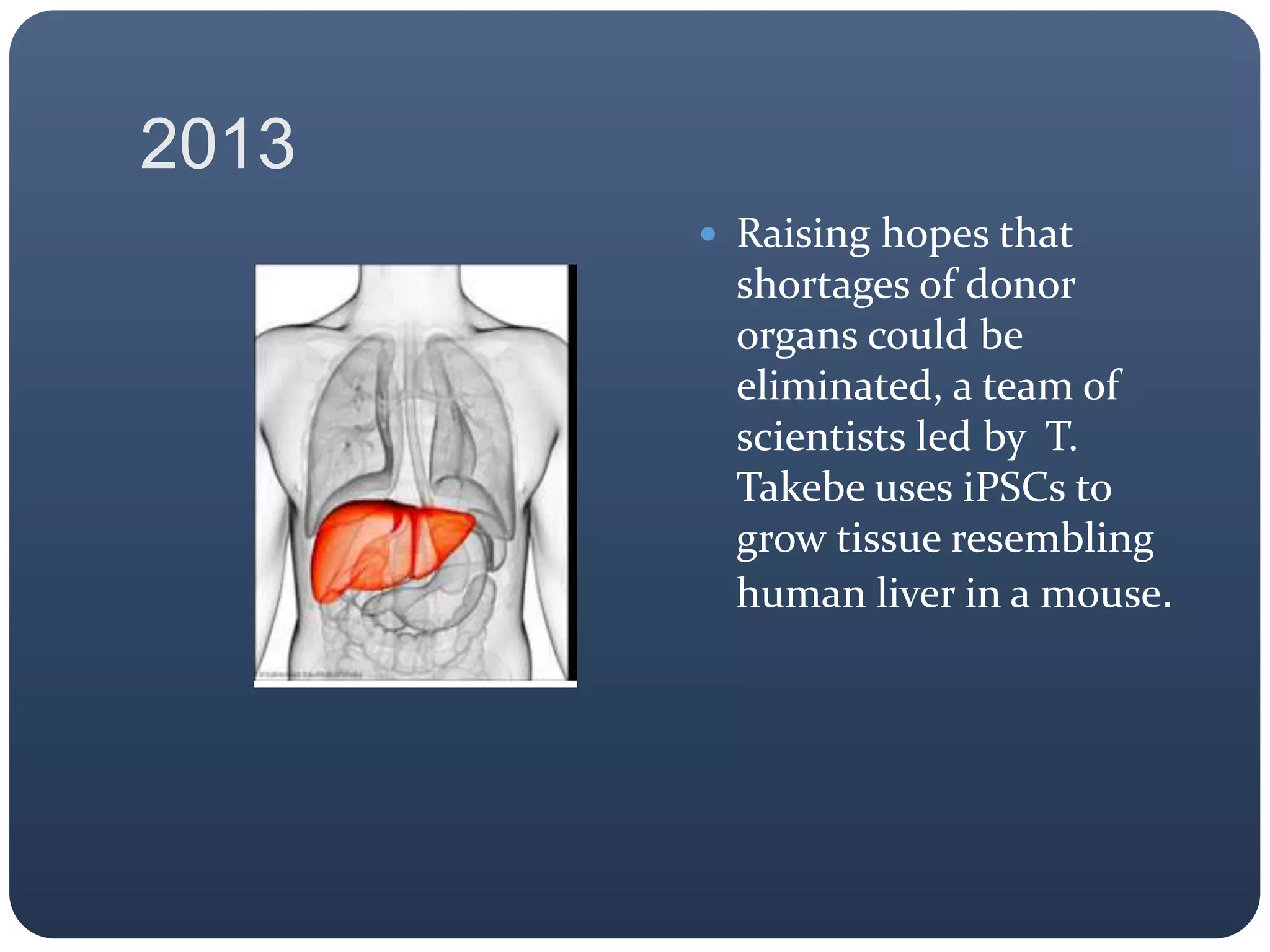
2013
 Raising hopes that
shortages of donor
organs could be
eliminated, a team of
scientists led by T.
Takebe uses iPSCs to
grow tissue resembling
human liver in a mouse.
2013
 In an advance that
anticipates future
commercial
applications, scientists
unveil a test-tube burger.
Made from bovine
skeleton stem cells, the
meat is costly, yet
proponents say that
mass production
remains a possibility.
Stem cell on history pages

Stem cell on history pages

  • 1.
    HARIS SADDIQUE M.PHIL SCHOLAR DEPTT:OF BIOTECHNOLOGY UNIVERSITY OF MALAKAND KPK,PAKISTAN STEM CELL ON HISTORY PAGES
  • 2.
    1950/51  Leon jacobsonand Egon lorenz show that mice can servive irradiation of their spleen are shielded or if bone marrow infusion are given. these results inspire additional studies, which suggest that spleen or bone marrow cells may reconstitute ravaged hematopoietic system
  • 3.
    1957  First humanbone marrow transplants are performed by E. Donnall Thomas and colleagues, in an attempt to cure patient dying of leukemia. This treatment called “intravenous infusion” is unsuccessful
  • 4.
    1959  E. DonnallThom and colleagues carryout bone marrow transplants between sets of identical twins. Two leukemia patients shows prompt hemoatologic recovery and well-being demonstrated that intravenous infusion of arrow can protect against lethal irradiation
  • 5.
    1960/61  Ernest McCullochand James Till show that stem cells self-renew and differentiate. Their technique, the colony forming unit spleen assay, is an early attempt to quantitate in vivo the immature cells in mouse bone-marrow that can reconstitute the hematopoietic system.
  • 6.
    1962  Using nuclear transplantation,John B. Gordon shows that cell specialization is reversible. He transfers the nucleus from a frogs mature intestinal cell into an enucleated egg, and the modified egg develops into a normal tadpole.
  • 7.
    1965/66  An invitro assay is developed for the identification and quantitation of hematopoietic protogenitor cells—the immature cells that arise directly from hematopoietic stem cells. Two teams-Bradley and Metcalf, and Pluznik and Sachs—develop the assay independently.
  • 8.
    1968/69  Mixed leukocyteculture, a test-tube-based assessment of Immune compatibility, enables the first two successful allogeneic bone marrow transplants. In each transplant (one by Fritz Bach's team, the other by Robert Good's team), a boy receives tissue from his sister.
  • 9.
    1977  A systemis developed to study hematopoiesis in vitro. This system becomes possible after TM. Dexter and colleagues realize that stromal cell support can be used to control the proliferation of hematopoietic stem cells in long-term culture.
  • 10.
    1979/81  Another transplant modality,peripheral blood stem cell transplantation, enters clinical use. Attempts by UCLA (1979) and the NIH (1980) fail, possibly because transfusions contain too few protogenitor cells. But 'Johns Hopkins (1981) provides first evidence of hemotopoietic reconstitution.
  • 11.
    1980/81  Mouse embryonicstem cells are established in culture. Martin Evans and Matthew Kaufman and, working independently, Gail Martin develop cell lines from the inner cell mass of blastocyst-stage embryos.
  • 12.
    1984  Hematopoietic stem cellsfrom mice are isolated from other bone marrow cells. To accomplish the task, J. Visser and colleagues utilize flow cytometry.
  • 13.
    1988  Using refinedcell- separation techniques, G. Spangrude. S. Heimfeld, and I. Weissman purify and characterize hematopoietic stem cells from mice.
  • 14.
    1988  Four embryonicstem cell lines are created from Mesocricetus auratus, the Syrian golden hamster. These lines, the first in vitro lines not derived from mice, anticipate an even greater diversification of stem cell sources.
  • 15.
    1988  Umbilical cordblood transplantation is used to treat a child with Fanconi anemia. This pioneering effort, led by Eliane Gluckman and Hal E. Broxmeyer, was eventually followed by thousands of cord blood transplants addressing a wide range of disorders.
  • 16.
    1990  The NobelPrize in Physiology or Medicine is awarded jointly to Joseph E. Murray and E. Donnall Thomas ‘for their discoveries concerning organ and cell transplantation in the treatment of human disease.’
  • 17.
    1995  Embryonic stemcells are derived from non human primates for the first time by J.A. Thomson and colleagues. This result, from rhesus monkeys and marmosets, raises expectations that such cells could be derived from humans.
  • 18.
    1996  Dolly, afemale sheep soon to be famous as the first cloned mammal, is born. Her creation, orchestrated by Ian Wilmut and colleagues, involves the transplant of a nucleus, taken from an adult sheep, into an enucleated egg.
  • 19.
    1998  The isolationof human embryonic stem cells is reported by J.A. Thomson and colleagues. Despite their enormous potential for research and treatment, human stem cell raise controversy because their derivation requires the destruction of human embryos.
  • 20.
    2000  The NIHpublishes guidelines for research using human pluripotent stem cells. The guidelines are intended to help ensure that ‘NIH- funded research in this area is conducted in an ethical and legal manner."
  • 21.
    2001  The UnitedKingdom becomes the first country to pass a law governing the use of human embryos for stem cell research.
  • 22.
    2006  Induced pluripotent stemcells (iPSCs) are produced from mouse cells by S. Yamanaka and K. Takahashi. The derivation is accomplished via the transfection of certain stem cell-associated genes into adult somatic cells.
  • 23.
    2007  iPSCs areproduced from human cells by S. Yamanaka’s team and Independently by J.A. Thomson's team. Because human iPSCs are obtained without destroying human embryos. They occasion less controversy. The vigors of induction, however, produce less capable stem cells.
  • 24.
    2007  The NobelPrize in Physiology or Medicine is awarded to Mario R. Copecchi, Sir Martin J. Evans, and Oliver Smithies ‘for their discoveries of principles for introducing specific gene modifications in mice by the use of embryonic stem cells.’
  • 25.
    2010  Geron launchesa clinical trial of a therapy that uses human embryonic stem cells. The trial, for patients with severe spinal cord injuries, is halted a year later after Geron cites financial problems.
  • 26.
    2010  Advanced CeIl Technology(ACT) gets FDA approval to test a stem cell therapy for Stargardt’s macular dystrophy. After Geron halts its trial, ACT’ is the sole company conducting a clinical trial involving human embryonic stem cells.
  • 27.
    2011  A federaljudge dismisses a lawsuit challenging the NIH’s policy for funding human embryonic stem cell research. The plaintiffs, adult stem cell researchers had argued that the NIH’s policy promoted embryo destruction.
  • 28.
    2012  The NobelPrize in Physiology or Medicine is awarded jointly to Sir John B. Gordon and Shinya Yamanaka ‘for the discovery that mature cells can be reprogrammed to become pluripotent.’
  • 29.
    2013  Human pluripotentstem cells are produced via the nuclear transfer technique. One key change, adding caffeine to the eggs before DNA transfer, allows S. Mitalipov and colleagues to extend cloning to humans.
  • 30.
    2013  Raising hopesthat shortages of donor organs could be eliminated, a team of scientists led by T. Takebe uses iPSCs to grow tissue resembling human liver in a mouse.
  • 31.
    2013  In anadvance that anticipates future commercial applications, scientists unveil a test-tube burger. Made from bovine skeleton stem cells, the meat is costly, yet proponents say that mass production remains a possibility.