ADULT STEM CELLS
AND
TRANSDIFFERENTIATION
Dr.Preethi
MD pathology 1st year postgraduate
Sree Balaji medical college
STEM CELLS
• Stem cells are those cells that have the capability of self renewal and
differentiation.
• When provided with appropriate stimuli ,stem cells differentiate into
one or more of the different types of specialised cells that are found
in tissues and organs
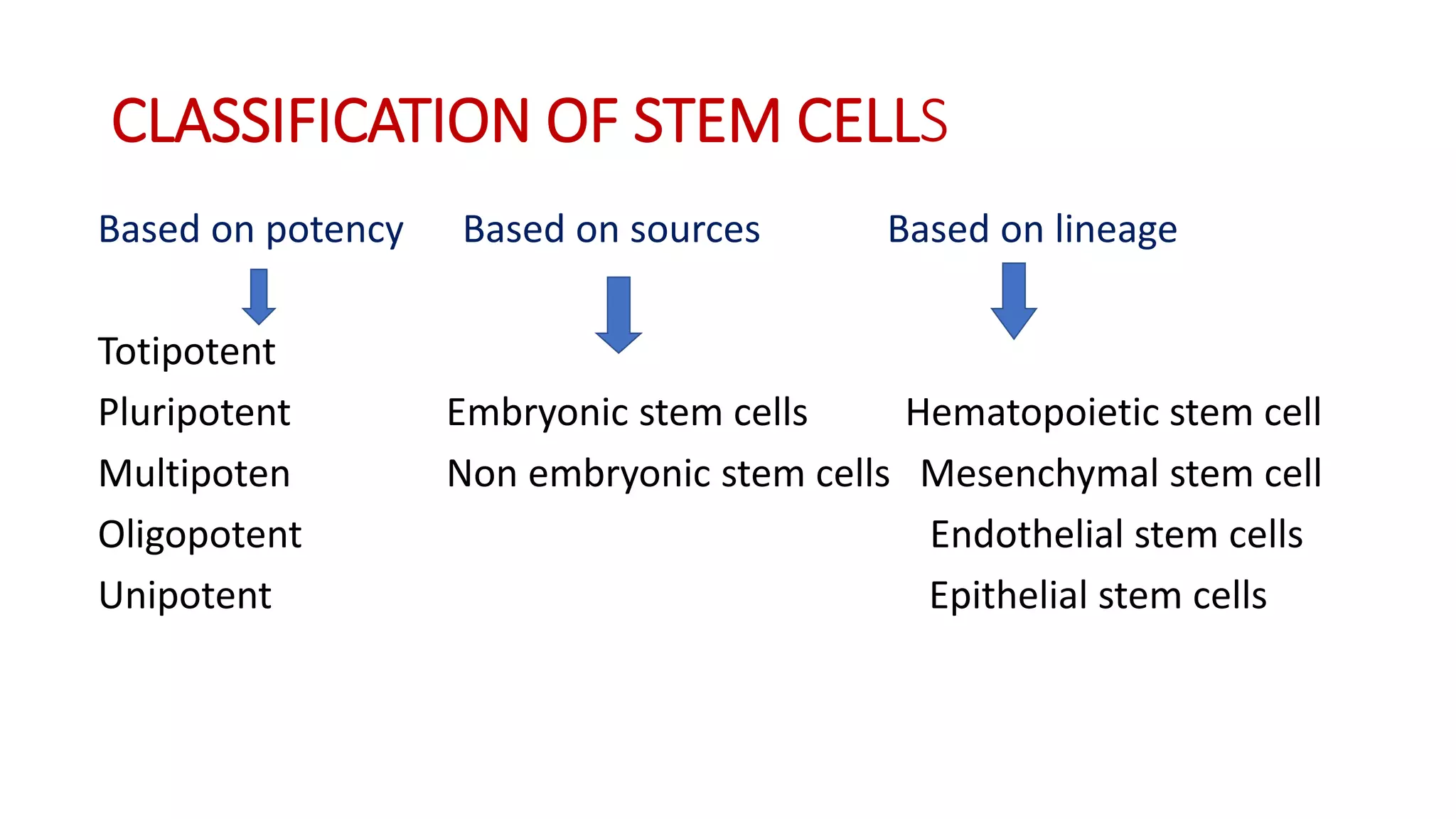
CLASSIFICATION OF STEM CELLS
Based on potency Based on sources Based on lineage
Totipotent
Pluripotent Embryonic stem cells Hematopoietic stem cell
Multipoten Non embryonic stem cells Mesenchymal stem cell
Oligopotent Endothelial stem cells
Unipotent Epithelial stem cells
Based on potency
• Totipotent – can differentiate into embryonic and extra embryonic cell
types ( zyogote to blastula )
• Pluripotent- can differentiate into nearly all cells ie. Cells derived from
any of the three germ layers ( embryonic stem cells )
• Multipotent – can differentiate into number of cells , but only those of
closely related family of cells ( either of the germ layers ) ( adult stem
cells such as HSCs)
• Oligopotent – stem cells differentiate into only a few cells , such as
lymphoid or myeloid stem cells
Based on
sources
• Embryonic stem cells :
 Five to six day old embryo
 Inner cell mass of a blastocyst
 Pluripotent
• Adult stem cell :
 Present in various tissues and
organs of adults and children.
 multipotent
stem cell niche
• A stem cell niche is defined as a
specific location in a tissue
where stem cells can reside for
an indefinite period of time
and produce progeny cells
while self renewing
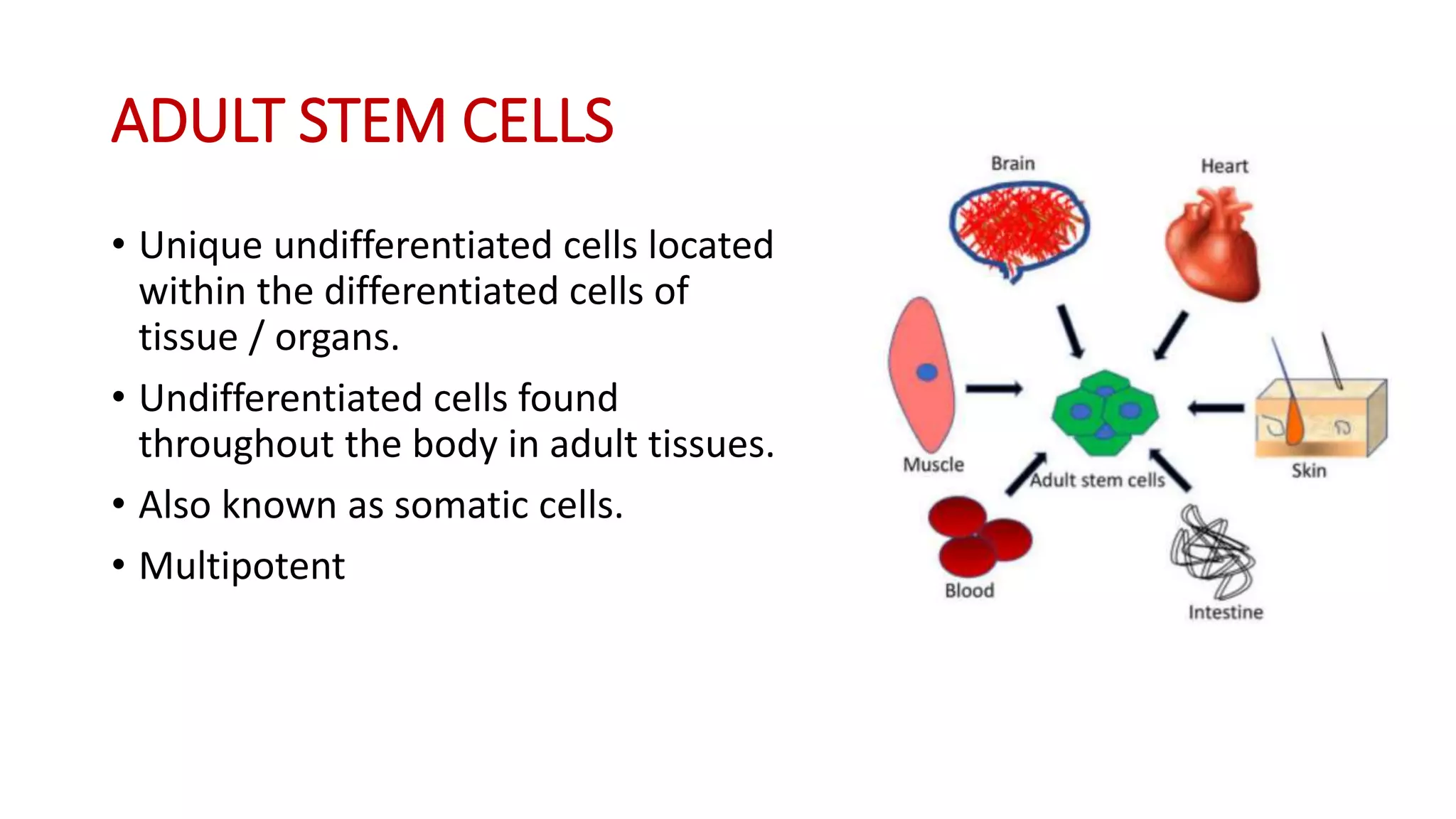
ADULT STEM CELLS
• Unique undifferentiated cells located
within the differentiated cells of
tissue / organs.
• Undifferentiated cells found
throughout the body in adult tissues.
• Also known as somatic cells.
• Multipotent
Role of adult stem cells
Four R’s
Repair Replace Regenerate Rejuvenate
Maternal sources of stem cells
• Placenta
• Menstrual blood
• Endometrial tissues
• Fallopian tube
• Breast tissue
• Breast milk
Advantages of adult stem cells
• Easy to isolate
• Less invasive / non invasive
• No ethical concern
• Highly plastic
Types of adult stem cells
• Hematopoietic stem cells
• Mesenchymal stem cells
• Neural stem cells
• Epithelial stem cells
• Skin stem cells
Isolation of stem cells
• Flow cytometry
A mixture of cells tagged by appropriate flurochrome labelled stem cell
markers is passed through a laser beam.
• Immunomagnetic beads based isolation method
Immunomagnetic beads coated with specific antibodies are for
isolation
Haematopoeitic stem cells
• Renew themselves
• differentiate into precursors
• produce specialised hematopoietic cells , including lymphocytes ,
dendritic and natural killer cells , megakaryocyte , erythrocytes,
granulocytes and macrophages.
• HSCs can be isolated from BM , PB and umbilical cord blood
• Human HSCs express CD34 ,CD108,THY 1 , CD 27,CD38, CD117.
Mesenchymal stem cells
• MSCs are multipotent stromal cells
that can be sourced from variety of
tissues including BM, adipose tissue ,
umbilical cord.
• Morphologically resemble fibroblast.
• They are adherent to plastic , express
certain cell surface markers CD 105, CD
75, CD 90.
• Initially shown to have the ability to be
directed to differentiate into variety of
specialised cell types of mesodermal
lineages including
osteoblasts,chondrocytes ,
adipocytes,tenocytes ,myocytes
• MSCs have potent trophic and anti inflammatory properties,
attributable to their ability produce growth factors ( VEGF,
IGF,HGF,prostaglandin E2)
• Suggest that they may also be directed into cells of ectoderm and
endoderm lineages
Induced pluripotent stem cells
• Adult stem cells can be reprogrammed
using genetic manipulation to become
embryo like IPSCs.
• Using retroviral or lentiviral tansfection to
introduce a combination of transcription
factors
• IPSCs proliferate in vitro as efficiently as
ESC and pluripotent.
• In Autologous they would not provoke on immunological rejection response.
• Donors are selected on basis of HLA type.
• One of the problems of reprogramming somatic stem cells to IPSCs using
retrovirus is the genomic integration of virus may lead to activation of oncogenes
genes , causing tumorigenesis.
• To reduce the risk non retrovirus such as adeno virus and sandai virus are used.
• Trandifferentiation means the conversion of stem cells from one
committed lineage to the other
• Eg :hematopoietic stem cells differentiating into brain cells ,skeletal
muscle cells , cardiac muscle cells and liver cells.
TRANSDIFFERENTIATION
Stem cell plasticity and the implications for
regenerative medicine
• While pluripotent and plasticity are considered properties of early
ESC,adult cells are traditionally thought to be restricted in their
differentiation potential to the progeny of the tissues in which they
reside.
• However ,a remarkable plasticity in differentiation potential of stem
cells derived from adult tissues was recently suggested.
• Bone marrow cells were reported to generate a wide spectrum of
different cell types like hepatocytes , endothelial ,myocardial
,neuronal and glial cells
• HSCs can produce cardiac myocytes and endothelial cells , functional
hepatocytes and epithelial cells of liver, gut ,lung,and skin
• MSCs can produce brain astrocytes.
• Despite examples of transdifferentiation events of adult stem cells
being reported , these findings are still controversial.
• Transdifferentiation has never been conclusively demonstrated in any
experimental setting .
Clinical applications of stem cells
• Hematopoietic reconstitution
• Regenerative medicine
• Gene therapy
• Immunotherapy
Adult stem cells in health and disease
Bone marrow transplantation
• HSCs were used in the treatment of
patients with haematological
malignancies
• During the course the patients
cancerous cells are destroyed
chemo / radiotherapy and
subsequently replaced with BM or
PB /G-CSF transplant from a HLA
matched donar.
• Allogenic transplants are also used in the treatment of hereditary
blood disorders
Aplastic anemia
Beta thalassemia
Wiskott Aldrich syndrome
SCID
• Inborn error metabolism disorders
Hunters syndrome
Hurlers syndrome
Bone marrow mononuclear cells ( BM –MNC) comprise of progenitor
and stem cells with pro angiogenesis and pro osteopenia properties.
Combination of autologous BM-MNCs and allogenic bone graft could
treat long bone pseudoarthrosis and non union by reproducing the
beneficial properties of autologous bone grafting while restricting its
disadvantages .
Stem cell therapy for non union fractures
Stem cell in avascular necrosis
• MSCs hav been applied for the re-growth of dead area of the femoral
head
• A common method of application has been by injection of bone
marrow concentrate.
Stem cell therapy
in cardiac muscle
• Regenerating ischaemic heart
disease can be achieved by delivering
culture expanded MSCs into the
coronary arteries or directly into
myocardium to expand the
endogenous regenerative pool.
• MSCs implantation for patients with
ST-elevation myocardial infarction.
• Stem cell therapy provide significant
reductions in myocardial infarct size
and better recovery rates.
Stem cell therapy in urinary tissues -bladder
• Cell based regeneration of bio engineered bladder has been reported
in several animal models
• Autologous urothelial and smooth muscle cells were cultured for six
weeks and then seeded on biodegradable 3D matrices.
• Thereafter , augmentation cystoplasty utilising engineered construct
is undertaken.
Stem cell therapy in spinal cord
• A strategy to increase axonal
regeneration could involve
transplantation of stem cells
into injured spinal cord.
• Bone marrow derived cells and
granulocyte macrophage
colony stimulating factor ( GM
CSF )
• Leads to proliferation of
endogenous neural stem cells.
Others
• Anemias
• Immunodeficiencies-including first successful human gene therapy
• Corneal scarring – generation of new corneas to restore sight
• Parkinson’s – retinal stem cells or patients own neural stem cells.
• Growth of new blood vessels – eg: preventing gangrene
• Gastrointestinal epithelia- regenerate damaged ulcerous tissue
• Skin – grafts grown from hair follicle stem cells,after plucking a few hairs
from patient.
Summary
• Stem cells can self renew and differentiate
• There are different kinds of stem cells like embryonic stem cells ,non
embryonic stem cells
• Sources of stem cells are from BM,PB and umbilical cord blood
• Transdifferentiation means conversion of stem cells from one
committed lineage to another .
• Regenerative medicine , gene therapy , immuno therapy are relatively
new but rapidly expanding fields in clinical application of stem cells.
Thank you
Reference
• Robbins basic pathology
• S.bajada,I.mazakova,B.A.Ashton,J.B.Richardson and N.Ashammakhi
stem cells in regenerative medicine.

Adult stem cells.pptx

  • 1.
    ADULT STEM CELLS AND TRANSDIFFERENTIATION Dr.Preethi MDpathology 1st year postgraduate Sree Balaji medical college
  • 2.
    STEM CELLS • Stemcells are those cells that have the capability of self renewal and differentiation. • When provided with appropriate stimuli ,stem cells differentiate into one or more of the different types of specialised cells that are found in tissues and organs
  • 3.
    CLASSIFICATION OF STEMCELLS Based on potency Based on sources Based on lineage Totipotent Pluripotent Embryonic stem cells Hematopoietic stem cell Multipoten Non embryonic stem cells Mesenchymal stem cell Oligopotent Endothelial stem cells Unipotent Epithelial stem cells
  • 4.
    Based on potency •Totipotent – can differentiate into embryonic and extra embryonic cell types ( zyogote to blastula ) • Pluripotent- can differentiate into nearly all cells ie. Cells derived from any of the three germ layers ( embryonic stem cells ) • Multipotent – can differentiate into number of cells , but only those of closely related family of cells ( either of the germ layers ) ( adult stem cells such as HSCs) • Oligopotent – stem cells differentiate into only a few cells , such as lymphoid or myeloid stem cells
  • 5.
    Based on sources • Embryonicstem cells :  Five to six day old embryo  Inner cell mass of a blastocyst  Pluripotent • Adult stem cell :  Present in various tissues and organs of adults and children.  multipotent
  • 6.
    stem cell niche •A stem cell niche is defined as a specific location in a tissue where stem cells can reside for an indefinite period of time and produce progeny cells while self renewing
  • 8.
    ADULT STEM CELLS •Unique undifferentiated cells located within the differentiated cells of tissue / organs. • Undifferentiated cells found throughout the body in adult tissues. • Also known as somatic cells. • Multipotent
  • 9.
    Role of adultstem cells Four R’s Repair Replace Regenerate Rejuvenate
  • 11.
    Maternal sources ofstem cells • Placenta • Menstrual blood • Endometrial tissues • Fallopian tube • Breast tissue • Breast milk
  • 13.
    Advantages of adultstem cells • Easy to isolate • Less invasive / non invasive • No ethical concern • Highly plastic
  • 14.
    Types of adultstem cells • Hematopoietic stem cells • Mesenchymal stem cells • Neural stem cells • Epithelial stem cells • Skin stem cells
  • 15.
    Isolation of stemcells • Flow cytometry A mixture of cells tagged by appropriate flurochrome labelled stem cell markers is passed through a laser beam. • Immunomagnetic beads based isolation method Immunomagnetic beads coated with specific antibodies are for isolation
  • 16.
    Haematopoeitic stem cells •Renew themselves • differentiate into precursors • produce specialised hematopoietic cells , including lymphocytes , dendritic and natural killer cells , megakaryocyte , erythrocytes, granulocytes and macrophages.
  • 18.
    • HSCs canbe isolated from BM , PB and umbilical cord blood • Human HSCs express CD34 ,CD108,THY 1 , CD 27,CD38, CD117.
  • 20.
    Mesenchymal stem cells •MSCs are multipotent stromal cells that can be sourced from variety of tissues including BM, adipose tissue , umbilical cord. • Morphologically resemble fibroblast. • They are adherent to plastic , express certain cell surface markers CD 105, CD 75, CD 90. • Initially shown to have the ability to be directed to differentiate into variety of specialised cell types of mesodermal lineages including osteoblasts,chondrocytes , adipocytes,tenocytes ,myocytes
  • 21.
    • MSCs havepotent trophic and anti inflammatory properties, attributable to their ability produce growth factors ( VEGF, IGF,HGF,prostaglandin E2) • Suggest that they may also be directed into cells of ectoderm and endoderm lineages
  • 22.
    Induced pluripotent stemcells • Adult stem cells can be reprogrammed using genetic manipulation to become embryo like IPSCs. • Using retroviral or lentiviral tansfection to introduce a combination of transcription factors • IPSCs proliferate in vitro as efficiently as ESC and pluripotent.
  • 23.
    • In Autologousthey would not provoke on immunological rejection response. • Donors are selected on basis of HLA type. • One of the problems of reprogramming somatic stem cells to IPSCs using retrovirus is the genomic integration of virus may lead to activation of oncogenes genes , causing tumorigenesis. • To reduce the risk non retrovirus such as adeno virus and sandai virus are used.
  • 24.
    • Trandifferentiation meansthe conversion of stem cells from one committed lineage to the other • Eg :hematopoietic stem cells differentiating into brain cells ,skeletal muscle cells , cardiac muscle cells and liver cells. TRANSDIFFERENTIATION
  • 25.
    Stem cell plasticityand the implications for regenerative medicine • While pluripotent and plasticity are considered properties of early ESC,adult cells are traditionally thought to be restricted in their differentiation potential to the progeny of the tissues in which they reside. • However ,a remarkable plasticity in differentiation potential of stem cells derived from adult tissues was recently suggested.
  • 26.
    • Bone marrowcells were reported to generate a wide spectrum of different cell types like hepatocytes , endothelial ,myocardial ,neuronal and glial cells • HSCs can produce cardiac myocytes and endothelial cells , functional hepatocytes and epithelial cells of liver, gut ,lung,and skin • MSCs can produce brain astrocytes.
  • 27.
    • Despite examplesof transdifferentiation events of adult stem cells being reported , these findings are still controversial. • Transdifferentiation has never been conclusively demonstrated in any experimental setting .
  • 28.
    Clinical applications ofstem cells • Hematopoietic reconstitution • Regenerative medicine • Gene therapy • Immunotherapy
  • 29.
    Adult stem cellsin health and disease
  • 30.
    Bone marrow transplantation •HSCs were used in the treatment of patients with haematological malignancies • During the course the patients cancerous cells are destroyed chemo / radiotherapy and subsequently replaced with BM or PB /G-CSF transplant from a HLA matched donar.
  • 31.
    • Allogenic transplantsare also used in the treatment of hereditary blood disorders Aplastic anemia Beta thalassemia Wiskott Aldrich syndrome SCID • Inborn error metabolism disorders Hunters syndrome Hurlers syndrome
  • 32.
    Bone marrow mononuclearcells ( BM –MNC) comprise of progenitor and stem cells with pro angiogenesis and pro osteopenia properties. Combination of autologous BM-MNCs and allogenic bone graft could treat long bone pseudoarthrosis and non union by reproducing the beneficial properties of autologous bone grafting while restricting its disadvantages . Stem cell therapy for non union fractures
  • 33.
    Stem cell inavascular necrosis • MSCs hav been applied for the re-growth of dead area of the femoral head • A common method of application has been by injection of bone marrow concentrate.
  • 34.
    Stem cell therapy incardiac muscle • Regenerating ischaemic heart disease can be achieved by delivering culture expanded MSCs into the coronary arteries or directly into myocardium to expand the endogenous regenerative pool. • MSCs implantation for patients with ST-elevation myocardial infarction. • Stem cell therapy provide significant reductions in myocardial infarct size and better recovery rates.
  • 35.
    Stem cell therapyin urinary tissues -bladder • Cell based regeneration of bio engineered bladder has been reported in several animal models • Autologous urothelial and smooth muscle cells were cultured for six weeks and then seeded on biodegradable 3D matrices. • Thereafter , augmentation cystoplasty utilising engineered construct is undertaken.
  • 36.
    Stem cell therapyin spinal cord • A strategy to increase axonal regeneration could involve transplantation of stem cells into injured spinal cord. • Bone marrow derived cells and granulocyte macrophage colony stimulating factor ( GM CSF ) • Leads to proliferation of endogenous neural stem cells.
  • 37.
    Others • Anemias • Immunodeficiencies-includingfirst successful human gene therapy • Corneal scarring – generation of new corneas to restore sight
  • 38.
    • Parkinson’s –retinal stem cells or patients own neural stem cells. • Growth of new blood vessels – eg: preventing gangrene • Gastrointestinal epithelia- regenerate damaged ulcerous tissue • Skin – grafts grown from hair follicle stem cells,after plucking a few hairs from patient.
  • 39.
    Summary • Stem cellscan self renew and differentiate • There are different kinds of stem cells like embryonic stem cells ,non embryonic stem cells • Sources of stem cells are from BM,PB and umbilical cord blood • Transdifferentiation means conversion of stem cells from one committed lineage to another . • Regenerative medicine , gene therapy , immuno therapy are relatively new but rapidly expanding fields in clinical application of stem cells.
  • 40.
  • 41.
    Reference • Robbins basicpathology • S.bajada,I.mazakova,B.A.Ashton,J.B.Richardson and N.Ashammakhi stem cells in regenerative medicine.