STEM
CELLS
contents
• Introduction
• Properties
• Potency
• Embryonic SC
• Adult SC
• Treatments
• Dental stem cells
• Research
• Conclusion
• References
Introduction
• Stem cells are biological cells that can differentiate into other types of
cells and can divide to produce more of the same type of stem cells.
• They are found in multicellular organisms.
• Stem cells playing a crucial role in homeostasis and tissue repair.
STEM CELL – DEFINITION
 A cell that has the ability to continuously divide
and differentiate (develop) into various other
kind(s) of cells/tissues
WHAT MAKES A CELL A STEMCELL?
• Plasticity: Stem cell - plastic, meaning - develop into another type of cell.
• Differentiation: Process where a stem cell specializes or develops into
another type of cell.
• Self-Renewal: Stem cell can divide (renew itself) indefinitely (go through
mitosis) & without always developing into another cell.
STEM CELL HISTORY
 1998 - Researchers first extract stem cells from human embryos
 1999 - First Successful human transplant of insulin-making cells from
cadavers
 2001 - President Bush restricts federal funding for embryonic stem- cell
research
 2002 - Juvenile Diabetes Research Foundation International creates $20
million fund-raising effort to support stem-cell research
 2004 - Harvard researchers grow stem cells from embryos using private
funding
WHAT ARE STEM CELLS?
• Stem cells - raw material from which all -
body’s mature, differentiated cells are made.
• Stem cells give rise - brain cells, nerve cells,
heart cells, pancreatic cells, etc.
MAJOR TYPES OF STEM CELLS
EMBRYONIC STEM CELLS
• Totipotent: cell can develop into all cell
cell types
• “Immortal”: can self-renew indefinitely
• Plentiful
ADULT STEM CELLS
• Multipotent: cell can develop into a
few cell types but not all
• Located in few organs or may be
unidentified
• Hard to find
STEM CELL – ARE DYNAMIC
 Undifferentiated
“master” cell that do not
yet have a specific
function
 Can change - one or several
different cell types
(differentiate) under proper
conditions
 Can undergo unlimited cell
division, self-renewal)
ONE CELL - SEVERAL LINEAGES
EMBRYOGENESIS AND DIFFERENTIATION
Specific regions of the embryo give rise to the specific organ systems
 Ectoderm generates - outer layer - embryo & produces - surface layer (epidermis) - skin
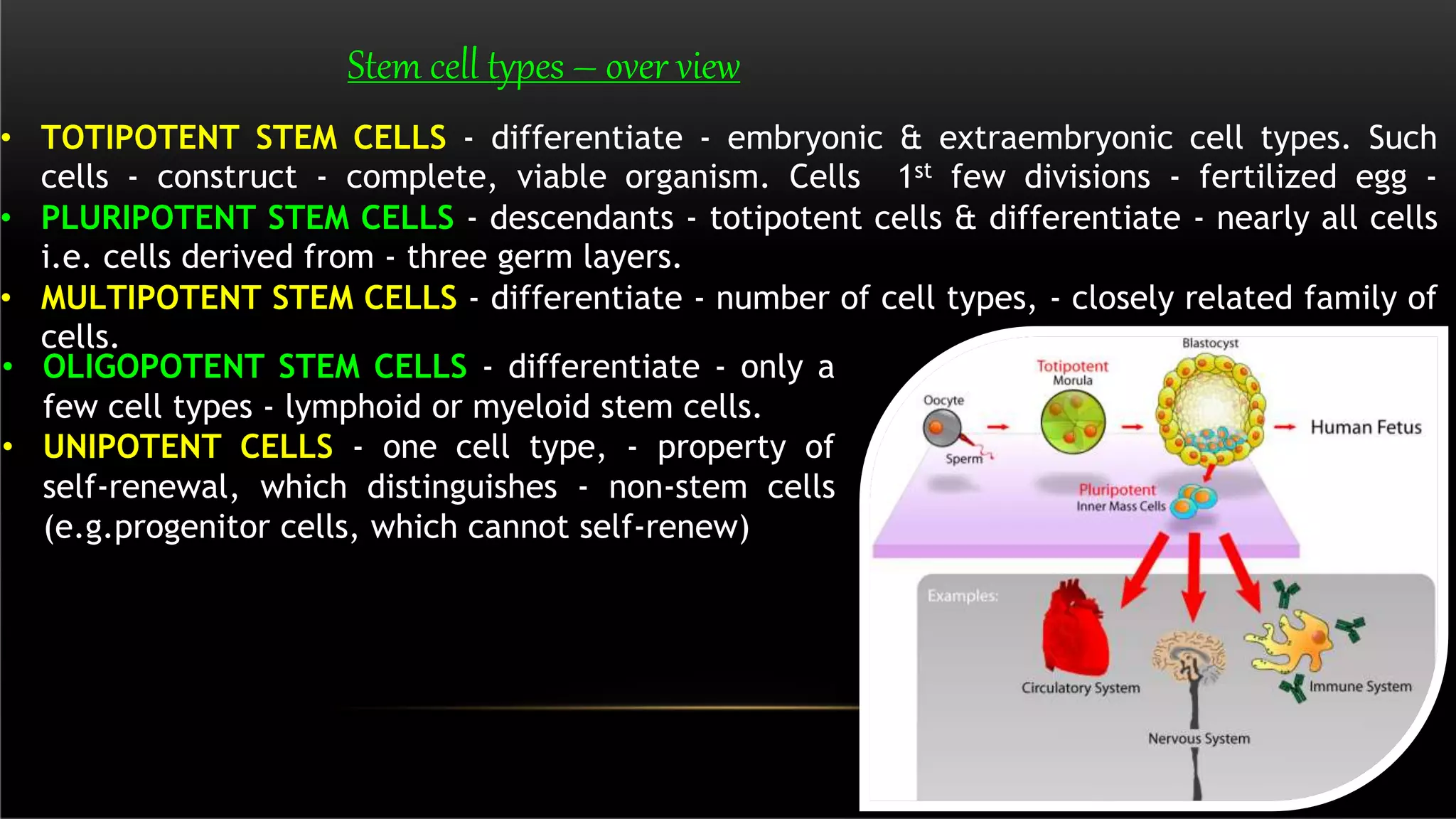
• TOTIPOTENT STEM CELLS - differentiate - embryonic & extraembryonic cell types. Such
cells - construct - complete, viable organism. Cells 1st few divisions - fertilized egg -
• PLURIPOTENT STEM CELLS - descendants - totipotent cells & differentiate - nearly all cells
i.e. cells derived from - three germ layers.
• MULTIPOTENT STEM CELLS - differentiate - number of cell types, - closely related family of
cells.
• OLIGOPOTENT STEM CELLS - differentiate - only a
few cell types - lymphoid or myeloid stem cells.
• UNIPOTENT CELLS - one cell type, - property of
self-renewal, which distinguishes - non-stem cells
(e.g.progenitor cells, which cannot self-renew)
Stem cell types – over view
THE SCIENCE OF STEM CELLS
 Stem cells - ability - continually reproduce themselves while maintaining
- capacity - give rise - other more specialized cells.
 Stem cells - found - all stages of development, from embryonic stem
(ES) cells that - differentiate - all specialized cells found - human body, to
adult stem cells capable - regenerating - tissue of origin.
 Stem cells occur - earliest stages - development & provide - starting
EMBRYONIC STEM (ES) CELLS
 ES cells - found - blastocyst stage, four - five
days after - union - sperm & egg, before -
embryo implants - uterus
19
ES CELLS - "PLURIPOTENT" - I.E. CAPABLE OF FORMING EMBRYONIC
TISSUES
 Stem cells - derived from autologous, allogeneic
or xenogeneic sources.
 Histocompatibility - prerequisite - transplantation
- allogeneic stem cells.
 Fetal tissue is the best current tissue source for
human neural stem cells, however ethical issues
are a major concern.
SOURCE OF STEM CELLS
PLACENTA A SOURCE OF STEM CELLS
 Placental stem cells - umbilical cord
blood & bone marrow stem cells, - used
to cure chronic blood-related disorders
such as sickle cell disease, Thalassemia,
& leukaemia.
UMBILICAL CORD BLOOD STEM CELL TRANSPLANT
 Umbilical cord blood stem cell transplants -
less prone to rejection than either bone marrow
or peripheral blood stem cells.
 This is probably because - cells have not yet
developed - features - recognized & attacked -
recipient's immune system
• They have the potential to replace cell tissue that
has been damaged or destroyed by severe
illnesses.
• They can replicate themselves over and over for a
very long time.
• Understanding how stem cells develop into healthy
and diseased cells will assist the search for cures.
WHAT’S SO SPECIAL ABOUT STEM CELLS?
EMBRYONIC STEM CELLS
• Researchers extract stem cells - 5-7 days old blastocyst.
• Stem cells - culture - form more - own kind, thereby creating a stem cell
line.
• The research aims to induce these cells to generate healthy tissue needed
by patients.
• Adult stem cells - somatic or body stem cells.
• Some researchers - adult because - found after an
embryo develops - fetus & no longer - ESC.
• Some organs - believed - lack stem cells & replace dead
cells - mitosis.
ADULT STEM CELLS
• Adult stem cells develop into a few cell types.
• These Multipotent cells - used - bone-marrow
transplants & develop - all the blood cells.
• These cells - important, but some organs may not
have adult stem cells & these cells - difficult to find.
ADULT STEM CELLS
AUTOLOGOUS – STEM CELLS
 Sources - patient's own stem cells (autologous) - either
the cells from patient's own blood or bone marrow.
 For autologous transplants physicians - collect stem
cells - peripheral blood rather than the marrow.
 This procedure is easier, unlike a bone marrow
harvest.
 Sources of stem cells from another donor
(allogeneic) are primarily relatives (familial-
allogeneic) or completely unrelated donors
(unrelated-allogeneic).
 The stem cells in this situation are extracted from
either the donor's body or cord blood
ALLOGENEIC – STEM CELLS
• Stem cells from different species -
transplanted, e.g. striatal porcine fetal ventral
mesencephalic (FVM) xenotransplants for
Parkinson's disease.
• This has no major ethical concerns and a large
amount of tissue is available, however life
long immunosupression and risk of rejection
are the major limitations.
XENOGENEIC - STEM CELLS
HOW DOES CELL THERAPY WORK?
 Bone marrow transplants - example of cell therapy - donor's marrow
- used to replace - blood cells - victims of leukemia.
 Cell therapy - used in experiments - graft new skin cells to treat serious
burn victims, & grow new corneas for - sight-impaired.
 Goal is for the healthy cells to become integrated into body & begin -
function like pt's own cells.
MAJOR PROGRESS IN SEVERAL IMPORTANT HEALTH PROBLEMS
 Alzheimer’s
disease
 Parkinson’s
disease
 Spinal cord
injury
 Heart disease
 Severe burns
 Diabetes
ALZHEIMER’S DISEASE AND CAN STEM CELLS HELP?
 Stem cells could, however, be genetically
modified so as to deliver substances -
Alzheimer brain, to stop cells from dying &
stimulate - function of existing cells.
 A recent clinical trial - approach - some benefit
– pt's - Alzheimer’s disease, by slowing down -
progression - disease.
DRUG TESTING
Stem cells - allow scientists - test new drugs - human cell
line which could speed up new drug development.
Only drugs - safe & had beneficial effects - cell line
testing would graduate to whole animal or human
testing.
It would allow quicker & safer development - new
drugs.
STEM CELLS ACT AS PROGENITOR CELLS
 In adult organisms, stem cells and
progenitor cells act as a repair system for
APPLICATIONS OF STEM CELLS
Cell ReplacementTherapies
 Cells - stimulated - develop - specialized cells - represent renewable
sources - cells & tissue - transplantation.
 Cell replacement therapy could treat injuries & various genetic &
degenerative conditions including muscular dystrophies, retinal
degeneration, Alzheimer disease, Parkinson's disease, arthritis,
diabetes, spinal cord injuries, & blood disorders such as hemophilia.
DEVELOPMENT AND TESTING OF DRUGS
 Researchers could study the beneficial
and toxic effects of new medications on
human pluripotent stem cells that have
been developed to mimic the disease
processes.
57
STEM CELLS – BLINDNESS
 In clinical trials - Moorfields Eye Hospital in
London, surgeons restored eye sight - six
patients - after chemical accidents & genetic
diseases.
 Patients - successful stem-cell transplant.
 Treatment - known as limbal stem cell therapy.
 By replacing - limbal stem cells, the cornea
begins to clear up as the cells - replaced -
Anatomy of dental pulp
• Dental pulp - centre of a tooth - living soft tissue & cells - odontoblasts.
• The central region - coronal & radicular pulp contains large nerve trunks & blood
vessels.
• This area is lined peripherally - aspecialized odontogenic area - four layers –zone of
odontoblastic layer, cell free zone, cell rich zone & Pulpal core.
Dental stem cells
• During tooth formation, interactions b/n epithelial & dental papilla cells promote tooth
morphogenesis by stimulating a subpopulation of mesenchymal cells to differentiate into
odontoblasts - form primary dentin.
• These odontoblasts - thought to arise - proliferation & differentiation - precursor
population, residing somewhere within the pulp tissue.
Types of dental stem cells
At least five different types of postnatal mesenchymal stem cells have been
reported to differentiated to odontoblast-like cells.
1. Dental pulp stem cells(DPSC)
2. Dental pulp of human exfoliated deciduous teeth(SHED)
3. Stem cells of apical papilla(SCAP)
4. Dental follicle progenitor cells(DFPC)
5. Bone marrow-derived mesenchymal stem cells(BMMCS)
1. Dental pulp stem cells: (DPSCs)
• 1.Dental pulp stem cells: (DPSCs) - adult cell colony - potent capacity - self-
renewing & multilineage differentiation.
• Origin - DPSCs – not - determined & seem to be - source of odontoblasts -
contribute - dentin-pulp complex.
• Some studies - DPSCs - producing dental tissues in vivo including dentin, pulp, &
crown-like structures.
• Theoretically, a bio-tooth made from autogenous DPSCs should be the best choice
2. Dental pulp of human exfoliated deciduous teeth
• Multipotent stem cells - human exfoliated deciduous teeth (SHED).
• Highly proliferative, clonogenic cells capable – differentiating - variety of
cell types including neural cells, adipocytes, and odontoblasts.
• Thus, exfoliated teeth may be - unexpected unique resource - stem-cell
therapies including autologous stem-cell transplantation & tissue
engineering.
3. Stem cells of apical papilla
• A unique population - dental stem cells known as (SCAP) - islocated - tips -
growing tooth roots .
• Apical papilla tissue - present during root development before - tooth
erupts - oral cavity.
• SCAP - capacity - differentiate – odontoblasts and adipocytes.
• These cells - CD24+ but expression - downregulated upon odontogenic
differentiation – in vitro coincident with alkaline phosphatase upregulation.
4. Dental follicle progenitor cells
• Dental follicle - loose ectomesenchyme-derived connective tissue sac
surrounding - enamel organ & dental papilla - developing tooth germ
before eruption.
• It is believed - contain progenitors for cementoblasts, PDL & osteoblasts.
• Dental follicle cells (DFC) form - PDL - differentiating - PDL fibroblasts -
secrete collagen & interact - fibres - surfaces of adjacent bone &
cementum
5. Bone marrow derived cells
• BMDCs - potential - engraft - several tissues after injury, but - dental
tissue-specific progenitor cells - normal conditions & relationship - cells
to the tissue-resident cells - unknown.
• Bone marrow progenitor cells communicate - dental tissues & become
tissue-specific mesenchymal progenitor cells - maintain tissue
homeostasis.
INDICATIONS
Dental tissue repair:
• Dental stem cells - currently considered - potential for tissue regeneration.
• Repair damaged tooth tissues - dentine, PDL & dental pulp.
• Even enamel tissue engineering - suggested as well as - use of dental stem
cells as sources of cells to facilitate repair of non-dental tissues – bone.
2.Periodontal regeneration:
• Periodontium - set - specialized tissues - surround & support - teeth to maintain
them - jaw.
• Periodontitis - inflammatory disease - irreversible loss - CT attachment &
supporting alveolar bone.
• One aim of current research - dental stem cells - replicate - key events -
periodontal development both temporally & spatially, so that healing can occur
- sequential manner to regenerate the periodontium.
3.Regeneration of dental pulp
• Dental pulp needs – removed - infected, and particularly - root
pulp - requires endodontic treatment.
• A recent study demonstrated denovo regeneration of dental pulp
in emptied root canal space using dental stem cells .
4. Whole tooth regeneration
• Current state - tooth replacement - dental implant - screwing a threaded
metal rod - predrilled hole in the bone - capped - plastic or ceramic
crown.
• Implants attach directly - bone without - PDL ‘shock absorber’ - forces -
mastication - transmitted directly – bone - one reason implants can fail.
• In case - insufficient bone for implants, such as tooth loss - consequence
- bone loss - occurs - postmenopausal osteoporosis, implants - preceded -
bone grafts.
• Ultimate goal - biologically replace lost teeth.
Techniques:
A. Idea - take adult stem cells - cell culture - programmed - develop - teeth &
transplanted - patients jaw - gap.
Placement tooth grows - happens - humans grow - original adult teeth.
Two - three months - tooth - fully develop.
Cost - more than existing treatments - attractive - other technologies such as
implants & dentures.
B. Tooth bud - implanted - jaw & gum stitched.
They - not started human clinical trials yet, however - expect - procedure - less
tooth extraction & requirements – post procedure - would be similar.
After implantation - takes - tooth about 3weeks - set - jaw of a mouse.
As long as - tooth - not under heavy load, it sets well.
Technology - grow replacement teeth - end of dentures.
Advantages.
1. It provides medical benefits - fields of therapeutic cloning & e-generative
medicine.
2. It provides great potential - treatments & cures - plethora of diseases including
Parkinsons disease, schizophrenia, Alzheimers disease, cancer, spinal cord injuries,
diabetes & many others
3. Regenerated pulp - re-build - damaged tooth from – inside.
4. Tooth - regenerated pulp - require markedly smaller restorations
5. Tooth - regenerated pulp - uphold the proprioceptive function - tooth
Disadvantages:
1. Use - ESC - destruction - blastocysts - laboratory- fertilized human eggs.
2. Like any other new technology, it is also completely unknown what the
long-term effects – interference - nature could materialize.
3. These are derived from embryos - not a patients own & patients immunity -
reject them.
POSSIBLE USES OF STEM CELL TECHNOLOGY
 Replaceable
tissues/organs
 Repair of defective cell types
 Delivery of genetic
therapies
 Delivery chemotherapeutic
agents
63
OBSTACLES OF STEM CELL RESEARCH
How to find the right type of stem cells?
How to put the stem cells into the right place?
Will the stem cells perform the desired function in the
body?
Differentiation protocols for many cell types have not
been developed.
• If stem cells have such potential to relieve
suffering, why are so many people so upset
about their use?
• The reason is that the most powerful type of
stem cell - embryonic stem (ES) cells - can only
be obtained from human embryos.
• Many people think that it's wrong to create and
destroy human embryos to treat disease
DESTROYING LIFE TO CURE SOME ONE – ETHICAL ?
FUTURE APPLICATIONS
Stem Cells may one day help scientists to regenerate cells lost in
diseases like:
• Repair heart muscle after a heart attack
• Pancreas cells lost in diabetes
• Neurons lost in Alzheimer’s
• Retinal cells causing blindness
• Understand the cell growths of cancers
• Help organ transplantation
conclusion
• Stem cells derived from all sources hold immense medical promises.
• Stem cell therapies have virtually unlimited medical & dental
applications.
• While there are several barriers that need to be broken down before this
novel therapy can be translated from lab to clinics, it is certain that the
future is going to be exciting for all of us.
References
1. Dental and skeletal stem cells : Potential cellular therapeutics for craniofacial
regeneration; Journal of Dental education, 2002; Vol. 66 (6): 766-773.
2. Stem cell based tissue engineering of murine teeth; J Dent Research, 2004; 83(7): 518-
522.
3. Mesenchymal stem cells acquire characteristics of cells in the periodontal ligament in
vitro; J Dent Research 2004; 83(1): 27-34.
4. Stem cells in craniofacial and dental tissue engineering; Orthod Craniofacial Res, 2005; 8:
54-59.
5. SHED: Stem cells from human exfoliated deciduous teeth: PNAS, 2003; 100 (10): 5807–

Stem cells & related treatments modalities

  • 1.
  • 2.
    contents • Introduction • Properties •Potency • Embryonic SC • Adult SC • Treatments • Dental stem cells • Research • Conclusion • References
  • 3.
    Introduction • Stem cellsare biological cells that can differentiate into other types of cells and can divide to produce more of the same type of stem cells. • They are found in multicellular organisms. • Stem cells playing a crucial role in homeostasis and tissue repair.
  • 4.
    STEM CELL –DEFINITION  A cell that has the ability to continuously divide and differentiate (develop) into various other kind(s) of cells/tissues
  • 5.
    WHAT MAKES ACELL A STEMCELL? • Plasticity: Stem cell - plastic, meaning - develop into another type of cell. • Differentiation: Process where a stem cell specializes or develops into another type of cell. • Self-Renewal: Stem cell can divide (renew itself) indefinitely (go through mitosis) & without always developing into another cell.
  • 6.
    STEM CELL HISTORY 1998 - Researchers first extract stem cells from human embryos  1999 - First Successful human transplant of insulin-making cells from cadavers  2001 - President Bush restricts federal funding for embryonic stem- cell research  2002 - Juvenile Diabetes Research Foundation International creates $20 million fund-raising effort to support stem-cell research  2004 - Harvard researchers grow stem cells from embryos using private funding
  • 7.
    WHAT ARE STEMCELLS? • Stem cells - raw material from which all - body’s mature, differentiated cells are made. • Stem cells give rise - brain cells, nerve cells, heart cells, pancreatic cells, etc.
  • 8.
    MAJOR TYPES OFSTEM CELLS EMBRYONIC STEM CELLS • Totipotent: cell can develop into all cell cell types • “Immortal”: can self-renew indefinitely • Plentiful ADULT STEM CELLS • Multipotent: cell can develop into a few cell types but not all • Located in few organs or may be unidentified • Hard to find
  • 9.
    STEM CELL –ARE DYNAMIC  Undifferentiated “master” cell that do not yet have a specific function  Can change - one or several different cell types (differentiate) under proper conditions  Can undergo unlimited cell division, self-renewal)
  • 10.
    ONE CELL -SEVERAL LINEAGES
  • 11.
    EMBRYOGENESIS AND DIFFERENTIATION Specificregions of the embryo give rise to the specific organ systems  Ectoderm generates - outer layer - embryo & produces - surface layer (epidermis) - skin
  • 12.
    • TOTIPOTENT STEMCELLS - differentiate - embryonic & extraembryonic cell types. Such cells - construct - complete, viable organism. Cells 1st few divisions - fertilized egg - • PLURIPOTENT STEM CELLS - descendants - totipotent cells & differentiate - nearly all cells i.e. cells derived from - three germ layers. • MULTIPOTENT STEM CELLS - differentiate - number of cell types, - closely related family of cells. • OLIGOPOTENT STEM CELLS - differentiate - only a few cell types - lymphoid or myeloid stem cells. • UNIPOTENT CELLS - one cell type, - property of self-renewal, which distinguishes - non-stem cells (e.g.progenitor cells, which cannot self-renew) Stem cell types – over view
  • 13.
    THE SCIENCE OFSTEM CELLS  Stem cells - ability - continually reproduce themselves while maintaining - capacity - give rise - other more specialized cells.  Stem cells - found - all stages of development, from embryonic stem (ES) cells that - differentiate - all specialized cells found - human body, to adult stem cells capable - regenerating - tissue of origin.  Stem cells occur - earliest stages - development & provide - starting
  • 14.
    EMBRYONIC STEM (ES)CELLS  ES cells - found - blastocyst stage, four - five days after - union - sperm & egg, before - embryo implants - uterus 19
  • 15.
    ES CELLS -"PLURIPOTENT" - I.E. CAPABLE OF FORMING EMBRYONIC TISSUES
  • 16.
     Stem cells- derived from autologous, allogeneic or xenogeneic sources.  Histocompatibility - prerequisite - transplantation - allogeneic stem cells.  Fetal tissue is the best current tissue source for human neural stem cells, however ethical issues are a major concern. SOURCE OF STEM CELLS
  • 17.
    PLACENTA A SOURCEOF STEM CELLS  Placental stem cells - umbilical cord blood & bone marrow stem cells, - used to cure chronic blood-related disorders such as sickle cell disease, Thalassemia, & leukaemia.
  • 18.
    UMBILICAL CORD BLOODSTEM CELL TRANSPLANT  Umbilical cord blood stem cell transplants - less prone to rejection than either bone marrow or peripheral blood stem cells.  This is probably because - cells have not yet developed - features - recognized & attacked - recipient's immune system
  • 19.
    • They havethe potential to replace cell tissue that has been damaged or destroyed by severe illnesses. • They can replicate themselves over and over for a very long time. • Understanding how stem cells develop into healthy and diseased cells will assist the search for cures. WHAT’S SO SPECIAL ABOUT STEM CELLS?
  • 20.
    EMBRYONIC STEM CELLS •Researchers extract stem cells - 5-7 days old blastocyst. • Stem cells - culture - form more - own kind, thereby creating a stem cell line. • The research aims to induce these cells to generate healthy tissue needed by patients.
  • 21.
    • Adult stemcells - somatic or body stem cells. • Some researchers - adult because - found after an embryo develops - fetus & no longer - ESC. • Some organs - believed - lack stem cells & replace dead cells - mitosis. ADULT STEM CELLS
  • 22.
    • Adult stemcells develop into a few cell types. • These Multipotent cells - used - bone-marrow transplants & develop - all the blood cells. • These cells - important, but some organs may not have adult stem cells & these cells - difficult to find. ADULT STEM CELLS
  • 23.
    AUTOLOGOUS – STEMCELLS  Sources - patient's own stem cells (autologous) - either the cells from patient's own blood or bone marrow.  For autologous transplants physicians - collect stem cells - peripheral blood rather than the marrow.  This procedure is easier, unlike a bone marrow harvest.
  • 24.
     Sources ofstem cells from another donor (allogeneic) are primarily relatives (familial- allogeneic) or completely unrelated donors (unrelated-allogeneic).  The stem cells in this situation are extracted from either the donor's body or cord blood ALLOGENEIC – STEM CELLS
  • 25.
    • Stem cellsfrom different species - transplanted, e.g. striatal porcine fetal ventral mesencephalic (FVM) xenotransplants for Parkinson's disease. • This has no major ethical concerns and a large amount of tissue is available, however life long immunosupression and risk of rejection are the major limitations. XENOGENEIC - STEM CELLS
  • 26.
    HOW DOES CELLTHERAPY WORK?  Bone marrow transplants - example of cell therapy - donor's marrow - used to replace - blood cells - victims of leukemia.  Cell therapy - used in experiments - graft new skin cells to treat serious burn victims, & grow new corneas for - sight-impaired.  Goal is for the healthy cells to become integrated into body & begin - function like pt's own cells.
  • 27.
    MAJOR PROGRESS INSEVERAL IMPORTANT HEALTH PROBLEMS  Alzheimer’s disease  Parkinson’s disease  Spinal cord injury  Heart disease  Severe burns  Diabetes
  • 28.
    ALZHEIMER’S DISEASE ANDCAN STEM CELLS HELP?  Stem cells could, however, be genetically modified so as to deliver substances - Alzheimer brain, to stop cells from dying & stimulate - function of existing cells.  A recent clinical trial - approach - some benefit – pt's - Alzheimer’s disease, by slowing down - progression - disease.
  • 29.
    DRUG TESTING Stem cells- allow scientists - test new drugs - human cell line which could speed up new drug development. Only drugs - safe & had beneficial effects - cell line testing would graduate to whole animal or human testing. It would allow quicker & safer development - new drugs.
  • 30.
    STEM CELLS ACTAS PROGENITOR CELLS  In adult organisms, stem cells and progenitor cells act as a repair system for
  • 31.
    APPLICATIONS OF STEMCELLS Cell ReplacementTherapies  Cells - stimulated - develop - specialized cells - represent renewable sources - cells & tissue - transplantation.  Cell replacement therapy could treat injuries & various genetic & degenerative conditions including muscular dystrophies, retinal degeneration, Alzheimer disease, Parkinson's disease, arthritis, diabetes, spinal cord injuries, & blood disorders such as hemophilia.
  • 32.
    DEVELOPMENT AND TESTINGOF DRUGS  Researchers could study the beneficial and toxic effects of new medications on human pluripotent stem cells that have been developed to mimic the disease processes. 57
  • 33.
    STEM CELLS –BLINDNESS  In clinical trials - Moorfields Eye Hospital in London, surgeons restored eye sight - six patients - after chemical accidents & genetic diseases.  Patients - successful stem-cell transplant.  Treatment - known as limbal stem cell therapy.  By replacing - limbal stem cells, the cornea begins to clear up as the cells - replaced -
  • 34.
    Anatomy of dentalpulp • Dental pulp - centre of a tooth - living soft tissue & cells - odontoblasts. • The central region - coronal & radicular pulp contains large nerve trunks & blood vessels. • This area is lined peripherally - aspecialized odontogenic area - four layers –zone of odontoblastic layer, cell free zone, cell rich zone & Pulpal core. Dental stem cells
  • 35.
    • During toothformation, interactions b/n epithelial & dental papilla cells promote tooth morphogenesis by stimulating a subpopulation of mesenchymal cells to differentiate into odontoblasts - form primary dentin. • These odontoblasts - thought to arise - proliferation & differentiation - precursor population, residing somewhere within the pulp tissue.
  • 36.
    Types of dentalstem cells At least five different types of postnatal mesenchymal stem cells have been reported to differentiated to odontoblast-like cells. 1. Dental pulp stem cells(DPSC) 2. Dental pulp of human exfoliated deciduous teeth(SHED) 3. Stem cells of apical papilla(SCAP) 4. Dental follicle progenitor cells(DFPC) 5. Bone marrow-derived mesenchymal stem cells(BMMCS)
  • 37.
    1. Dental pulpstem cells: (DPSCs) • 1.Dental pulp stem cells: (DPSCs) - adult cell colony - potent capacity - self- renewing & multilineage differentiation. • Origin - DPSCs – not - determined & seem to be - source of odontoblasts - contribute - dentin-pulp complex. • Some studies - DPSCs - producing dental tissues in vivo including dentin, pulp, & crown-like structures. • Theoretically, a bio-tooth made from autogenous DPSCs should be the best choice
  • 38.
    2. Dental pulpof human exfoliated deciduous teeth • Multipotent stem cells - human exfoliated deciduous teeth (SHED). • Highly proliferative, clonogenic cells capable – differentiating - variety of cell types including neural cells, adipocytes, and odontoblasts. • Thus, exfoliated teeth may be - unexpected unique resource - stem-cell therapies including autologous stem-cell transplantation & tissue engineering.
  • 39.
    3. Stem cellsof apical papilla • A unique population - dental stem cells known as (SCAP) - islocated - tips - growing tooth roots . • Apical papilla tissue - present during root development before - tooth erupts - oral cavity. • SCAP - capacity - differentiate – odontoblasts and adipocytes. • These cells - CD24+ but expression - downregulated upon odontogenic differentiation – in vitro coincident with alkaline phosphatase upregulation.
  • 40.
    4. Dental follicleprogenitor cells • Dental follicle - loose ectomesenchyme-derived connective tissue sac surrounding - enamel organ & dental papilla - developing tooth germ before eruption. • It is believed - contain progenitors for cementoblasts, PDL & osteoblasts. • Dental follicle cells (DFC) form - PDL - differentiating - PDL fibroblasts - secrete collagen & interact - fibres - surfaces of adjacent bone & cementum
  • 41.
    5. Bone marrowderived cells • BMDCs - potential - engraft - several tissues after injury, but - dental tissue-specific progenitor cells - normal conditions & relationship - cells to the tissue-resident cells - unknown. • Bone marrow progenitor cells communicate - dental tissues & become tissue-specific mesenchymal progenitor cells - maintain tissue homeostasis.
  • 42.
    INDICATIONS Dental tissue repair: •Dental stem cells - currently considered - potential for tissue regeneration. • Repair damaged tooth tissues - dentine, PDL & dental pulp. • Even enamel tissue engineering - suggested as well as - use of dental stem cells as sources of cells to facilitate repair of non-dental tissues – bone.
  • 43.
    2.Periodontal regeneration: • Periodontium- set - specialized tissues - surround & support - teeth to maintain them - jaw. • Periodontitis - inflammatory disease - irreversible loss - CT attachment & supporting alveolar bone. • One aim of current research - dental stem cells - replicate - key events - periodontal development both temporally & spatially, so that healing can occur - sequential manner to regenerate the periodontium.
  • 44.
    3.Regeneration of dentalpulp • Dental pulp needs – removed - infected, and particularly - root pulp - requires endodontic treatment. • A recent study demonstrated denovo regeneration of dental pulp in emptied root canal space using dental stem cells .
  • 45.
    4. Whole toothregeneration • Current state - tooth replacement - dental implant - screwing a threaded metal rod - predrilled hole in the bone - capped - plastic or ceramic crown. • Implants attach directly - bone without - PDL ‘shock absorber’ - forces - mastication - transmitted directly – bone - one reason implants can fail. • In case - insufficient bone for implants, such as tooth loss - consequence - bone loss - occurs - postmenopausal osteoporosis, implants - preceded - bone grafts. • Ultimate goal - biologically replace lost teeth.
  • 46.
    Techniques: A. Idea -take adult stem cells - cell culture - programmed - develop - teeth & transplanted - patients jaw - gap. Placement tooth grows - happens - humans grow - original adult teeth. Two - three months - tooth - fully develop. Cost - more than existing treatments - attractive - other technologies such as implants & dentures.
  • 47.
    B. Tooth bud- implanted - jaw & gum stitched. They - not started human clinical trials yet, however - expect - procedure - less tooth extraction & requirements – post procedure - would be similar. After implantation - takes - tooth about 3weeks - set - jaw of a mouse. As long as - tooth - not under heavy load, it sets well. Technology - grow replacement teeth - end of dentures.
  • 48.
    Advantages. 1. It providesmedical benefits - fields of therapeutic cloning & e-generative medicine. 2. It provides great potential - treatments & cures - plethora of diseases including Parkinsons disease, schizophrenia, Alzheimers disease, cancer, spinal cord injuries, diabetes & many others 3. Regenerated pulp - re-build - damaged tooth from – inside. 4. Tooth - regenerated pulp - require markedly smaller restorations 5. Tooth - regenerated pulp - uphold the proprioceptive function - tooth
  • 49.
    Disadvantages: 1. Use -ESC - destruction - blastocysts - laboratory- fertilized human eggs. 2. Like any other new technology, it is also completely unknown what the long-term effects – interference - nature could materialize. 3. These are derived from embryos - not a patients own & patients immunity - reject them.
  • 50.
    POSSIBLE USES OFSTEM CELL TECHNOLOGY  Replaceable tissues/organs  Repair of defective cell types  Delivery of genetic therapies  Delivery chemotherapeutic agents 63
  • 51.
    OBSTACLES OF STEMCELL RESEARCH How to find the right type of stem cells? How to put the stem cells into the right place? Will the stem cells perform the desired function in the body? Differentiation protocols for many cell types have not been developed.
  • 52.
    • If stemcells have such potential to relieve suffering, why are so many people so upset about their use? • The reason is that the most powerful type of stem cell - embryonic stem (ES) cells - can only be obtained from human embryos. • Many people think that it's wrong to create and destroy human embryos to treat disease DESTROYING LIFE TO CURE SOME ONE – ETHICAL ?
  • 53.
    FUTURE APPLICATIONS Stem Cellsmay one day help scientists to regenerate cells lost in diseases like: • Repair heart muscle after a heart attack • Pancreas cells lost in diabetes • Neurons lost in Alzheimer’s • Retinal cells causing blindness • Understand the cell growths of cancers • Help organ transplantation
  • 54.
    conclusion • Stem cellsderived from all sources hold immense medical promises. • Stem cell therapies have virtually unlimited medical & dental applications. • While there are several barriers that need to be broken down before this novel therapy can be translated from lab to clinics, it is certain that the future is going to be exciting for all of us.
  • 55.
    References 1. Dental andskeletal stem cells : Potential cellular therapeutics for craniofacial regeneration; Journal of Dental education, 2002; Vol. 66 (6): 766-773. 2. Stem cell based tissue engineering of murine teeth; J Dent Research, 2004; 83(7): 518- 522. 3. Mesenchymal stem cells acquire characteristics of cells in the periodontal ligament in vitro; J Dent Research 2004; 83(1): 27-34. 4. Stem cells in craniofacial and dental tissue engineering; Orthod Craniofacial Res, 2005; 8: 54-59. 5. SHED: Stem cells from human exfoliated deciduous teeth: PNAS, 2003; 100 (10): 5807–

Editor's Notes

  • #4 INTRODUCTION Stem cells are biological cells that can differentiate into other types of cells and can divide to produce more of the same type of stem cells. They are found in multicellular organisms. Stem cells playing a crucial role in homeostasis and tissue repair.
  • #5 STEM CELL – DEFINITION A cell that has the ability to continuously divide and differentiate (develop) into various other kind(s) of cells/tissues
  • #6 WHAT MAKES A CELL A STEM CELL? Plasticity: A stem cell is plastic, meaning it can develop into another type of cell. Differentiation: The process where a stem cell specializes or develops into another type of cell. Self-Renewal: a stem cell can divide (renew itself) indefinitely (go through mitosis) and without always developing into another cell.
  • #7 STEM CELL HISTORY 1998 - Researchers first extract stem cells from human embryos 1999 - First Successful human transplant of insulin-making cells from cadavers 2001 - President Bush restricts federal funding for embryonic stem- cell research 2002 - Juvenile Diabetes Research Foundation International creates $20 million fund-raising effort to support stem-cell research 2004 - Harvard researchers grow stem cells from embryos using private funding 2004 - Ballot measure for $3 Billion bond for stem cells
  • #8 WHAT ARE STEM CELLS? Stem cells are the raw material from which all of the body’s mature, differentiated cells are made. Stem cells give rise to brain cells, nerve cells, heart cells, pancreatic cells, etc.
  • #9 MAJOR TYPES OF STEM CELLS Embryonic Stem Cells Totipotent : cell can develop into all cell types “Immortal”: can self-renew indefinitely Plentiful Adult Stem Cells Multipotent: cell can develop into a few cell types but not all Located in few organs or may be unidentified Hard to find
  • #10 STEM CELL – ARE DYNAMIC Are undifferentiated “master” cell that do not yet have a specific function Can change to one or several different cell types (differentiate) under proper conditions Can undergo unlimited cell division, self-renewal)
  • #12 EMBRYOGENESIS AND DIFFERENTIATION Specific regions of the embryo give rise to the specific organ systems Ectoderm generates the outer layer of the embryo and produces the surface layer (epidermis) of the skin and forms the nerves Endoderm becomes the innermost layer of the embryo and produces the digestive tube and its associated organs (including the lungs) Mesoderm becomes sandwiched between the ectoderm and endoderm and generates the blood, Heart, kidney, gonads, bones, and connective tissues11.
  • #13 Stem cell types – over view Totipotent stem cells can differentiate into embryonic and extraembryonic cell types. Such cells can construct a complete, viable organism. These cells are produced from the fusion of an egg and sperm cell. Cells produced by the first few divisions of the fertilized egg are also totipotent. Pluripotent stem cells are the descendants of totipotent cells and can differentiate into nearly all cells i.e. cells derived from any of the three germ layers. Multipotent stem cells can differentiate into a number of cell types, but only those of a closely related family of cells. Oligopotent stem cells can differentiate into only a few cell types, such as lymphoid or myeloid stem cells. Unipotent cells can produce only one cell type, their own, but have the property of self-renewal, which distinguishes them from non-stem cells (e.g.progenitor cells, which cannot self-renew)
  • #14 THE SCIENCE OF STEM CELLS Stem cells have the ability to continually reproduce themselves while maintaining the capacity to give rise to other more specialized cells. Stem cells are found at all stages of development, from embryonic stem (ES) cells that can differentiate into all specialized cells found in the human body, to adult stem cells capable of regenerating their tissue of origin. Stem cells occur from the earliest stages of development and provide the starting material For every organ and tissues.
  • #15 EMBRYONIC STEM (ES) CELLS ES cells are found at the blastocyst stage, four to five days after the union of the sperm and egg, before the embryo implants in the uterus
  • #16 Pluripotent stem cells are the descendants of totipotent cells and can differentiate into nearly all cells i.e. cells derived from any of the three germ layers.
  • #17 SOURCE OF STEM CELLS Stem cells may be derived from autologous, allogeneic or xenogeneic sources. Histocompatibility is prerequisite for transplantation of allogeneic stem cells. Fetal tissue is the best current tissue source for human neural stem cells, however ethical issues are a major concern.
  • #18 PLACENTA A SOURCE OF STEM CELLS Placental stem cells, like umbilical cord blood and bone marrow stem cells, can be used to cure chronic blood-related disorders such as sickle cell disease, Thalassemia, and leukaemia.
  • #19 UMBILICAL CORD BLOOD STEM CELL TRANSPLANT Umbilical cord blood stem cell transplants are less prone to rejection than either bone marrow or peripheral blood stem cells. This is probably because the cells have not yet developed the features that can be recognized and attacked by the recipient's immune system
  • #20 WHAT’S SO SPECIAL ABOUT STEM CELLS? They have the potential to replace cell tissue that has been damaged or destroyed by severe illnesses. They can replicate themselves over and over for a very long time. Understanding how stem cells develop into healthy and diseased cells will assist the search for cures.
  • #21 EMBRYONIC STEM CELLS Researchers extract stem cells from a 5-7 days old blastocyst. Stem cells can divide in culture to form more of their own kind, thereby creating a stem cell line. The research aims to induce these cells to generate healthy tissue needed by patients.
  • #22 ADULT STEM CELLS Adult stem cells are called somatic or body stem cells. Some researchers call these adult because they are found after an embryo develops into a fetus and are no longer an embryonic stem cell. Some organs are believed to lack stem cells and replace dead cells with mitosis.
  • #23 ADULT STEM CELLS Adult stem cells develop into a few cell types. These Multipotent cells are used in bone-marrow transplants and will develop into all the blood cells. These cells are important, but some organs may not have adult stem cells and these cells can be difficult to find
  • #24 AUTOLOGOUS – STEM CELLS Sources of the patient's own stem cells (autologous) are either the cells from patient's own blood or bone marrow. For autologous transplants physicians now usually collect stem cells from the peripheral blood rather than the marrow This procedure is easier, unlike a bone marrow harvest, it can take place outside of an operating room and the patient does not have to be under general anaesthesia
  • #25 ALLOGENEIC – STEM CELLS Sources of stem cells from another donor (allogeneic) are primarily relatives (familial- allogeneic) or completely unrelated donors (unrelated-allogeneic). The stem cells in this situation are extracted from either the donor's body or cord blood
  • #26 XENOGENEIC - STEM CELLS In this stem cells from different species are transplanted, e.g. striatal porcine fetal ventral mesencephalic (FVM) xenotransplants for Parkinson's disease. This has no major ethical concerns and a large amount of tissue is available, however life long immunosupression and risk of rejection are the major limitations
  • #27 HOW DOES CELL THERAPY WORK? Bone marrow transplants are an example of cell therapy in which the stem cells in a donor's marrow are used to replace the blood cells of the victims of leukemia. Cell therapy is also being used in experiments to graft new skin cells to treat serious burn victims, and to grow new corneas for the sight-impaired. In all of these uses, the goal is for the healthy cells to become integrated into the body and begin to function like the patient's own cells.
  • #28 MAJOR PROGRESS IN SEVERAL IMPORTANT HEALTH PROBLEMS Alzheimer’s disease Parkinson’s disease Spinal cord injury Heart disease Severe burns Diabetes
  • #29 ALZHEIMER’S DISEASE AND CAN STEM CELLS HELP? Stem cells could, however, be genetically modified so as to deliver substances to the Alzheimer brain, to stop cells from dying and stimulate the function of existing cells. A recent clinical trial (Phase I) has shown this approach to be of some benefit to patients with Alzheimer’s disease, by slowing down the progression of the disease.
  • #30 DRUG TESTING Stem cells could allow scientists to test new drugs using human cell line which could speed up new drug development. Only drugs that were safe and had beneficial effects in cell line testing would graduate to whole animal or human testing. It would allow quicker and safer development of new drugs.
  • #31 STEM CELLS ACT AS PROGENITOR CELLS In adult organisms, stem cells and progenitor cells act as a repair system for the body, replenishing specialized cells, but also maintain the normal turnover of regenerative organs, such as blood, skin or intestinal tissues.
  • #32 APPLICATIONS OF STEM CELLS Cell Replacement Therapies Cells could be stimulated to develop into specialized cells that represent renewable sources of cells and tissue for transplantation. Cell replacement therapy could treat injuries and various genetic and degenerative conditions including muscular dystrophies, retinal degeneration, Alzheimer disease, Parkinson's disease, arthritis, diabetes, spinal cord injuries, and blood disorders such as hemophilia.
  • #34 STEM CELLS – BLINDNESS In clinical trials at Moorfields Eye Hospital in London, surgeons restored eye sight for six patients who lost their sight after chemical accidents and genetic diseases. The patients went under successful stem-cell transplant. The treatment is known as limbal stem cell therapy By replacing the limbal stem cells, the cornea begins to clear up as the cells are replaced with the healthy transparent layer again.
  • #35 Dental stem cells Anatomy of dental pulp The dental pulp is the part in the center of a tooth made up of living soft tissue and cells called odontoblasts. The central region of the coronal and radicular pulp contains large nerve trunks and blood vessels. This area is lined peripherally by aspecialized odontogenic area which has three layers which are zone of odontoblastic layer, cell free zone, cell rich zone & Pulpal core.
  • #36 During tooth formation, interactions between epithelial and dental papilla cells promote tooth morphogenesis by stimulating a subpopulation of mesenchymal cells to differentiate into odontoblasts, which in turn form primary dentin. These odontoblasts are thought to arise from theproliferation and differentiation of a precursorpopulation, residing somewhere within the pulptissue
  • #37 Types of dental stem cells:At least five different types of postnatalmesenchymal stem cells have been reported todifferentiated to odontoblast-like cells. 1.dental pulp stem cells(DPSC)2.dental pulp of human exfolliated deciduousteeth(SHED)3.stem cells of apicall papilla(SCAP)4.Dental follicle progenitor cells(DFPC)5.Bone marrow-derived mesenchymal stemcells(BMMCS)
  • #38 1.Dental pulp stem cells: (DPSCs) represent a kind of adult cell colony which has the potent capacity of self-renewing and multilineage differentiation. The exact origin of DPSCs has not been fully determined and these stem cells seem to be the source of odontoblasts that contribute to the formation of dentin-pulp complex. Recently, achievements obtained from stem cell biology and tooth regeneration have enabled us to contemplate the potential applications of DPSCs. Some studies have proved that DPSCs are capable of producing dental tissues in vivo including dentin, pulp, and crown-like structures. Whereas other investigations have shown that these stem cells can bring about the formation of bone-like tissues. Theoretically, a bio-tooth made from autogenous DPSCs should be the best choice for clinical tooth reconstruction.
  • #39 2.Dental pulp of human exfolliated deciduous teeth contains multipotent stem cells from human exfoliated deciduous teeth (SHED). Were identified to be a population of highly proliferative, clonogenic cells capable of differentiating into a variety of cell types including neural cells, adipocytes, and odontoblasts. Thus,exfoliated teeth may be an unexpected unique resource for stem-cell therapies including autologous stem-cell transplantation and tissue engineering.
  • #40 3.Stem cells of apical papilla A unique population of dental stem cells known as stem cells from the root apical papilla (SCAP) is located at the tips of growing tooth roots. The apical papilla tissue is only present during root development before the tooth erupts into the oral cavity. SCAP have the capacity to differentiate into odontoblasts and adipocytes. These cells are CD24+ but expression is downregulated upon odontogenic differentiation in vitro coincident with alkalinephosphatase upregulation
  • #41 4.Dental follicle progenitor cells: The dental follicle is a loose ectomesenchyme-derived connective tissue sac surrounding the enamel organ and the dental papilla of the developing tooth germ before eruption. It isbelieved to contain progenitors for cementoblasts, PDL and osteoblasts. Dental follicle cells (DFC)form the PDL by differentiating into PDL fibroblasts that secrete collagen and interact with fibres on the surfaces of adjacent bone and cementum.
  • #42 5. bone marrow derrived cells: Bone marrow-derived cells (BMDCs) have the potential to engraft into several tissues after injury, but whether they can become dental tissue-specific progenitor cells under normal conditions and the relationship of these cells to the tissue-resident cells are unknown. bone marrow progenitor cells communicate with dental tissues and become tissue-specific mesenchymal progenitor cells to maintain tissue homeostasis.
  • #43 INDICATION1. Dental tissue repair: dental stem cells are currently considered to offer potential for tissue regeneration. These include the obvious uses of cells to repair damaged tooth tissues such as dentine, periodontal ligament and dental pulp. Even enamel tissue engineering has been suggested as well as the use of dental stem cells as sources of cells to facilitate repair of non-dental tissues such as bone.
  • #44 2.Periodontal regeneration: The periodontium is a set of specialized tissues that surround and support the teeth to maintain them in the jaw. Periodontitis is an inflammatory disease that affects the periodontium and results in irreversible loss of connective tissue attachment and the supporting alveolar bone. The challenge for cell-based replacement of a functional periodontium is therefore to form new ligament and bone, and to ensure that the appropriate connections are made between these tissues, as well as between the bone and tooth root. One aim of current research is to use different populations of dental stem cells to replicate the key events in periodontal development both temporally and spatially, so that healing can occur in a sequential manner to regenerate the periodontium.
  • #45 4.Regeneration of dental pulp. Dental pulp needs to be removed when it becomes infected, and this is particularly problematic for root pulp that requires endodontic (root canal) treatment. The restoration of tooth pulp is thus a much sought after goal in dentistry because the current practice of replacing infected pulp with inorganic materials (cements) results in a devitalized (dead) tooth. A recent study demonstrated denovo regeneration of dental pulp in emptied root canal space using dental stem cells.
  • #46 5.Whole tooth regeneration: The current state of the art in tooth replacement is a dental implant that involves screwing a threaded metal rod into a predrilled hole in the bone, which is then capped with a plastic or ceramic crown. Because these implants attach directly to the bone without the PDL ‘shock absorber’, the forces of mastication are transmitted directly to the bone, which is one reason implants can fail. In cases where there is insufficient bone for implants, such as tooth loss as a consequence of the bone loss that occurs in postmenopausal osteoporosis, implants have to be preceded by bone grafts. The ultimate goal in dentistry is to have a method to biologically replace lost teeth.
  • #47 Techniques: The idea is to take adult stem cells, treat them in a cell culture so they would be programmed to develop into teeth and then transplanted into the patients jaw where the gap. Then placement tooth grows just as happens when humans grow their original adult teeth. It is thought it would then take two to three months for the tooth to fully develop. The cost should not be more than existing treatments making it an attractive alternative to other technologies such as implants and dentures.
  • #48 b. The tooth bud is then implanted in the jaw and the gum stitched. They have not started human clinical trials yet, however they expect the procedure to be less invasive than a tooth extraction and the requirements for post-procedure care would be similar. After implantation it takes the tooth about 3weeks to set in the jaw of a mouse. As long as the tooth is not under heavy load, it sets well. The technology to grow replacement teeth could mean the end of dentures
  • #49 Advantages 1. It provides medical benefits in the fields of therapeutic cloning and regenerative medicine. 2.It provides great potential for discovering treatments and cures to a plethora of diseases including Parkinsons disease, schizophrenia, Alzheimers disease, cancer, spinal cord injuries, diabetes and many others 3.Regenerated pulp can re-build a damaged tooth from the inside 4.Tooth with a regenerated pulp will require markedly smaller restorations 5• Tooth with a regenerated pulp may uphold the proprioceptive function of the tooth
  • #50 Disadvantages: 1.The use of embryonic stem cells involves the destruction of blastocysts formed from laboratory-fertilized human eggs. For those people who believe that life begins at conception, the blastocyst is a human life and to destroy it is immoral and unacceptable. 2.Like any other new technology, it is also completely unknown what the long-term effects of such an interference with nature could materialize. 3. These are derived from embryos that are not a patients own and the patients body may reject them.
  • #51 POSSIBLE USES OF STEM CELL TECHNOLOGY Replaceable tissues/organs Repair of defective cell types Delivery of genetic therapies Delivery chemotherapeutic agents
  • #52 OBSTACLES OF STEM CELL RESEARCH How to find the right type of stem cells? How to put the stem cells into the right place? Will the stem cells perform the desired function in the body? Differentiation protocols for many cell types have not been developed.
  • #53 DESTROYING LIFE TO CURE SOME ONE – ETHICAL ? If stem cells have such potential to relieve suffering, why are so many people so upset about their use? The reason is that the most powerful type of stem cell - embryonic stem (ES) cells - can only be obtained from human embryos. Many people think that it's wrong to create and destroy human embryos to treat disease
  • #54 FUTURE APPLICATIONS Stem Cells may one day help scientists to regenerate cells lost in diseases like: Repair heart muscle after a heart attack Pancreas cells lost in diabetes Neurons lost in Alzheimer’s Retinal cells causing blindness Understand the cell growths of cancers Help organ transplantation
  • #55 Conclusion Stem cells derived from all sources hold immense medical promises. Stem cell therapies have virtually unlimited medical & dental applications. While there are several barriers that need to be broken down before this novel therapy can be translated from lab to clinics, it is certain that the future is going to be exciting for all of us.