{
STEAM
CONDENSER
ASSIGNMENT
• Steam Condenser is a mechanical device
which converts the low pressure exhaust
steam from the turbine into water
• In other words it is a device which is used to
condense exhaust steam of the turbine into
water. With the help of cooling water
circulated from cooling tower
The principle requirements
of steam condensing plant
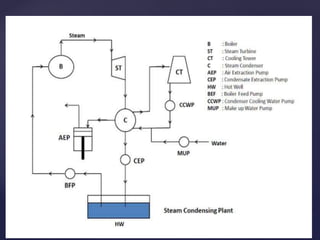
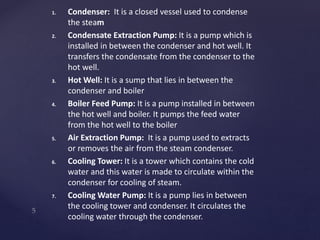
1. Condenser: It is a closed vessel used to condense
the steam
2. Condensate Extraction Pump: It is a pump which is
installed in between the condenser and hot well. It
transfers the condensate from the condenser to the
hot well.
3. Hot Well: It is a sump that lies in between the
condenser and boiler
4. Boiler Feed Pump: It is a pump installed in between
the hot well and boiler. It pumps the feed water
from the hot well to the boiler
5. Air Extraction Pump: It is a pump used to extracts
or removes the air from the steam condenser.
6. Cooling Tower: It is a tower which contains the cold
water and this water is made to circulate within the
condenser for cooling of steam.
7. Cooling Water Pump: It is a pump lies in between
the cooling tower and condenser. It circulates the
cooling water through the condenser.
 The steam condenser receives the exhaust
steam from one end and comes in contact with
the cooling water circulated within it form the
cooling tower.
 As the low pressure steam comes in contact
with the cooling water, it condenses and
converts into water.
 After the condensation of steam, the
condensate is pumped to the hot well with the
help of condensate extraction pump.
 The air extraction pump extracts the air from
the condenser and creates the vacuum inside
it. The vacuum created helps in the circulation
of cooling water and flow of condensate
downward.
Working:
 Jet condensers or mixing type
condenser
 Surface condenser or non-mixing type
condenser
Classification of Steam
Condenser
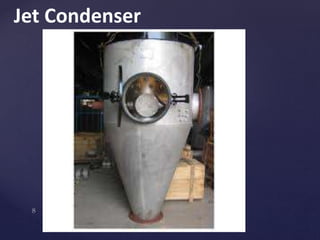
Jet Condenser
Types of Jet Condenser
1.Parallel Flow Jet Condenser
2.Counter Flow or Low Level Jet
Condenser
3.Barometric or High Level Jet
Condenser
4.Ejector Condenser
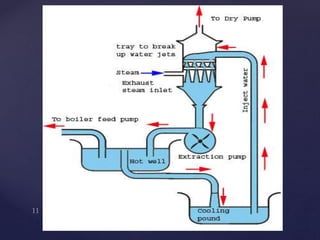
 In parallel flow jet condenser, the steam and water
enters into the condenser at the top and leaves at the
bottom.
 The cooling water and steam enters at the top. As both
steam and cooling water mix with each other, the steam
gets condense
 The condensate, cooling water and air moves downward
and it is removed by two separate pumps known as air
extraction pump and condensate extraction pump
 The condensate pump transfers the condensate to the
hot well and from there the extra water is made to flow
in cooling water tank or pond through overflow pipe.
Parallel Flow Jet Condenser
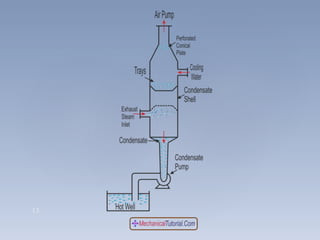
 In counter Flow or low level jet condensers, the
steam enters at the bottom and the cooling water at
the top. The steam flows upward and meets the
cooling water coming downward
 the air pump is located at the top. Air pump creates
vacuum and this vacuum draws water from the
cooling tower.
 The cooling water enter into the condenser and falls
on the perforated conical plate.
 As the steam mix with the water, it gets condense.
The condensate and cooling water moves down
through a vertical pipe to the condensate pump. And
finally the pump delivers it to the hot well
Counter Flow or Low Level Jet
Condenser
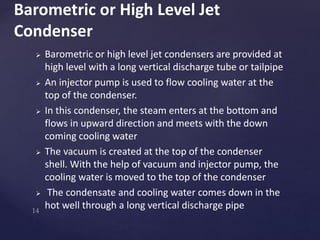
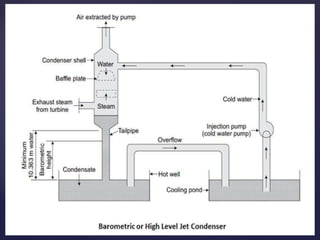
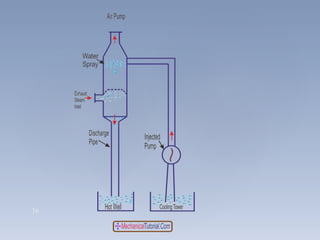
 Barometric or high level jet condensers are provided at
high level with a long vertical discharge tube or tailpipe
 An injector pump is used to flow cooling water at the
top of the condenser.
 In this condenser, the steam enters at the bottom and
flows in upward direction and meets with the down
coming cooling water
 The vacuum is created at the top of the condenser
shell. With the help of vacuum and injector pump, the
cooling water is moved to the top of the condenser
 The condensate and cooling water comes down in the
hot well through a long vertical discharge pipe
Barometric or High Level Jet
Condenser
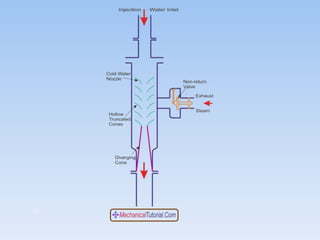
 In ejector condensers, it has a non-return valve through which exhaust
steam enters, hollow truncated cones, and diverging cone.
 the cooling water is injected at the top. The steam enters into the
condenser through a non-return valve
 The steam and water mixes with each other while passing through
series of hollow truncated metal cones and steam changes into water.
 At the end of the metal cones a diverging cone is present. When the
condensate passes through diverging cone, its kinetic energy is partly
transformed into pressure energy
 The condensate and cooling water is then discharged to the hot well.
Ejector Condenser
Surface Condensers
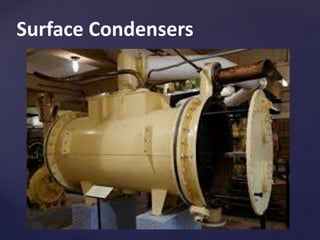
 Surface condenser is a type of steam
condenser in which the steam and
cooling water do not mix with each
other.
 the whole condensate can be used as
boiler feed water. It is also called as
non-mixing types condenser
Surface Condensers
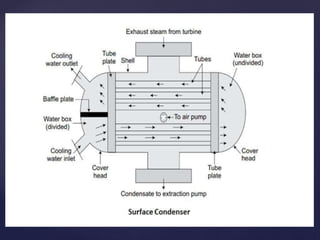
 It consists of a horizontal cylindrical vessel made of
cast iron and packed with tubes.
 The cooling water flows through these tubes
 The water tubes are passed horizontally through
the main condensing space
 The exhaust steam from the turbine or engine
enters at the top and forced to move downward
due to the suction of the air extraction pump.
 In this steam condenser, the cooling water enters
into boiler through lower half of the tubes in one
direction and returns in opposite direction through
the upper half
working
1. Down Flow
2. Central Flow
3. Evaporative
Types of Surface Condensers
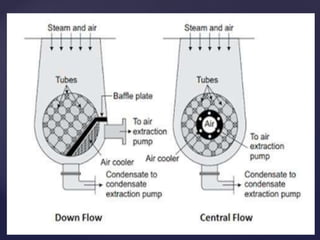
 In Down flow surface condenser, the steam enters
at the top of the condenser and flows downwards
over the tubes due to the gravity and air
extraction pumps.
 The condensate gets collected at the bottom and
then pumped with the help of condensate
extraction pump.
 The steam in down flow condenser flows
perpendicular to the direction of flow of cooling
water, so it is also called as cross-surface
condenser
Down Flow
 In central flow condenser, the steam enters at the
top of the condenser and flows in downward
direction.
 In this the suction pipe of the air extraction pump
is provided in the center of the tube nest
 Due to this placement of the suction pipe in the
center of the tube nest, the exhaust steam flows
radially inward over the tubes towards the suction
pipe.
 The condensate is collected at the bottom of the
condenser and pumped to the hot well
Central Flow
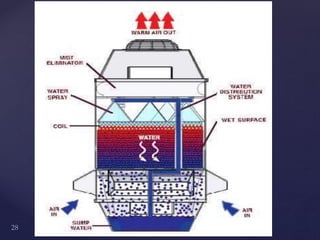
 the steam enters at the top of the condenser in a series
of pipes over which a film of cold water is falling.
 At the same time, current of air is made to circulate over
the film of water. As the air circulates over the water
film, it evaporates some of the cooling water
 As a result of this rapid evaporation, the steam
circulating inside the series of pipes gets condensed.
Remaining cooling water that left is collected at an
increased temperature and reused
 It is brought to the original temperature by adding
required quantity of cold water
Evaporative
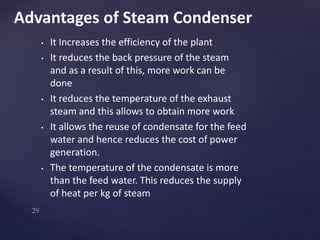
• It Increases the efficiency of the plant
• It reduces the back pressure of the steam
and as a result of this, more work can be
done
• It reduces the temperature of the exhaust
steam and this allows to obtain more work
• It allows the reuse of condensate for the feed
water and hence reduces the cost of power
generation.
• The temperature of the condensate is more
than the feed water. This reduces the supply
of heat per kg of steam
Advantages of Steam Condenser
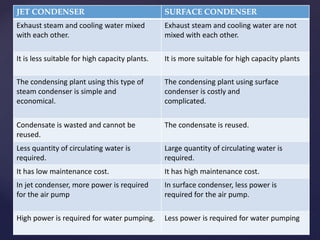
JET CONDENSER SURFACE CONDENSER
Exhaust steam and cooling water mixed
with each other.
Exhaust steam and cooling water are not
mixed with each other.
It is less suitable for high capacity plants. It is more suitable for high capacity plants
The condensing plant using this type of
steam condenser is simple and
economical.
The condensing plant using surface
condenser is costly and
complicated.
Condensate is wasted and cannot be
reused.
The condensate is reused.
Less quantity of circulating water is
required.
Large quantity of circulating water is
required.
It has low maintenance cost. It has high maintenance cost.
In jet condenser, more power is required
for the air pump
In surface condenser, less power is
required for the air pump.
High power is required for water pumping. Less power is required for water pumping
 PREPARED BY,
ROLLNO:11-20
THANK YOU

Steam condenser

  • 1.
  • 2.
    • Steam Condenseris a mechanical device which converts the low pressure exhaust steam from the turbine into water • In other words it is a device which is used to condense exhaust steam of the turbine into water. With the help of cooling water circulated from cooling tower
  • 3.
    The principle requirements ofsteam condensing plant
  • 5.
    1. Condenser: Itis a closed vessel used to condense the steam 2. Condensate Extraction Pump: It is a pump which is installed in between the condenser and hot well. It transfers the condensate from the condenser to the hot well. 3. Hot Well: It is a sump that lies in between the condenser and boiler 4. Boiler Feed Pump: It is a pump installed in between the hot well and boiler. It pumps the feed water from the hot well to the boiler 5. Air Extraction Pump: It is a pump used to extracts or removes the air from the steam condenser. 6. Cooling Tower: It is a tower which contains the cold water and this water is made to circulate within the condenser for cooling of steam. 7. Cooling Water Pump: It is a pump lies in between the cooling tower and condenser. It circulates the cooling water through the condenser.
  • 6.
     The steamcondenser receives the exhaust steam from one end and comes in contact with the cooling water circulated within it form the cooling tower.  As the low pressure steam comes in contact with the cooling water, it condenses and converts into water.  After the condensation of steam, the condensate is pumped to the hot well with the help of condensate extraction pump.  The air extraction pump extracts the air from the condenser and creates the vacuum inside it. The vacuum created helps in the circulation of cooling water and flow of condensate downward. Working:
  • 7.
     Jet condensersor mixing type condenser  Surface condenser or non-mixing type condenser Classification of Steam Condenser
  • 8.
  • 9.
    Types of JetCondenser 1.Parallel Flow Jet Condenser 2.Counter Flow or Low Level Jet Condenser 3.Barometric or High Level Jet Condenser 4.Ejector Condenser
  • 10.
     In parallelflow jet condenser, the steam and water enters into the condenser at the top and leaves at the bottom.  The cooling water and steam enters at the top. As both steam and cooling water mix with each other, the steam gets condense  The condensate, cooling water and air moves downward and it is removed by two separate pumps known as air extraction pump and condensate extraction pump  The condensate pump transfers the condensate to the hot well and from there the extra water is made to flow in cooling water tank or pond through overflow pipe. Parallel Flow Jet Condenser
  • 12.
     In counterFlow or low level jet condensers, the steam enters at the bottom and the cooling water at the top. The steam flows upward and meets the cooling water coming downward  the air pump is located at the top. Air pump creates vacuum and this vacuum draws water from the cooling tower.  The cooling water enter into the condenser and falls on the perforated conical plate.  As the steam mix with the water, it gets condense. The condensate and cooling water moves down through a vertical pipe to the condensate pump. And finally the pump delivers it to the hot well Counter Flow or Low Level Jet Condenser
  • 14.
     Barometric orhigh level jet condensers are provided at high level with a long vertical discharge tube or tailpipe  An injector pump is used to flow cooling water at the top of the condenser.  In this condenser, the steam enters at the bottom and flows in upward direction and meets with the down coming cooling water  The vacuum is created at the top of the condenser shell. With the help of vacuum and injector pump, the cooling water is moved to the top of the condenser  The condensate and cooling water comes down in the hot well through a long vertical discharge pipe Barometric or High Level Jet Condenser
  • 17.
     In ejectorcondensers, it has a non-return valve through which exhaust steam enters, hollow truncated cones, and diverging cone.  the cooling water is injected at the top. The steam enters into the condenser through a non-return valve  The steam and water mixes with each other while passing through series of hollow truncated metal cones and steam changes into water.  At the end of the metal cones a diverging cone is present. When the condensate passes through diverging cone, its kinetic energy is partly transformed into pressure energy  The condensate and cooling water is then discharged to the hot well. Ejector Condenser
  • 19.
  • 21.
     Surface condenseris a type of steam condenser in which the steam and cooling water do not mix with each other.  the whole condensate can be used as boiler feed water. It is also called as non-mixing types condenser Surface Condensers
  • 22.
     It consistsof a horizontal cylindrical vessel made of cast iron and packed with tubes.  The cooling water flows through these tubes  The water tubes are passed horizontally through the main condensing space  The exhaust steam from the turbine or engine enters at the top and forced to move downward due to the suction of the air extraction pump.  In this steam condenser, the cooling water enters into boiler through lower half of the tubes in one direction and returns in opposite direction through the upper half working
  • 23.
    1. Down Flow 2.Central Flow 3. Evaporative Types of Surface Condensers
  • 24.
     In Downflow surface condenser, the steam enters at the top of the condenser and flows downwards over the tubes due to the gravity and air extraction pumps.  The condensate gets collected at the bottom and then pumped with the help of condensate extraction pump.  The steam in down flow condenser flows perpendicular to the direction of flow of cooling water, so it is also called as cross-surface condenser Down Flow
  • 25.
     In centralflow condenser, the steam enters at the top of the condenser and flows in downward direction.  In this the suction pipe of the air extraction pump is provided in the center of the tube nest  Due to this placement of the suction pipe in the center of the tube nest, the exhaust steam flows radially inward over the tubes towards the suction pipe.  The condensate is collected at the bottom of the condenser and pumped to the hot well Central Flow
  • 27.
     the steamenters at the top of the condenser in a series of pipes over which a film of cold water is falling.  At the same time, current of air is made to circulate over the film of water. As the air circulates over the water film, it evaporates some of the cooling water  As a result of this rapid evaporation, the steam circulating inside the series of pipes gets condensed. Remaining cooling water that left is collected at an increased temperature and reused  It is brought to the original temperature by adding required quantity of cold water Evaporative
  • 29.
    • It Increasesthe efficiency of the plant • It reduces the back pressure of the steam and as a result of this, more work can be done • It reduces the temperature of the exhaust steam and this allows to obtain more work • It allows the reuse of condensate for the feed water and hence reduces the cost of power generation. • The temperature of the condensate is more than the feed water. This reduces the supply of heat per kg of steam Advantages of Steam Condenser
  • 30.
    JET CONDENSER SURFACECONDENSER Exhaust steam and cooling water mixed with each other. Exhaust steam and cooling water are not mixed with each other. It is less suitable for high capacity plants. It is more suitable for high capacity plants The condensing plant using this type of steam condenser is simple and economical. The condensing plant using surface condenser is costly and complicated. Condensate is wasted and cannot be reused. The condensate is reused. Less quantity of circulating water is required. Large quantity of circulating water is required. It has low maintenance cost. It has high maintenance cost. In jet condenser, more power is required for the air pump In surface condenser, less power is required for the air pump. High power is required for water pumping. Less power is required for water pumping
  • 31.