Condensers
&
Cooling Towers
by
Mr. S. R. Khandagale
1
Condenser
It is a device which condenses working fluid with the
help of cooling media (another circulating fluid)
• IF cooling media is air  Air cooled condenser
mostly used in refrigeration or mobile equipment
• IF cooling media is water  water cooled condenser
mostly used in stationary plants
2
Steam condenser
It is condenser which is used to condense steam
Steam condensers are mostly water cooled
i.e. in steam condenser
working fluid steam
cooling media water
• Functions
1. Maintain condensing pressure below atmospheric
 for improving efficiency
2. to supply hot(?) and pure water to cycle again
3
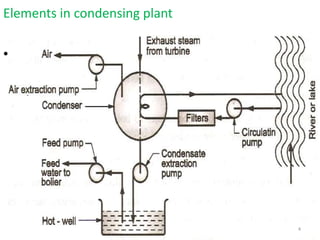
Elements in condensing plant
• (
4
Classification
Depending upon contact of working fluid and
cooling media
A. Jet condenser  Direct Contact
B. Surface Condenser  Indirect contact
5
Jet Condenser
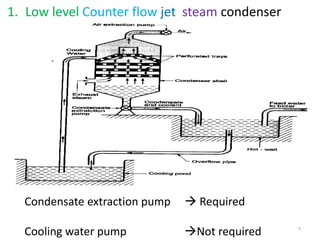
a. Low level jet condenser
Cooling water required to lift up to 5.5 m
i. Counter flow
Cooling media & steam flow in opposite direction
ii. Parallel Flow
Cooling media & steam flow in same direction
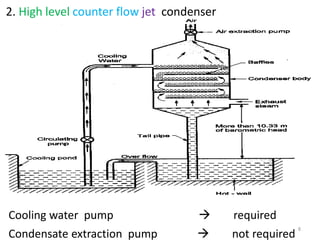
b. High level jet condenser
Cooling water required to lift above 10.33 m
c. Ejector jet condenser 6
1. Low level Counter flow jet steam condenser
Condensate extraction pump  Required
Cooling water pump Not required 7
2. High level counter flow jet condenser
Cooling water pump  required
Condensate extraction pump  not required
8
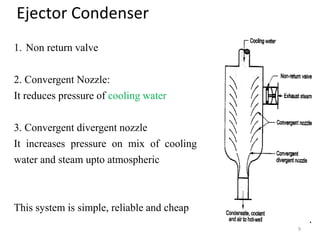
Ejector Condenser
1. Non return valve
2. Convergent Nozzle:
It reduces pressure of cooling water
3. Convergent divergent nozzle
It increases pressure on mix of cooling
water and steam upto atmospheric
This system is simple, reliable and cheap
9
B. Surface Condenser
1. Shell and tube surface condenser
a. Single Pass
b. Double Pass
2. Central flow surface condenser
3. Down flow surface condenser
4. Inverted flow surface condenser
5. Evaporative condenser
10
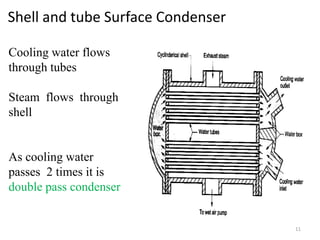
Shell and tube Surface Condenser
Cooling water flows
through tubes
Steam flows through
shell
As cooling water
passes 2 times it is
double pass condenser
11
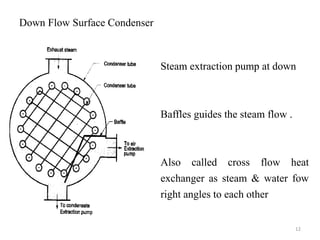
Down Flow Surface Condenser
Steam extraction pump at down
Baffles guides the steam flow .
Also called cross flow heat
exchanger as steam & water fow
right angles to each other
12
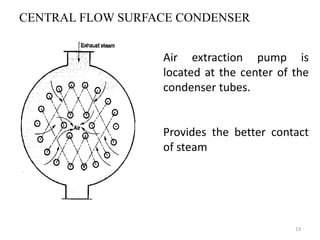
CENTRAL FLOW SURFACE CONDENSER
Air extraction pump is
located at the center of the
condenser tubes.
Provides the better contact
of steam
13
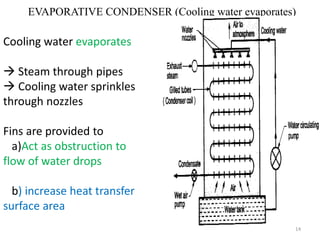
EVAPORATIVE CONDENSER (Cooling water evaporates)
Cooling water evaporates
 Steam through pipes
 Cooling water sprinkles
through nozzles
Fins are provided to
a)Act as obstruction to
flow of water drops
b) increase heat transfer
surface area
14
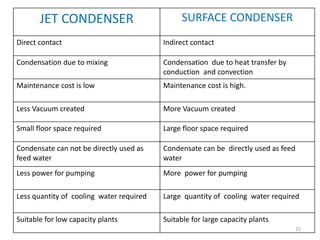
JET CONDENSER SURFACE CONDENSER
Direct contact Indirect contact
Condensation due to mixing Condensation due to heat transfer by
conduction and convection
Maintenance cost is low Maintenance cost is high.
Less Vacuum created More Vacuum created
Small floor space required Large floor space required
Condensate can not be directly used as
feed water
Condensate can be directly used as feed
water
Less power for pumping More power for pumping
Less quantity of cooling water required Large quantity of cooling water required
Suitable for low capacity plants Suitable for large capacity plants
15
Cooling Tower
• Cooling towers are commonly used to remove
excess heat that is generated & represent a
relatively inexpensive and dependable means of
removing low-grade heat from cooling water
Working fluid cooling water
Cooling media  air
Some of cooling water evaporates leading to cooling
effect
16
Cooling tower types
• Natural draft
Air circulation due to density differences
• Mechanical or forced or induced draft
Air circulation due to fans
17
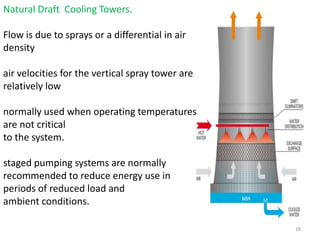
Natural Draft Cooling Towers.
Flow is due to sprays or a differential in air
density
air velocities for the vertical spray tower are
relatively low
normally used when operating temperatures
are not critical
to the system.
staged pumping systems are normally
recommended to reduce energy use in
periods of reduced load and
ambient conditions.
18
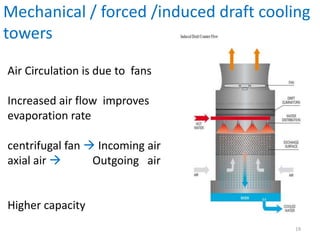
Mechanical / forced /induced draft cooling
towers
Air Circulation is due to fans
Increased air flow improves
evaporation rate
centrifugal fan  Incoming air
axial air  Outgoing air
Higher capacity
19
Factors governing operation of Cooling
tower
• The dry-bulb and wet-bulb temperatures of the air
• The temperature of warm water
• The area of contact between air and hot water
• The contact time between the air and the water
• The air pressure drop
• The desired temperature of the cooled water 20

CONDENSERS & COOLING TOWERS

  • 1.
  • 2.
    Condenser It is adevice which condenses working fluid with the help of cooling media (another circulating fluid) • IF cooling media is air  Air cooled condenser mostly used in refrigeration or mobile equipment • IF cooling media is water  water cooled condenser mostly used in stationary plants 2
  • 3.
    Steam condenser It iscondenser which is used to condense steam Steam condensers are mostly water cooled i.e. in steam condenser working fluid steam cooling media water • Functions 1. Maintain condensing pressure below atmospheric  for improving efficiency 2. to supply hot(?) and pure water to cycle again 3
  • 4.
  • 5.
    Classification Depending upon contactof working fluid and cooling media A. Jet condenser  Direct Contact B. Surface Condenser  Indirect contact 5
  • 6.
    Jet Condenser a. Lowlevel jet condenser Cooling water required to lift up to 5.5 m i. Counter flow Cooling media & steam flow in opposite direction ii. Parallel Flow Cooling media & steam flow in same direction b. High level jet condenser Cooling water required to lift above 10.33 m c. Ejector jet condenser 6
  • 7.
    1. Low levelCounter flow jet steam condenser Condensate extraction pump  Required Cooling water pump Not required 7
  • 8.
    2. High levelcounter flow jet condenser Cooling water pump  required Condensate extraction pump  not required 8
  • 9.
    Ejector Condenser 1. Nonreturn valve 2. Convergent Nozzle: It reduces pressure of cooling water 3. Convergent divergent nozzle It increases pressure on mix of cooling water and steam upto atmospheric This system is simple, reliable and cheap 9
  • 10.
    B. Surface Condenser 1.Shell and tube surface condenser a. Single Pass b. Double Pass 2. Central flow surface condenser 3. Down flow surface condenser 4. Inverted flow surface condenser 5. Evaporative condenser 10
  • 11.
    Shell and tubeSurface Condenser Cooling water flows through tubes Steam flows through shell As cooling water passes 2 times it is double pass condenser 11
  • 12.
    Down Flow SurfaceCondenser Steam extraction pump at down Baffles guides the steam flow . Also called cross flow heat exchanger as steam & water fow right angles to each other 12
  • 13.
    CENTRAL FLOW SURFACECONDENSER Air extraction pump is located at the center of the condenser tubes. Provides the better contact of steam 13
  • 14.
    EVAPORATIVE CONDENSER (Coolingwater evaporates) Cooling water evaporates  Steam through pipes  Cooling water sprinkles through nozzles Fins are provided to a)Act as obstruction to flow of water drops b) increase heat transfer surface area 14
  • 15.
    JET CONDENSER SURFACECONDENSER Direct contact Indirect contact Condensation due to mixing Condensation due to heat transfer by conduction and convection Maintenance cost is low Maintenance cost is high. Less Vacuum created More Vacuum created Small floor space required Large floor space required Condensate can not be directly used as feed water Condensate can be directly used as feed water Less power for pumping More power for pumping Less quantity of cooling water required Large quantity of cooling water required Suitable for low capacity plants Suitable for large capacity plants 15
  • 16.
    Cooling Tower • Coolingtowers are commonly used to remove excess heat that is generated & represent a relatively inexpensive and dependable means of removing low-grade heat from cooling water Working fluid cooling water Cooling media  air Some of cooling water evaporates leading to cooling effect 16
  • 17.
    Cooling tower types •Natural draft Air circulation due to density differences • Mechanical or forced or induced draft Air circulation due to fans 17
  • 18.
    Natural Draft CoolingTowers. Flow is due to sprays or a differential in air density air velocities for the vertical spray tower are relatively low normally used when operating temperatures are not critical to the system. staged pumping systems are normally recommended to reduce energy use in periods of reduced load and ambient conditions. 18
  • 19.
    Mechanical / forced/induced draft cooling towers Air Circulation is due to fans Increased air flow improves evaporation rate centrifugal fan  Incoming air axial air  Outgoing air Higher capacity 19
  • 20.
    Factors governing operationof Cooling tower • The dry-bulb and wet-bulb temperatures of the air • The temperature of warm water • The area of contact between air and hot water • The contact time between the air and the water • The air pressure drop • The desired temperature of the cooled water 20