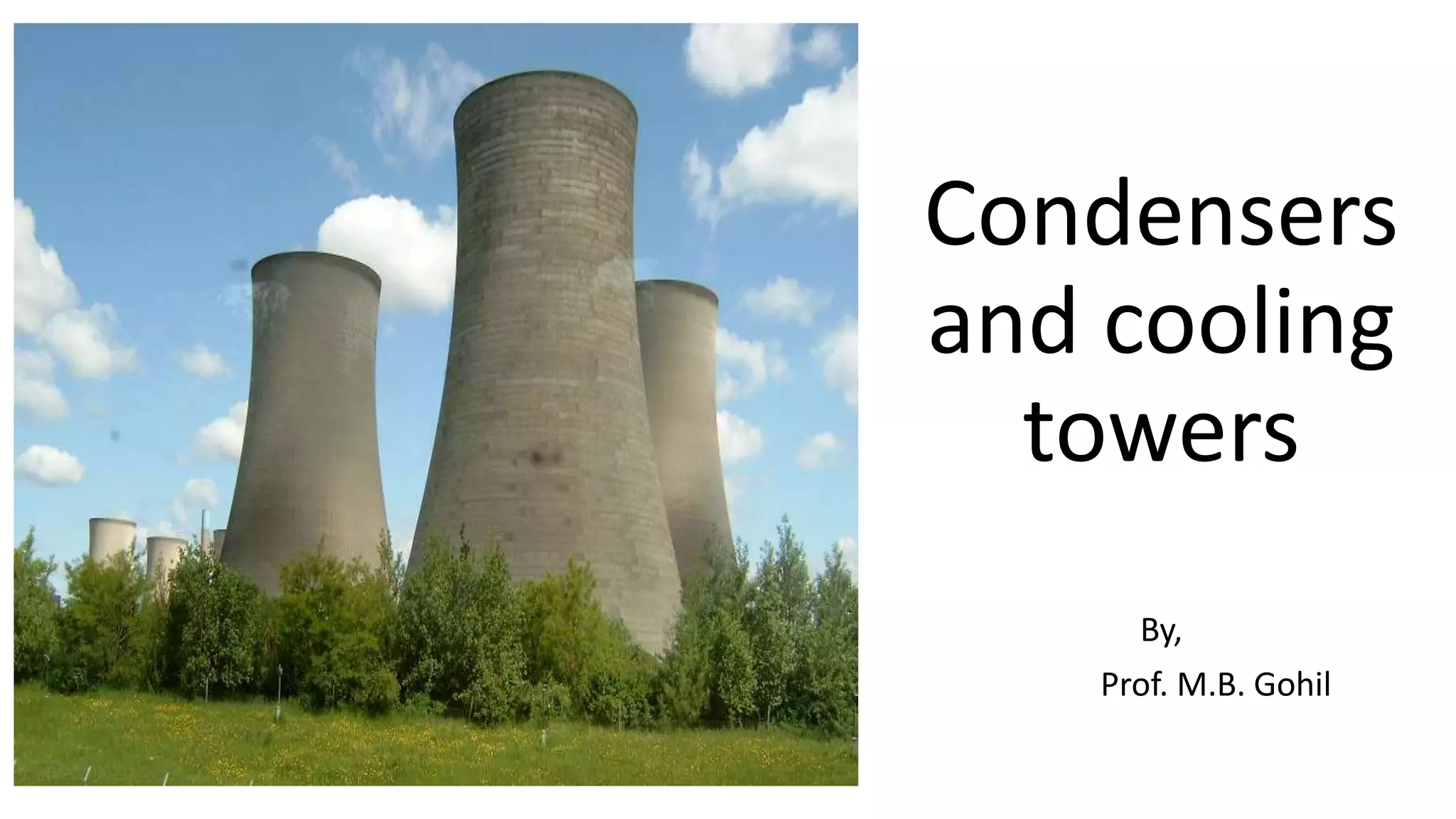
Condensers
and cooling
towers
By,
Prof. M.B. Gohil
Condenser
Objects
1. The main object is to creates a low back (vacuum) for the turbine
exhaust so as to obtain the maximum possible energy from steam
and thus to secure a high efficiency.
2. Condense the exhaust steam from turbine.
Steam condensing plant
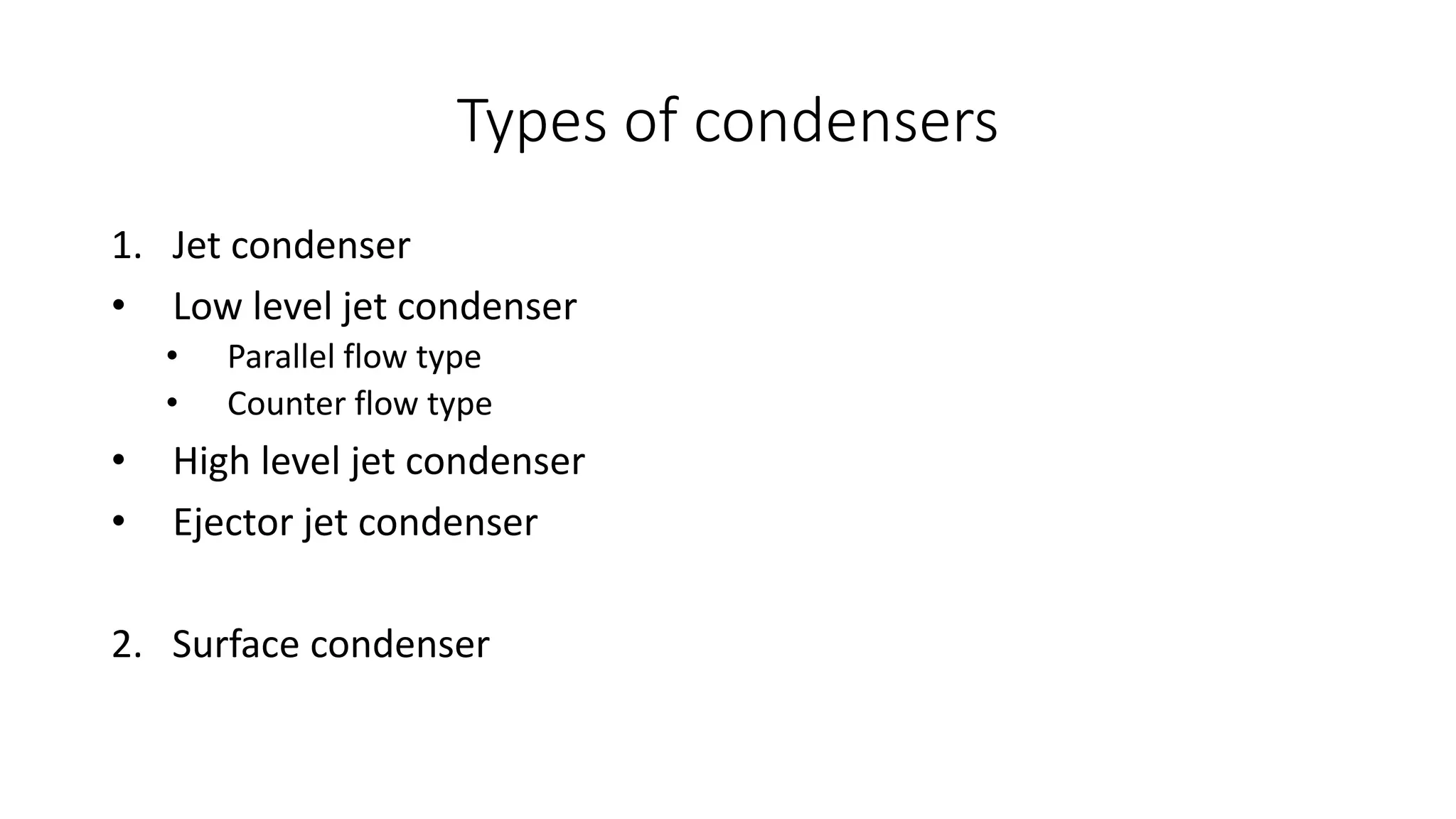
Types of condensers
1. Jet condenser
• Low level jet condenser
• Parallel flow type
• Counter flow type
• High level jet condenser
• Ejector jet condenser
2. Surface condenser
low level parallel flow jet condenser
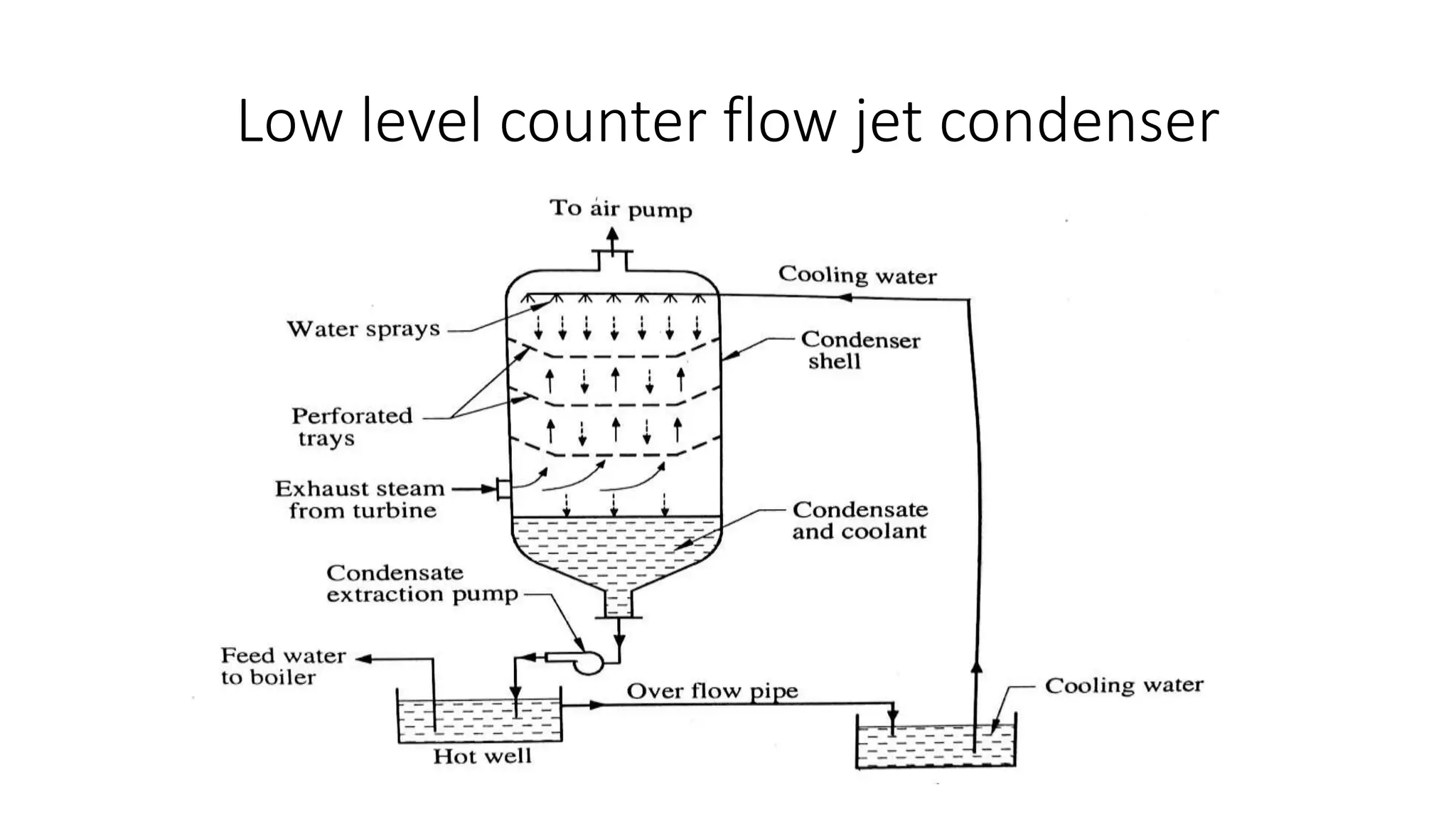
Low level counter flow jet condenser
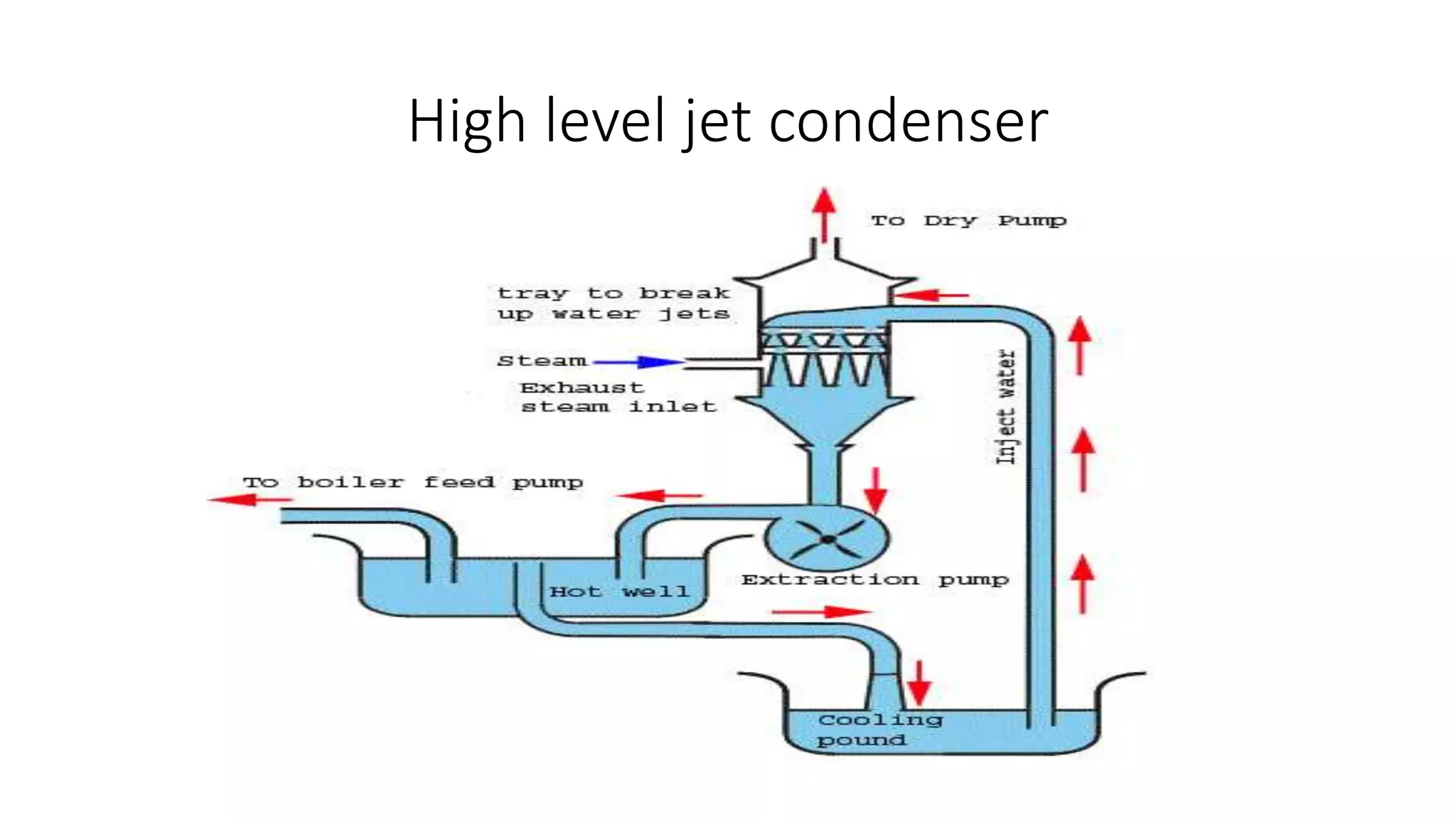
High level jet condenser
Ejector condenser
Ejector condenser
Advantages of jet condenser
• The quantity of cooling water required per kg of steam condensed is
lower than that required for surface condenser.
• They are simple in design.
• They require less floor space.
• Lower maintenance cost.
Double pass surface condenser
Down flow surface condenser
Central flow surface condenser
Evaporative condenser
Advantages
• It is simple in design and cheap in first cost.
• It does not require large quantity of cooling water, so needs a small
capacity cooling water pump.
• Its operating cost is less.
Jet condenser Surface condenser
Cooling water and steam come in direct contact. Cooling water and steam do not come in direct
contact.
More suitable for low capacity plants. More suitable for high capacity plants.
Vacuum created is upto 600 mm of Hg. Vacuum crated is upto 760 mm of Hg.
Sources of air leakage in condenser
• The air leaks through the joints and packing and into condenser
where the pressure is below the atmospheric pressure.
• The boiler feed water contains dissolved air. From the boiler it is
carried off by steam and to the turbine and finally to the condenser.
• Normally the quantity of air leakage in surface condenser is 0.05% of
steam condensed.
Effect of air leakage
• It is increases the back pressure on the turbine with the effect that
there is less enthalpy drop and low thermal efficiency of plant.
• It reduces the rate of condensation of steam, because air having poor
thermal conductivity reduces the overall heat transfer from steam
air mixture.
• The presence of air in the condenser increases the corrosive action.
Methods of obtain maximum vacuum in
condenser
1. Air pump:
it is used to extract air and other non-condensable gases from
condenser.
• Wet air pump: it removes mixture of condensate and air with other
non-condensable gases.
• Dry air pump: it removes the air and other non-condensable gases
only.
• 2. Steam jet air ejector: to remove air from condenser.
• De-aerated feed water:
it is process of removal of non condensable gases from water. It
helps both in maintain better vacuum in condenser and controlling
corrosion of steel shell and piping of power plant.
• Air tight joints:
the air leaks through the joints, packing and glands into the
condenser. This can be reduced by proper workmanship while the
joints and maintained as such by proper inspection from time to time.
Edward air pump
Dalton’s law of partial pressure
• It states “the pressure of the mixture of air and steam is equal to the sum of
the pressure which each constituent would expert, if it occupied the same
space by itself”
• Pc=Pa+Ps
• Where, Pc= pressure in condenser.
Pa= partial pressure of air,
Ps= partial pressure of steam.
Vacuum and condenser efficiency
• Vacuum efficiency: It is the ratio of the actual vacuum at the steam
inlet to the maximum obtainable vacuum in a perfect condensing
plant, i.e., it is the ratio of actual vacuum to ideal vacuum.
• If, Ps= saturation pressure of steam corrosponding to the steam
temperature entering into condenser.
Pc= total pressure of air and steam in the condenser (Pa+Ps).
Pb= atm. Or barometric pressure.
• Ideal vacuum possible without air leakage = (Pb-Ps)
• Actual vacuum existing in condenser due to air leakage= Pb-Pc
= pb – (Pa+Ps)
• Vacuum efficiency, ῃv= Pb- (Pa+Ps)/Pb-Ps
= Pb-Pc/Pb-Ps
• The leakge of air and insufficient quality of cooling water
decreases the vacuum efficirncy of the condenser.
Condenser efficiency
• It is ratio actual rise in the temperature of cooling water to the
maximum possible rise in temperature of cooling water.
Mass of cooling water required for
condensation of steam
Condenser water cooling systems
1. Open or once through system
2. Closed cooling system
3. Mixed cooling system
Open or once through system
Closed cooling system
Mixed cooling system
Cooling Tower
Types of cooling tower
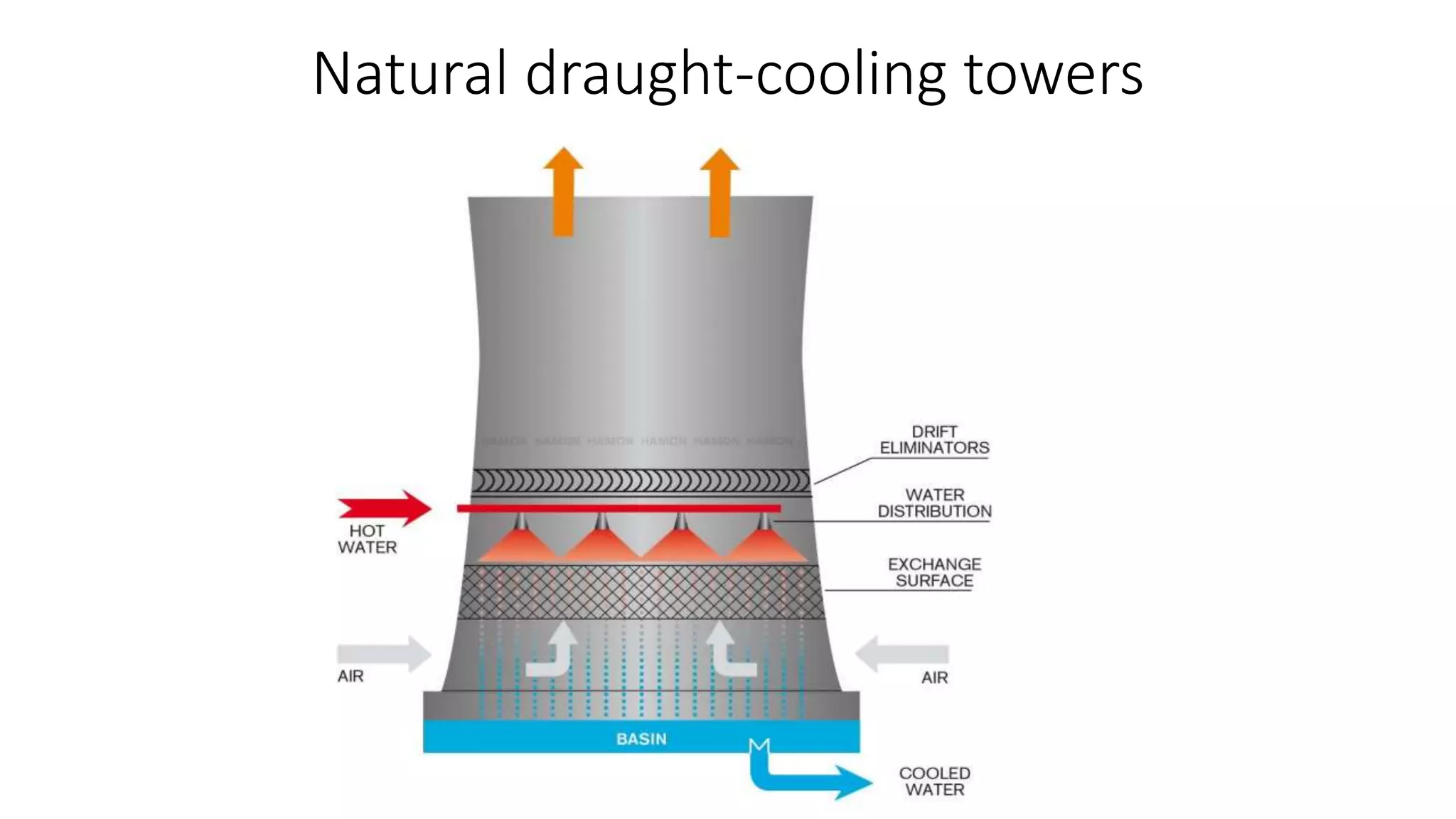
1. Natural draught-cooling towers
2. Mechanical cooling towers
1. Forced draught cooling towers
2. Induced draught cooling towers
Natural draught-cooling towers
Forced draught cooling tower
Induced draught (counter flow) cooling tower
Induced draught (cross-flow) cooling tower
Principle Natural draught cooling tower Forced draught cooling
tower
Size and shape It may be 125 m high and 100 m in diameter and
has hyperbolic shape.
It may be 15 m high and thousands of
meters in length and has long
rectangle box shape.
Initial cost high Half of natural tower draught cooling
tower.
Operating cost less High
Maintenance cost low High
Water loss less More
life more Less
Cooling ponds
• The cooling pond is one of the simple method of cooling the
condenser water.
• This method is less efficient than cooling water.
1. Natural and directed flow cooling pond.
2. Single deck and double deck cooling pond.
3. Open and louver fence cooling pong.
Natural flow cooling pond
Directed flow cooling pond
Single deck spray pond
Double deck spray pond
Spray pond with louver fence
Advantages of cooling ponds
• Its initial cost is less
• Simple in design and arrangement.
Disadvantages
• It requires large area for cooling
• More amount of loss of water due to evaporation.
• Low cooling efficiency.
• There is no control over the temperature of cooled water.
The End

Condensers and cooling towers

  • 1.
  • 2.
  • 3.
    Objects 1. The mainobject is to creates a low back (vacuum) for the turbine exhaust so as to obtain the maximum possible energy from steam and thus to secure a high efficiency. 2. Condense the exhaust steam from turbine.
  • 4.
  • 5.
    Types of condensers 1.Jet condenser • Low level jet condenser • Parallel flow type • Counter flow type • High level jet condenser • Ejector jet condenser 2. Surface condenser
  • 6.
    low level parallelflow jet condenser
  • 7.
    low level parallelflow jet condenser
  • 8.
    Low level counterflow jet condenser
  • 9.
    Low level counterflow jet condenser
  • 10.
    High level jetcondenser
  • 11.
    High level jetcondenser
  • 12.
  • 13.
  • 14.
    Advantages of jetcondenser • The quantity of cooling water required per kg of steam condensed is lower than that required for surface condenser. • They are simple in design. • They require less floor space. • Lower maintenance cost.
  • 15.
  • 16.
  • 17.
  • 18.
  • 19.
    Advantages • It issimple in design and cheap in first cost. • It does not require large quantity of cooling water, so needs a small capacity cooling water pump. • Its operating cost is less.
  • 20.
    Jet condenser Surfacecondenser Cooling water and steam come in direct contact. Cooling water and steam do not come in direct contact. More suitable for low capacity plants. More suitable for high capacity plants. Vacuum created is upto 600 mm of Hg. Vacuum crated is upto 760 mm of Hg.
  • 21.
    Sources of airleakage in condenser • The air leaks through the joints and packing and into condenser where the pressure is below the atmospheric pressure. • The boiler feed water contains dissolved air. From the boiler it is carried off by steam and to the turbine and finally to the condenser. • Normally the quantity of air leakage in surface condenser is 0.05% of steam condensed.
  • 22.
    Effect of airleakage • It is increases the back pressure on the turbine with the effect that there is less enthalpy drop and low thermal efficiency of plant. • It reduces the rate of condensation of steam, because air having poor thermal conductivity reduces the overall heat transfer from steam air mixture. • The presence of air in the condenser increases the corrosive action.
  • 23.
    Methods of obtainmaximum vacuum in condenser 1. Air pump: it is used to extract air and other non-condensable gases from condenser. • Wet air pump: it removes mixture of condensate and air with other non-condensable gases. • Dry air pump: it removes the air and other non-condensable gases only.
  • 24.
    • 2. Steamjet air ejector: to remove air from condenser.
  • 25.
    • De-aerated feedwater: it is process of removal of non condensable gases from water. It helps both in maintain better vacuum in condenser and controlling corrosion of steel shell and piping of power plant. • Air tight joints: the air leaks through the joints, packing and glands into the condenser. This can be reduced by proper workmanship while the joints and maintained as such by proper inspection from time to time.
  • 26.
  • 27.
    Dalton’s law ofpartial pressure • It states “the pressure of the mixture of air and steam is equal to the sum of the pressure which each constituent would expert, if it occupied the same space by itself” • Pc=Pa+Ps • Where, Pc= pressure in condenser. Pa= partial pressure of air, Ps= partial pressure of steam.
  • 28.
    Vacuum and condenserefficiency • Vacuum efficiency: It is the ratio of the actual vacuum at the steam inlet to the maximum obtainable vacuum in a perfect condensing plant, i.e., it is the ratio of actual vacuum to ideal vacuum. • If, Ps= saturation pressure of steam corrosponding to the steam temperature entering into condenser. Pc= total pressure of air and steam in the condenser (Pa+Ps). Pb= atm. Or barometric pressure. • Ideal vacuum possible without air leakage = (Pb-Ps) • Actual vacuum existing in condenser due to air leakage= Pb-Pc = pb – (Pa+Ps)
  • 29.
    • Vacuum efficiency,ῃv= Pb- (Pa+Ps)/Pb-Ps = Pb-Pc/Pb-Ps • The leakge of air and insufficient quality of cooling water decreases the vacuum efficirncy of the condenser.
  • 30.
    Condenser efficiency • Itis ratio actual rise in the temperature of cooling water to the maximum possible rise in temperature of cooling water.
  • 31.
    Mass of coolingwater required for condensation of steam
  • 32.
    Condenser water coolingsystems 1. Open or once through system 2. Closed cooling system 3. Mixed cooling system
  • 33.
    Open or oncethrough system
  • 34.
  • 35.
  • 36.
  • 37.
    Types of coolingtower 1. Natural draught-cooling towers 2. Mechanical cooling towers 1. Forced draught cooling towers 2. Induced draught cooling towers
  • 38.
  • 39.
  • 40.
  • 41.
  • 42.
    Induced draught (counterflow) cooling tower
  • 43.
    Induced draught (counterflow) cooling tower
  • 44.
  • 45.
  • 46.
    Principle Natural draughtcooling tower Forced draught cooling tower Size and shape It may be 125 m high and 100 m in diameter and has hyperbolic shape. It may be 15 m high and thousands of meters in length and has long rectangle box shape. Initial cost high Half of natural tower draught cooling tower. Operating cost less High Maintenance cost low High Water loss less More life more Less
  • 47.
    Cooling ponds • Thecooling pond is one of the simple method of cooling the condenser water. • This method is less efficient than cooling water. 1. Natural and directed flow cooling pond. 2. Single deck and double deck cooling pond. 3. Open and louver fence cooling pong.
  • 48.
  • 49.
  • 50.
  • 51.
  • 52.
    Spray pond withlouver fence
  • 53.
    Advantages of coolingponds • Its initial cost is less • Simple in design and arrangement.
  • 54.
    Disadvantages • It requireslarge area for cooling • More amount of loss of water due to evaporation. • Low cooling efficiency. • There is no control over the temperature of cooled water.
  • 55.