Steam Condensers
3/28/2015 1Footer Text
Definition:
 Condenser is a device in which steam is condensed to
water at a pressure less than atmosphere.
 Condensation can be done by removing heat from
exhaust steam using circulating cooling water.
 During condensation, the working substance changes
its phase from vapour to liquid and rejects latent
heat.
 The exhaust pressure in the condenser is maintaned
nearly 7 to 8 kpa which corresponds to condensate
temperature of nearly 313 kelvin.
3/28/2015Footer Text 2
Functions of Condenser:
 To reduce the turbine exhaust pressure so as to
increase the specific output and hence increase the
plant efficiency and decrease the specific steam
consumption.
 To condense the exhaust steam from the turbine and
reuse it as pure feed water in the boiler. Thus only
make up water is required to compensate loss of
water
 Enables removal of air and other non condensable
gases from steam. Hence improved heat transfer.
3/28/2015Footer Text 3
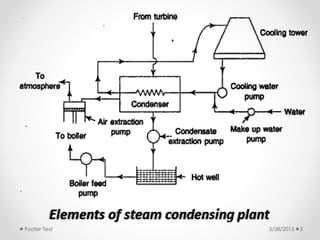
Elements of Condensing Plant:
 Condenser
 Air Extraction Pump
 Condensate Extraction Pump
 Cooling Water Circulating Pump
 Hot Well
 Cooling Tower
 Make up Water Pump
 Boiler Feed Pump
3/28/2015Footer Text 4
3/28/2015Footer Text 5
Classification of Condensers:
According to the type of flow:
 Parallel flow , Counter flow & Cross flow
According to the Cooling Action:
 Jet Condensers:
• Low Level Parallel Flow Jet Condenser
• Low Level Counter Flow Jet Condenser
• High Level Jet Condenser
• Ejector Jet Condenser
 Surface Condensers:
• Shell and Tube type
1. Down Flow 2. Central Flow 3. Inverted Flow
• Evaporative type
3/28/2015Footer Text 6
Jet Condensers:
• In jet condensers exhaust steam and cooling water come
in direct contact and mix up together. Thus, the final
temperature of condensate and cooling water leaving the
condenser is same.
• A jet condenser is very simple in design and cheaper.
• It can be used when cooling water is cheaply and easily
available.
• Condensate can not be reused in boiler, because it
contains impurities like dust, oil, metal particles etc.
3/28/2015Footer Text 7
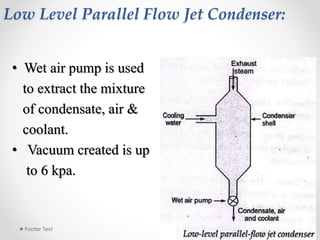
Low Level Parallel Flow Jet Condenser:
• Wet air pump is used
to extract the mixture
of condensate, air &
coolant.
• Vacuum created is up
to 6 kpa.
3/28/2015Footer Text 8
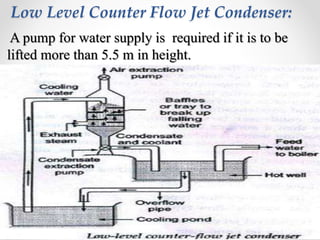
Low Level Counter Flow Jet Condenser:
A pump for water supply is required if it is to be
lifted more than 5.5 m in height.
3/28/2015Footer Text 9
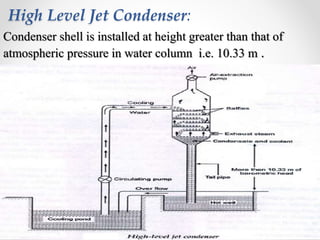
High Level Jet Condenser:
3/28/2015Footer Text 10
Condenser shell is installed at height greater than that of
atmospheric pressure in water column i.e. 10.33 m .
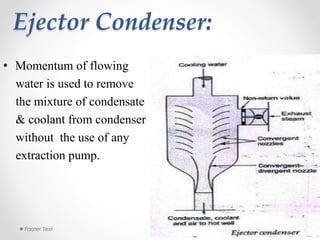
Ejector Condenser:
3/28/2015Footer Text 11
• Momentum of flowing
water is used to remove
the mixture of condensate
& coolant from condenser
without the use of any
extraction pump.
Advantages & Disadvantages of
Jet Condensers:
Advantages:
• Simple in design & cheaper.
• Less floor area is required.
Disadvantages:
• Condensate is not pure hence can not be
reused.
• Low vacuum efficiency.
3/28/2015Footer Text 12
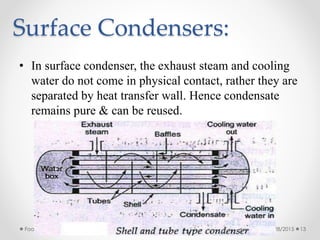
Surface Condensers:
3/28/2015Footer Text 13
• In surface condenser, the exhaust steam and cooling
water do not come in physical contact, rather they are
separated by heat transfer wall. Hence condensate
remains pure & can be reused.
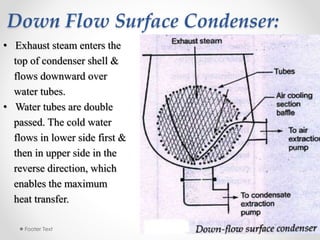
Down Flow Surface Condenser:
3/28/2015Footer Text 14
• Exhaust steam enters the
top of condenser shell &
flows downward over
water tubes.
• Water tubes are double
passed. The cold water
flows in lower side first &
then in upper side in the
reverse direction, which
enables the maximum
heat transfer.
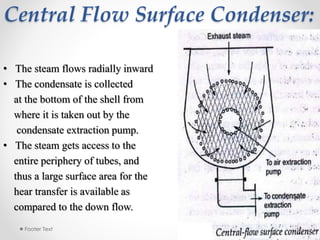
Central Flow Surface Condenser:
3/28/2015Footer Text 15
• The steam flows radially inward
• The condensate is collected
at the bottom of the shell from
where it is taken out by the
condensate extraction pump.
• The steam gets access to the
entire periphery of tubes, and
thus a large surface area for the
hear transfer is available as
compared to the down flow.
Inverted Flow Condenser:
• The steam enters the bottom of the shell and
air extraction pump connected at the top.
• Steam flows upward first and subsequently,
returns to the bottom of the condenser.
• The condensate extraction pump is connected
at the bottom of the shell to extract the
condensate.
3/28/2015Footer Text 16
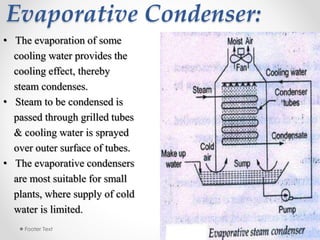
Evaporative Condenser:
3/28/2015Footer Text 17
• The evaporation of some
cooling water provides the
cooling effect, thereby
steam condenses.
• Steam to be condensed is
passed through grilled tubes
& cooling water is sprayed
over outer surface of tubes.
• The evaporative condensers
are most suitable for small
plants, where supply of cold
water is limited.
Advantages & Disadvantages
of Surface Condensers:
Advantages:
• High vacuum efficiency.
• Pure condensate.
• Low quality cooling water can be used.
• It allows the expansion of steam through a higher pressure ratio.
Disadvantages:
• Large amount of water is required.
• Construction is complicated.
• Costly maintenance and skilled workers.
• Large floor area.
3/28/2015Footer Text 18
Comparison of Jet & Surface Condensers:
Jet Condensers Surface Condensers
3/28/2015Footer Text 19
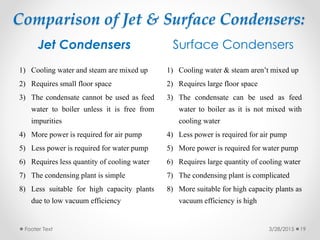
1) Cooling water and steam are mixed up
2) Requires small floor space
3) The condensate cannot be used as feed
water to boiler unless it is free from
impurities
4) More power is required for air pump
5) Less power is required for water pump
6) Requires less quantity of cooling water
7) The condensing plant is simple
8) Less suitable for high capacity plants
due to low vacuum efficiency
1) Cooling water & steam aren’t mixed up
2) Requires large floor space
3) The condensate can be used as feed
water to boiler as it is not mixed with
cooling water
4) Less power is required for air pump
5) More power is required for water pump
6) Requires large quantity of cooling water
7) The condensing plant is complicated
8) More suitable for high capacity plants as
vacuum efficiency is high
Effect of Condenser Pressure on
Rankine Efficiency:
3/28/2015Footer Text 20
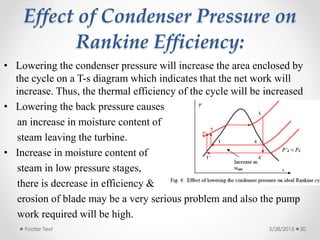
• Lowering the condenser pressure will increase the area enclosed by
the cycle on a T-s diagram which indicates that the net work will
increase. Thus, the thermal efficiency of the cycle will be increased
• Lowering the back pressure causes
an increase in moisture content of
steam leaving the turbine.
• Increase in moisture content of
steam in low pressure stages,
there is decrease in efficiency &
erosion of blade may be a very serious problem and also the pump
work required will be high.
Vacuum Creation in Condenser:
• When the steam condenses in a closed vessel, the vapour phase
of working substance changes to liquid phase, and thus its
specific volume reduces to more than one thousand times.
• Due to change in specific volume, the absolute pressure in the
condenser falls below atmospheric pressure and a high vacuum is
created.
• This minimum pressure that can be attained depends on the
temperature of condensate and air present in the condenser.
The absolute pressure = Atmospheric pressure – Vacuum Gauge
in the condenser Pressure
3/28/2015Footer Text 21
Sources of Air in the Condenser:
• The ambient air leaks to the condenser chamber at the joints & glands
which are internally under pressure lower than that of ambient.
• Another source of air is the dissolved air with feed water. The
dissolved air in feed water enters into boiler and it travels with steam
into condenser.
Effects of Air Leakage:
• The presence of air lowers vacuum in the condenser. Thus back
pressure of the plant increases, and consequently, the work output
decreases.
• Air has very poor thermal conductivity. Hence, the rate of heat
transfer from vapour to cooling medium is reduced.
• The presence of air in the condenser corrodes to the metal surfaces.
Therefore, the life of condenser is reduced.
3/28/2015Footer Text 22
3/28/2015Footer Text 23

Steam Condensers

  • 1.
  • 2.
    Definition:  Condenser isa device in which steam is condensed to water at a pressure less than atmosphere.  Condensation can be done by removing heat from exhaust steam using circulating cooling water.  During condensation, the working substance changes its phase from vapour to liquid and rejects latent heat.  The exhaust pressure in the condenser is maintaned nearly 7 to 8 kpa which corresponds to condensate temperature of nearly 313 kelvin. 3/28/2015Footer Text 2
  • 3.
    Functions of Condenser: To reduce the turbine exhaust pressure so as to increase the specific output and hence increase the plant efficiency and decrease the specific steam consumption.  To condense the exhaust steam from the turbine and reuse it as pure feed water in the boiler. Thus only make up water is required to compensate loss of water  Enables removal of air and other non condensable gases from steam. Hence improved heat transfer. 3/28/2015Footer Text 3
  • 4.
    Elements of CondensingPlant:  Condenser  Air Extraction Pump  Condensate Extraction Pump  Cooling Water Circulating Pump  Hot Well  Cooling Tower  Make up Water Pump  Boiler Feed Pump 3/28/2015Footer Text 4
  • 5.
  • 6.
    Classification of Condensers: Accordingto the type of flow:  Parallel flow , Counter flow & Cross flow According to the Cooling Action:  Jet Condensers: • Low Level Parallel Flow Jet Condenser • Low Level Counter Flow Jet Condenser • High Level Jet Condenser • Ejector Jet Condenser  Surface Condensers: • Shell and Tube type 1. Down Flow 2. Central Flow 3. Inverted Flow • Evaporative type 3/28/2015Footer Text 6
  • 7.
    Jet Condensers: • Injet condensers exhaust steam and cooling water come in direct contact and mix up together. Thus, the final temperature of condensate and cooling water leaving the condenser is same. • A jet condenser is very simple in design and cheaper. • It can be used when cooling water is cheaply and easily available. • Condensate can not be reused in boiler, because it contains impurities like dust, oil, metal particles etc. 3/28/2015Footer Text 7
  • 8.
    Low Level ParallelFlow Jet Condenser: • Wet air pump is used to extract the mixture of condensate, air & coolant. • Vacuum created is up to 6 kpa. 3/28/2015Footer Text 8
  • 9.
    Low Level CounterFlow Jet Condenser: A pump for water supply is required if it is to be lifted more than 5.5 m in height. 3/28/2015Footer Text 9
  • 10.
    High Level JetCondenser: 3/28/2015Footer Text 10 Condenser shell is installed at height greater than that of atmospheric pressure in water column i.e. 10.33 m .
  • 11.
    Ejector Condenser: 3/28/2015Footer Text11 • Momentum of flowing water is used to remove the mixture of condensate & coolant from condenser without the use of any extraction pump.
  • 12.
    Advantages & Disadvantagesof Jet Condensers: Advantages: • Simple in design & cheaper. • Less floor area is required. Disadvantages: • Condensate is not pure hence can not be reused. • Low vacuum efficiency. 3/28/2015Footer Text 12
  • 13.
    Surface Condensers: 3/28/2015Footer Text13 • In surface condenser, the exhaust steam and cooling water do not come in physical contact, rather they are separated by heat transfer wall. Hence condensate remains pure & can be reused.
  • 14.
    Down Flow SurfaceCondenser: 3/28/2015Footer Text 14 • Exhaust steam enters the top of condenser shell & flows downward over water tubes. • Water tubes are double passed. The cold water flows in lower side first & then in upper side in the reverse direction, which enables the maximum heat transfer.
  • 15.
    Central Flow SurfaceCondenser: 3/28/2015Footer Text 15 • The steam flows radially inward • The condensate is collected at the bottom of the shell from where it is taken out by the condensate extraction pump. • The steam gets access to the entire periphery of tubes, and thus a large surface area for the hear transfer is available as compared to the down flow.
  • 16.
    Inverted Flow Condenser: •The steam enters the bottom of the shell and air extraction pump connected at the top. • Steam flows upward first and subsequently, returns to the bottom of the condenser. • The condensate extraction pump is connected at the bottom of the shell to extract the condensate. 3/28/2015Footer Text 16
  • 17.
    Evaporative Condenser: 3/28/2015Footer Text17 • The evaporation of some cooling water provides the cooling effect, thereby steam condenses. • Steam to be condensed is passed through grilled tubes & cooling water is sprayed over outer surface of tubes. • The evaporative condensers are most suitable for small plants, where supply of cold water is limited.
  • 18.
    Advantages & Disadvantages ofSurface Condensers: Advantages: • High vacuum efficiency. • Pure condensate. • Low quality cooling water can be used. • It allows the expansion of steam through a higher pressure ratio. Disadvantages: • Large amount of water is required. • Construction is complicated. • Costly maintenance and skilled workers. • Large floor area. 3/28/2015Footer Text 18
  • 19.
    Comparison of Jet& Surface Condensers: Jet Condensers Surface Condensers 3/28/2015Footer Text 19 1) Cooling water and steam are mixed up 2) Requires small floor space 3) The condensate cannot be used as feed water to boiler unless it is free from impurities 4) More power is required for air pump 5) Less power is required for water pump 6) Requires less quantity of cooling water 7) The condensing plant is simple 8) Less suitable for high capacity plants due to low vacuum efficiency 1) Cooling water & steam aren’t mixed up 2) Requires large floor space 3) The condensate can be used as feed water to boiler as it is not mixed with cooling water 4) Less power is required for air pump 5) More power is required for water pump 6) Requires large quantity of cooling water 7) The condensing plant is complicated 8) More suitable for high capacity plants as vacuum efficiency is high
  • 20.
    Effect of CondenserPressure on Rankine Efficiency: 3/28/2015Footer Text 20 • Lowering the condenser pressure will increase the area enclosed by the cycle on a T-s diagram which indicates that the net work will increase. Thus, the thermal efficiency of the cycle will be increased • Lowering the back pressure causes an increase in moisture content of steam leaving the turbine. • Increase in moisture content of steam in low pressure stages, there is decrease in efficiency & erosion of blade may be a very serious problem and also the pump work required will be high.
  • 21.
    Vacuum Creation inCondenser: • When the steam condenses in a closed vessel, the vapour phase of working substance changes to liquid phase, and thus its specific volume reduces to more than one thousand times. • Due to change in specific volume, the absolute pressure in the condenser falls below atmospheric pressure and a high vacuum is created. • This minimum pressure that can be attained depends on the temperature of condensate and air present in the condenser. The absolute pressure = Atmospheric pressure – Vacuum Gauge in the condenser Pressure 3/28/2015Footer Text 21
  • 22.
    Sources of Airin the Condenser: • The ambient air leaks to the condenser chamber at the joints & glands which are internally under pressure lower than that of ambient. • Another source of air is the dissolved air with feed water. The dissolved air in feed water enters into boiler and it travels with steam into condenser. Effects of Air Leakage: • The presence of air lowers vacuum in the condenser. Thus back pressure of the plant increases, and consequently, the work output decreases. • Air has very poor thermal conductivity. Hence, the rate of heat transfer from vapour to cooling medium is reduced. • The presence of air in the condenser corrodes to the metal surfaces. Therefore, the life of condenser is reduced. 3/28/2015Footer Text 22
  • 23.