Condenser
WAQAR AHMED
HUBCO POWER PLANT
Contents
 Introduction
 Types
 Condenser vacuum
 Function of condenser
 Tube materials
 Importance
 Leak test methods
 Cleaning of tubes
Introduction
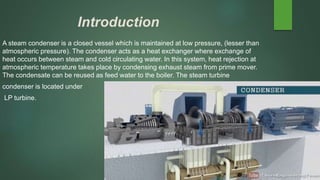
A steam condenser is a closed vessel which is maintained at low pressure, (lesser than
atmospheric pressure). The condenser acts as a heat exchanger where exchange of
heat occurs between steam and cold circulating water. In this system, heat rejection at
atmospheric temperature takes place by condensing exhaust steam from prime mover.
The condensate can be reused as feed water to the boiler. The steam turbine
condenser is located under
LP turbine.
Types of Steam Condensers
The steam condensers are broadly classified into two types:
 Jet condensers (or mixing type condensers). In jet condensers there is
direct contact between the exhaust steam and cooling water.
 Surface condensers (or non-mixing type condensers). In surface
condensers, there is no direct contact between the exhaust steam and the
cooling water.
Jet Condenser
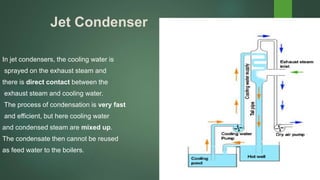
In jet condensers, the cooling water is
sprayed on the exhaust steam and
there is direct contact between the
exhaust steam and cooling water.
The process of condensation is very fast
and efficient, but here cooling water
and condensed steam are mixed up.
The condensate then cannot be reused
as feed water to the boilers.
Surface Condenser
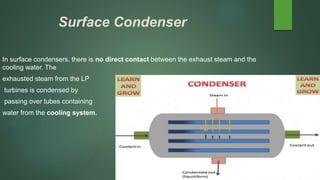
In surface condensers, there is no direct contact between the exhaust steam and the
cooling water. The
exhausted steam from the LP
turbines is condensed by
passing over tubes containing
water from the cooling system.
Surface Condenser
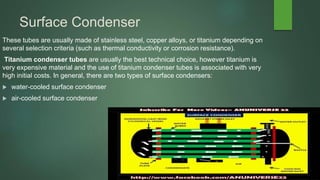
These tubes are usually made of stainless steel, copper alloys, or titanium depending on
several selection criteria (such as thermal conductivity or corrosion resistance).
Titanium condenser tubes are usually the best technical choice, however titanium is
very expensive material and the use of titanium condenser tubes is associated with very
high initial costs. In general, there are two types of surface condensers:
 water-cooled surface condenser
 air-cooled surface condenser
Condenser vacuum
For water-cooled surface condensers, the shell's internal vacuum is most
commonly supplied and maintained by an external ejector system. Such an
ejector system uses steam as the motive fluid to remove any non-condensible
gases that may be present in the surface condenser.
Motor driven mechanical vacuum pump such as the liquid ring type, are also
popular for this service.
Why vacuum is necessary
 To pull out non condensable gases/air
 Make faster the process of condensation otherwise the gases will react ,
can cause of serious material fatigue & tubes failure.
 To achieve the process/plant efficiency.
 To pull the low pressure steam.
 To change the phase steam to water rapidly.
 To prevent the turbine back pressure.
 To protect the tubes failure.
Sources of air ingress
 Atmospheric relief valves
 Rapture disks
 LP heaters / re-heater
 Drain valves
 Turbine seals
 Condenser expansion bellow
 From ejector lines
 Instruments /sight glasses
 Valve stems/bonnets
 Hot well man hole covers
 Piping weld joints
 Condensate pump seals
Effects of air ingress
 Efficiency of condenser decreases
 Condensation process will slow
 Failure to remove non condense able gases , that may cause of corrosion
or material failure
 Lower heat transfer properties
 Unconscious temperature occur in turbine last stages
 Pressure can generates on last stages
 Rotor blades can effected
Function of Condenser
 Create the vacuum for condensing steam
 Removing dissolved noncondensable gases from steam
 Change the phase, steam to condensate
 Re use the demin water
 Providing a barrier between condensate and non treated cooling water
 Providing a barrier against the air ingress
 Preventing excessive back pressure to turbine
 Serving as a drain receptacle ,receiving vapors & condensate from many exchanger, from valve
leak off
 Facility of storage and makeup water
Condenser tube materials
 Copper base alloy (ASTM B111 , B543)
 Stainless steel (ASTM A213, A249, A268, A269, B268)
 Titanium (ASTM B338 , Gr1&2)
 Carbon steel (ASTM A179, A214)
Why condenser is
important in power plant
Why condenser is important
 Can get Maximum steam energy
 For Rankine cycle
 High vacuum can obtained easily
 increases of plant efficiency
 Reuse of condensate water
 Saving of Water treatment plant cost
 Power saving
Condenser Leak Test Methods
 Hydro testing
 Soap test
 Electronic device test
Hydro testing
 Take permit and open the water box covers.
 Check the oxygen level in confined space.
 Fill the shell with water until all tubes get dip in water
 Insert the fluorescent powder in water and mix it well.
 Give some time to penetrate the water in cracks.
 Check tube sheet from both sides, if any water leak find then mark and plug both end of tube
 After it , use the fluorescent light to detect leak(off other light while using F.light)
 The fluorescent light identify the minor leaks, then plug the tube both ends.
 After all , drain the water and close the covers.
 Check housekeeping , return permit .
 Fill the box up sheet.
Soap testing
 Take permit and open the water box covers.
 Check oxygen level in confined space.
 Clean the tube and tube sheet.
 Start the ejector / vacuum pump for vacuum , because we need vacuum .
 Use rubber gloves and Prepare the soap water & mix well to obtain the bubbles.
 Put the soap bubbles to the tube ends and check the bubbles is cracking or not, because if the
bubbles are cracking it means the tube is sucking air, and that particular tube is leak.
 Identify the leak tube and install plugs on both ends.
 After all check housekeeping and close covers.
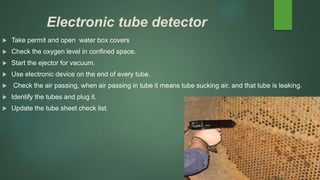
Electronic tube detector
 Take permit and open water box covers
 Check the oxygen level in confined space.
 Start the ejector for vacuum.
 Use electronic device on the end of every tube.
 Check the air passing, when air passing in tube it means tube sucking air, and that tube is leaking.
 Identify the tubes and plug it.
 Update the tube sheet check list.
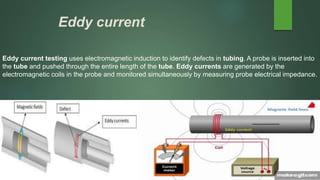
Eddy current
Eddy current testing uses electromagnetic induction to identify defects in tubing. A probe is inserted into
the tube and pushed through the entire length of the tube. Eddy currents are generated by the
electromagnetic coils in the probe and monitored simultaneously by measuring probe electrical impedance.
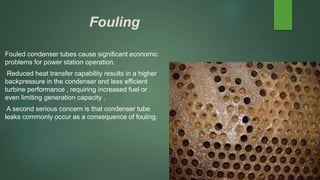
Fouling
Fouled condenser tubes cause significant economic
problems for power station operation.
Reduced heat transfer capability results in a higher
backpressure in the condenser and less efficient
turbine performance , requiring increased fuel or
even limiting generation capacity .
A second serious concern is that condenser tube
leaks commonly occur as a consequence of fouling.
Types of fouling
Condenser tube fouling is mostly a tube interior concern, generally into the
categories
 Microbiological
 Scale
 Deposition
 Corrosion
 Tube sheet plug gage
Fouling prevention
Steps can be taken to significantly reduce the possibility of condenser tube
fouling .incoming water may be treated for particular removal by the use of
settling ponds or by filtration.
The chemical dosing system can reduce the fouling effect (to improve water
quality).
The travelling mesh can prevent from fouling.
Mechanical system of sponge ball can also be use to prevent the tube fouling.
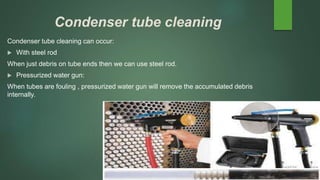
Condenser tube cleaning
Condenser tube cleaning can occur:
 With steel rod
When just debris on tube ends then we can use steel rod.
 Pressurized water gun:
When tubes are fouling , pressurized water gun will remove the accumulated debris
internally.
Any Question??
Thank You

Steam Condenser types,function, tube test, condenser vacuum

  • 1.
  • 2.
    Contents  Introduction  Types Condenser vacuum  Function of condenser  Tube materials  Importance  Leak test methods  Cleaning of tubes
  • 3.
    Introduction A steam condenseris a closed vessel which is maintained at low pressure, (lesser than atmospheric pressure). The condenser acts as a heat exchanger where exchange of heat occurs between steam and cold circulating water. In this system, heat rejection at atmospheric temperature takes place by condensing exhaust steam from prime mover. The condensate can be reused as feed water to the boiler. The steam turbine condenser is located under LP turbine.
  • 4.
    Types of SteamCondensers The steam condensers are broadly classified into two types:  Jet condensers (or mixing type condensers). In jet condensers there is direct contact between the exhaust steam and cooling water.  Surface condensers (or non-mixing type condensers). In surface condensers, there is no direct contact between the exhaust steam and the cooling water.
  • 5.
    Jet Condenser In jetcondensers, the cooling water is sprayed on the exhaust steam and there is direct contact between the exhaust steam and cooling water. The process of condensation is very fast and efficient, but here cooling water and condensed steam are mixed up. The condensate then cannot be reused as feed water to the boilers.
  • 6.
    Surface Condenser In surfacecondensers, there is no direct contact between the exhaust steam and the cooling water. The exhausted steam from the LP turbines is condensed by passing over tubes containing water from the cooling system.
  • 7.
    Surface Condenser These tubesare usually made of stainless steel, copper alloys, or titanium depending on several selection criteria (such as thermal conductivity or corrosion resistance). Titanium condenser tubes are usually the best technical choice, however titanium is very expensive material and the use of titanium condenser tubes is associated with very high initial costs. In general, there are two types of surface condensers:  water-cooled surface condenser  air-cooled surface condenser
  • 8.
    Condenser vacuum For water-cooledsurface condensers, the shell's internal vacuum is most commonly supplied and maintained by an external ejector system. Such an ejector system uses steam as the motive fluid to remove any non-condensible gases that may be present in the surface condenser. Motor driven mechanical vacuum pump such as the liquid ring type, are also popular for this service.
  • 9.
    Why vacuum isnecessary  To pull out non condensable gases/air  Make faster the process of condensation otherwise the gases will react , can cause of serious material fatigue & tubes failure.  To achieve the process/plant efficiency.  To pull the low pressure steam.  To change the phase steam to water rapidly.  To prevent the turbine back pressure.  To protect the tubes failure.
  • 10.
    Sources of airingress  Atmospheric relief valves  Rapture disks  LP heaters / re-heater  Drain valves  Turbine seals  Condenser expansion bellow  From ejector lines  Instruments /sight glasses  Valve stems/bonnets  Hot well man hole covers  Piping weld joints  Condensate pump seals
  • 11.
    Effects of airingress  Efficiency of condenser decreases  Condensation process will slow  Failure to remove non condense able gases , that may cause of corrosion or material failure  Lower heat transfer properties  Unconscious temperature occur in turbine last stages  Pressure can generates on last stages  Rotor blades can effected
  • 12.
    Function of Condenser Create the vacuum for condensing steam  Removing dissolved noncondensable gases from steam  Change the phase, steam to condensate  Re use the demin water  Providing a barrier between condensate and non treated cooling water  Providing a barrier against the air ingress  Preventing excessive back pressure to turbine  Serving as a drain receptacle ,receiving vapors & condensate from many exchanger, from valve leak off  Facility of storage and makeup water
  • 13.
    Condenser tube materials Copper base alloy (ASTM B111 , B543)  Stainless steel (ASTM A213, A249, A268, A269, B268)  Titanium (ASTM B338 , Gr1&2)  Carbon steel (ASTM A179, A214)
  • 14.
  • 15.
    Why condenser isimportant  Can get Maximum steam energy  For Rankine cycle  High vacuum can obtained easily  increases of plant efficiency  Reuse of condensate water  Saving of Water treatment plant cost  Power saving
  • 16.
    Condenser Leak TestMethods  Hydro testing  Soap test  Electronic device test
  • 17.
    Hydro testing  Takepermit and open the water box covers.  Check the oxygen level in confined space.  Fill the shell with water until all tubes get dip in water  Insert the fluorescent powder in water and mix it well.  Give some time to penetrate the water in cracks.  Check tube sheet from both sides, if any water leak find then mark and plug both end of tube  After it , use the fluorescent light to detect leak(off other light while using F.light)  The fluorescent light identify the minor leaks, then plug the tube both ends.  After all , drain the water and close the covers.  Check housekeeping , return permit .  Fill the box up sheet.
  • 18.
    Soap testing  Takepermit and open the water box covers.  Check oxygen level in confined space.  Clean the tube and tube sheet.  Start the ejector / vacuum pump for vacuum , because we need vacuum .  Use rubber gloves and Prepare the soap water & mix well to obtain the bubbles.  Put the soap bubbles to the tube ends and check the bubbles is cracking or not, because if the bubbles are cracking it means the tube is sucking air, and that particular tube is leak.  Identify the leak tube and install plugs on both ends.  After all check housekeeping and close covers.
  • 19.
    Electronic tube detector Take permit and open water box covers  Check the oxygen level in confined space.  Start the ejector for vacuum.  Use electronic device on the end of every tube.  Check the air passing, when air passing in tube it means tube sucking air, and that tube is leaking.  Identify the tubes and plug it.  Update the tube sheet check list.
  • 20.
    Eddy current Eddy currenttesting uses electromagnetic induction to identify defects in tubing. A probe is inserted into the tube and pushed through the entire length of the tube. Eddy currents are generated by the electromagnetic coils in the probe and monitored simultaneously by measuring probe electrical impedance.
  • 21.
    Fouling Fouled condenser tubescause significant economic problems for power station operation. Reduced heat transfer capability results in a higher backpressure in the condenser and less efficient turbine performance , requiring increased fuel or even limiting generation capacity . A second serious concern is that condenser tube leaks commonly occur as a consequence of fouling.
  • 22.
    Types of fouling Condensertube fouling is mostly a tube interior concern, generally into the categories  Microbiological  Scale  Deposition  Corrosion  Tube sheet plug gage
  • 23.
    Fouling prevention Steps canbe taken to significantly reduce the possibility of condenser tube fouling .incoming water may be treated for particular removal by the use of settling ponds or by filtration. The chemical dosing system can reduce the fouling effect (to improve water quality). The travelling mesh can prevent from fouling. Mechanical system of sponge ball can also be use to prevent the tube fouling.
  • 24.
    Condenser tube cleaning Condensertube cleaning can occur:  With steel rod When just debris on tube ends then we can use steel rod.  Pressurized water gun: When tubes are fouling , pressurized water gun will remove the accumulated debris internally.
  • 25.
  • 26.