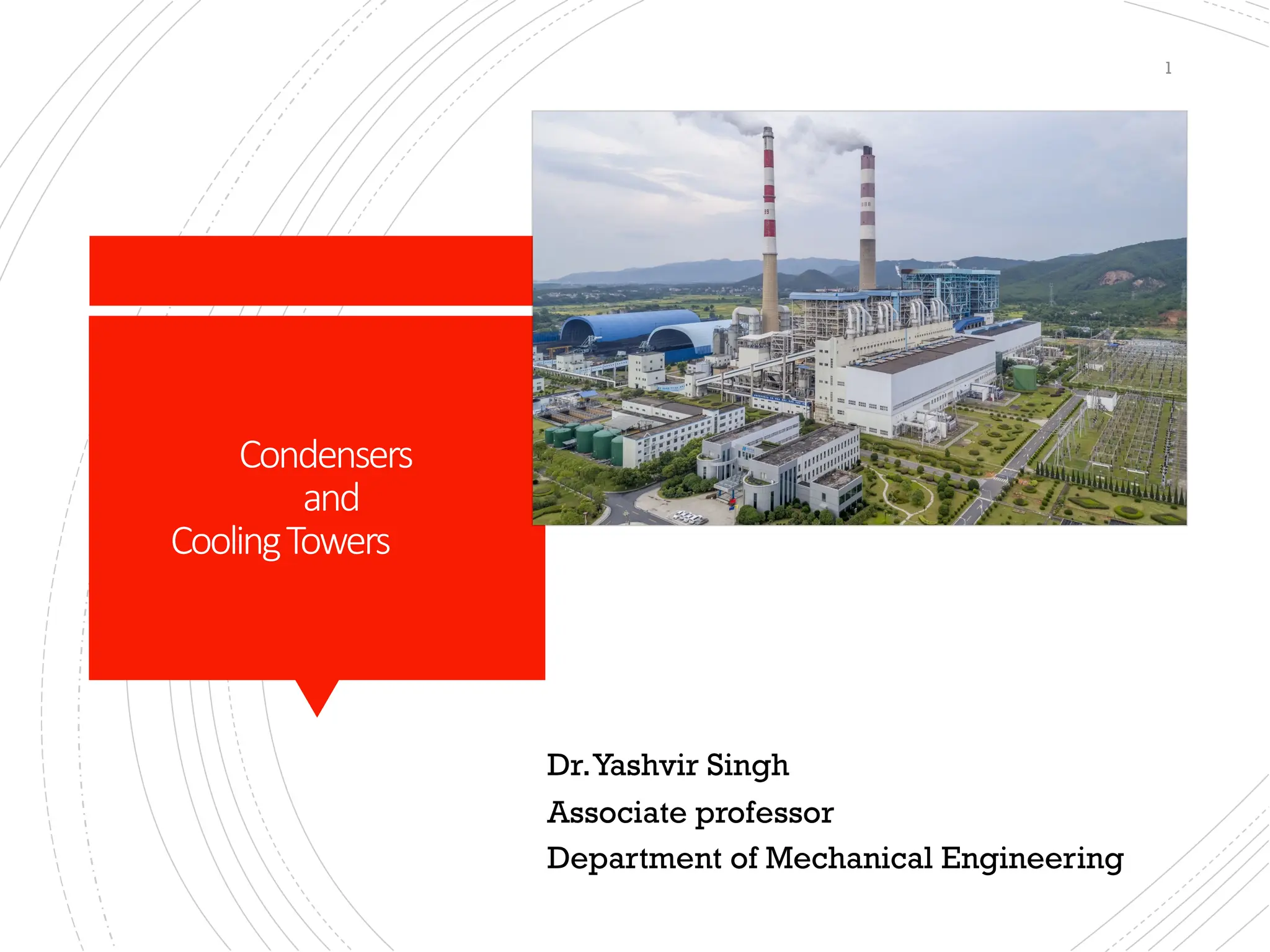
Condensers
and
CoolingTowers
1
Dr.Yashvir Singh
Associate professor
Department of Mechanical Engineering
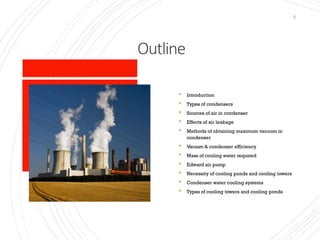
Outline
2
 Introduction
 Types of condensers
 Sources of air in condenser
 Effects of air leakage
 Methods of obtaining maximum vacuum in
condenser
 Vacuum & condenser efficiency
 Mass of cooling water required
 Edward air pump
 Necessity of cooling ponds and cooling towers
 Condenser water cooling systems
 Types of cooling towers and cooling ponds
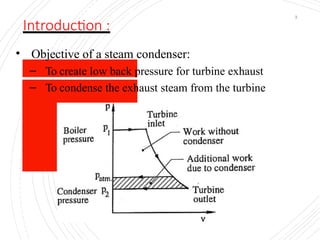
Introduction :
3
• Objective of a steam condenser:
– To create low back pressure for turbine exhaust
– To condense the exhaust steam from the turbine
Introduction :
Advantages :
• Increases work done per kg of steam
• Increases thermal efficiency of plant
• Condensed steam provides
a source of
good pure feed water.
• High temperature condensate
water reduces amount
of heat supplied per kg of steam
• Reduces corrosion of boiler tube
4
Introduction:
5
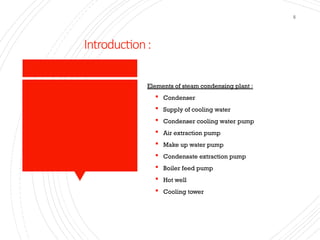
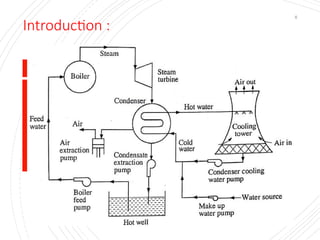
Elements of steam condensing plant :
 Condenser
 Supply of cooling water
 Condenser cooling water pump
 Air extraction pump
 Make up water pump
 Condensate extraction pump
 Boiler feed pump
 Hot well
 Cooling tower
Introduction :
6
Types of Condensers :
7
Two main types :
 Jet condenser
 Surface condenser
JetCondenser:
8
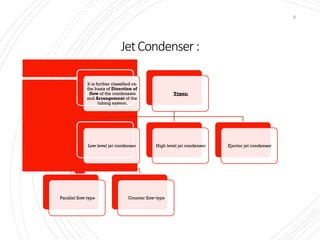
It is further classified on
the basis of Direction of
flow of the condensate
and Arrangement of the
tubing system.
Types:
Low level jet condenser
Parallel flow type Counter flow type
High level jet condenser Ejector jet condenser
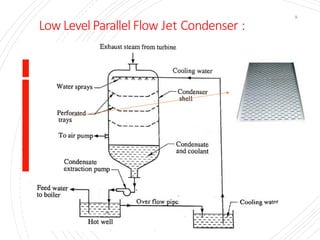
Low Level Parallel Flow Jet Condenser :
9
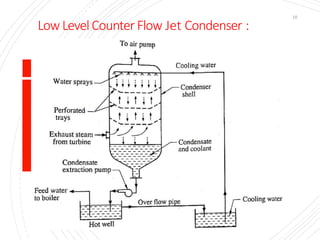
Low Level Counter Flow Jet Condenser :
10
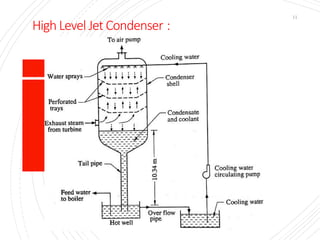
High Level Jet Condenser :
11
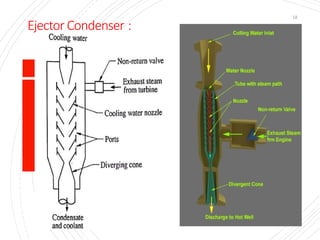
Ejector Condenser :
12
JetCondenser:
13
Advantages :
 Lower quantity of cooling water
required
 Simple in design
 Require less floor space
 Lower capital and maintenance cost
 Due to direct contact heat transfer is
more effective
Disadvantages :
 Condensate cannot be directly used
as feed water
 Power consumption in pump is more
 Piping cost is high.
Surface Condenser :
14
It is further classified as
follows :
According to number of
cooling water passes
Single pass
Multi pass
According to direction of
condensate flow
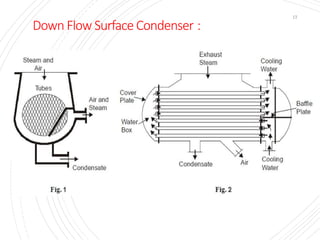
Down flow condenser
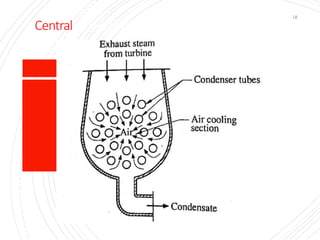
Central flow condenser
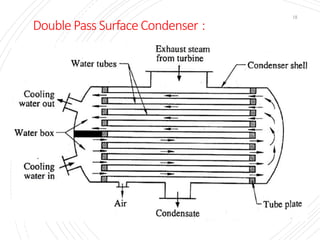
Double Pass Surface Condenser :
15
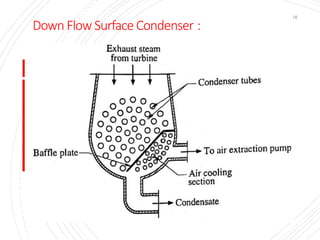
Down Flow Surface Condenser :
16
Down Flow Surface Condenser :
17
Central Flow Surface Condenser :
18
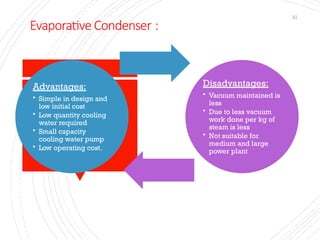
Evaporative Condenser :
19
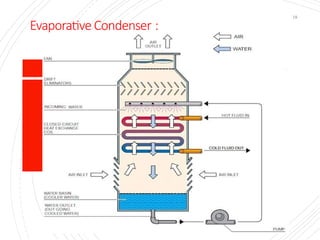
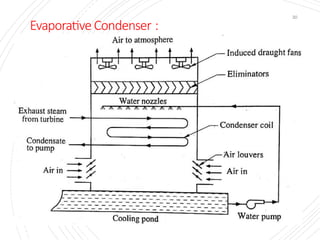
Evaporative Condenser :
20
Evaporative Condenser :
21
Advantages:
• Simple in design and
low initial cost
• Low quantity cooling
water required
• Small capacity
cooling water pump
• Low operating cost.
Disadvantages:
• Vacuum maintained is
less
• Due to less vacuum
work done per kg of
steam is less
• Not suitable for
medium and large
power plant
Surface
Condenser:
22
•Due to high vacuum increases thermal
efficiency and output of plant
•Condensate can be reused as boiler feed
water
•Auxiliary power requirement is less
•Less amount of air is carried to the boiler
•Any kind of feed water can be used
•Can develop high vacuum, so
suitable for medium and large power
plants
Advantages
:
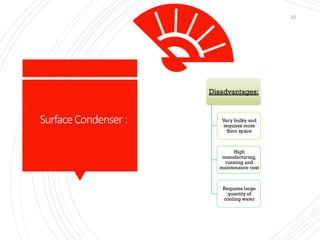
SurfaceCondenser:
23
Disadvantages:
Very bulky and
requires more
floor space
High
manufacturing,
running and
maintenance cost
Requires large
quantity of
cooling water
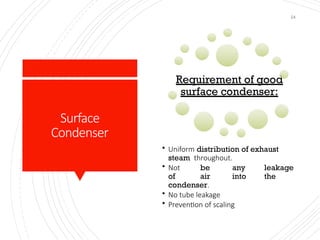
24
Requirement of good
surface condenser:
• Uniform distribution of exhaust
steam throughout.
• Not be any leakage
of air into the
condenser.
• No tube leakage
• Prevention of scaling
Surface
Condenser
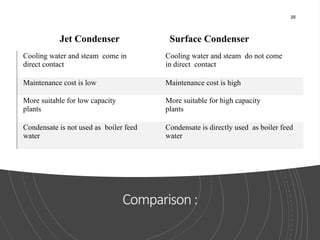
Comparison:
25
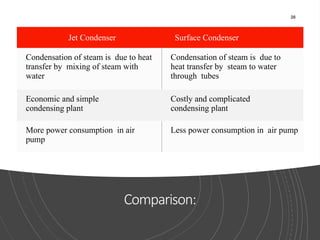
Jet Condenser Surface Condenser
Cooling water and steam come in
direct contact
Cooling water and steam do not come
in direct contact
Maintenance cost is low Maintenance cost is high
More suitable for low capacity
plants
More suitable for high capacity
plants
Condensate is not used as boiler feed
water
Condensate is directly used as boiler feed
water
Comparison:
26
Jet Condenser Surface Condenser
Condensation of steam is due to heat
transfer by mixing of steam with
water
Condensation of steam is due to
heat transfer by steam to water
through tubes
Economic and simple
condensing plant
Costly and complicated
condensing plant
More power consumption in air
pump
Less power consumption in air pump
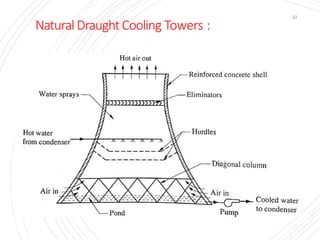
Natural Draught Cooling Towers :
27
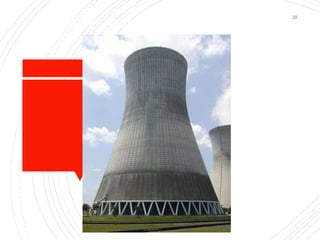
Natural Draught Cooling Towers :
28
Ajaypalsinh Barad
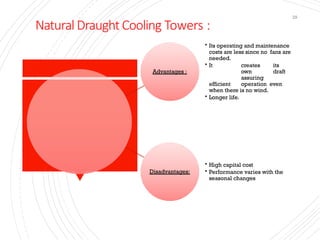
Natural Draught Cooling Towers :
29
Advantages :
• Its operating and maintenance
costs are less since no fans are
needed.
• It creates its
own draft
assuring
efficient operation even
when there is no wind.
• Longer life.
Disadvantages:
• High capital cost
• Performance varies with the
seasonal changes
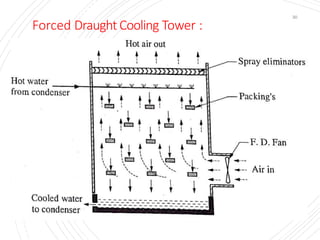
Forced Draught Cooling Tower :
30
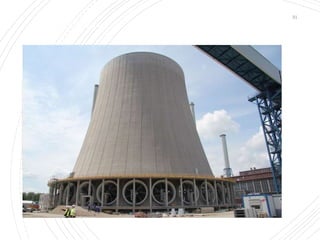
Forced Draught Cooling Tower :
31
Forced Draught Cooling Tower :
32
Advantages:
• More efficient
• Problems of blade erosion are avoided
• Fan is located at ground so more safe
• Vibration and noise are less as mechanical equipments are
set on a solid foundation.
Disadvantages :
• Possibility of recirculation of hot humid exhaust
air coming out from the top of the tower
• Fan size is limited to 4 meters
• Possibility of ice formation on fan blades in cold weather
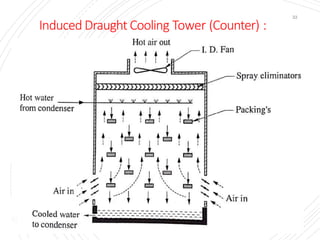
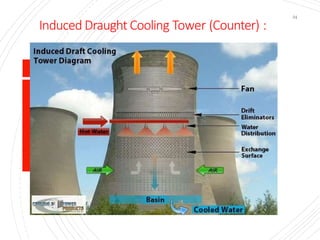
Induced Draught Cooling Tower (Counter) :
33
Induced Draught Cooling Tower (Counter) :
34
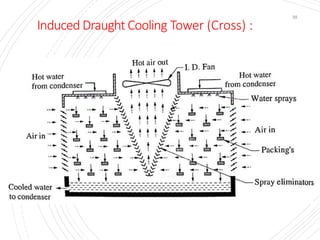
Induced Draught Cooling Tower (Cross) :
35
Induced Draught Cooling Tower :
36
Advantages:
• Coldest water comes in contact with the driest air and
the warmest water comes in contact with the most air.
• The recirculation of hot humid air is not a
major problem.
• Larger fan size can be used.
• Lower first cost due to the reduced pump capacity
• Capable of cooling through a wide range.
Induced Draught Cooling Tower :
37
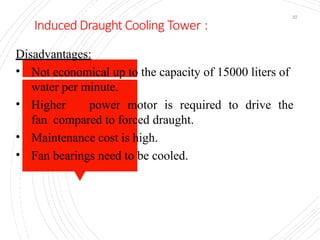
Disadvantages:
• Not economical up to the capacity of 15000 liters of
water per minute.
• Higher power motor is required to drive the
fan compared to forced draught.
• Maintenance cost is high.
• Fan bearings need to be cooled.
Terms related with Cooling Tower:
38
Fill:
• The hot water from the condenser is sprayed through
the nozzles over a series of horizontal bars called fill
or packing.
Drift:
• When the air flows from bottom to top of the cooling
tower, it carries fine water droplets along with the air.
These fine droplets of water are called drift.
Terms related with Cooling Tower:
39
Approach (A):
• It is defined as the difference between the exit
temperature of the cooling water (tc2) and the wet
bulb temperature of the ambient air (twb).
A = tc2 - twb
Cooling range (R):
• It is the difference in temperature of the incoming
warm water (tc1) and the exit temperature of cooled
water (tc2).
R = tc1 - tc2
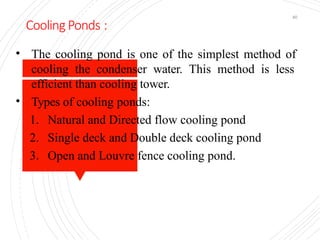
Cooling Ponds :
40
• The cooling pond is one of the simplest method of
cooling the condenser water. This method is less
efficient than cooling tower.
• Types of cooling ponds:
1. Natural and Directed flow cooling pond
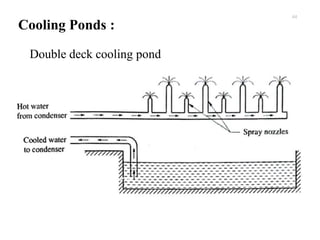
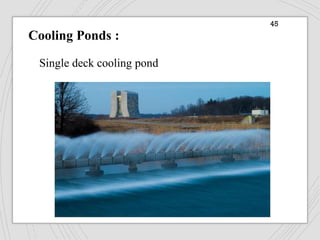
2. Single deck and Double deck cooling pond
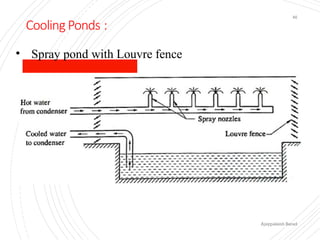
3. Open and Louvre fence cooling pond.
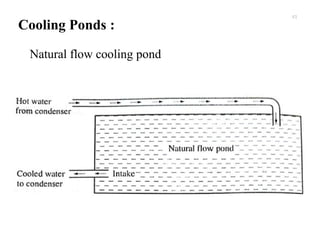
Cooling Ponds :
Natural flow cooling pond
41
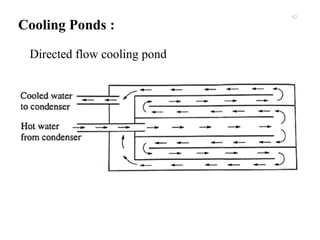
Cooling Ponds :
Directed flow cooling pond
42
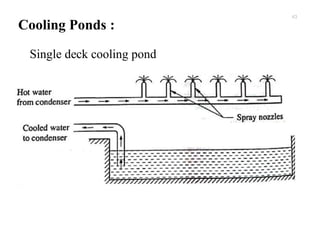
Cooling Ponds :
Single deck cooling pond
43
Cooling Ponds :
Double deck cooling pond
44
Cooling Ponds :
Single deck cooling pond
45
Cooling Ponds :
Ajaypalsinh Barad
46
• Spray pond with Louvre fence
Cooling Ponds :
47
Advantages:
• Initial cost is less and Simple in design and arrangement
Disadvantages:
• Requires large area for cooling.
Condenser and cooling tower.pptxdljsajfsbafabkfa

Condenser and cooling tower.pptxdljsajfsbafabkfa

  • 1.
  • 2.
    Outline 2  Introduction  Typesof condensers  Sources of air in condenser  Effects of air leakage  Methods of obtaining maximum vacuum in condenser  Vacuum & condenser efficiency  Mass of cooling water required  Edward air pump  Necessity of cooling ponds and cooling towers  Condenser water cooling systems  Types of cooling towers and cooling ponds
  • 3.
    Introduction : 3 • Objectiveof a steam condenser: – To create low back pressure for turbine exhaust – To condense the exhaust steam from the turbine
  • 4.
    Introduction : Advantages : •Increases work done per kg of steam • Increases thermal efficiency of plant • Condensed steam provides a source of good pure feed water. • High temperature condensate water reduces amount of heat supplied per kg of steam • Reduces corrosion of boiler tube 4
  • 5.
    Introduction: 5 Elements of steamcondensing plant :  Condenser  Supply of cooling water  Condenser cooling water pump  Air extraction pump  Make up water pump  Condensate extraction pump  Boiler feed pump  Hot well  Cooling tower
  • 6.
  • 7.
    Types of Condensers: 7 Two main types :  Jet condenser  Surface condenser
  • 8.
    JetCondenser: 8 It is furtherclassified on the basis of Direction of flow of the condensate and Arrangement of the tubing system. Types: Low level jet condenser Parallel flow type Counter flow type High level jet condenser Ejector jet condenser
  • 9.
    Low Level ParallelFlow Jet Condenser : 9
  • 10.
    Low Level CounterFlow Jet Condenser : 10
  • 11.
    High Level JetCondenser : 11
  • 12.
  • 13.
    JetCondenser: 13 Advantages :  Lowerquantity of cooling water required  Simple in design  Require less floor space  Lower capital and maintenance cost  Due to direct contact heat transfer is more effective Disadvantages :  Condensate cannot be directly used as feed water  Power consumption in pump is more  Piping cost is high.
  • 14.
    Surface Condenser : 14 Itis further classified as follows : According to number of cooling water passes Single pass Multi pass According to direction of condensate flow Down flow condenser Central flow condenser
  • 15.
    Double Pass SurfaceCondenser : 15
  • 16.
    Down Flow SurfaceCondenser : 16
  • 17.
    Down Flow SurfaceCondenser : 17
  • 18.
    Central Flow SurfaceCondenser : 18
  • 19.
  • 20.
  • 21.
    Evaporative Condenser : 21 Advantages: •Simple in design and low initial cost • Low quantity cooling water required • Small capacity cooling water pump • Low operating cost. Disadvantages: • Vacuum maintained is less • Due to less vacuum work done per kg of steam is less • Not suitable for medium and large power plant
  • 22.
    Surface Condenser: 22 •Due to highvacuum increases thermal efficiency and output of plant •Condensate can be reused as boiler feed water •Auxiliary power requirement is less •Less amount of air is carried to the boiler •Any kind of feed water can be used •Can develop high vacuum, so suitable for medium and large power plants Advantages :
  • 23.
    SurfaceCondenser: 23 Disadvantages: Very bulky and requiresmore floor space High manufacturing, running and maintenance cost Requires large quantity of cooling water
  • 24.
    24 Requirement of good surfacecondenser: • Uniform distribution of exhaust steam throughout. • Not be any leakage of air into the condenser. • No tube leakage • Prevention of scaling Surface Condenser
  • 25.
    Comparison: 25 Jet Condenser SurfaceCondenser Cooling water and steam come in direct contact Cooling water and steam do not come in direct contact Maintenance cost is low Maintenance cost is high More suitable for low capacity plants More suitable for high capacity plants Condensate is not used as boiler feed water Condensate is directly used as boiler feed water
  • 26.
    Comparison: 26 Jet Condenser SurfaceCondenser Condensation of steam is due to heat transfer by mixing of steam with water Condensation of steam is due to heat transfer by steam to water through tubes Economic and simple condensing plant Costly and complicated condensing plant More power consumption in air pump Less power consumption in air pump
  • 27.
  • 28.
    Natural Draught CoolingTowers : 28 Ajaypalsinh Barad
  • 29.
    Natural Draught CoolingTowers : 29 Advantages : • Its operating and maintenance costs are less since no fans are needed. • It creates its own draft assuring efficient operation even when there is no wind. • Longer life. Disadvantages: • High capital cost • Performance varies with the seasonal changes
  • 30.
  • 31.
  • 32.
    Forced Draught CoolingTower : 32 Advantages: • More efficient • Problems of blade erosion are avoided • Fan is located at ground so more safe • Vibration and noise are less as mechanical equipments are set on a solid foundation. Disadvantages : • Possibility of recirculation of hot humid exhaust air coming out from the top of the tower • Fan size is limited to 4 meters • Possibility of ice formation on fan blades in cold weather
  • 33.
    Induced Draught CoolingTower (Counter) : 33
  • 34.
    Induced Draught CoolingTower (Counter) : 34
  • 35.
    Induced Draught CoolingTower (Cross) : 35
  • 36.
    Induced Draught CoolingTower : 36 Advantages: • Coldest water comes in contact with the driest air and the warmest water comes in contact with the most air. • The recirculation of hot humid air is not a major problem. • Larger fan size can be used. • Lower first cost due to the reduced pump capacity • Capable of cooling through a wide range.
  • 37.
    Induced Draught CoolingTower : 37 Disadvantages: • Not economical up to the capacity of 15000 liters of water per minute. • Higher power motor is required to drive the fan compared to forced draught. • Maintenance cost is high. • Fan bearings need to be cooled.
  • 38.
    Terms related withCooling Tower: 38 Fill: • The hot water from the condenser is sprayed through the nozzles over a series of horizontal bars called fill or packing. Drift: • When the air flows from bottom to top of the cooling tower, it carries fine water droplets along with the air. These fine droplets of water are called drift.
  • 39.
    Terms related withCooling Tower: 39 Approach (A): • It is defined as the difference between the exit temperature of the cooling water (tc2) and the wet bulb temperature of the ambient air (twb). A = tc2 - twb Cooling range (R): • It is the difference in temperature of the incoming warm water (tc1) and the exit temperature of cooled water (tc2). R = tc1 - tc2
  • 40.
    Cooling Ponds : 40 •The cooling pond is one of the simplest method of cooling the condenser water. This method is less efficient than cooling tower. • Types of cooling ponds: 1. Natural and Directed flow cooling pond 2. Single deck and Double deck cooling pond 3. Open and Louvre fence cooling pond.
  • 41.
    Cooling Ponds : Naturalflow cooling pond 41
  • 42.
    Cooling Ponds : Directedflow cooling pond 42
  • 43.
    Cooling Ponds : Singledeck cooling pond 43
  • 44.
    Cooling Ponds : Doubledeck cooling pond 44
  • 45.
    Cooling Ponds : Singledeck cooling pond 45
  • 46.
    Cooling Ponds : AjaypalsinhBarad 46 • Spray pond with Louvre fence
  • 47.
    Cooling Ponds : 47 Advantages: •Initial cost is less and Simple in design and arrangement Disadvantages: • Requires large area for cooling.