STEAM CONDENSERS
BY: Prashant Kumar
CONDENSATION
If the pressure of the exhaust steam
reduced below the atmospheric
pressure and hence its energy, partially
of fully, can not be reutilized, than this
phenomenon is called Steam
Condensation.
STEAM CONDENSERS
The heat transfer device in which the
exhaust steam of a turbine or an
engine is condensed by means of
cooling water at pressure below
atmospheric, is called Steam
Condenser.
CONDENSATE
The condensed Steam is called
Condensate and can be again
returned to Boiler. It saves the
cost of water.
PRINCIPLE OF CONDENSATION
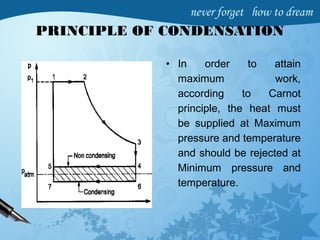
• In order to attain
maximum work,
according to Carnot
principle, the heat must
be supplied at Maximum
pressure and temperature
and should be rejected at
Minimum pressure and
temperature.
PRINCIPLE OF CONDENSATION
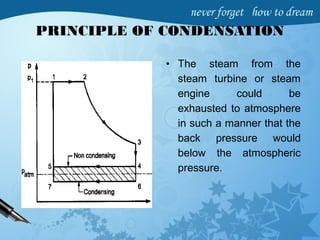
• The steam from the
steam turbine or steam
engine could be
exhausted to atmosphere
in such a manner that the
back pressure would
below the atmospheric
pressure.
ADVANTAGES OF CONDENSERS
•It increases the work output per kg of steam
supplied to the power plant.
•Reduces the specific steam consumption.
•Reduces the size of power plant of given capacity.
•Improves the thermal efficiency of power plant.
•Saves the cost of water to be supplied to boiler.
ELEMENTS OF CONDENSING PLANT
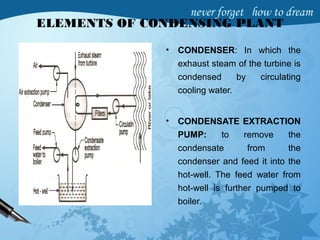
• CONDENSER: In which the
exhaust steam of the turbine is
condensed by circulating
cooling water.
• CONDENSATE EXTRACTION
PUMP: to remove the
condensate from the
condenser and feed it into the
hot-well. The feed water from
hot-well is further pumped to
boiler.
ELEMENTS OF CONDENSING PLANT
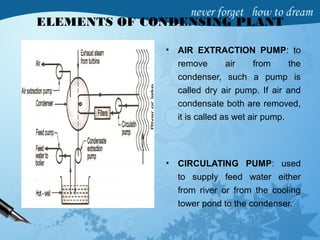
• AIR EXTRACTION PUMP: to
remove air from the
condenser, such a pump is
called dry air pump. If air and
condensate both are removed,
it is called as wet air pump.
• CIRCULATING PUMP: used
to supply feed water either
from river or from the cooling
tower pond to the condenser.
ELEMENTS OF CONDENSING PLANT
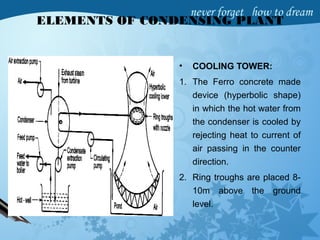
• COOLING TOWER:
1. The Ferro concrete made
device (hyperbolic shape)
in which the hot water from
the condenser is cooled by
rejecting heat to current of
air passing in the counter
direction.
2. Ring troughs are placed 8-
10m above the ground
level.
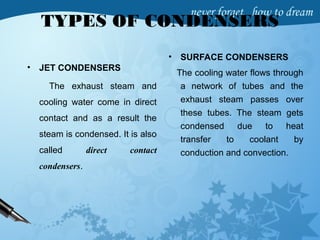
TYPES OF CONDENSERS
• JET CONDENSERS
The exhaust steam and
cooling water come in direct
contact and as a result the
steam is condensed. It is also
called direct contact
condensers.
• SURFACE CONDENSERS
The cooling water flows through
a network of tubes and the
exhaust steam passes over
these tubes. The steam gets
condensed due to heat
transfer to coolant by
conduction and convection.
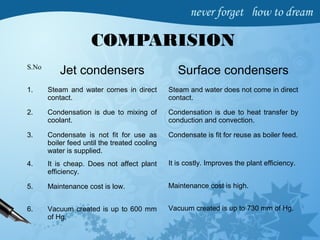
COMPARISION
S.No
Jet condensers
1. Steam and water comes in direct
contact.
2. Condensation is due to mixing of
coolant.
3. Condensate is not fit for use as
boiler feed until the treated cooling
water is supplied.
4. It is cheap. Does not affect plant
efficiency.
5. Maintenance cost is low.
6. Vacuum created is up to 600 mm
of Hg.
Surface condensers
Steam and water does not come in direct
contact.
Condensation is due to heat transfer by
conduction and convection.
Condensate is fit for reuse as boiler feed.
It is costly. Improves the plant efficiency.
Maintenance cost is high.
Vacuum created is up to 730 mm of Hg.
JET CONDENSERS
CLASSIFICATION OF JET CONDENSERS
1. Low level jet condensers
i) Counter flow type
ii) Parallel flow type
2. High level jet injectors
3. Ejector jet condensers
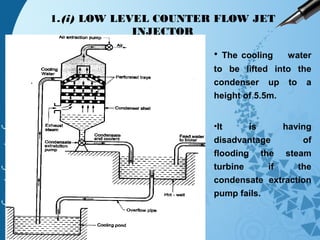
1.(i) LOW LEVEL COUNTER FLOW JET
INJECTOR
• The cooling water
to be lifted into the
condenser up to a
height of 5.5m.
•It is having
disadvantage of
flooding the steam
turbine if the
condensate extraction
pump fails.
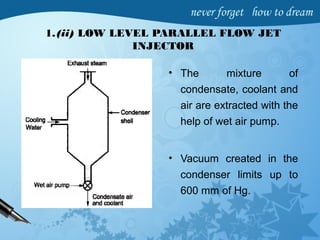
1.(ii) LOW LEVEL PARALLEL FLOW JET
INJECTOR
• The mixture of
condensate, coolant and
air are extracted with the
help of wet air pump.
• Vacuum created in the
condenser limits up to
600 mm of Hg.
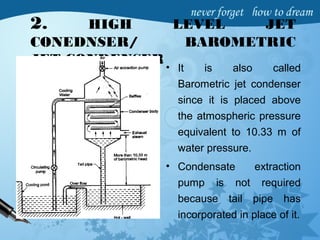
2. HIGH LEVEL JET
CONEDNSER/ BAROMETRIC
JET CONDENSER
• It is also called
Barometric jet condenser
since it is placed above
the atmospheric pressure
equivalent to 10.33 m of
water pressure.
• Condensate extraction
pump is not required
because tail pipe has
incorporated in place of it.
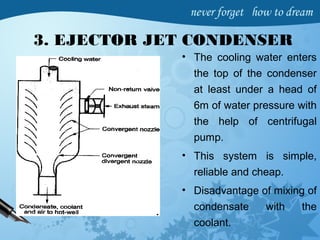
3. EJECTOR JET CONDENSER
• The cooling water enters
the top of the condenser
at least under a head of
6m of water pressure with
the help of centrifugal
pump.
• This system is simple,
reliable and cheap.
• Disadvantage of mixing of
condensate with the
coolant.
SURFACE CONDENSERS
Surface condensers are of two types
• SURFACE
CONDENSERS
In this steam flows
outside the network of
tubes and water flows
inside the tubes.
• EVAPORATIVE
CONDENSERS
In this condenser shell is
omitted. The steam
passes through
condenser tubes, the
water is sprayed while
the air passes upward
outside the tube.
CLASSIFICATION OF SURFACE CONDENSERS
• The number of water
passes:
1. Single pass
2. Multipass
• The direction of
condensate flow and
tube arrangement:
1. Down flow condenser
2. Central flow condenser
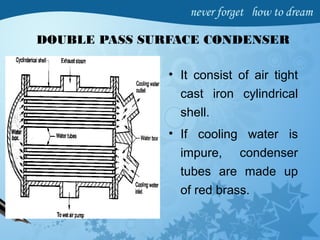
DOUBLE PASS SURFACE CONDENSER
• It consist of air tight
cast iron cylindrical
shell.
• If cooling water is
impure, condenser
tubes are made up
of red brass.
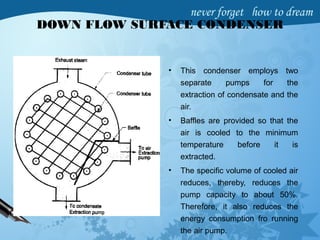
DOWN FLOW SURFACE CONDENSER
• This condenser employs two
separate pumps for the
extraction of condensate and the
air.
• Baffles are provided so that the
air is cooled to the minimum
temperature before it is
extracted.
• The specific volume of cooled air
reduces, thereby, reduces the
pump capacity to about 50%.
Therefore, it also reduces the
energy consumption fro running
the air pump.
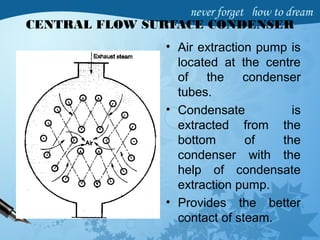
CENTRAL FLOW SURFACE CONDENSER
• Air extraction pump is
located at the centre
of the condenser
tubes.
• Condensate is
extracted from the
bottom of the
condenser with the
help of condensate
extraction pump.
• Provides the better
contact of steam.
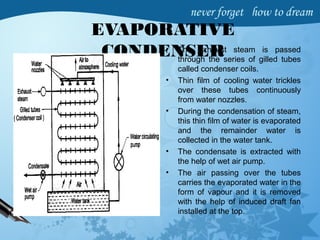
EVAPORATIVE
CONDENSER• The exhaust steam is passed
through the series of gilled tubes
called condenser coils.
• Thin film of cooling water trickles
over these tubes continuously
from water nozzles.
• During the condensation of steam,
this thin film of water is evaporated
and the remainder water is
collected in the water tank.
• The condensate is extracted with
the help of wet air pump.
• The air passing over the tubes
carries the evaporated water in the
form of vapour and it is removed
with the help of induced draft fan
installed at the top.
MERITS AND DEMERITS OF JET CONDENSERS
• MERITS
1. Less quantity of
cooling water is
required to condense
the steam.
2. Simple in construction
and low in cost.
3. Does not require
cooling water pump.
4. Less space is required.
5. Low maintenance cost.
• DEMERITS
1. The condensate is a
waste.
2. Less suitable for high
capacity plants.
3. Large length of pipes
required, hence piping
cost is high.
4. Loss of vacuum due to
leakage of air from long
pipings.
MERITS AND DEMERITS OF SURFACE CONDENSERS
• MERITS
1. No mixing of cooling water
and steam, hence the
condensate directly
pumped into the boiler.
2. Any kind of feed water can
be used.
3. Develops high vacuum,
therefore suitable fro large
power plants.
4. Require less power to run
the air extraction and water
extraction pump.
5. System is more efficient.
• DEMERITS
1. Require large quantity of
cooling water.
2. System is complicated, costly
and requires high
maintenance cost.
3. Require large floor space
since it is bulky.
AIR PUMPS
TYPES OF AIR PUMPS
1. WET AIR PUMP
2. DRY AIR PUMP
AIR PUMPS
• WET AIR PUMP
Used to remove both
condensate and the air
from the condenser.
These may be of type:
i) Reciprocating
ii) Rotary
• DRY AIR PUMP
Used only to remove
moist air. These may
be of type:
i) Reciprocating
ii) Rotary
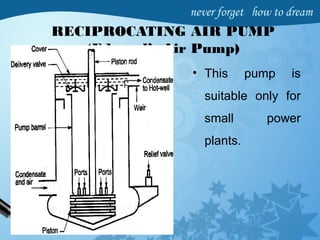
RECIPROCATING AIR PUMP
(Edward’s Air Pump)
• This pump is
suitable only for
small power
plants.
STEAM JET AIR EJECTOR
• It consists of convergent-
divergent nozzle and a
diffuser.
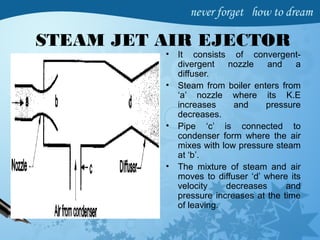
• Steam from boiler enters from
‘a’ nozzle where its K.E
increases and pressure
decreases.
• Pipe ‘c’ is connected to
condenser form where the air
mixes with low pressure steam
at ‘b’.
• The mixture of steam and air
moves to diffuser ‘d’ where its
velocity decreases and
pressure increases at the time
of leaving.
STEAM JET AIR EJECTOR
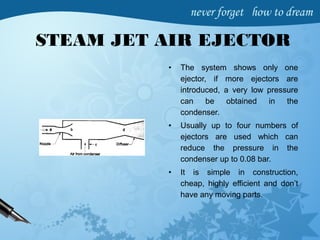
• The system shows only one
ejector, if more ejectors are
introduced, a very low pressure
can be obtained in the
condenser.
• Usually up to four numbers of
ejectors are used which can
reduce the pressure in the
condenser up to 0.08 bar.
• It is simple in construction,
cheap, highly efficient and don’t
have any moving parts.
Thank You

Steam condensors

  • 1.
  • 2.
    CONDENSATION If the pressureof the exhaust steam reduced below the atmospheric pressure and hence its energy, partially of fully, can not be reutilized, than this phenomenon is called Steam Condensation.
  • 3.
    STEAM CONDENSERS The heattransfer device in which the exhaust steam of a turbine or an engine is condensed by means of cooling water at pressure below atmospheric, is called Steam Condenser.
  • 4.
    CONDENSATE The condensed Steamis called Condensate and can be again returned to Boiler. It saves the cost of water.
  • 5.
    PRINCIPLE OF CONDENSATION •In order to attain maximum work, according to Carnot principle, the heat must be supplied at Maximum pressure and temperature and should be rejected at Minimum pressure and temperature.
  • 6.
    PRINCIPLE OF CONDENSATION •The steam from the steam turbine or steam engine could be exhausted to atmosphere in such a manner that the back pressure would below the atmospheric pressure.
  • 7.
    ADVANTAGES OF CONDENSERS •Itincreases the work output per kg of steam supplied to the power plant. •Reduces the specific steam consumption. •Reduces the size of power plant of given capacity. •Improves the thermal efficiency of power plant. •Saves the cost of water to be supplied to boiler.
  • 8.
    ELEMENTS OF CONDENSINGPLANT • CONDENSER: In which the exhaust steam of the turbine is condensed by circulating cooling water. • CONDENSATE EXTRACTION PUMP: to remove the condensate from the condenser and feed it into the hot-well. The feed water from hot-well is further pumped to boiler.
  • 9.
    ELEMENTS OF CONDENSINGPLANT • AIR EXTRACTION PUMP: to remove air from the condenser, such a pump is called dry air pump. If air and condensate both are removed, it is called as wet air pump. • CIRCULATING PUMP: used to supply feed water either from river or from the cooling tower pond to the condenser.
  • 10.
    ELEMENTS OF CONDENSINGPLANT • COOLING TOWER: 1. The Ferro concrete made device (hyperbolic shape) in which the hot water from the condenser is cooled by rejecting heat to current of air passing in the counter direction. 2. Ring troughs are placed 8- 10m above the ground level.
  • 11.
    TYPES OF CONDENSERS •JET CONDENSERS The exhaust steam and cooling water come in direct contact and as a result the steam is condensed. It is also called direct contact condensers. • SURFACE CONDENSERS The cooling water flows through a network of tubes and the exhaust steam passes over these tubes. The steam gets condensed due to heat transfer to coolant by conduction and convection.
  • 12.
    COMPARISION S.No Jet condensers 1. Steamand water comes in direct contact. 2. Condensation is due to mixing of coolant. 3. Condensate is not fit for use as boiler feed until the treated cooling water is supplied. 4. It is cheap. Does not affect plant efficiency. 5. Maintenance cost is low. 6. Vacuum created is up to 600 mm of Hg. Surface condensers Steam and water does not come in direct contact. Condensation is due to heat transfer by conduction and convection. Condensate is fit for reuse as boiler feed. It is costly. Improves the plant efficiency. Maintenance cost is high. Vacuum created is up to 730 mm of Hg.
  • 13.
  • 14.
    CLASSIFICATION OF JETCONDENSERS 1. Low level jet condensers i) Counter flow type ii) Parallel flow type 2. High level jet injectors 3. Ejector jet condensers
  • 15.
    1.(i) LOW LEVELCOUNTER FLOW JET INJECTOR • The cooling water to be lifted into the condenser up to a height of 5.5m. •It is having disadvantage of flooding the steam turbine if the condensate extraction pump fails.
  • 16.
    1.(ii) LOW LEVELPARALLEL FLOW JET INJECTOR • The mixture of condensate, coolant and air are extracted with the help of wet air pump. • Vacuum created in the condenser limits up to 600 mm of Hg.
  • 17.
    2. HIGH LEVELJET CONEDNSER/ BAROMETRIC JET CONDENSER • It is also called Barometric jet condenser since it is placed above the atmospheric pressure equivalent to 10.33 m of water pressure. • Condensate extraction pump is not required because tail pipe has incorporated in place of it.
  • 18.
    3. EJECTOR JETCONDENSER • The cooling water enters the top of the condenser at least under a head of 6m of water pressure with the help of centrifugal pump. • This system is simple, reliable and cheap. • Disadvantage of mixing of condensate with the coolant.
  • 19.
  • 20.
    Surface condensers areof two types • SURFACE CONDENSERS In this steam flows outside the network of tubes and water flows inside the tubes. • EVAPORATIVE CONDENSERS In this condenser shell is omitted. The steam passes through condenser tubes, the water is sprayed while the air passes upward outside the tube.
  • 21.
    CLASSIFICATION OF SURFACECONDENSERS • The number of water passes: 1. Single pass 2. Multipass • The direction of condensate flow and tube arrangement: 1. Down flow condenser 2. Central flow condenser
  • 22.
    DOUBLE PASS SURFACECONDENSER • It consist of air tight cast iron cylindrical shell. • If cooling water is impure, condenser tubes are made up of red brass.
  • 23.
    DOWN FLOW SURFACECONDENSER • This condenser employs two separate pumps for the extraction of condensate and the air. • Baffles are provided so that the air is cooled to the minimum temperature before it is extracted. • The specific volume of cooled air reduces, thereby, reduces the pump capacity to about 50%. Therefore, it also reduces the energy consumption fro running the air pump.
  • 24.
    CENTRAL FLOW SURFACECONDENSER • Air extraction pump is located at the centre of the condenser tubes. • Condensate is extracted from the bottom of the condenser with the help of condensate extraction pump. • Provides the better contact of steam.
  • 25.
    EVAPORATIVE CONDENSER• The exhauststeam is passed through the series of gilled tubes called condenser coils. • Thin film of cooling water trickles over these tubes continuously from water nozzles. • During the condensation of steam, this thin film of water is evaporated and the remainder water is collected in the water tank. • The condensate is extracted with the help of wet air pump. • The air passing over the tubes carries the evaporated water in the form of vapour and it is removed with the help of induced draft fan installed at the top.
  • 26.
    MERITS AND DEMERITSOF JET CONDENSERS • MERITS 1. Less quantity of cooling water is required to condense the steam. 2. Simple in construction and low in cost. 3. Does not require cooling water pump. 4. Less space is required. 5. Low maintenance cost. • DEMERITS 1. The condensate is a waste. 2. Less suitable for high capacity plants. 3. Large length of pipes required, hence piping cost is high. 4. Loss of vacuum due to leakage of air from long pipings.
  • 27.
    MERITS AND DEMERITSOF SURFACE CONDENSERS • MERITS 1. No mixing of cooling water and steam, hence the condensate directly pumped into the boiler. 2. Any kind of feed water can be used. 3. Develops high vacuum, therefore suitable fro large power plants. 4. Require less power to run the air extraction and water extraction pump. 5. System is more efficient. • DEMERITS 1. Require large quantity of cooling water. 2. System is complicated, costly and requires high maintenance cost. 3. Require large floor space since it is bulky.
  • 28.
  • 29.
    TYPES OF AIRPUMPS 1. WET AIR PUMP 2. DRY AIR PUMP
  • 30.
    AIR PUMPS • WETAIR PUMP Used to remove both condensate and the air from the condenser. These may be of type: i) Reciprocating ii) Rotary • DRY AIR PUMP Used only to remove moist air. These may be of type: i) Reciprocating ii) Rotary
  • 31.
    RECIPROCATING AIR PUMP (Edward’sAir Pump) • This pump is suitable only for small power plants.
  • 32.
    STEAM JET AIREJECTOR • It consists of convergent- divergent nozzle and a diffuser. • Steam from boiler enters from ‘a’ nozzle where its K.E increases and pressure decreases. • Pipe ‘c’ is connected to condenser form where the air mixes with low pressure steam at ‘b’. • The mixture of steam and air moves to diffuser ‘d’ where its velocity decreases and pressure increases at the time of leaving.
  • 33.
    STEAM JET AIREJECTOR • The system shows only one ejector, if more ejectors are introduced, a very low pressure can be obtained in the condenser. • Usually up to four numbers of ejectors are used which can reduce the pressure in the condenser up to 0.08 bar. • It is simple in construction, cheap, highly efficient and don’t have any moving parts.
  • 34.