Condenser
1
Introduction
 It is a device which condenses working fluid with the help of cooling media
(another circulating fluid).
 A condenser is a type of heat exchanger in which vapors are transferred into
liquid state by removing the latent heat with the help of a coolant such as water.
 Condensers are basically heat exchangers in which the refrigerant undergoes a
phase change.
2
Working
 In condenser Latent heat of a substance in vapour form is removed and it is
converted into liquid form.
 Condensation can be done by removing heat from steam using circulating cooling
water.
 During condensation, the working substance changes its phase from vapour to
liquid and rejects latent heat.
3
Jet Condensers
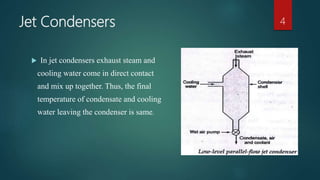
 In jet condensers exhaust steam and
cooling water come in direct contact
and mix up together. Thus, the final
temperature of condensate and cooling
water leaving the condenser is same.
4
 A jet condenser is very simple in design and
cheaper.
 It can be used when cooling water is cheaply and
easily available.
 Condensate can not be reused in boiler, because it
contains impurities like dust, oil, metal particles
etc.
5
Surface Condensers
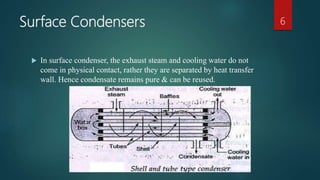
 In surface condenser, the exhaust steam and cooling water do not
come in physical contact, rather they are separated by heat transfer
wall. Hence condensate remains pure & can be reused.
6
Evaporative Condenser
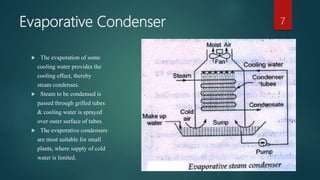
 The evaporation of some
cooling water provides the
cooling effect, thereby
steam condenses.
 Steam to be condensed is
passed through grilled tubes
& cooling water is sprayed
over outer surface of tubes.
 The evaporative condensers
are most suitable for small
plants, where supply of cold
water is limited.
7
Comparison of Jet & Surface
CondensersJet Condensers
1) Cooling water and steam are mixed up
2) The condensate cannot be used as feed
water to boiler unless it is free from
impurities
3) More power is required for air pump
4) Less power is required for water pump
5) Requires less quantity of cooling water
6) Less suitable for high capacity plants due
to low vacuum efficiency
Surface Condensers
1) Cooling water & steam aren’t mixed up
2) The condensate can be used as feed water
to boiler as it is not mixed with cooling
water
3) Less power is required for air pump
4) More power is required for water pump
5) Requires large quantity of cooling water
6) More suitable for high capacity plants as
vacuum efficiency is high
8
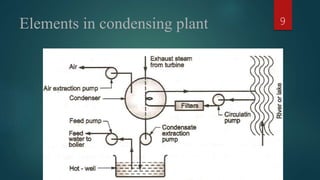
Elements in condensing plant 9
Classification of condensers
Based on the external fluid, condensers can be classified as:
a) Air cooled condensers
b) Water cooled condensers
c) Evaporative condensers
10
Air-cooled condensers
 This is the condenser in which the removal of heat is done by air.
 These condensers are the most popular type used on small commercial and
domestic refrigeration and air conditioning units.
 They consist of steel or copper tubing through which the refrigerant flows.
 Tubes are usually provided with plate type fins to increase the surface area
for heat transfer.
11
Air cooled condenser 12
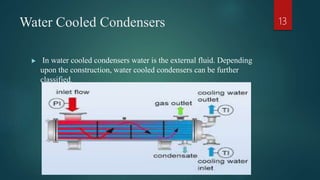
Water Cooled Condensers
 In water cooled condensers water is the external fluid. Depending
upon the construction, water cooled condensers can be further
classified.
13
Water cooled condensers
 The refrigerant condenses on or in the condenser tubes,
giving up its heat to the cooling water. The high pressure
liquid refrigerant from the condenser then passes through
the expansion device that reduces the refrigerant pressure
and temperature as it enters the evaporator.
 Double pipe or tube-in-tube type
 Shell-and-coil type
 Shell-and-tube type
14
Double pipe or tube-in-tube type 15
Shell-and-coil type 16
Shell-and-tube type 17
Evaporative Condenser
 Evaporative Condenser is also named Evaporative Cooler.
It’s a type of cooling equipment utilizing the evaporation
of spray water, to absorb the heat from the flowing
gaseous refrigerant of high temperature inside the
condensing coils, and cool the refrigerant from gaseous
state to liquid form.
18

Condenser

  • 1.
  • 2.
    Introduction  It isa device which condenses working fluid with the help of cooling media (another circulating fluid).  A condenser is a type of heat exchanger in which vapors are transferred into liquid state by removing the latent heat with the help of a coolant such as water.  Condensers are basically heat exchangers in which the refrigerant undergoes a phase change. 2
  • 3.
    Working  In condenserLatent heat of a substance in vapour form is removed and it is converted into liquid form.  Condensation can be done by removing heat from steam using circulating cooling water.  During condensation, the working substance changes its phase from vapour to liquid and rejects latent heat. 3
  • 4.
    Jet Condensers  Injet condensers exhaust steam and cooling water come in direct contact and mix up together. Thus, the final temperature of condensate and cooling water leaving the condenser is same. 4
  • 5.
     A jetcondenser is very simple in design and cheaper.  It can be used when cooling water is cheaply and easily available.  Condensate can not be reused in boiler, because it contains impurities like dust, oil, metal particles etc. 5
  • 6.
    Surface Condensers  Insurface condenser, the exhaust steam and cooling water do not come in physical contact, rather they are separated by heat transfer wall. Hence condensate remains pure & can be reused. 6
  • 7.
    Evaporative Condenser  Theevaporation of some cooling water provides the cooling effect, thereby steam condenses.  Steam to be condensed is passed through grilled tubes & cooling water is sprayed over outer surface of tubes.  The evaporative condensers are most suitable for small plants, where supply of cold water is limited. 7
  • 8.
    Comparison of Jet& Surface CondensersJet Condensers 1) Cooling water and steam are mixed up 2) The condensate cannot be used as feed water to boiler unless it is free from impurities 3) More power is required for air pump 4) Less power is required for water pump 5) Requires less quantity of cooling water 6) Less suitable for high capacity plants due to low vacuum efficiency Surface Condensers 1) Cooling water & steam aren’t mixed up 2) The condensate can be used as feed water to boiler as it is not mixed with cooling water 3) Less power is required for air pump 4) More power is required for water pump 5) Requires large quantity of cooling water 6) More suitable for high capacity plants as vacuum efficiency is high 8
  • 9.
  • 10.
    Classification of condensers Basedon the external fluid, condensers can be classified as: a) Air cooled condensers b) Water cooled condensers c) Evaporative condensers 10
  • 11.
    Air-cooled condensers  Thisis the condenser in which the removal of heat is done by air.  These condensers are the most popular type used on small commercial and domestic refrigeration and air conditioning units.  They consist of steel or copper tubing through which the refrigerant flows.  Tubes are usually provided with plate type fins to increase the surface area for heat transfer. 11
  • 12.
  • 13.
    Water Cooled Condensers In water cooled condensers water is the external fluid. Depending upon the construction, water cooled condensers can be further classified. 13
  • 14.
    Water cooled condensers The refrigerant condenses on or in the condenser tubes, giving up its heat to the cooling water. The high pressure liquid refrigerant from the condenser then passes through the expansion device that reduces the refrigerant pressure and temperature as it enters the evaporator.  Double pipe or tube-in-tube type  Shell-and-coil type  Shell-and-tube type 14
  • 15.
    Double pipe ortube-in-tube type 15
  • 16.
  • 17.
  • 18.
    Evaporative Condenser  EvaporativeCondenser is also named Evaporative Cooler. It’s a type of cooling equipment utilizing the evaporation of spray water, to absorb the heat from the flowing gaseous refrigerant of high temperature inside the condensing coils, and cool the refrigerant from gaseous state to liquid form. 18