This document discusses key concepts in geometric optics including reflection and refraction using mirrors and lenses. It defines geometric optics as focusing on the creation of images and outlines basic rules like light traveling in straight lines. Reflection is described for plane and spherical mirrors, including image formation. Refraction is covered for convex and concave lenses, including image distances and uses. Reflection and refraction in the eye are also summarized.
RULES OFGEOMETRIC OPTICS:
â˘Lightis a flow of photons with wavelengths.
We'll call these as âlight rays.â
⢠Light rays travel in straight lines in free space.
â˘Light rays do not interfere with each other as
they cross.
â˘Light rays obey the laws of reflection and
refraction.
⢠Light rays travel from the light sources to the
Eye.
4.
PRINCIPLE:
The principle objectiveof geometric
optics is to be able to determine the
location of an
image for certain optical elements
arrange in a specific geometry.
5.
This may beaccomplished in two
ways:
1. One can sketch key ray paths in a
scale drawing of the geometry.
2. one can calculate the image
distance and properties using a set
of equations.
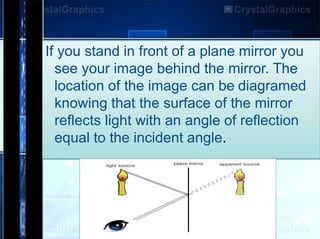
PLANE MIRROR:
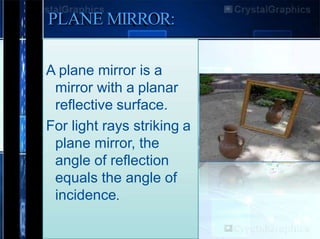
A planemirror is a
mirror with a planar
reflective surface.
For light rays striking a
plane mirror, the
angle of reflection
equals the angle of
incidence.
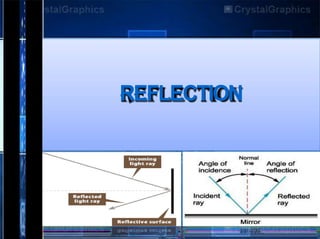
If you standin front of a plane mirror you
see your image behind the mirror. The
location of the image can be diagramed
knowing that the surface of the mirror
reflects light with an angle of reflection
equal to the incident angle.
11.
PROPERTIES OF IMAGE:
Itis formed
⢠behind the mirror
⢠it is right side up
⢠having same size as that of object
⢠Far behind the surface as the object is in front
of it.
⢠We refer to the image as virtual image.
SPHERICAL MIRROR:
RAY DIAGRAMSPOINTS:
⢠One surface of the curved mirror is
silvered.
⢠The centre of the sphere is called the
centre of curvature C.
⢠The geometrical centre of the mirror is
called its pole (P)
⢠The line joining the pole of the mirror and
its centre of curvature is called the
principal axis.
14.
Cont..
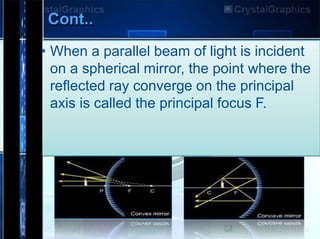
⢠When aparallel beam of light is incident
on a spherical mirror, the point where the
reflected ray converge on the principal
axis is called the principal focus F.
15.
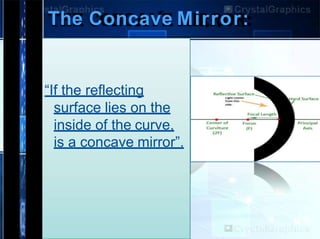
The Concave Mirror:
âIfthe reflecting
surface lies on the
inside of the curve,
is a concave mirrorâ.
16.
RULES:
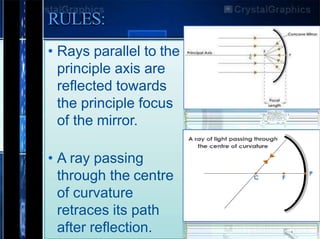
⢠Rays parallelto the
principle axis are
reflected towards
the principle focus
of the mirror.
⢠A ray passing
through the centre
of curvature
retraces its path
after reflection.
17.
Cont..
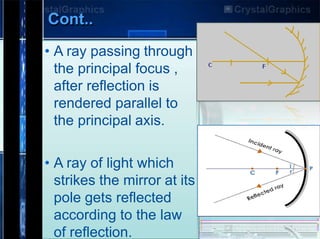
⢠A raypassing through
the principal focus ,
after reflection is
rendered parallel to
the principal axis.
⢠A ray of light which
strikes the mirror at its
pole gets reflected
according to the law
of reflection.
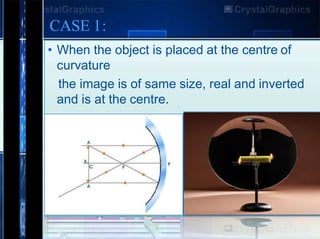
⢠When theobject is placed at the centre of
curvature
the image is of same size, real and inverted
and is at the centre.
CASE 1:
20.
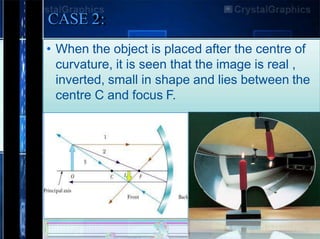
CASE 2:
⢠Whenthe object is placed after the centre of
curvature, it is seen that the image is real ,
inverted, small in shape and lies between the
centre C and focus F.
21.
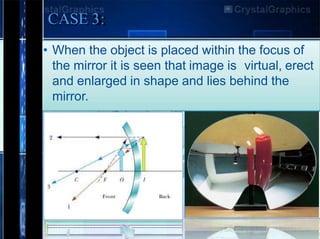
CASE 3:
⢠Whenthe object is placed within the focus of
the mirror it is seen that image is virtual, erect
and enlarged in shape and lies behind the
mirror.
22.
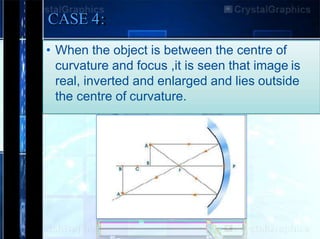
CASE 4:
⢠Whenthe object is between the centre of
curvature and focus ,it is seen that image is
real, inverted and enlarged and lies outside
the centre of curvature.
23.
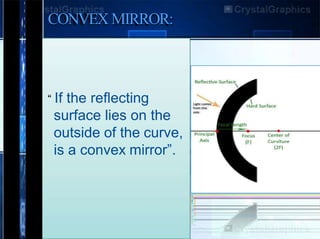
CONVEX MIRROR:
â Ifthe reflecting
surface lies on the
outside of the curve,
is a convex mirrorâ.
24.
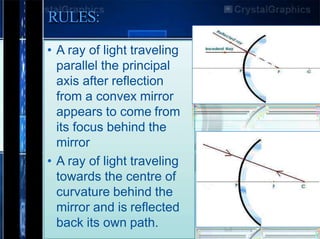
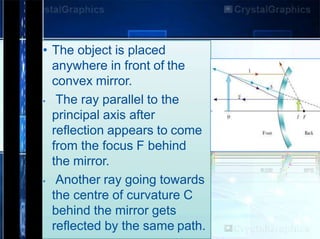
RULES:
⢠A rayof light traveling
parallel the principal
axis after reflection
from a convex mirror
appears to come from
its focus behind the
mirror
⢠A ray of light traveling
towards the centre of
curvature behind the
mirror and is reflected
back its own path.
⢠The objectis placed
anywhere in front of the
convex mirror.
⢠The ray parallel to the
principal axis after
reflection appears to come
from the focus F behind
the mirror.
⢠Another ray going towards
the centre of curvature C
behind the mirror gets
reflected by the same path.
27.
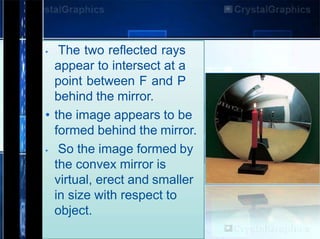
⢠The tworeflected rays
appear to intersect at a
point between F and P
behind the mirror.
⢠the image appears to be
formed behind the mirror.
⢠So the image formed by
the convex mirror is
virtual, erect and smaller
in size with respect to
object.
REFLECTION IN EYEor PURKEINJE
IMAGES
Reflection in eye occurs at two surfaces.
1.Cornea 2. Crystalline lens
Purkinje image 1- outer corneal surface
reflection
Purkinje image 2- inner corneal surface
reflection
Purkinje image 3 â anterior surface of crystalline
lens reflection
Purkinje image 4 â posterior surface of
crystalline lens reflection
38.
RELECTION IN THEEYE
When the reflection of light is very high, Iris
contract and pupil allows less light to enter the
eyes.
When the reflection of light is very low, Iris
dilates, and pupil allows more light to enter the
eyes.
39.
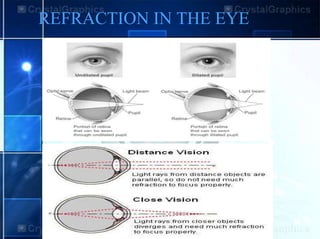
REFRACTION IN THEEYE
â˘The vision process relies heavily on the ability
of the eye to refract light. This takes place at
both the cornea and the lens of the eye.
â˘The process of vision first starts with the light
passing through the cornea. Since the cornea
has a spherical surface it acts like a
converging lens. as light rays hit the cornea, the
light is refracted
â˘Once the light passes through the cornea it
goes through the pupil.
40.
REFRACTION IN THEEYE
â˘After light rays travel through the pupil they hit
the lens. Refraction also takes place at this
converging lens of the eye. However since the
vitreous humor has a refractive index of 1.34,
and this lens has a refractive index of 1.44, the
refractive power is not as strong as in the
cornea. This makes the lens responsible for fine
tuning an image that they eye sees