
ASSESMENT OF VISUAL
ACUITY IN CHILDREN
Dr. VINIT KUMAR
O.A 2nd year class
SCEH , LAHAN.
Definition
It is defined as the resolving power of the eye or
ability to see two separate objects.
It is determined by the smallest retinal image which can be
appreciated at a certain distance.
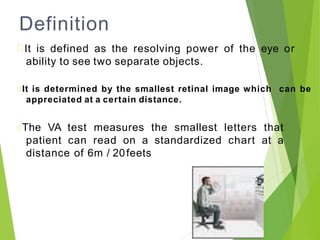
The VA test measures the smallest letters that
patient can read on a standardized chart at a
distance of 6m / 20feets
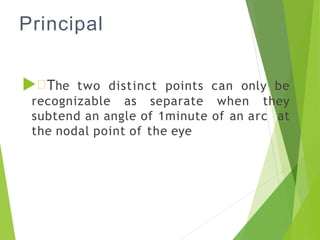
Principal
 The two distinct points can only be
recognizable as separate when they
subtend an angle of 1minute of an arc at
the nodal point of the eye
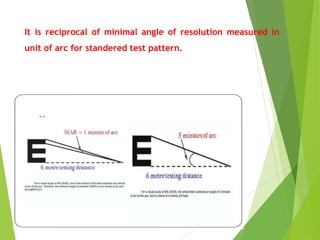
It is reciprocal of minimal angle of resolution measured in
unit of arc for standered test pattern.
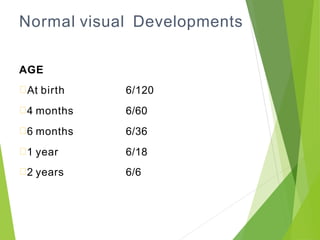
Normal visual Developments
AGE
At birth 6/120
4 months 6/60
6 months 6/36
1 year 6/18
2 years 6/6
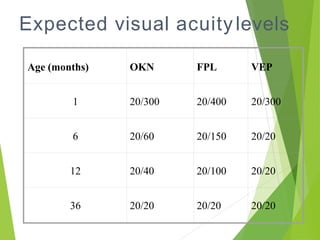
Expected visual acuitylevels
Age (months) OKN FPL VEP
1 20/300 20/400 20/300
6 20/60 20/150 20/20
12 20/40 20/100 20/20
36 20/20 20/20 20/20
Vision Tests in Infants
CSM method
C : Central
S : Steady
M : Maintenance
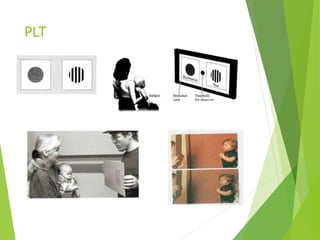
2.Preferential Looking Test
Most Commonly used Test
Based upon turning of the head or eyes towards the
pattern rather than a uniform [homogenous] field.
Alternating Black and White Stripes are present
Stripe width progressively narrows which is then
randomly shown next to plain test object
Children with better vision are able to see finer grating
and turn towards it
PLT
Drawbacks of Preferential Looking Tests
Test near vision not distance vision
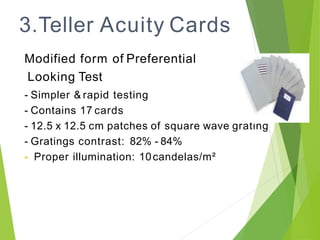
3.Teller Acuity Cards
Modified form of Preferential
Looking Test
- Simpler & rapid testing
- Contains 17 cards
- 12.5 x 12.5 cm patches of square wave grating
- Gratings contrast: 82% - 84%
- Proper illumination: 10candelas/m²
Drawbacks
Measures near visual acuity and not distance
Measures resolution acuity
4.Visual Evoked Potential
VEP is the measure of change of electrical activity
of the visual cortex in response to patterned
stimulus
Checkered board or squarewave grating
Abnormal VEP may indicate a problem with the
visual information reaching the cortex
VEP is very sensitive to optical blurring, can thus be
used as a method of refraction in very young patient
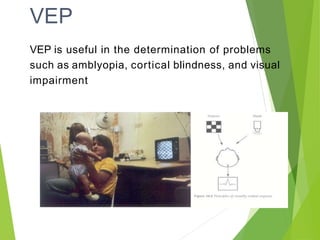
VEP
VEP is useful in the determination of problems
such as amblyopia, cortical blindness, and visual
impairment
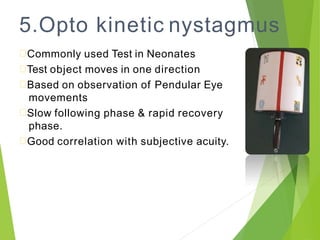
5.Opto kinetic nystagmus
Commonly used Test in Neonates
Test object moves in one direction
Based on observation of Pendular Eye
movements
Slow following phase & rapid recovery
phase.
Good correlation with subjective acuity.
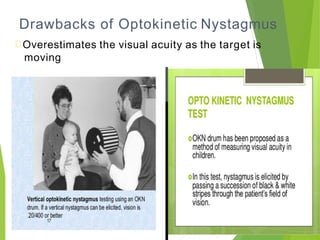
Drawbacks of Optokinetic Nystagmus
Overestimates the visual acuity as the target is
moving
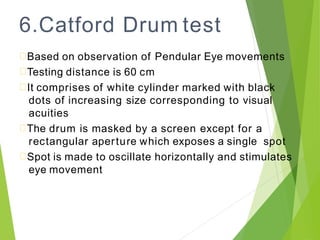
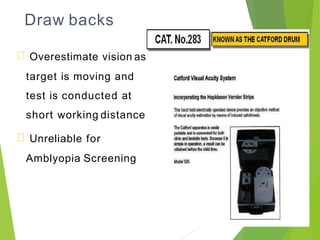
6.Catford Drum test
Based on observation of Pendular Eye movements
Testing distance is 60 cm
It comprises of white cylinder marked with black
dots of increasing size corresponding to visual
acuities
The drum is masked by a screen except for a
rectangular aperture which exposes a single spot
Spot is made to oscillate horizontally and stimulates
eye movement
Draw backs
Overestimate vision as
target is moving and
test is conducted at
short working distance
Unreliable for
Amblyopia Screening
Testing Of Uniocular Amblyopia In
Infants
Occluding Amblyopic eye child does not resist.
while occluding the normal eye, child resists
the occlusion.
Vision test in 1-2 years
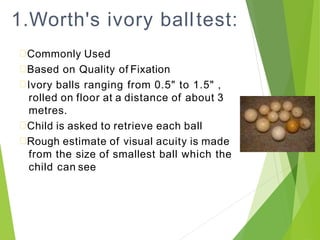
1.Worth's ivory balltest:
Commonly Used
Based on Quality of Fixation
Ivory balls ranging from 0.5" to 1.5" ,
rolled on floor at a distance of about 3
metres.
Child is asked to retrieve each ball
Rough estimate of visual acuity is made
from the size of smallest ball which the
child can see
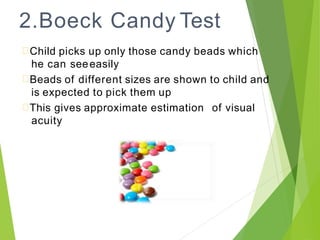
2.Boeck Candy Test
Child picks up only those candy beads which
he can seeeasily
Beads of different sizes are shown to child and
is expected to pick them up
This gives approximate estimation of visual
acuity
3.Screening Test for Young Children
& Retards [STYCAR]
Based on Pursuit Eye movements
Ten Balls rolled across a well illuminating
contrasting floor 3m away from child
Pursuit Eye movements indicate that they are
seen
Vision Test in 2-3 years
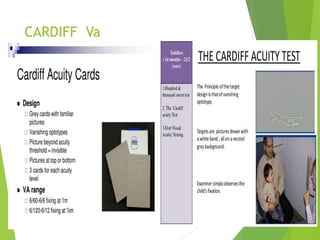
1.Cardiff Acuity Test
Principle: vanishing optotype
Target - pictures, of the same overall size, drawn in decreasing
widths of white space
Acuity is determined by the narrowest white band for which the
target is visible to the child
Child naturally prefers to look at a target figure rather than the
blank end of the stimulus.
CARDIFF Va
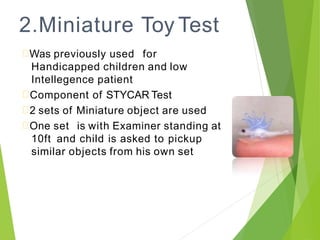
2.Miniature Toy Test
Was previously used for
Handicapped children and low
Intellegence patient
Component of STYCAR Test
2 sets of Miniature object are used
One set is with Examiner standing at
10ft and child is asked to pickup
similar objects from his own set
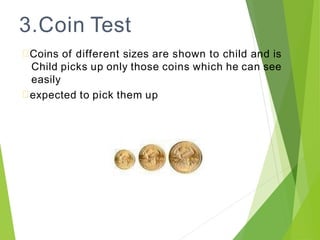
3.Coin Test
Coins of different sizes are shown to child and is
Child picks up only those coins which he can see
easily
expected to pick them up
Vision test in 3-5 years
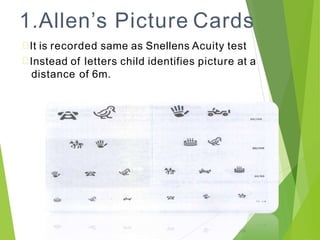
1.Allen’s Picture Cards
It is recorded same as Snellens Acuity test
Instead of letters child identifies picture at a
distance of 6m.
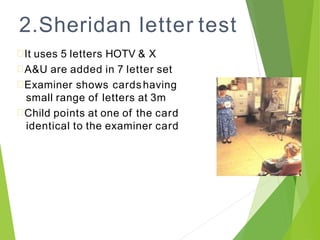
2.Sheridan letter test
It uses 5 letters HOTV & X
A&U are added in 7 letter set
Examiner shows cardshaving
small range of letters at 3m
Child points at one of the card
identical to the examiner card
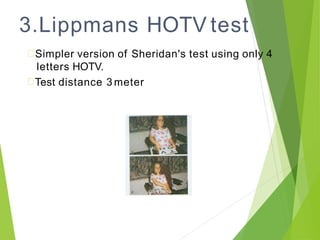
3.Lippmans HOTV test
Simpler version of Sheridan's test using only 4
letters HOTV.
Test distance 3 meter
Vision Test in 5-6 Yrs & above
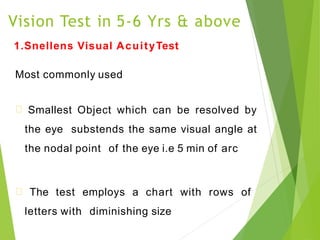
1.Snellens Visual AcuityTest
Most commonly used
Smallest Object which can be resolved by
the eye substends the same visual angle at
the nodal point of the eye i.e 5 min of arc
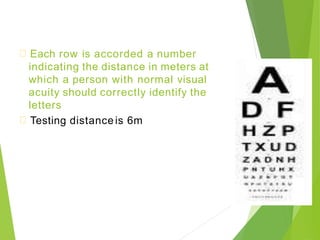
The test employs a chart with rows of
letters with diminishing size
Each row is accorded a number
indicating the distance in meters at
which a person with normal visual
acuity should correctly identify the
letters
Testing distanceis 6m
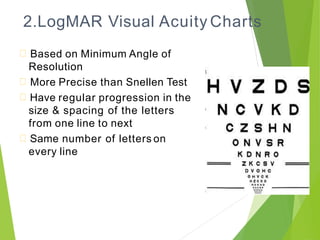
2.LogMAR Visual Acuity Charts
Based on Minimum Angle of
Resolution
More Precise than Snellen Test
Have regular progression in the
size & spacing of the letters
from one line to next
Same number of letters on
every line
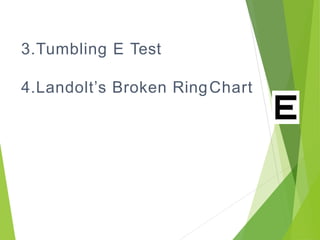
3.Tumbling E Test
4.Landolt’s Broken RingChart
Conclusion
Despite the development of methods appropriate
to different ages, measuring acuity remains
difficult in infants.
Whichever method is used to measure a child’s
vision, it is important to assess vision corrected
for any refractive errors, and to assess the eyes
separately as well as together whenever possible
HOME WORK …
 What is visual acuity ? What are the principle of normal
visual acuity ?
 What is MAR/ minimal angle of resolution ? Normal value ?
 What is normal visual development & normal vision
according to different age group ?
 How to test vision in 1-2 year age group child ?
 What are the different types of vision chart used in school
going children ?
 What is VEP ? What are the types of VEP ? Indication &
clinical significance of VEP ?
 How to calculate visual acuity in infants ? & 2 to 4 years age group
child ? What are the diffent chart used ?
Thank You

Visual acuity in child converted

  • 1.
    ASSESMENT OF VISUAL ACUITYIN CHILDREN Dr. VINIT KUMAR O.A 2nd year class SCEH , LAHAN.
  • 2.
    Definition It is definedas the resolving power of the eye or ability to see two separate objects. It is determined by the smallest retinal image which can be appreciated at a certain distance. The VA test measures the smallest letters that patient can read on a standardized chart at a distance of 6m / 20feets
  • 3.
    Principal  The twodistinct points can only be recognizable as separate when they subtend an angle of 1minute of an arc at the nodal point of the eye
  • 4.
    It is reciprocalof minimal angle of resolution measured in unit of arc for standered test pattern.
  • 5.
    Normal visual Developments AGE Atbirth 6/120 4 months 6/60 6 months 6/36 1 year 6/18 2 years 6/6
  • 6.
    Expected visual acuitylevels Age(months) OKN FPL VEP 1 20/300 20/400 20/300 6 20/60 20/150 20/20 12 20/40 20/100 20/20 36 20/20 20/20 20/20
  • 7.
  • 8.
    CSM method C :Central S : Steady M : Maintenance
  • 9.
    2.Preferential Looking Test MostCommonly used Test Based upon turning of the head or eyes towards the pattern rather than a uniform [homogenous] field. Alternating Black and White Stripes are present Stripe width progressively narrows which is then randomly shown next to plain test object Children with better vision are able to see finer grating and turn towards it
  • 10.
  • 11.
    Drawbacks of PreferentialLooking Tests Test near vision not distance vision
  • 12.
    3.Teller Acuity Cards Modifiedform of Preferential Looking Test - Simpler & rapid testing - Contains 17 cards - 12.5 x 12.5 cm patches of square wave grating - Gratings contrast: 82% - 84% - Proper illumination: 10candelas/m²
  • 13.
    Drawbacks Measures near visualacuity and not distance Measures resolution acuity
  • 14.
    4.Visual Evoked Potential VEPis the measure of change of electrical activity of the visual cortex in response to patterned stimulus Checkered board or squarewave grating Abnormal VEP may indicate a problem with the visual information reaching the cortex VEP is very sensitive to optical blurring, can thus be used as a method of refraction in very young patient
  • 15.
    VEP VEP is usefulin the determination of problems such as amblyopia, cortical blindness, and visual impairment
  • 16.
    5.Opto kinetic nystagmus Commonlyused Test in Neonates Test object moves in one direction Based on observation of Pendular Eye movements Slow following phase & rapid recovery phase. Good correlation with subjective acuity.
  • 17.
    Drawbacks of OptokineticNystagmus Overestimates the visual acuity as the target is moving
  • 18.
    6.Catford Drum test Basedon observation of Pendular Eye movements Testing distance is 60 cm It comprises of white cylinder marked with black dots of increasing size corresponding to visual acuities The drum is masked by a screen except for a rectangular aperture which exposes a single spot Spot is made to oscillate horizontally and stimulates eye movement
  • 19.
    Draw backs Overestimate visionas target is moving and test is conducted at short working distance Unreliable for Amblyopia Screening
  • 20.
    Testing Of UniocularAmblyopia In Infants Occluding Amblyopic eye child does not resist. while occluding the normal eye, child resists the occlusion.
  • 21.
    Vision test in1-2 years
  • 22.
    1.Worth's ivory balltest: CommonlyUsed Based on Quality of Fixation Ivory balls ranging from 0.5" to 1.5" , rolled on floor at a distance of about 3 metres. Child is asked to retrieve each ball Rough estimate of visual acuity is made from the size of smallest ball which the child can see
  • 23.
    2.Boeck Candy Test Childpicks up only those candy beads which he can seeeasily Beads of different sizes are shown to child and is expected to pick them up This gives approximate estimation of visual acuity
  • 24.
    3.Screening Test forYoung Children & Retards [STYCAR] Based on Pursuit Eye movements Ten Balls rolled across a well illuminating contrasting floor 3m away from child Pursuit Eye movements indicate that they are seen
  • 25.
    Vision Test in2-3 years
  • 26.
    1.Cardiff Acuity Test Principle:vanishing optotype Target - pictures, of the same overall size, drawn in decreasing widths of white space Acuity is determined by the narrowest white band for which the target is visible to the child Child naturally prefers to look at a target figure rather than the blank end of the stimulus.
  • 27.
  • 28.
    2.Miniature Toy Test Waspreviously used for Handicapped children and low Intellegence patient Component of STYCAR Test 2 sets of Miniature object are used One set is with Examiner standing at 10ft and child is asked to pickup similar objects from his own set
  • 29.
    3.Coin Test Coins ofdifferent sizes are shown to child and is Child picks up only those coins which he can see easily expected to pick them up
  • 30.
    Vision test in3-5 years
  • 31.
    1.Allen’s Picture Cards Itis recorded same as Snellens Acuity test Instead of letters child identifies picture at a distance of 6m.
  • 32.
    2.Sheridan letter test Ituses 5 letters HOTV & X A&U are added in 7 letter set Examiner shows cardshaving small range of letters at 3m Child points at one of the card identical to the examiner card
  • 33.
    3.Lippmans HOTV test Simplerversion of Sheridan's test using only 4 letters HOTV. Test distance 3 meter
  • 34.
    Vision Test in5-6 Yrs & above 1.Snellens Visual AcuityTest Most commonly used Smallest Object which can be resolved by the eye substends the same visual angle at the nodal point of the eye i.e 5 min of arc The test employs a chart with rows of letters with diminishing size
  • 35.
    Each row isaccorded a number indicating the distance in meters at which a person with normal visual acuity should correctly identify the letters Testing distanceis 6m
  • 36.
    2.LogMAR Visual AcuityCharts Based on Minimum Angle of Resolution More Precise than Snellen Test Have regular progression in the size & spacing of the letters from one line to next Same number of letters on every line
  • 37.
  • 38.
    Conclusion Despite the developmentof methods appropriate to different ages, measuring acuity remains difficult in infants. Whichever method is used to measure a child’s vision, it is important to assess vision corrected for any refractive errors, and to assess the eyes separately as well as together whenever possible
  • 39.
    HOME WORK … What is visual acuity ? What are the principle of normal visual acuity ?  What is MAR/ minimal angle of resolution ? Normal value ?  What is normal visual development & normal vision according to different age group ?  How to test vision in 1-2 year age group child ?  What are the different types of vision chart used in school going children ?  What is VEP ? What are the types of VEP ? Indication & clinical significance of VEP ?  How to calculate visual acuity in infants ? & 2 to 4 years age group child ? What are the diffent chart used ?
  • 40.