CSCR ( CENTRAL SEROUS CHORIORETINOPATHY )
Macular oedema & Macular hole
Dr. ANITA KUMARI
SCEH, LAHAN
O.A 2nd YEAR
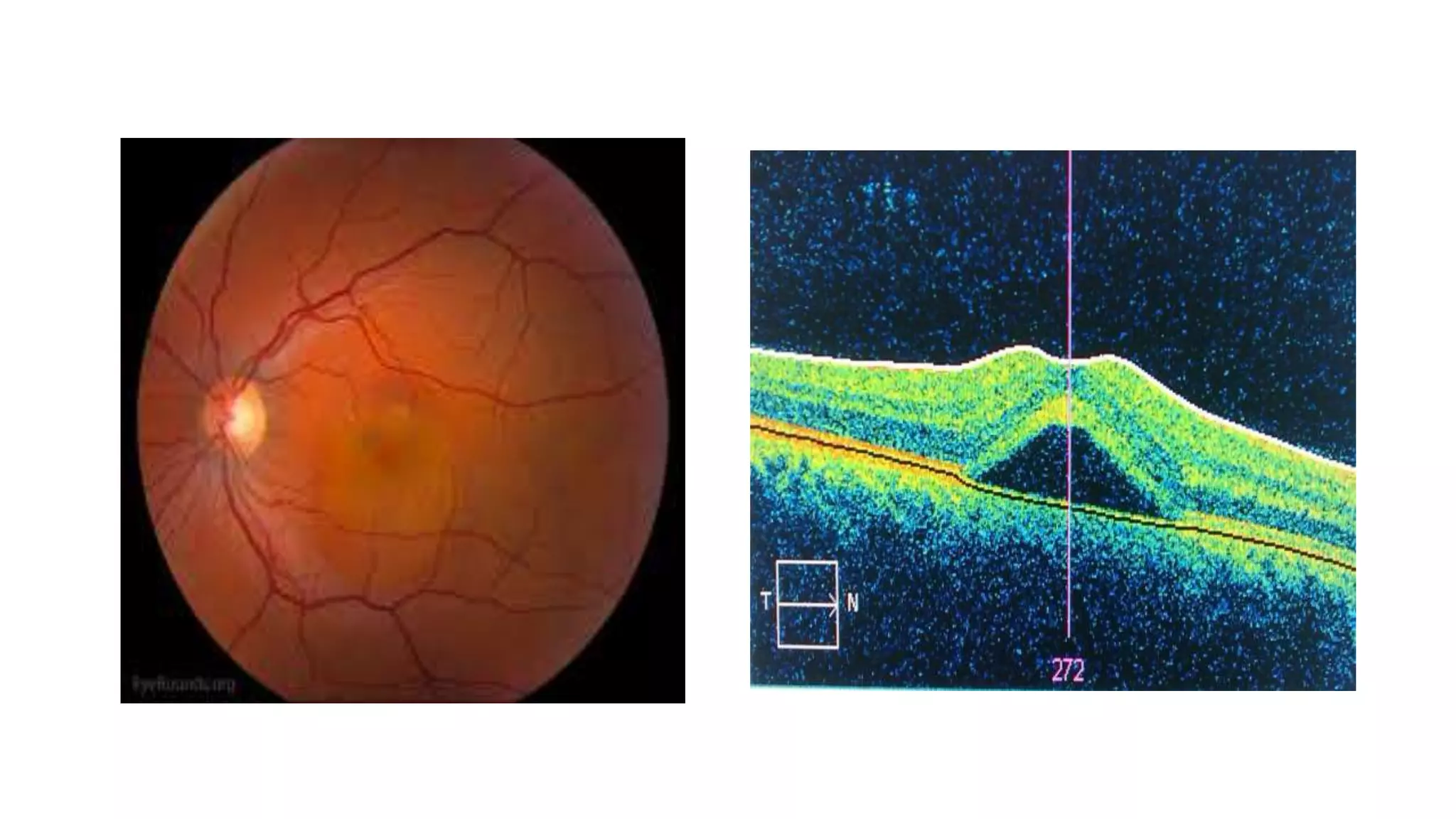
• Central serous chorioretinopathy (CSCR) is characterised by spontaneous serous
detachment of neurosensory retina in the macular region, with or without retinal
pigment epithelium detachment .
Etiopathogenesis & Risk factors
• Age and sex. The disease affects typically young adult (20–50 years), males
more than females
• • Personality. Type A personality individuals are more prone
• • Steroid intake is an important risk factor
• • Emotional stress ( thyroid & Cushings syndrome )
• Hypertension • Pregnancy (usually 3rd trimester)
Pathogenesis of CSCR
• Pathogenesis is not known exactly. Various theories have been postulated.
Presently, the most accepted theory is of ‘choroidal vascular hyperpermeability’
• sympathetic drive, sympathomimetics and corticosteroids alter the choroidal
vascular permeability either directly or indirectly by affecting its autoregulation.
• This, in turn, increases the tissue hydrostatic pressure in the choroid causing
pigment epithelial defect (PED) resulting in a breach in the outer blood retinal
barrier .
• Leakage of fluid across this area results in development of localized serous
detachment of neurosensory retina .
• Clinical features Symptoms. Patient may present with:
• • Sudden painless loss of vision (6/9–6/24) associated with
• • Relative positive scotoma, micropsia & metamorphopsia.
Signs. fundus examination shows
• : • Mild elevation of macular area, demarcated by a circular ring reflex.
• • Small yellow grey elevations may be seen due to RPE /PED detachment.
• • Foveal reflex is absent or distorted
• • Subretinal deposits & pigmentary changes
Clinical course CSR is usually self-limiting but often recurrent
• Acute classic CSCR : spontaneous resolution within 3–6 months . Recurrences are
known in 30–50% cases
• Chronic CSCR . It is characterized by a chronic course lasting more than 12
months, typically affecting individuals above 50 years of age.
• Bullous CSCR is rare presentation characterized by larger and more numerous
areas of serous retinal and RPE detachments
Investigations
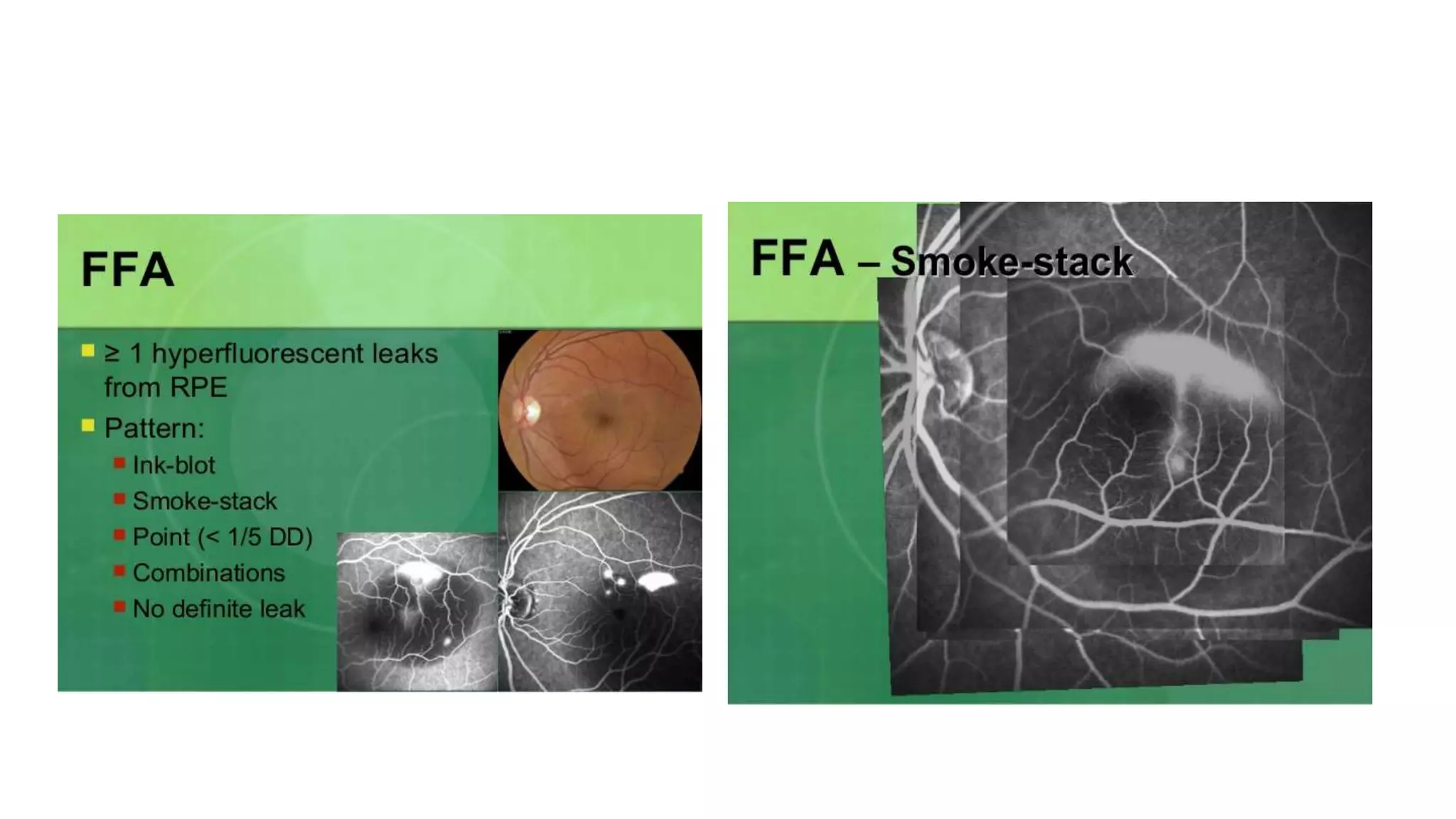
• 1. Fundus fluorescein angiography : leakage and pooling
• Ink-blot pattern
• Smoke-stack pattern
• 2 OCT
• 3 ICG
Treatment
• 1. Conservative measures. Reassurance mostly in 80% cases .
• CSR undergoes spontaneous resolution in 80 to 90% cases. Visual acuity returns to
normal or near normal within 3 to 6 months .
• Discontinuation of steroids
• Life style changes to reduces stress in life
• 2. Anti-VEGF can be considered if CNV
• 3. Laser photocoagulation : Long-standing cases (more than 6 months).
• • Patients having recurrent CSR with visual loss.
• • Patients having permanent loss of vision in the other eye due to this condition
• 4. Photodynamic therapy (PDT)
CME
CYSTOID MACULAR OEDEMA (CME )
• DEFINE : It refers to collection of fluid in the outer plexiform and inner nuclear
layer of the retina, centred around the foveola.
• Etiology :
• 1. Complication of ocular treatment such as: • Ocular surgery, e.g., cataract
extraction (ICCE>ECCE) (Irvine Gass syndrome), keratoplasty, glaucoma surgery &
RD surgery.
• Topical ocular therapy with eye drops like epinephrine and prostaglandin
etc.
• 2. Retinal vascular disorders : such as CRVO, BRVO , Coats’ disease, Eales disease,
and hypertensive retinopathy
• 3. Intraocular inflammations & intraocular tumours e.g. posterior uveitis and
anterior uveitis
• 4. Retinal dystrophies, e.g., retinitis pigmentosa & VMR ( Vitreomacular traction
syndrome )
• 5. Systemic diseases such as leukaemia, chronic renal failure and multiple
myeloma
Pathogenesis CME
• It develops due to leakage of fluid following breakdown of inner blood-retinal
barrier (i.e., leakage from the retinal capillaries) & accumulating fluid in the outer
plexiform and inner nuclear layer of retina .
Clinical features
• 1. Visual loss.
• 2. Direct Ophthalmoscopy or slit lamp biomicroscopy with 90 D lens : : shows loss
of foveal reflex, retinal thickening, a yellow spot at the center of fovea .
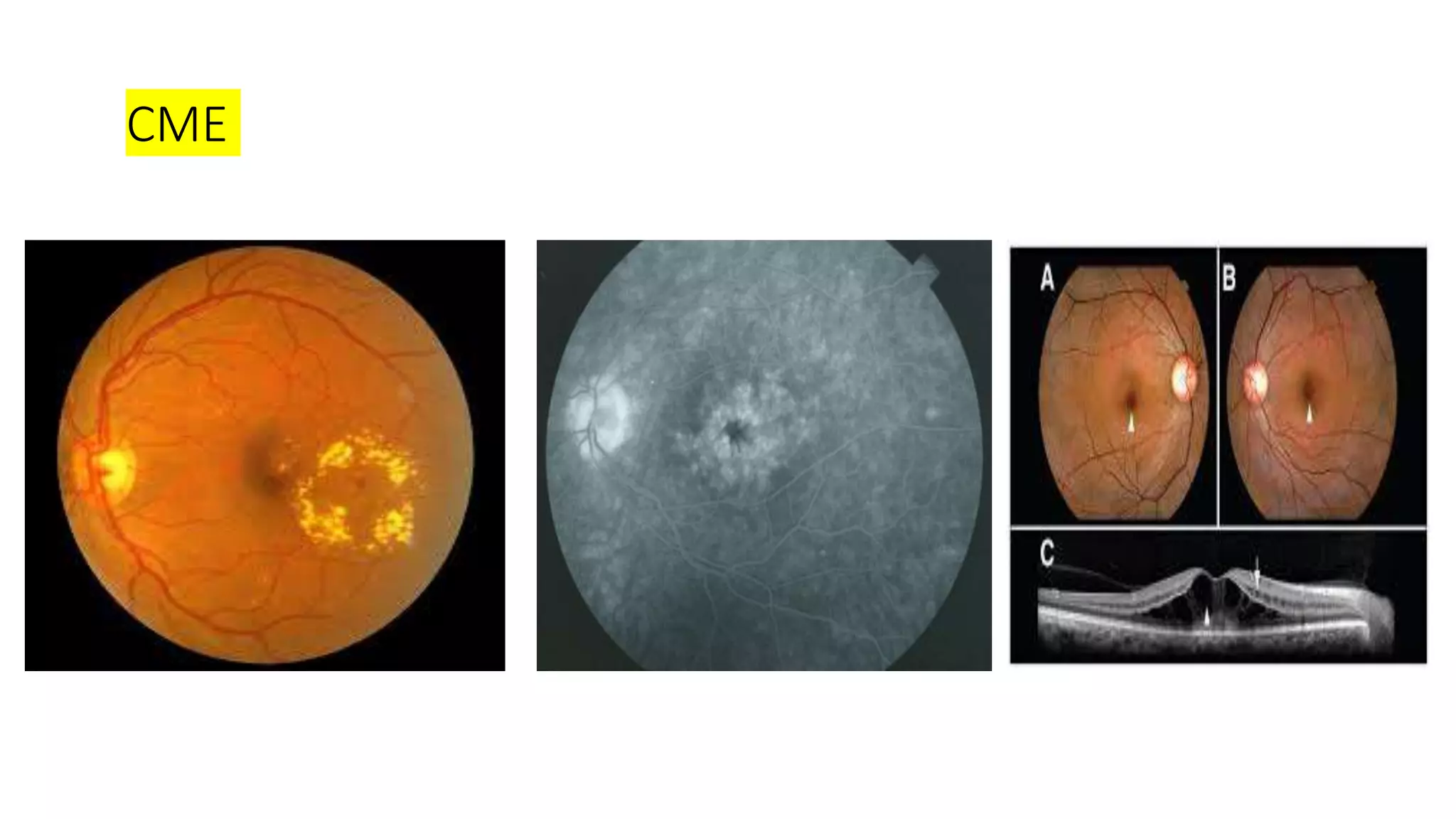
• Typical ‘Honeycomb appearance’ of macula (due to multiple cystoid oval spaces )
• 3. Fundus fluorescein angiography : ‘flower petal appearance’
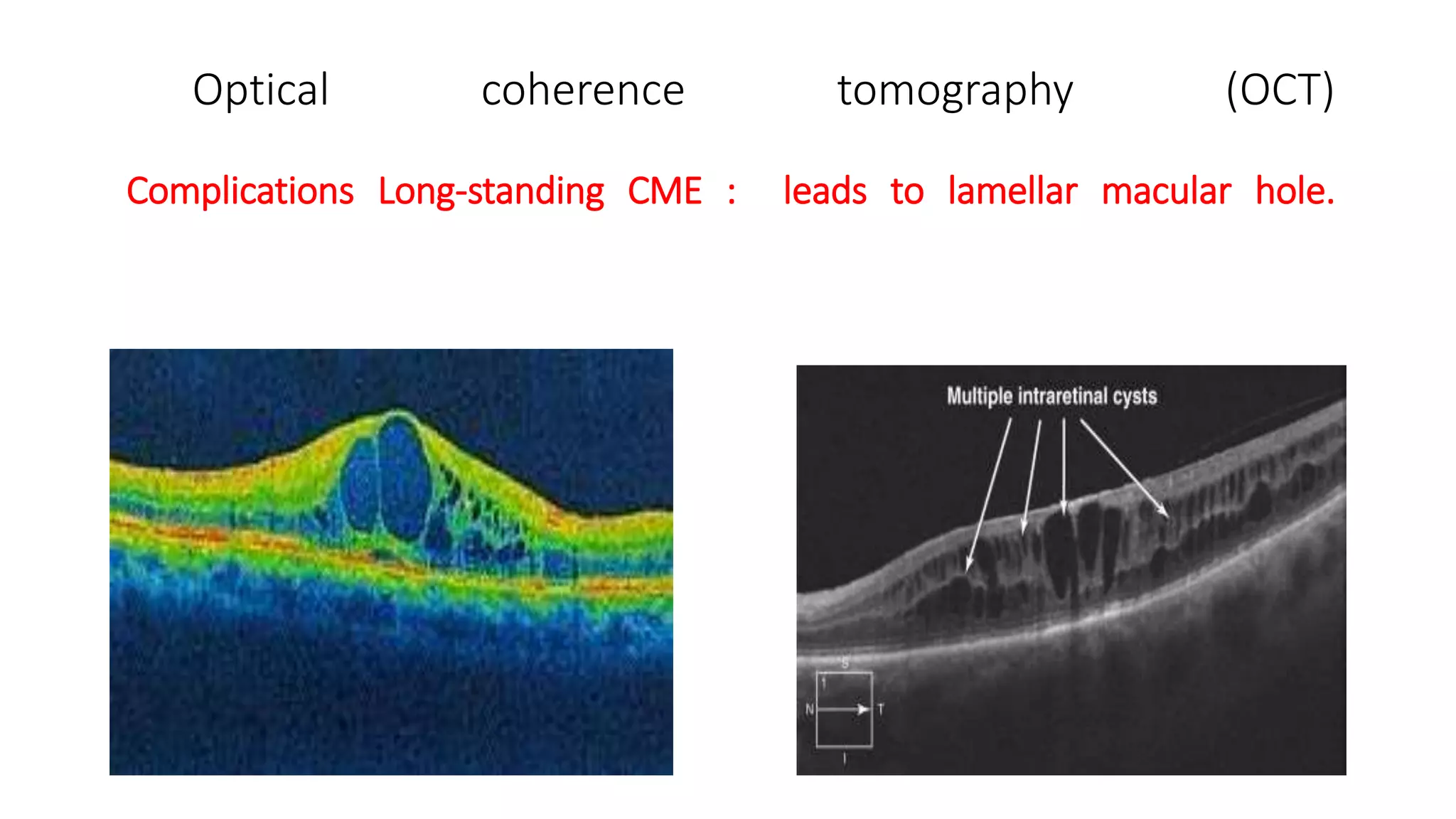
• 4. Optical coherence tomography (OCT) reveals loss of foveal depression, intrareti
with round optically clear (cystoid spaces) and retinal thicknening
flower petal appearance
Optical coherence tomography (OCT)
Complications Long-standing CME : leads to lamellar macular hole.
Treatment
• 1. Treatment of the causative factor, e.g., photocoagulation for diabetic CSME, STOP
use of topical 2% adrenaline eye drops etc.
• 2. Topical antiprostaglandin (NSAID) drops like ketorolac or nepafenac when used
pre- and postoperatively, prevent the occurrence of CME associated with intraocular
surgery .
• 3. Topical and systemic steroid for inflammation
• 4. Systemic carbonic anhydrase inhibitors (CAIs) Tab. Diamox may be beneficial in some
cases of CME, e.g., in retinitis pigmentosa
Macular Hole
• Macular hole refers to a partial thickness of full thickness hole in the
neurosensory retina in the foveal region .
• Etiology : 1. Senile or idiopathic (83%), more common in females aged 60–80
years than males (F:M, 3:1).
• 2. Traumatic macular hole account for (5%) cases
• 3. Other causes of macular hole include: CME, vitreomacular traction,
postsurgery, myopia, post-laser treatment and post-inflammatory.
Clinical features : Symptoms
• : • Decreased vision, typically around 6/60 level for a full thickness hole and
better for a partial hole.
• • Metamorphopsia or distortion of vision may be there.
• • Central scotoma
• Pathogenesis: Senile macular holes are caused by tractional forces associated with
early PVD .
Clinical features & Symptoms include
• Decreased vision, typically around 6/60
• Metamorphopsia or distortion of vision
• Central scotoma
• Signs.
• Based on the fundus appearance (best examined with 78/90D slit-lamp
examination)
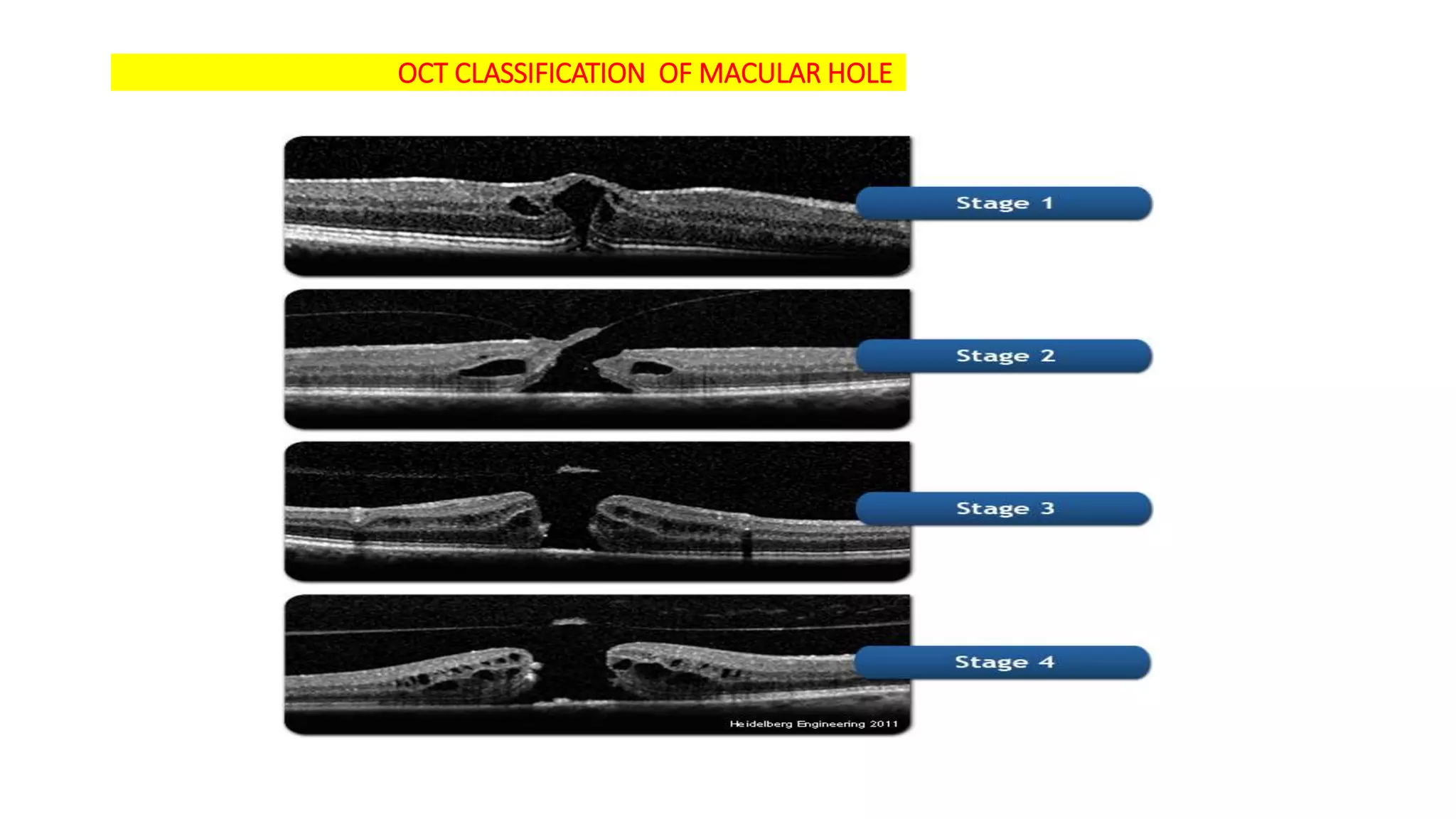
• the macular hole can be classified into four stages ( Gass Classification)
• Stage 1 or impending hole : it shows absent foveal reflex & a yellow spot or
yellow ring in the foveal region .
• Stage 2. A small full thickness hole ( either centre or marginal ) full thickness hole
less than 400 um in size
• Stage 3. A full thickness hole is seen as round reddish spot surrounded by a grey
halo [cuff of subretinal fluid (SRF)]& no PVD ,more than 400 um in size
• Stage 4. Full thickness hole with with posterior vitreous detached from the disc
and macula .
OCT CLASSIFICATION OF MACULAR HOLE
Management : Differential diagnosis
• Macular pucker (epiretinal membrane)
• • Solar retinopathy
• • Intraretinal cyst (e.g., chronic CME )
• • Vitreomacular traction syndrome
• Investigation : mostly OCT & slit lamp biomicroscopy & detail history .
Treatment
• ■Stage 1. Treatment is not recommended as spontaneous hole closure can occur.
But close follow-up and observation is required as 50% cases .
• Stage 2 to 4 holes of recent onset (<1 year) with reduced visual acuity (<6/24)
should be treated with pars plana vitrectomy with posterior hyaloid removal,
internal limiting membrane (ILM) peeling and gas or silicon oil tamponade with strict
postoperative face down position for 7–14 days
• Prognosis. Of M.H = Anatomical closure is reported in 60–85% of cases. Visual
improvement is reported in 70% cases with recent onset hole .
• complications include:
• retinal breaks, retinal detachment, late reopening of the hole, RPE loss under the
hole, phototoxicity and endophthalmitis.
HOME WORK ?
1. What is CSCR ? What are types & etiology of CSCR?
2. What is cystoid macular odema ? Etiology & managemt of macular odema?
3. what are clinical features & signs of CSCR on slit lamp biomicroscopy ?
4. What is macular hole ? Etiology ?
5. Explain in brief OCT classification / Gass classification of macular hole ?
6. Management of macular hole explain briefly ?
7. What are the different types of macular odema ? What is pathogenesis ?
8. Explain in short management of cystoid macular odema ?
Cscr ( central serous chorioretinopathy )

Cscr ( central serous chorioretinopathy )

  • 1.
    CSCR ( CENTRALSEROUS CHORIORETINOPATHY ) Macular oedema & Macular hole Dr. ANITA KUMARI SCEH, LAHAN O.A 2nd YEAR
  • 2.
    • Central serouschorioretinopathy (CSCR) is characterised by spontaneous serous detachment of neurosensory retina in the macular region, with or without retinal pigment epithelium detachment .
  • 4.
    Etiopathogenesis & Riskfactors • Age and sex. The disease affects typically young adult (20–50 years), males more than females • • Personality. Type A personality individuals are more prone • • Steroid intake is an important risk factor • • Emotional stress ( thyroid & Cushings syndrome ) • Hypertension • Pregnancy (usually 3rd trimester)
  • 5.
    Pathogenesis of CSCR •Pathogenesis is not known exactly. Various theories have been postulated. Presently, the most accepted theory is of ‘choroidal vascular hyperpermeability’ • sympathetic drive, sympathomimetics and corticosteroids alter the choroidal vascular permeability either directly or indirectly by affecting its autoregulation.
  • 6.
    • This, inturn, increases the tissue hydrostatic pressure in the choroid causing pigment epithelial defect (PED) resulting in a breach in the outer blood retinal barrier . • Leakage of fluid across this area results in development of localized serous detachment of neurosensory retina .
  • 7.
    • Clinical featuresSymptoms. Patient may present with: • • Sudden painless loss of vision (6/9–6/24) associated with • • Relative positive scotoma, micropsia & metamorphopsia.
  • 8.
    Signs. fundus examinationshows • : • Mild elevation of macular area, demarcated by a circular ring reflex. • • Small yellow grey elevations may be seen due to RPE /PED detachment. • • Foveal reflex is absent or distorted • • Subretinal deposits & pigmentary changes
  • 9.
    Clinical course CSRis usually self-limiting but often recurrent • Acute classic CSCR : spontaneous resolution within 3–6 months . Recurrences are known in 30–50% cases • Chronic CSCR . It is characterized by a chronic course lasting more than 12 months, typically affecting individuals above 50 years of age. • Bullous CSCR is rare presentation characterized by larger and more numerous areas of serous retinal and RPE detachments
  • 10.
    Investigations • 1. Fundusfluorescein angiography : leakage and pooling • Ink-blot pattern • Smoke-stack pattern • 2 OCT • 3 ICG
  • 12.
    Treatment • 1. Conservativemeasures. Reassurance mostly in 80% cases . • CSR undergoes spontaneous resolution in 80 to 90% cases. Visual acuity returns to normal or near normal within 3 to 6 months . • Discontinuation of steroids • Life style changes to reduces stress in life • 2. Anti-VEGF can be considered if CNV • 3. Laser photocoagulation : Long-standing cases (more than 6 months). • • Patients having recurrent CSR with visual loss. • • Patients having permanent loss of vision in the other eye due to this condition • 4. Photodynamic therapy (PDT)
  • 13.
  • 14.
    CYSTOID MACULAR OEDEMA(CME ) • DEFINE : It refers to collection of fluid in the outer plexiform and inner nuclear layer of the retina, centred around the foveola. • Etiology : • 1. Complication of ocular treatment such as: • Ocular surgery, e.g., cataract extraction (ICCE>ECCE) (Irvine Gass syndrome), keratoplasty, glaucoma surgery & RD surgery. • Topical ocular therapy with eye drops like epinephrine and prostaglandin etc.
  • 15.
    • 2. Retinalvascular disorders : such as CRVO, BRVO , Coats’ disease, Eales disease, and hypertensive retinopathy • 3. Intraocular inflammations & intraocular tumours e.g. posterior uveitis and anterior uveitis • 4. Retinal dystrophies, e.g., retinitis pigmentosa & VMR ( Vitreomacular traction syndrome ) • 5. Systemic diseases such as leukaemia, chronic renal failure and multiple myeloma
  • 16.
    Pathogenesis CME • Itdevelops due to leakage of fluid following breakdown of inner blood-retinal barrier (i.e., leakage from the retinal capillaries) & accumulating fluid in the outer plexiform and inner nuclear layer of retina .
  • 17.
    Clinical features • 1.Visual loss. • 2. Direct Ophthalmoscopy or slit lamp biomicroscopy with 90 D lens : : shows loss of foveal reflex, retinal thickening, a yellow spot at the center of fovea . • Typical ‘Honeycomb appearance’ of macula (due to multiple cystoid oval spaces ) • 3. Fundus fluorescein angiography : ‘flower petal appearance’ • 4. Optical coherence tomography (OCT) reveals loss of foveal depression, intrareti with round optically clear (cystoid spaces) and retinal thicknening
  • 18.
  • 19.
    Optical coherence tomography(OCT) Complications Long-standing CME : leads to lamellar macular hole.
  • 20.
    Treatment • 1. Treatmentof the causative factor, e.g., photocoagulation for diabetic CSME, STOP use of topical 2% adrenaline eye drops etc. • 2. Topical antiprostaglandin (NSAID) drops like ketorolac or nepafenac when used pre- and postoperatively, prevent the occurrence of CME associated with intraocular surgery . • 3. Topical and systemic steroid for inflammation • 4. Systemic carbonic anhydrase inhibitors (CAIs) Tab. Diamox may be beneficial in some cases of CME, e.g., in retinitis pigmentosa
  • 21.
  • 22.
    • Macular holerefers to a partial thickness of full thickness hole in the neurosensory retina in the foveal region . • Etiology : 1. Senile or idiopathic (83%), more common in females aged 60–80 years than males (F:M, 3:1). • 2. Traumatic macular hole account for (5%) cases • 3. Other causes of macular hole include: CME, vitreomacular traction, postsurgery, myopia, post-laser treatment and post-inflammatory.
  • 24.
    Clinical features :Symptoms • : • Decreased vision, typically around 6/60 level for a full thickness hole and better for a partial hole. • • Metamorphopsia or distortion of vision may be there. • • Central scotoma • Pathogenesis: Senile macular holes are caused by tractional forces associated with early PVD .
  • 25.
    Clinical features &Symptoms include • Decreased vision, typically around 6/60 • Metamorphopsia or distortion of vision • Central scotoma • Signs. • Based on the fundus appearance (best examined with 78/90D slit-lamp examination) • the macular hole can be classified into four stages ( Gass Classification)
  • 26.
    • Stage 1or impending hole : it shows absent foveal reflex & a yellow spot or yellow ring in the foveal region . • Stage 2. A small full thickness hole ( either centre or marginal ) full thickness hole less than 400 um in size • Stage 3. A full thickness hole is seen as round reddish spot surrounded by a grey halo [cuff of subretinal fluid (SRF)]& no PVD ,more than 400 um in size • Stage 4. Full thickness hole with with posterior vitreous detached from the disc and macula .
  • 27.
  • 28.
    Management : Differentialdiagnosis • Macular pucker (epiretinal membrane) • • Solar retinopathy • • Intraretinal cyst (e.g., chronic CME ) • • Vitreomacular traction syndrome • Investigation : mostly OCT & slit lamp biomicroscopy & detail history .
  • 29.
    Treatment • ■Stage 1.Treatment is not recommended as spontaneous hole closure can occur. But close follow-up and observation is required as 50% cases . • Stage 2 to 4 holes of recent onset (<1 year) with reduced visual acuity (<6/24) should be treated with pars plana vitrectomy with posterior hyaloid removal, internal limiting membrane (ILM) peeling and gas or silicon oil tamponade with strict postoperative face down position for 7–14 days
  • 30.
    • Prognosis. OfM.H = Anatomical closure is reported in 60–85% of cases. Visual improvement is reported in 70% cases with recent onset hole . • complications include: • retinal breaks, retinal detachment, late reopening of the hole, RPE loss under the hole, phototoxicity and endophthalmitis.
  • 31.
    HOME WORK ? 1.What is CSCR ? What are types & etiology of CSCR? 2. What is cystoid macular odema ? Etiology & managemt of macular odema? 3. what are clinical features & signs of CSCR on slit lamp biomicroscopy ? 4. What is macular hole ? Etiology ? 5. Explain in brief OCT classification / Gass classification of macular hole ? 6. Management of macular hole explain briefly ? 7. What are the different types of macular odema ? What is pathogenesis ? 8. Explain in short management of cystoid macular odema ?