


Koya University
Faculty of Engineering
School of Chemical & Petroleum Engineering
Chemical Engineering department
MECHANICAL FLUID
EXPERIMENT NUMBER FIVE
STATIC & DYNAMIC PRESSURE
Instructor: Mr. Ali & Miss. Hawzheen
Author Name: Aree Salah Tahir
Experiment Contacted on: 19/Nov/2013
Report Submitted on: 26/Nov /2013
Group:A
The aim of this experiment:
The aim of this experiment is to find the dynamic
pressure in a moving fluid using piezometer and pitot
tube. By calculating its static pressure and its total
pressure.
Introduction:
When a fluid is in motion it’s affected by two types of
pressure which are dynamic and static pressure. Static
pressure is the pressure in still liquids and in this
experiment it’s used to calculate the dynamic pressure
in moving fluids, for finding the static pressure we use
the piezometer.
Dynamic pressure (velocity pressure) is the kinetic
energy per unit volume of a fluid particle, it’s the
difference between the total pressure (also called
stagnation pressure) and
static pressure.
Theory:
To find the dynamic pressure we have to find two
other pressures at first, which are static and the
total pressure because the total pressure is the sum
of both dynamic and static pressure, thus dynamic
pressure is the difference between the total and the
static pressure.
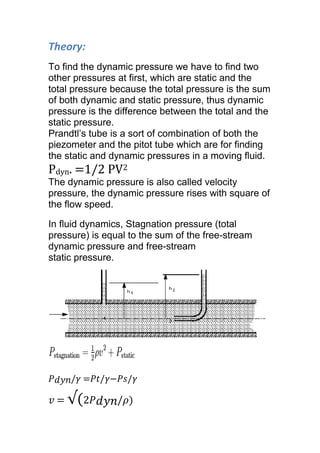
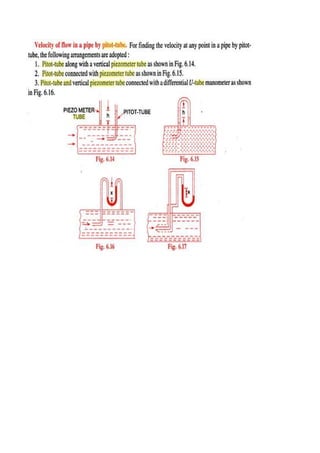
Prandtl’s tube is a sort of combination of both the
piezometer and the pitot tube which are for finding
the static and dynamic pressures in a moving fluid.
Pdyn. =1/2 PV2
The dynamic pressure is also called velocity
pressure, the dynamic pressure rises with square of
the flow speed.
In fluid dynamics, Stagnation pressure (total
pressure) is equal to the sum of the free-stream
dynamic pressure and free-stream
static pressure.
𝑃 𝑑𝑦𝑛/𝛾 =𝑃𝑡/𝛾−𝑃𝑠/𝛾
)𝜌/𝑛𝑦𝑑𝑃2√(=𝑣
Procedure:
Preparing:
Before the actual measurement the manometer
must be prepared and vented;
1. Connect the outputs of the prandtl’s tube by the
connecting hoses to the dual water manometer.
2. Close all cocks of the pipe system, and the vent
valves on the water manometer.
3. Switch on the pump and open the pipe system
inlet cock.
4. Open the lower vent valves of the water
manometer:
The pipe section and connecting hoses are vented
by the water flow.
When there are no longer air bubbles in the
connecting hoses, close the lower vent valve
simultaneously, then close the inlet cock and open
the drain cock.
Performing the experiment:
Carefully open the upper vent valve and inlet
cock, observing the water
level: No water should emerge from the upper vent
valve.
Read of the two heads of water Pt and Ps.
High pressures can be adjusted by means of the
inlet. If lower pressures
are to be measured, reduce the inlet cock and
adjust the head of the water with the drain cock.
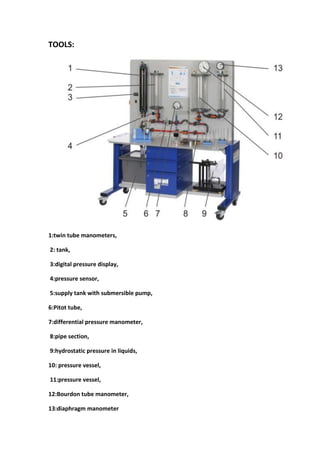
TOOLS:
twin tube manometers,1:
tank,:2
digital pressure display,3:
pressure sensor,:4
supply tank with submersible pump,:5
Pitot tube,:6
differential pressure manometer,:7
pipe section,:8
hydrostatic pressure in liquids,:9
pressure vessel,:10
pressure vessel,:11
Bourdon tube manometer,:12
diaphragm manometer:13
Discussion:
As the velocity increases all of dynamic, static and total
pressure increases but for dynamic pressure it increases
with square of the flow velocity.

STATIC & DYNAMIC PRESSURE

  • 1.
    Koya University Faculty ofEngineering School of Chemical & Petroleum Engineering Chemical Engineering department MECHANICAL FLUID EXPERIMENT NUMBER FIVE STATIC & DYNAMIC PRESSURE Instructor: Mr. Ali & Miss. Hawzheen Author Name: Aree Salah Tahir Experiment Contacted on: 19/Nov/2013 Report Submitted on: 26/Nov /2013 Group:A
  • 2.
    The aim ofthis experiment: The aim of this experiment is to find the dynamic pressure in a moving fluid using piezometer and pitot tube. By calculating its static pressure and its total pressure.
  • 3.
    Introduction: When a fluidis in motion it’s affected by two types of pressure which are dynamic and static pressure. Static pressure is the pressure in still liquids and in this experiment it’s used to calculate the dynamic pressure in moving fluids, for finding the static pressure we use the piezometer. Dynamic pressure (velocity pressure) is the kinetic energy per unit volume of a fluid particle, it’s the difference between the total pressure (also called stagnation pressure) and static pressure.
  • 4.
    Theory: To find thedynamic pressure we have to find two other pressures at first, which are static and the total pressure because the total pressure is the sum of both dynamic and static pressure, thus dynamic pressure is the difference between the total and the static pressure. Prandtl’s tube is a sort of combination of both the piezometer and the pitot tube which are for finding the static and dynamic pressures in a moving fluid. Pdyn. =1/2 PV2 The dynamic pressure is also called velocity pressure, the dynamic pressure rises with square of the flow speed. In fluid dynamics, Stagnation pressure (total pressure) is equal to the sum of the free-stream dynamic pressure and free-stream static pressure. 𝑃 𝑑𝑦𝑛/𝛾 =𝑃𝑡/𝛾−𝑃𝑠/𝛾 )𝜌/𝑛𝑦𝑑𝑃2√(=𝑣
  • 5.
    Procedure: Preparing: Before the actualmeasurement the manometer must be prepared and vented; 1. Connect the outputs of the prandtl’s tube by the connecting hoses to the dual water manometer. 2. Close all cocks of the pipe system, and the vent valves on the water manometer. 3. Switch on the pump and open the pipe system inlet cock. 4. Open the lower vent valves of the water manometer: The pipe section and connecting hoses are vented by the water flow. When there are no longer air bubbles in the connecting hoses, close the lower vent valve simultaneously, then close the inlet cock and open the drain cock. Performing the experiment: Carefully open the upper vent valve and inlet cock, observing the water level: No water should emerge from the upper vent valve. Read of the two heads of water Pt and Ps. High pressures can be adjusted by means of the inlet. If lower pressures are to be measured, reduce the inlet cock and adjust the head of the water with the drain cock.
  • 7.
    TOOLS: twin tube manometers,1: tank,:2 digitalpressure display,3: pressure sensor,:4 supply tank with submersible pump,:5 Pitot tube,:6 differential pressure manometer,:7 pipe section,:8 hydrostatic pressure in liquids,:9 pressure vessel,:10 pressure vessel,:11 Bourdon tube manometer,:12 diaphragm manometer:13
  • 8.
    Discussion: As the velocityincreases all of dynamic, static and total pressure increases but for dynamic pressure it increases with square of the flow velocity.