SAIF AL-DIN ALI MADI
Department of Mechanical Engineering/ College of Engineering/ University of Baghdad
18/3/2019 1 | P a g e
[Fluid Laboratory II]
University of Baghdad
Name: - Saif Al-din Ali -B-
SAIF AL-DIN ALI MADI
Department of Mechanical Engineering/ College of Engineering/ University of Baghdad
18/3/2019 2 | P a g e
TABLE OF CONTENTS
ABSTRACT.........................................................................I
INTRODUCTION..............................................................II
THEORY............................................................................III
APPARATUS........................................................................V
Objective............................................................................VI
Calculations and results...................................................VII
SAIF AL-DIN ALI MADI
Department of Mechanical Engineering/ College of Engineering/ University of Baghdad
18/3/2019 3 | P a g e
Experiment Name: - Centrifugal pump
1. Abstract
1. Studying the performance of this type of centrifugal pump
2. Calculating the theoretical efficiency of centrifugal pump and
compare with experimental efficiency of centrifugal pump
3.
2. Introduction
Thecentrifugal pump is used to raise liquids from a lower to a higher
level by creating the required pressure with the help of centrifugal action.
Whirling motion is imparted to the liquid by means of backward curved blades
mounted on a wheel known as the impeller. As the impeller rotates, the fluid
that is drawn into the blade passages at the impeller inlet or eye is
accelerated as it is forced radially outwards. In this way, the static pressure at
the outer radius is much higher than at the eye inlet radius. The water coming
out of the impeller is then lead through the pump casing under high pressure.
The fluid has a very high velocity at the outer radius of the impeller, and, to
recover this kinetic energy by changing it into pressure energy, diffuser
blades mounted on a diffuser ring may be used. The stationary blade
passages have an increasing cross-sectional area. As the fluid moves
through them, diffusion action takes place and hence the kinetic energy is
converted into pressure energy. Vaneless diffuser passages may also be
used. The fluid moves from the diffuser blades into the volute casing. The
functions of a volute casing can be summarized as follows: It collects water
and conveys it to the pump outlet. The shape of the casing is such that its
area of cross section gradually pump. As the flowing water progresses
towards the delivery pipe, more and more water is added from the outlet
periphery of the. Increases towards the outlet of the impeller. Figure 1 shows
a centrifugal pump impeller with the velocity triangles at inlet and outlet
SAIF AL-DIN ALI MADI
Department of Mechanical Engineering/ College of Engineering/ University of Baghdad
18/3/2019 4 | P a g e
Classification of Centrifugal Pumps:
a. Type of casing.
b. Working head.
c. No. of impellers per shaft.
d. Relative direction of flow through impeller.
e. No. of entrances to the impeller.
f. Disposition of shaft.
g. Liquid handled.
h. Specific speed
a. Type of Casing:
The casing of a centrifugal pump is so designed that the kinetic
energy of water is converted into pressure energy before the water
leaves the casing. This considerably increases the efficiency of the
pump. There are mainly two type of casing.
 Volute or Scroll Collector
 Volute Casing with Guide Blades ((Diffuser (Turbine) Pump)
b. Working Head
It is the head at which water is delivered by the pump. According to
rang of working head, pumps may be divided broadly in three
categories:
 Low Lift Centrifugal Pumps.
 Medium Lift Centrifugal Pumps.
 High Lift Centrifugal Pumps.
c. Number of Impellers:
 Single stage centrifugal pump
 Multi- stage centrifugal pump.
SAIF AL-DIN ALI MADI
Department of Mechanical Engineering/ College of Engineering/ University of Baghdad
18/3/2019 5 | P a g e
d. Relative Direction of Flow Through Impeller
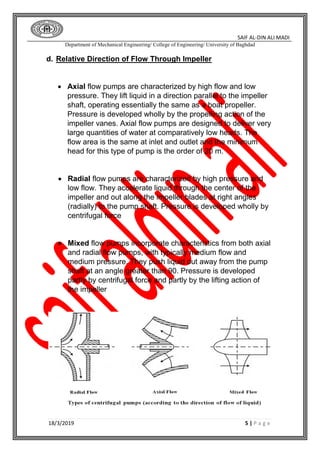
 Axial flow pumps are characterized by high flow and low
pressure. They lift liquid in a direction parallel to the impeller
shaft, operating essentially the same as a boat propeller.
Pressure is developed wholly by the propelling action of the
impeller vanes. Axial flow pumps are designed to deliver very
large quantities of water at comparatively low heads. The
flow area is the same at inlet and outlet and the minimum
head for this type of pump is the order of 20 m.
 Radial flow pumps are characterized by high pressure and
low flow. They accelerate liquid through the center of the
impeller and out along the impeller blades at right angles
(radially) to the pump shaft. Pressure is developed wholly by
centrifugal force
 Mixed flow pumps incorporate characteristics from both axial
and radial flow pumps, with typically medium flow and
medium pressure. They push liquid out away from the pump
shaft at an angle greater than 90. Pressure is developed
partly by centrifugal force and partly by the lifting action of
the impeller
SAIF AL-DIN ALI MADI
Department of Mechanical Engineering/ College of Engineering/ University of Baghdad
18/3/2019 6 | P a g e
e. Number of Entrance to The Impeller
 Single entry or single suction pump.
 Double entry or double suction pump
f. Disposition of shaft
The shaft may be disposed horizontally or vertically. Generally,
centrifugal pumps are designed with horizontal shafts. Vertical
disposition of shaft affects an economy in space occupied and is
therefore suitable for deep-wells and mines.
g. Liquid Handled
Depending on the type and viscosity of liquid to be pumped, the
pump may have closed or open impeller. Each of these types may
have ferrous, non- ferrous or pumped stone-coated impeller to
resist chemical attack of liquids being
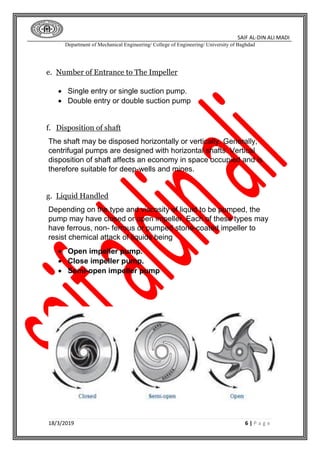
 Open impeller pump.
 Close impeller pump.
 Semi-open impeller pump
SAIF AL-DIN ALI MADI
Department of Mechanical Engineering/ College of Engineering/ University of Baghdad
18/3/2019 7 | P a g e
 LOSSES IN CENTRIFUGAL PUMP
1. Hydraulic losses
 Friction losses in the impeller.
 Shock or eddy losses at inlet to outlet of impeller.
 Friction and eddy losses in the diffuser or guide vanes and
casing.
 Friction losses in suction and delivery pipes
2. Mechanical losses
 Losses due to friction between liquid and impeller in space
between impeller and casing
 Losses due to friction between different parts like bearing, glands
packing etc
3. Leakage losses
 Loss of energy due to pressure difference between liquid inside
the pump and atmosphere.
Centrifugal Pump Efficiency
The performance of a centrifugal pump can be known by finding
the following efficiencies:
• Mechanical efficiency
• Hydraulic efficiency
• Volumetric efficiency
• Overall efficiency
SAIF AL-DIN ALI MADI
Department of Mechanical Engineering/ College of Engineering/ University of Baghdad
18/3/2019 8 | P a g e
1 .Mechanical efficiency of a centrifugal pump;
Mechanical efficiency of a centrifugal pump (ηm) is the ratio of
theoretical power that must be supplied to operate the pump to the
actual power delivered to the pump .
Mechanical efficiency can be used to determine the power loss in
bearings and other moving parts of a centrifugal pump. It
determines the actual power that must be supplied to a centrifugal
pump for desired result.
2 .Hydraulic efficiency of a centrifugal pump;
Hydraulic efficiency of a centrifugal pump (ηm) is defined as the
ratio of the useful hydrodynamic energy in fluid to Mechanical
energy supplied to rotor.
3 .Volumetric efficiency of a centrifugal pump;
Volumetric efficiency of a centrifugal pump (ηv) is defined as the
ratio of the actual flow rate delivered by the pump to the theoretical
discharge flow rate (flow rate without any leakage) that must be
produced by the pump.
Volumetric efficiency can be used to determine the amount of loss
of liquid due to leakage in a pump during the flow.
4 .Overall efficiency of a centrifugal pump;
Overall efficiency of a centrifugal pump (ηo) is the ratio of the actual
power output of a pump to the actual power input to the pump. It is
the efficiency that determines the overall energy loss in a
centrifugal pump.
SAIF AL-DIN ALI MADI
Department of Mechanical Engineering/ College of Engineering/ University of Baghdad
18/3/2019 9 | P a g e
3. Theory
A pump is a device that moves fluids (liquids or gases), or
sometimes slurries, by mechanical action. Pumps can be
classified into three major groups according to the method
they use to move the fluid: direct lift, displacement, and
gravity pumps, Pumps operate by some mechanism
(typically reciprocating or rotary), and consume energy to
perform mechanical work moving the fluid. Pumps operate
via many energy sources, including manual operation,
electricity, engines, or wind power, come in many sizes,
from microscopic for use in medical applications to large
industrial pumps. Mechanical pumps serve in a wide
range of applications such as pumping water from wells,
aquarium filtering, pond filtering and aeration, in the car
industry for water-cooling and fuel injection, in the energy
industry for pumping oil and natural gas or for operating
cooling towers. In the medical industry, pumps are used
for biochemical processes in developing and
manufacturing medicine, and as artificial replacements for
body parts, in particular the artificial heart and penile
prosthesis. When a casing contains only one revolving
impeller, it is called a single-stage pump. When a casing
contains two or more revolving impellers, it is called a
double- or multi-stage pump. In biology, many different
types of chemical and biomechanical pumps have
evolved; biomimicry is sometimes used in developing new
types of mechanical pumps.
SAIF AL-DIN ALI MADI
Department of Mechanical Engineering/ College of Engineering/ University of Baghdad
18/3/2019 10 | P a g e
4. APPARATUS
Experimental apparatus
 Water tank
The device of centrifugal pump contain on water tank. Al the practices
laboratory the water elevation in the tank gauge (28 cm) and the water
elevation in the tank change upon lift or depression the tank.
 Control interface box (micro process):
Control interface box with process diagram in the front panel and the
same distribution that the different element located in the unit for an
easy understanding by the student
 Sensors (SP), SP2, SCI)
Sp1 pressure sensor
Sp2 pressure sensor
Se1 flow sensor
By the perilous sensor we can make the measurement of the most
representation parameter of the pump: -
 Speed.
 Torque.
 Total imp.
Computing :
Laboratory practices :-
Traditionally, the practices laboratory has been a stimulating place
for students, where they have the opportunity of being in contact
with experimental facts that give them new experiences and a
bigger knowledge and domain of its environment. By simple
experiences, students develop their intuition of the reality dexterity
in the handling of the measure devices.
SAIF AL-DIN ALI MADI
Department of Mechanical Engineering/ College of Engineering/ University of Baghdad
18/3/2019 11 | P a g e
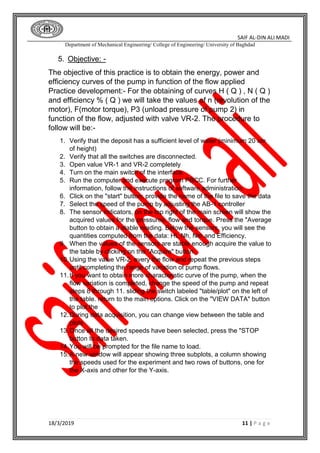
5. Objective: -
The objective of this practice is to obtain the energy, power and
efficiency curves of the pump in function of the flow applied
Practice development:- For the obtaining of curves H ( Q ) , N ( Q )
and efficiency % ( Q ) we will take the values of n (revolution of the
motor), F(motor torque), P3 (unload pressure of pump 2) in
function of the flow, adjusted with valve VR-2. The procedure to
follow will be:-
1. Verify that the deposit has a sufficient level of water (minimum 20 cm
of height)
2. Verify that all the switches are disconnected.
3. Open value VR-1 and VR-2 completely
4. Turn on the main switch of the interface.
5. Run the computer and execute program PBCC. For further
information, follow the instructions of software administration.
6. Click on the "start" button; provide the name of the file to save the data
7. Select the speed of the pump by adjusting the AB-1 controller
8. The sensor indicators, on the top right of the main screen will show the
acquired values for the pressures, flow and torque. Press the "Average
button to obtain a stable reading. Below the sensors, you will see the
quantities computed from the data: Ht, Nh, Nm and Efficiency.
9. When the values of the sensors are stable enough acquire the value to
the table by clicking on the "Acquire" button.
10.Using the value VR-2, every the flow and repeat the previous steps
until completing the range of variation of pump flows.
11.If you want to obtain more characteristic curve of the pump, when the
flow variation is completed, change the speed of the pump and repeat
steps 8 through 11. sliding the switch labeled "table/plot" on the left of
the table. return to the main options. Click on the "VIEW DATA" button
to plot the
12.During data acquisition, you can change view between the table and
plots
13.Once all the desired speeds have been selected, press the "STOP
button to data taken.
14.You will be prompted for the file name to load.
15.A new window will appear showing three subplots, a column showing
the speeds used for the experiment and two rows of buttons, one for
the X-axis and other for the Y-axis.
SAIF AL-DIN ALI MADI
Department of Mechanical Engineering/ College of Engineering/ University of Baghdad
18/3/2019 12 | P a g e
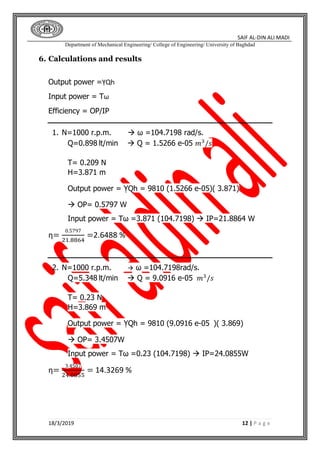
6. Calculations and results
Output power =ỴQh
Input power = Tω
Efficiency = OP/IP
1. N=1000 r.p.m.  ω =104.7198 rad/s.
Q=0.898 lt/min  Q = 1.5266 e-05 𝑚3
/𝑠
T= 0.209 N
H=3.871 m
Output power = ỴQh = 9810 (1.5266 e-05)( 3.871)
 OP= 0.5797 W
Input power = Tω =3.871 (104.7198)  IP=21.8864 W
η=
0.5797
21.8864
=2.6488 %
2. N=1000 r.p.m.  ω =104.7198rad/s.
Q=5.348 lt/min  Q = 9.0916 e-05 𝑚3
/𝑠
T= 0.23 N
H=3.869 m
Output power = ỴQh = 9810 (9.0916 e-05 )( 3.869)
 OP= 3.4507W
Input power = Tω =0.23 (104.7198)  IP=24.0855W
η=
3.4507
24.0855
= 14.3269 %
SAIF AL-DIN ALI MADI
Department of Mechanical Engineering/ College of Engineering/ University of Baghdad
18/3/2019 13 | P a g e
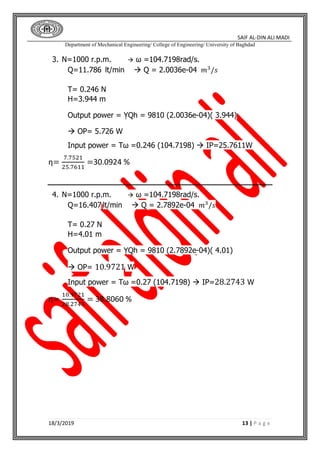
3. N=1000 r.p.m.  ω =104.7198rad/s.
Q=11.786 lt/min  Q = 2.0036e-04 𝑚3
/𝑠
T= 0.246 N
H=3.944 m
Output power = ỴQh = 9810 (2.0036e-04)( 3.944)
 OP= 5.726 W
Input power = Tω =0.246 (104.7198)  IP=25.7611W
η=
7.7521
25.7611
=30.0924 %
4. N=1000 r.p.m.  ω =104.7198rad/s.
Q=16.407 lt/min  Q = 2.7892e-04 𝑚3
/𝑠
T= 0.27 N
H=4.01 m
Output power = ỴQh = 9810 (2.7892e-04)( 4.01)
 OP= 10.9721 W
Input power = Tω =0.27 (104.7198)  IP=28.2743 W
η=
10.9721
28.2743
= 38.8060 %
SAIF AL-DIN ALI MADI
Department of Mechanical Engineering/ College of Engineering/ University of Baghdad
18/3/2019 14 | P a g e
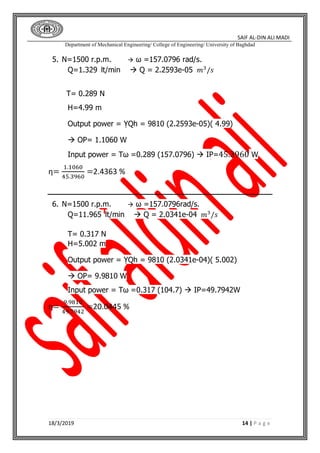
5. N=1500 r.p.m.  ω =157.0796 rad/s.
Q=1.329 lt/min  Q = 2.2593e-05 𝑚3
/𝑠
T= 0.289 N
H=4.99 m
Output power = ỴQh = 9810 (2.2593e-05)( 4.99)
 OP= 1.1060 W
Input power = Tω =0.289 (157.0796)  IP=45.3960 W
η=
1.1060
45.3960
=2.4363 %
6. N=1500 r.p.m.  ω =157.0796rad/s.
Q=11.965 lt/min  Q = 2.0341e-04 𝑚3
/𝑠
T= 0.317 N
H=5.002 m
Output power = ỴQh = 9810 (2.0341e-04)( 5.002)
 OP= 9.9810 W
Input power = Tω =0.317 (104.7)  IP=49.7942W
η=
9.9810
49.7942
=20.0445 %
SAIF AL-DIN ALI MADI
Department of Mechanical Engineering/ College of Engineering/ University of Baghdad
18/3/2019 15 | P a g e
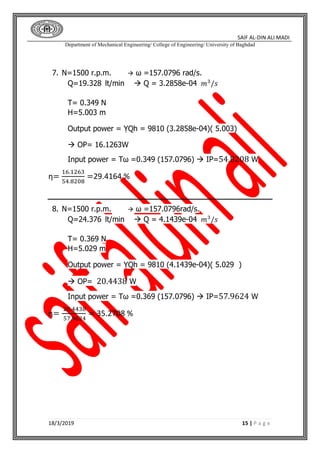
7. N=1500 r.p.m.  ω =157.0796 rad/s.
Q=19.328 lt/min  Q = 3.2858e-04 𝑚3
/𝑠
T= 0.349 N
H=5.003 m
Output power = ỴQh = 9810 (3.2858e-04)( 5.003)
 OP= 16.1263W
Input power = Tω =0.349 (157.0796)  IP=54.8208 W
η=
16.1263
54.8208
=29.4164 %
8. N=1500 r.p.m.  ω =157.0796rad/s.
Q=24.376 lt/min  Q = 4.1439e-04 𝑚3
/𝑠
T= 0.369 N
H=5.029 m
Output power = ỴQh = 9810 (4.1439e-04)( 5.029 )
 OP= 20.4438 W
Input power = Tω =0.369 (157.0796)  IP=57.9624 W
η=
20.4438
57.9624
= 35.2708 %
SAIF AL-DIN ALI MADI
Department of Mechanical Engineering/ College of Engineering/ University of Baghdad
18/3/2019 16 | P a g e
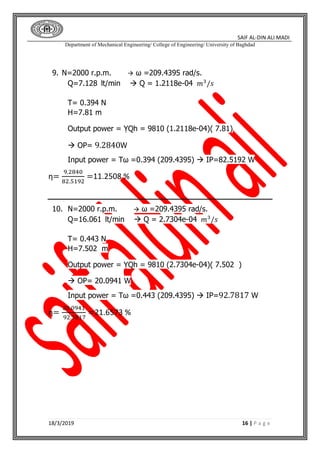
9. N=2000 r.p.m.  ω =209.4395 rad/s.
Q=7.128 lt/min  Q = 1.2118e-04 𝑚3
/𝑠
T= 0.394 N
H=7.81 m
Output power = ỴQh = 9810 (1.2118e-04)( 7.81)
 OP= 9.2840W
Input power = Tω =0.394 (209.4395)  IP=82.5192 W
η=
9.2840
82.5192
=11.2508 %
10. N=2000 r.p.m.  ω =209.4395 rad/s.
Q=16.061 lt/min  Q = 2.7304e-04 𝑚3
/𝑠
T= 0.443 N
H=7.502 m
Output power = ỴQh = 9810 (2.7304e-04)( 7.502 )
 OP= 20.0941 W
Input power = Tω =0.443 (209.4395)  IP=92.7817 W
η=
20.0941
92.7817
=21.6573 %
SAIF AL-DIN ALI MADI
Department of Mechanical Engineering/ College of Engineering/ University of Baghdad
18/3/2019 17 | P a g e
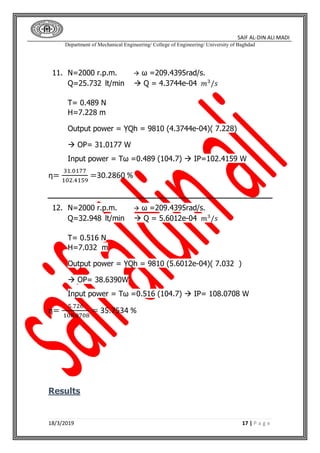
11. N=2000 r.p.m.  ω =209.4395rad/s.
Q=25.732 lt/min  Q = 4.3744e-04 𝑚3
/𝑠
T= 0.489 N
H=7.228 m
Output power = ỴQh = 9810 (4.3744e-04)( 7.228)
 OP= 31.0177 W
Input power = Tω =0.489 (104.7)  IP=102.4159 W
η=
31.0177
102.4159
=30.2860 %
12. N=2000 r.p.m.  ω =209.4395rad/s.
Q=32.948 lt/min  Q = 5.6012e-04 𝑚3
/𝑠
T= 0.516 N
H=7.032 m
Output power = ỴQh = 9810 (5.6012e-04)( 7.032 )
 OP= 38.6390W
Input power = Tω =0.516 (104.7)  IP= 108.0708 W
η=
5.726
108.0708
= 35.7534 %
Results
SAIF AL-DIN ALI MADI
Department of Mechanical Engineering/ College of Engineering/ University of Baghdad
18/3/2019 18 | P a g e
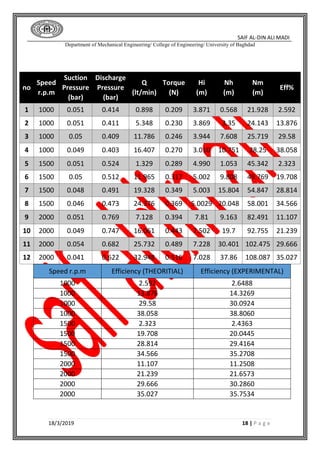
Speed r.p.m Efficiency (THEORITIAL) Efficiency (EXPERIMENTAL)
1000 2.592 2.6488
1000 13.876 14.3269
1000 29.58 30.0924
1000 38.058 38.8060
1500 2.323 2.4363
1500 19.708 20.0445
1500 28.814 29.4164
1500 34.566 35.2708
2000 11.107 11.2508
2000 21.239 21.6573
2000 29.666 30.2860
2000 35.027 35.7534
no
Speed
r.p.m
Suction
Pressure
(bar)
Discharge
Pressure
(bar)
Q
(lt/min)
Torque
(N)
Hi
(m)
Nh
(m)
Nm
(m)
Eff%
1 1000 0.051 0.414 0.898 0.209 3.871 0.568 21.928 2.592
2 1000 0.051 0.411 5.348 0.230 3.869 3.35 24.143 13.876
3 1000 0.05 0.409 11.786 0.246 3.944 7.608 25.719 29.58
4 1000 0.049 0.403 16.407 0.270 3.010 10.751 28.25 38.058
5 1500 0.051 0.524 1.329 0.289 4.990 1.053 45.342 2.323
6 1500 0.05 0.512 11.965 0.317 5.002 9.808 49.769 19.708
7 1500 0.048 0.491 19.328 0.349 5.003 15.804 54.847 28.814
8 1500 0.046 0.473 24.376 0.369 5.0029 20.048 58.001 34.566
9 2000 0.051 0.769 7.128 0.394 7.81 9.163 82.491 11.107
10 2000 0.049 0.747 16.061 0.443 7.502 19.7 92.755 21.239
11 2000 0.054 0.682 25.732 0.489 7.228 30.401 102.475 29.666
12 2000 0.041 0.622 32.948 0.516 7.028 37.86 108.087 35.027
SAIF AL-DIN ALI MADI
Department of Mechanical Engineering/ College of Engineering/ University of Baghdad
18/3/2019 19 | P a g e
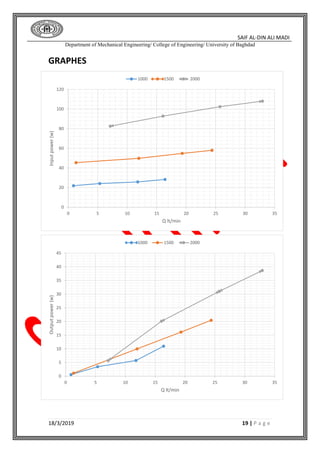
GRAPHES
0
20
40
60
80
100
120
0 5 10 15 20 25 30 35
Inputpower(w)
Q lt/min
1000 1500 2000
0
5
10
15
20
25
30
35
40
45
0 5 10 15 20 25 30 35
Outputpower(w)
Q lt/min
1000 1500 2000
SAIF AL-DIN ALI MADI
Department of Mechanical Engineering/ College of Engineering/ University of Baghdad
18/3/2019 20 | P a g e
0
1
2
3
4
5
6
7
8
9
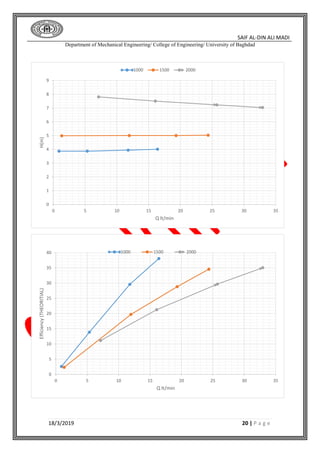
0 5 10 15 20 25 30 35
H(m)
Q lt/min
1000 1500 2000
0
5
10
15
20
25
30
35
40
0 5 10 15 20 25 30 35
Efficiency(THEORITIAL)
Q lt/min
1000 1500 2000
SAIF AL-DIN ALI MADI
Department of Mechanical Engineering/ College of Engineering/ University of Baghdad
18/3/2019 21 | P a g e
0
5
10
15
20
25
30
35
40
45
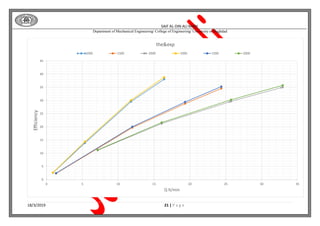
0 5 10 15 20 25 30 35
Efficiency
Q lt/min
the&exp
1000 1500 2000 1000 1500 2000

Centrifugal pump | Fluid Laboratory

  • 1.
    SAIF AL-DIN ALIMADI Department of Mechanical Engineering/ College of Engineering/ University of Baghdad 18/3/2019 1 | P a g e [Fluid Laboratory II] University of Baghdad Name: - Saif Al-din Ali -B-
  • 2.
    SAIF AL-DIN ALIMADI Department of Mechanical Engineering/ College of Engineering/ University of Baghdad 18/3/2019 2 | P a g e TABLE OF CONTENTS ABSTRACT.........................................................................I INTRODUCTION..............................................................II THEORY............................................................................III APPARATUS........................................................................V Objective............................................................................VI Calculations and results...................................................VII
  • 3.
    SAIF AL-DIN ALIMADI Department of Mechanical Engineering/ College of Engineering/ University of Baghdad 18/3/2019 3 | P a g e Experiment Name: - Centrifugal pump 1. Abstract 1. Studying the performance of this type of centrifugal pump 2. Calculating the theoretical efficiency of centrifugal pump and compare with experimental efficiency of centrifugal pump 3. 2. Introduction Thecentrifugal pump is used to raise liquids from a lower to a higher level by creating the required pressure with the help of centrifugal action. Whirling motion is imparted to the liquid by means of backward curved blades mounted on a wheel known as the impeller. As the impeller rotates, the fluid that is drawn into the blade passages at the impeller inlet or eye is accelerated as it is forced radially outwards. In this way, the static pressure at the outer radius is much higher than at the eye inlet radius. The water coming out of the impeller is then lead through the pump casing under high pressure. The fluid has a very high velocity at the outer radius of the impeller, and, to recover this kinetic energy by changing it into pressure energy, diffuser blades mounted on a diffuser ring may be used. The stationary blade passages have an increasing cross-sectional area. As the fluid moves through them, diffusion action takes place and hence the kinetic energy is converted into pressure energy. Vaneless diffuser passages may also be used. The fluid moves from the diffuser blades into the volute casing. The functions of a volute casing can be summarized as follows: It collects water and conveys it to the pump outlet. The shape of the casing is such that its area of cross section gradually pump. As the flowing water progresses towards the delivery pipe, more and more water is added from the outlet periphery of the. Increases towards the outlet of the impeller. Figure 1 shows a centrifugal pump impeller with the velocity triangles at inlet and outlet
  • 4.
    SAIF AL-DIN ALIMADI Department of Mechanical Engineering/ College of Engineering/ University of Baghdad 18/3/2019 4 | P a g e Classification of Centrifugal Pumps: a. Type of casing. b. Working head. c. No. of impellers per shaft. d. Relative direction of flow through impeller. e. No. of entrances to the impeller. f. Disposition of shaft. g. Liquid handled. h. Specific speed a. Type of Casing: The casing of a centrifugal pump is so designed that the kinetic energy of water is converted into pressure energy before the water leaves the casing. This considerably increases the efficiency of the pump. There are mainly two type of casing.  Volute or Scroll Collector  Volute Casing with Guide Blades ((Diffuser (Turbine) Pump) b. Working Head It is the head at which water is delivered by the pump. According to rang of working head, pumps may be divided broadly in three categories:  Low Lift Centrifugal Pumps.  Medium Lift Centrifugal Pumps.  High Lift Centrifugal Pumps. c. Number of Impellers:  Single stage centrifugal pump  Multi- stage centrifugal pump.
  • 5.
    SAIF AL-DIN ALIMADI Department of Mechanical Engineering/ College of Engineering/ University of Baghdad 18/3/2019 5 | P a g e d. Relative Direction of Flow Through Impeller  Axial flow pumps are characterized by high flow and low pressure. They lift liquid in a direction parallel to the impeller shaft, operating essentially the same as a boat propeller. Pressure is developed wholly by the propelling action of the impeller vanes. Axial flow pumps are designed to deliver very large quantities of water at comparatively low heads. The flow area is the same at inlet and outlet and the minimum head for this type of pump is the order of 20 m.  Radial flow pumps are characterized by high pressure and low flow. They accelerate liquid through the center of the impeller and out along the impeller blades at right angles (radially) to the pump shaft. Pressure is developed wholly by centrifugal force  Mixed flow pumps incorporate characteristics from both axial and radial flow pumps, with typically medium flow and medium pressure. They push liquid out away from the pump shaft at an angle greater than 90. Pressure is developed partly by centrifugal force and partly by the lifting action of the impeller
  • 6.
    SAIF AL-DIN ALIMADI Department of Mechanical Engineering/ College of Engineering/ University of Baghdad 18/3/2019 6 | P a g e e. Number of Entrance to The Impeller  Single entry or single suction pump.  Double entry or double suction pump f. Disposition of shaft The shaft may be disposed horizontally or vertically. Generally, centrifugal pumps are designed with horizontal shafts. Vertical disposition of shaft affects an economy in space occupied and is therefore suitable for deep-wells and mines. g. Liquid Handled Depending on the type and viscosity of liquid to be pumped, the pump may have closed or open impeller. Each of these types may have ferrous, non- ferrous or pumped stone-coated impeller to resist chemical attack of liquids being  Open impeller pump.  Close impeller pump.  Semi-open impeller pump
  • 7.
    SAIF AL-DIN ALIMADI Department of Mechanical Engineering/ College of Engineering/ University of Baghdad 18/3/2019 7 | P a g e  LOSSES IN CENTRIFUGAL PUMP 1. Hydraulic losses  Friction losses in the impeller.  Shock or eddy losses at inlet to outlet of impeller.  Friction and eddy losses in the diffuser or guide vanes and casing.  Friction losses in suction and delivery pipes 2. Mechanical losses  Losses due to friction between liquid and impeller in space between impeller and casing  Losses due to friction between different parts like bearing, glands packing etc 3. Leakage losses  Loss of energy due to pressure difference between liquid inside the pump and atmosphere. Centrifugal Pump Efficiency The performance of a centrifugal pump can be known by finding the following efficiencies: • Mechanical efficiency • Hydraulic efficiency • Volumetric efficiency • Overall efficiency
  • 8.
    SAIF AL-DIN ALIMADI Department of Mechanical Engineering/ College of Engineering/ University of Baghdad 18/3/2019 8 | P a g e 1 .Mechanical efficiency of a centrifugal pump; Mechanical efficiency of a centrifugal pump (ηm) is the ratio of theoretical power that must be supplied to operate the pump to the actual power delivered to the pump . Mechanical efficiency can be used to determine the power loss in bearings and other moving parts of a centrifugal pump. It determines the actual power that must be supplied to a centrifugal pump for desired result. 2 .Hydraulic efficiency of a centrifugal pump; Hydraulic efficiency of a centrifugal pump (ηm) is defined as the ratio of the useful hydrodynamic energy in fluid to Mechanical energy supplied to rotor. 3 .Volumetric efficiency of a centrifugal pump; Volumetric efficiency of a centrifugal pump (ηv) is defined as the ratio of the actual flow rate delivered by the pump to the theoretical discharge flow rate (flow rate without any leakage) that must be produced by the pump. Volumetric efficiency can be used to determine the amount of loss of liquid due to leakage in a pump during the flow. 4 .Overall efficiency of a centrifugal pump; Overall efficiency of a centrifugal pump (ηo) is the ratio of the actual power output of a pump to the actual power input to the pump. It is the efficiency that determines the overall energy loss in a centrifugal pump.
  • 9.
    SAIF AL-DIN ALIMADI Department of Mechanical Engineering/ College of Engineering/ University of Baghdad 18/3/2019 9 | P a g e 3. Theory A pump is a device that moves fluids (liquids or gases), or sometimes slurries, by mechanical action. Pumps can be classified into three major groups according to the method they use to move the fluid: direct lift, displacement, and gravity pumps, Pumps operate by some mechanism (typically reciprocating or rotary), and consume energy to perform mechanical work moving the fluid. Pumps operate via many energy sources, including manual operation, electricity, engines, or wind power, come in many sizes, from microscopic for use in medical applications to large industrial pumps. Mechanical pumps serve in a wide range of applications such as pumping water from wells, aquarium filtering, pond filtering and aeration, in the car industry for water-cooling and fuel injection, in the energy industry for pumping oil and natural gas or for operating cooling towers. In the medical industry, pumps are used for biochemical processes in developing and manufacturing medicine, and as artificial replacements for body parts, in particular the artificial heart and penile prosthesis. When a casing contains only one revolving impeller, it is called a single-stage pump. When a casing contains two or more revolving impellers, it is called a double- or multi-stage pump. In biology, many different types of chemical and biomechanical pumps have evolved; biomimicry is sometimes used in developing new types of mechanical pumps.
  • 10.
    SAIF AL-DIN ALIMADI Department of Mechanical Engineering/ College of Engineering/ University of Baghdad 18/3/2019 10 | P a g e 4. APPARATUS Experimental apparatus  Water tank The device of centrifugal pump contain on water tank. Al the practices laboratory the water elevation in the tank gauge (28 cm) and the water elevation in the tank change upon lift or depression the tank.  Control interface box (micro process): Control interface box with process diagram in the front panel and the same distribution that the different element located in the unit for an easy understanding by the student  Sensors (SP), SP2, SCI) Sp1 pressure sensor Sp2 pressure sensor Se1 flow sensor By the perilous sensor we can make the measurement of the most representation parameter of the pump: -  Speed.  Torque.  Total imp. Computing : Laboratory practices :- Traditionally, the practices laboratory has been a stimulating place for students, where they have the opportunity of being in contact with experimental facts that give them new experiences and a bigger knowledge and domain of its environment. By simple experiences, students develop their intuition of the reality dexterity in the handling of the measure devices.
  • 11.
    SAIF AL-DIN ALIMADI Department of Mechanical Engineering/ College of Engineering/ University of Baghdad 18/3/2019 11 | P a g e 5. Objective: - The objective of this practice is to obtain the energy, power and efficiency curves of the pump in function of the flow applied Practice development:- For the obtaining of curves H ( Q ) , N ( Q ) and efficiency % ( Q ) we will take the values of n (revolution of the motor), F(motor torque), P3 (unload pressure of pump 2) in function of the flow, adjusted with valve VR-2. The procedure to follow will be:- 1. Verify that the deposit has a sufficient level of water (minimum 20 cm of height) 2. Verify that all the switches are disconnected. 3. Open value VR-1 and VR-2 completely 4. Turn on the main switch of the interface. 5. Run the computer and execute program PBCC. For further information, follow the instructions of software administration. 6. Click on the "start" button; provide the name of the file to save the data 7. Select the speed of the pump by adjusting the AB-1 controller 8. The sensor indicators, on the top right of the main screen will show the acquired values for the pressures, flow and torque. Press the "Average button to obtain a stable reading. Below the sensors, you will see the quantities computed from the data: Ht, Nh, Nm and Efficiency. 9. When the values of the sensors are stable enough acquire the value to the table by clicking on the "Acquire" button. 10.Using the value VR-2, every the flow and repeat the previous steps until completing the range of variation of pump flows. 11.If you want to obtain more characteristic curve of the pump, when the flow variation is completed, change the speed of the pump and repeat steps 8 through 11. sliding the switch labeled "table/plot" on the left of the table. return to the main options. Click on the "VIEW DATA" button to plot the 12.During data acquisition, you can change view between the table and plots 13.Once all the desired speeds have been selected, press the "STOP button to data taken. 14.You will be prompted for the file name to load. 15.A new window will appear showing three subplots, a column showing the speeds used for the experiment and two rows of buttons, one for the X-axis and other for the Y-axis.
  • 12.
    SAIF AL-DIN ALIMADI Department of Mechanical Engineering/ College of Engineering/ University of Baghdad 18/3/2019 12 | P a g e 6. Calculations and results Output power =ỴQh Input power = Tω Efficiency = OP/IP 1. N=1000 r.p.m.  ω =104.7198 rad/s. Q=0.898 lt/min  Q = 1.5266 e-05 𝑚3 /𝑠 T= 0.209 N H=3.871 m Output power = ỴQh = 9810 (1.5266 e-05)( 3.871)  OP= 0.5797 W Input power = Tω =3.871 (104.7198)  IP=21.8864 W η= 0.5797 21.8864 =2.6488 % 2. N=1000 r.p.m.  ω =104.7198rad/s. Q=5.348 lt/min  Q = 9.0916 e-05 𝑚3 /𝑠 T= 0.23 N H=3.869 m Output power = ỴQh = 9810 (9.0916 e-05 )( 3.869)  OP= 3.4507W Input power = Tω =0.23 (104.7198)  IP=24.0855W η= 3.4507 24.0855 = 14.3269 %
  • 13.
    SAIF AL-DIN ALIMADI Department of Mechanical Engineering/ College of Engineering/ University of Baghdad 18/3/2019 13 | P a g e 3. N=1000 r.p.m.  ω =104.7198rad/s. Q=11.786 lt/min  Q = 2.0036e-04 𝑚3 /𝑠 T= 0.246 N H=3.944 m Output power = ỴQh = 9810 (2.0036e-04)( 3.944)  OP= 5.726 W Input power = Tω =0.246 (104.7198)  IP=25.7611W η= 7.7521 25.7611 =30.0924 % 4. N=1000 r.p.m.  ω =104.7198rad/s. Q=16.407 lt/min  Q = 2.7892e-04 𝑚3 /𝑠 T= 0.27 N H=4.01 m Output power = ỴQh = 9810 (2.7892e-04)( 4.01)  OP= 10.9721 W Input power = Tω =0.27 (104.7198)  IP=28.2743 W η= 10.9721 28.2743 = 38.8060 %
  • 14.
    SAIF AL-DIN ALIMADI Department of Mechanical Engineering/ College of Engineering/ University of Baghdad 18/3/2019 14 | P a g e 5. N=1500 r.p.m.  ω =157.0796 rad/s. Q=1.329 lt/min  Q = 2.2593e-05 𝑚3 /𝑠 T= 0.289 N H=4.99 m Output power = ỴQh = 9810 (2.2593e-05)( 4.99)  OP= 1.1060 W Input power = Tω =0.289 (157.0796)  IP=45.3960 W η= 1.1060 45.3960 =2.4363 % 6. N=1500 r.p.m.  ω =157.0796rad/s. Q=11.965 lt/min  Q = 2.0341e-04 𝑚3 /𝑠 T= 0.317 N H=5.002 m Output power = ỴQh = 9810 (2.0341e-04)( 5.002)  OP= 9.9810 W Input power = Tω =0.317 (104.7)  IP=49.7942W η= 9.9810 49.7942 =20.0445 %
  • 15.
    SAIF AL-DIN ALIMADI Department of Mechanical Engineering/ College of Engineering/ University of Baghdad 18/3/2019 15 | P a g e 7. N=1500 r.p.m.  ω =157.0796 rad/s. Q=19.328 lt/min  Q = 3.2858e-04 𝑚3 /𝑠 T= 0.349 N H=5.003 m Output power = ỴQh = 9810 (3.2858e-04)( 5.003)  OP= 16.1263W Input power = Tω =0.349 (157.0796)  IP=54.8208 W η= 16.1263 54.8208 =29.4164 % 8. N=1500 r.p.m.  ω =157.0796rad/s. Q=24.376 lt/min  Q = 4.1439e-04 𝑚3 /𝑠 T= 0.369 N H=5.029 m Output power = ỴQh = 9810 (4.1439e-04)( 5.029 )  OP= 20.4438 W Input power = Tω =0.369 (157.0796)  IP=57.9624 W η= 20.4438 57.9624 = 35.2708 %
  • 16.
    SAIF AL-DIN ALIMADI Department of Mechanical Engineering/ College of Engineering/ University of Baghdad 18/3/2019 16 | P a g e 9. N=2000 r.p.m.  ω =209.4395 rad/s. Q=7.128 lt/min  Q = 1.2118e-04 𝑚3 /𝑠 T= 0.394 N H=7.81 m Output power = ỴQh = 9810 (1.2118e-04)( 7.81)  OP= 9.2840W Input power = Tω =0.394 (209.4395)  IP=82.5192 W η= 9.2840 82.5192 =11.2508 % 10. N=2000 r.p.m.  ω =209.4395 rad/s. Q=16.061 lt/min  Q = 2.7304e-04 𝑚3 /𝑠 T= 0.443 N H=7.502 m Output power = ỴQh = 9810 (2.7304e-04)( 7.502 )  OP= 20.0941 W Input power = Tω =0.443 (209.4395)  IP=92.7817 W η= 20.0941 92.7817 =21.6573 %
  • 17.
    SAIF AL-DIN ALIMADI Department of Mechanical Engineering/ College of Engineering/ University of Baghdad 18/3/2019 17 | P a g e 11. N=2000 r.p.m.  ω =209.4395rad/s. Q=25.732 lt/min  Q = 4.3744e-04 𝑚3 /𝑠 T= 0.489 N H=7.228 m Output power = ỴQh = 9810 (4.3744e-04)( 7.228)  OP= 31.0177 W Input power = Tω =0.489 (104.7)  IP=102.4159 W η= 31.0177 102.4159 =30.2860 % 12. N=2000 r.p.m.  ω =209.4395rad/s. Q=32.948 lt/min  Q = 5.6012e-04 𝑚3 /𝑠 T= 0.516 N H=7.032 m Output power = ỴQh = 9810 (5.6012e-04)( 7.032 )  OP= 38.6390W Input power = Tω =0.516 (104.7)  IP= 108.0708 W η= 5.726 108.0708 = 35.7534 % Results
  • 18.
    SAIF AL-DIN ALIMADI Department of Mechanical Engineering/ College of Engineering/ University of Baghdad 18/3/2019 18 | P a g e Speed r.p.m Efficiency (THEORITIAL) Efficiency (EXPERIMENTAL) 1000 2.592 2.6488 1000 13.876 14.3269 1000 29.58 30.0924 1000 38.058 38.8060 1500 2.323 2.4363 1500 19.708 20.0445 1500 28.814 29.4164 1500 34.566 35.2708 2000 11.107 11.2508 2000 21.239 21.6573 2000 29.666 30.2860 2000 35.027 35.7534 no Speed r.p.m Suction Pressure (bar) Discharge Pressure (bar) Q (lt/min) Torque (N) Hi (m) Nh (m) Nm (m) Eff% 1 1000 0.051 0.414 0.898 0.209 3.871 0.568 21.928 2.592 2 1000 0.051 0.411 5.348 0.230 3.869 3.35 24.143 13.876 3 1000 0.05 0.409 11.786 0.246 3.944 7.608 25.719 29.58 4 1000 0.049 0.403 16.407 0.270 3.010 10.751 28.25 38.058 5 1500 0.051 0.524 1.329 0.289 4.990 1.053 45.342 2.323 6 1500 0.05 0.512 11.965 0.317 5.002 9.808 49.769 19.708 7 1500 0.048 0.491 19.328 0.349 5.003 15.804 54.847 28.814 8 1500 0.046 0.473 24.376 0.369 5.0029 20.048 58.001 34.566 9 2000 0.051 0.769 7.128 0.394 7.81 9.163 82.491 11.107 10 2000 0.049 0.747 16.061 0.443 7.502 19.7 92.755 21.239 11 2000 0.054 0.682 25.732 0.489 7.228 30.401 102.475 29.666 12 2000 0.041 0.622 32.948 0.516 7.028 37.86 108.087 35.027
  • 19.
    SAIF AL-DIN ALIMADI Department of Mechanical Engineering/ College of Engineering/ University of Baghdad 18/3/2019 19 | P a g e GRAPHES 0 20 40 60 80 100 120 0 5 10 15 20 25 30 35 Inputpower(w) Q lt/min 1000 1500 2000 0 5 10 15 20 25 30 35 40 45 0 5 10 15 20 25 30 35 Outputpower(w) Q lt/min 1000 1500 2000
  • 20.
    SAIF AL-DIN ALIMADI Department of Mechanical Engineering/ College of Engineering/ University of Baghdad 18/3/2019 20 | P a g e 0 1 2 3 4 5 6 7 8 9 0 5 10 15 20 25 30 35 H(m) Q lt/min 1000 1500 2000 0 5 10 15 20 25 30 35 40 0 5 10 15 20 25 30 35 Efficiency(THEORITIAL) Q lt/min 1000 1500 2000
  • 21.
    SAIF AL-DIN ALIMADI Department of Mechanical Engineering/ College of Engineering/ University of Baghdad 18/3/2019 21 | P a g e 0 5 10 15 20 25 30 35 40 45 0 5 10 15 20 25 30 35 Efficiency Q lt/min the&exp 1000 1500 2000 1000 1500 2000