
Koya University
Faulty of Engineering
School of Petroleum & Chemical Engineering
Chemical Engineering department
EXPERIMENT NUMBER ONE
BOYLES LOW
Thermodynamics
Boyle's low
Instructor: Mr.Rebwar
Author Name: Aree Salah Tahir
Experiment Contacted on: 8/oct/2013
Report Submitted on: 22/oct /2013
OBJECTIVES:
The aim of this experiment is to show that the pressure
(P) is proportional to show thatinverse to volume
P=1/V
BACKGROUND THEORY:
Boyle's Law, a principle that describes the relationship
between the pressure and volume of a gas. According to
this law, the pressure exerted by a gas held at a constant
temperature varies inversely with the volume of the gas.
For example, if the volume is halved, the pressure is
doubled; and if the volume is doubled, the pressure is
halved. The reason for this effect is that a gas is made up
of loosely spaced molecules moving at random. If a gas
is compressed in a container, these molecules are pushed
together; thus, the gas occupies less volume. The
molecules, having less space in which to move, hit the
walls of the container more frequently and thus exert an
increased pressure.
Boyle's Law actually applies only to an ideal, theoretical
gas. When real gases are compressed at a constant
temperature, changes in the relationship between
pressure and volume occur. However, the law is accurate
enough to be useful in a number of practical applications.
It is used, for example, in calculating the volume and
pressure of internal-combustion engines and steam
engines.
The law was first stated in 1662 by Robert Boyle. In
1676, EdmeMariotte of France independently stated the
same law, and it is sometimes called Mariette’s Law.
Stated as a formula, Boyle's Law reads:
V1/V2=P2/P1 (at constant temperature)
Where V1 equals the original volume, V2 equals the new
volume, P1 the original pressure, and P2 the new
pressure.
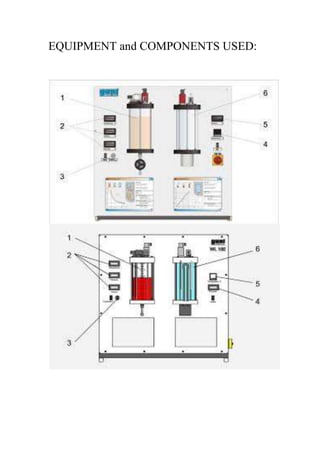
EQUIPMENT and COMPONENTS USED:
Introduction:
Boyle’s law is a quantitative relationship between
volume and pressure of a gas at constant temperature.
The quantitative relationship between pressure and
volume was studied by Robert Boyle. In this experiment,
you will try to discover a relationship between the
volume and pressure of a sample of gas trapped in a
closed hypodermic syringe.
Reference:
http://science.howstuffworks.com/boyles-law-info.htm

Boyle's low

  • 1.
    Koya University Faulty ofEngineering School of Petroleum & Chemical Engineering Chemical Engineering department EXPERIMENT NUMBER ONE BOYLES LOW Thermodynamics Boyle's low Instructor: Mr.Rebwar Author Name: Aree Salah Tahir Experiment Contacted on: 8/oct/2013 Report Submitted on: 22/oct /2013
  • 2.
    OBJECTIVES: The aim ofthis experiment is to show that the pressure (P) is proportional to show thatinverse to volume P=1/V
  • 3.
    BACKGROUND THEORY: Boyle's Law,a principle that describes the relationship between the pressure and volume of a gas. According to this law, the pressure exerted by a gas held at a constant temperature varies inversely with the volume of the gas. For example, if the volume is halved, the pressure is doubled; and if the volume is doubled, the pressure is halved. The reason for this effect is that a gas is made up of loosely spaced molecules moving at random. If a gas is compressed in a container, these molecules are pushed together; thus, the gas occupies less volume. The molecules, having less space in which to move, hit the walls of the container more frequently and thus exert an increased pressure. Boyle's Law actually applies only to an ideal, theoretical gas. When real gases are compressed at a constant temperature, changes in the relationship between pressure and volume occur. However, the law is accurate enough to be useful in a number of practical applications. It is used, for example, in calculating the volume and pressure of internal-combustion engines and steam engines. The law was first stated in 1662 by Robert Boyle. In 1676, EdmeMariotte of France independently stated the same law, and it is sometimes called Mariette’s Law. Stated as a formula, Boyle's Law reads: V1/V2=P2/P1 (at constant temperature) Where V1 equals the original volume, V2 equals the new volume, P1 the original pressure, and P2 the new pressure.
  • 4.
  • 5.
    Introduction: Boyle’s law isa quantitative relationship between volume and pressure of a gas at constant temperature. The quantitative relationship between pressure and volume was studied by Robert Boyle. In this experiment, you will try to discover a relationship between the volume and pressure of a sample of gas trapped in a closed hypodermic syringe.
  • 6.